
EHSShala
Water & Effluent Sampling Basics for Indian Factories | EHSSHala
EHSSaral is an Environmental Compliance Intelligence Platform for Industries. Consent Intelligence • Alerts & Tasks • Incident Reporting • Form IV & V • Audit-Ready Records
See how EHSSaral works
24 Aug 2026
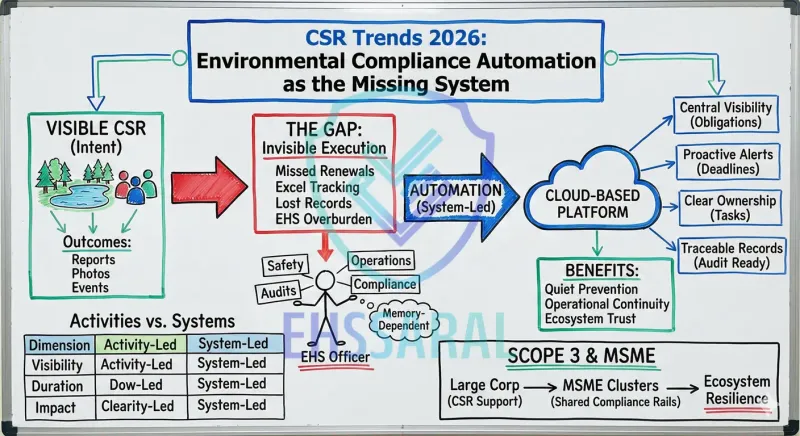
Over the last decade, Corporate Social Responsibility in India has grown significantly in scale, structure, and seriousness.
Large organisations now run structured CSR programs covering environmental protection, community development, health, education, and sustainability. Tree plantation drives, lake rejuvenation projects, waste clean-up campaigns, biodiversity initiatives, and awareness programs have become standard features of annual CSR reports.
These efforts are valuable.
They reflect intent.
They reflect responsibility.
Yet, alongside this growth in CSR activity, environmental violations, regulatory notices, and compliance failures across Indian industry have not reduced at the same pace.
This is not because companies do not care.
It is because most environmental harm does not originate where CSR traditionally operates.
Environmental damage is visible.
Its causes are usually procedural.
In many Indian factories, pollution events, regulatory non-compliances, and audit failures arise not from deliberate neglect, but from missed renewals, overlooked consent conditions, incomplete records, or delayed responses buried deep inside operational workflows.
CSR, by design, focuses on outcomes we can see and report.
Environmental compliance, however, fails inside systems we rarely examine.
This gap between visible responsibility and invisible execution is where the conversation needs to shift in 2026.
Most CSR frameworks are built around metrics that are easy to capture and communicate:
Number of trees planted
Tonnes of waste collected
Villages covered
Beneficiaries reached
Events conducted
These indicators are important, but they tell only part of the story.
Environmental non-compliance, on the other hand, usually originates from data points that sit outside CSR dashboards:
Consent to Operate renewals missed by weeks or months
Consent conditions spread across multiple documents with no central visibility
Environmental audit failures triggered by missing documents rather than emissions violations.
Notices issued because records exist, but cannot be produced on demand
This does not happen because CSR teams ignore compliance.
It happens because compliance data lives inside operational silos - EHS departments, plant teams, consultants, vendors - far below the CSR layer.
CSR operates above the system.
Compliance failures occur below it.
Until this structural separation is acknowledged, environmental responsibility will remain reactive - responding to damage rather than preventing it.
From a practical, on-ground perspective, most environmental violations in Indian factories are not driven by disregard.
They emerge from process gaps.
Common realities seen across sectors include:
Multiple active consents, each carrying dozens of conditions
Conditions written in regulatory language but executed by operational teams
Tracking done through Excel sheets, email threads, or WhatsApp reminders
Heavy dependence on external consultants for “handling compliance”
EHS officers balancing compliance alongside safety, audits, training, and production pressures
In such environments, compliance becomes memory-dependent instead of system-dependent.
A renewal date is remembered late.
A condition is misunderstood.
A report exists but is not traceable.
An audit arrives before preparation.
In most Indian factories, environmental violations emerge from process gaps, not disregard.
This distinction matters - because solutions aimed at intent will never fix failures rooted in systems.
Read The Missing Data Layer Between Indian Industrial Compliance and Sustainability Reporting
Environmental compliance is not executed by policies or reports.
It is executed by people.
In most Indian factories, this responsibility sits with junior or mid-level Environment, Health & Safety officers.
They are expected to:
Interpret regulatory conditions
Coordinate with laboratories and vendors
Maintain records
Respond to inspections
Prepare audits
Track deadlines
Answer management queries
All while managing day-to-day plant realities.
These officers are critical to environmental outcomes, yet they are rarely part of CSR design conversations. CSR initiatives typically engage communities, NGOs, or external partners - not the individuals who actually operate compliance systems daily.
They operate as the bridge between regulatory obligation and operational reality - yet they work with tools designed for neither.
As a result, CSR strengthens intent, while execution remains fragile.
This is not a capability problem.
It is a system support problem.
Until environmental compliance is treated as an execution layer that requires infrastructure - not just awareness - the same failures will continue to repeat quietly.
(Beyond Excel & WhatsApp)
When automation is mentioned in the context of environmental compliance, it is often misunderstood as something complex, expensive, or disruptive.
In practice, compliance automation is far more basic - and far more necessary.
At its core, it means replacing memory-driven compliance with system-driven compliance.
Instead of tracking obligations across spreadsheets, emails, folders, and individual reminders, automation brings all environmental requirements into a single, structured system that provides:
Central visibility of all consent conditions and obligations
Clear ownership of each compliance task
Traceable records that can be produced on demand
A continuous state of audit readiness
Automation does not simplify environmental laws.
It makes their complexity manageable.
Consider a typical mid-sized chemical or automotive parts manufacturing unit in Maharashtra or Tamil Nadu. It may operate under five to seven active environmental consents, each carrying thirty to fifty individual conditions. These conditions span air, water, waste, monitoring, reporting, and record-keeping requirements - often issued at different times by different authorities.
Without a system, this complexity is managed informally.
With a system, it becomes visible.
Automation does not replace regulators.
It does not bypass inspections.
It does not remove accountability.
What it does is reduce the distance between responsibility and execution.
When compliance is visible, proactive, and traceable, enforcement becomes smoother, conversations become factual, and surprises reduce dramatically.
CSR frameworks in India already recognise the importance of environmental sustainability, capacity building, and long-term impact.
What is often missing is the recognition that environmental compliance itself is a form of capacity.
A factory that consistently complies with environmental regulations:
Prevents pollution before it occurs
Protects surrounding communities quietly
Reduces conflict with regulators
Maintains operational stability
From this perspective, funding systems that improve compliance execution is not a departure from CSR objectives - it is a direct extension of them.
Under India’s CSR framework, initiatives that strengthen environmental sustainability, institutional capacity, and technology-led public benefit are already recognised as legitimate areas of contribution.
Funding compliance infrastructure simply shifts CSR from outcome repair to cause prevention.
It transforms environmental responsibility from episodic intervention into continuous protection.
Most large corporations today have reasonably mature internal compliance systems.
The real environmental fragility lies elsewhere.
It sits across supply chains - in MSMEs, contractors, ancillary units, and industrial clusters that operate with limited EHS capacity but contribute significantly to cumulative environmental impact.
This is where CSR has a unique opportunity.
Supply-chain related environmental failures create risks that go beyond regulatory penalties. They affect brand reputation, community trust, operational continuity, and long-term sustainability commitments.
At the same time, directly controlling supplier operations introduces legal and operational complexity.
Compliance automation offers a middle path.
It allows visibility without ownership.
Support without control.
Prevention without liability transfer.
By enabling shared compliance systems across clusters or supply chains, CSR initiatives can strengthen environmental performance at the ecosystem level - without turning CSR teams into compliance managers.
CSR programs traditionally fund activities because activities are easy to see, document, and report.
Systems, by contrast, are quiet.
They do not produce photographs.
They do not create event milestones.
They do not show immediate transformation.
Yet, they determine whether outcomes are sustained.
| Dimension | Activity-Led CSR | System-Led CSR |
|---|---|---|
| Visibility | High | Low |
| Duration | Short-term | Long-term |
| Impact | Localised | Ecosystem-wide |
| Measurement | Events, counts, images | Compliance rates, trend reduction |
Systems are harder to communicate - which is precisely why they are often overlooked.
But without systems, activities struggle to survive beyond the project cycle.
Environmental compliance automation sits squarely in this system layer. It supports everything else quietly, continuously, and without visibility demands.
Environmental compliance failures are often discussed in regulatory or legal terms.
In reality, their consequences are social.
When a factory faces a sudden shutdown due to non-compliance, the impact extends beyond balance sheets:
Production halts
Contract workers lose wages
Local transport and service ecosystems stall
Communities experience uncertainty and disruption
CSR may not be responsible for factory profitability, but it is deeply connected to community stability and livelihood continuity.
From this lens, preventing avoidable compliance failures is not an operational concern alone - it is a social responsibility.
Automation plays a quiet but critical role here. By reducing surprise inspections, last-minute escalations, and documentation-driven shutdowns, it helps industries operate steadily rather than reactively.
Prevention is less visible than remediation.
But it is far more stabilising.
For CSR-funded compliance initiatives to succeed, one boundary is essential.
They must remain neutral.
Environmental compliance systems should not be controlled by regulators, consultants, or any single corporate entity. When ownership becomes concentrated, trust erodes and adoption slows.
The most resilient systems behave like infrastructure:
Open in intent
Neutral in governance
Focused on standardisation rather than advantage
India’s experience with digital public infrastructure offers a useful parallel. When systems are designed as shared rails rather than proprietary tools, adoption accelerates and outcomes scale naturally.
Environmental compliance requires a similar approach - one that strengthens execution without creating dependency.
CSR involvement in compliance automation does not require designing regulations or enforcing rules.
Its role is enablement.
Examples of responsible support include:
Supporting compliance visibility pilots in MSME industrial clusters
Enabling shared systems for factories operating around common air sheds or water bodies
Funding open knowledge repositories that translate regulatory obligations into practical language
Strengthening preventive compliance infrastructure rather than post-incident remediation projects
Such interventions do not replace existing CSR work.
They reinforce it by ensuring environmental protection continues even when projects end.
Environmental responsibility in India is entering a more mature phase.
Intent is no longer the limiting factor.
Execution is.
As regulatory systems tighten and expectations rise, the gap between well-meaning CSR initiatives and fragile compliance execution will become more visible.
CSR has the opportunity to act before that gap turns into crisis.
By supporting systems that prevent environmental failures quietly - before inspections, notices, or shutdowns force attention - CSR can deliver its most lasting impact.
Environmental compliance automation is not a departure from CSR’s mission.
It is the missing infrastructure that allows that mission to sustain.
Yes. Under India’s CSR framework, initiatives that support environmental sustainability, capacity building, and technology-led public benefit are eligible. Funding systems that improve environmental compliance execution aligns naturally with these objectives, especially when designed as shared or ecosystem-level infrastructure.
Environmental compliance automation refers to using cloud-based digital systems to track consent conditions, renewals, audits, monitoring requirements, and documentation instead of relying on manual spreadsheets, emails, or reminders. Its purpose is to reduce missed obligations and improve audit readiness, not to bypass regulation.
Most audit failures are procedural, not emission-related. Common reasons include missed renewal dates, incomplete records, inability to trace documents during inspections, or unclear ownership of compliance tasks. These gaps typically arise from manual tracking and fragmented workflows rather than intentional non-compliance.
Operational execution does sit with factories, but the social impact of compliance failures extends beyond operations. Shutdowns, penalties, and regulatory escalations affect workers, communities, and local ecosystems. From this perspective, enabling preventive compliance systems is a legitimate CSR concern focused on long-term stability and protection.
Compliance automation enables visibility without operational control. For large organisations, this helps identify risk patterns across MSME suppliers or clusters without taking on direct liability. For MSMEs, it provides structure and clarity that reduces dependence on memory or external intermediaries.
No. Compliance systems are not a replacement for community or environmental projects. They act as foundational infrastructure, ensuring that environmental protection continues consistently alongside CSR initiatives, rather than only during project cycles.

Founder, EHSSaral
Founder - EHSSaral | Partner - Perfect Pollucon | ISO 14001 Lead Auditor | GHG Protocol Scope 2 | Chemist | Data Scientist | Second-generation environmental professional simplifying EHS compliance for Indian industries through practical, automated, tech-enabled, data driven compliance workflows.
Water & Effluent Sampling Basics for Indian Factories | EHSSHala

Can You Transfer Hazardous Waste Responsibility in India? (What the Law Says)

Ultimate MPCB Form IV Checklist for Maharashtra Industries

MPCB Consent Guide: CTE, CTO, Renewal, Fees & Conditions | EHSShala
Why BMW Inspections Feel Stricter Today (India) | EHSSaral
Hazardous Waste Management Software India | EHSSaral

Consent to Establish (CTE) Explained: Process, Documents, Rules & Common Mistakes | EHSShala
The ZLD Mass Balance Trap: How Auditors Calculate Effluent Using Your Water Bills | EHSSaral
EBWGR Certificate: Eligibility, Process, Cost & Records

Form 4 Hazardous Waste Annual Return: Filing Guide & Format