
EHSShala
Calibration & QA/QC in Environmental Monitoring Guide | EHSShala
EHSSaral is an Environmental Compliance Intelligence Platform for Industries. Consent Intelligence • Alerts & Tasks • Incident Reporting • Form IV & V • Audit-Ready Records
See how EHSSaral works
22 Dec 2025
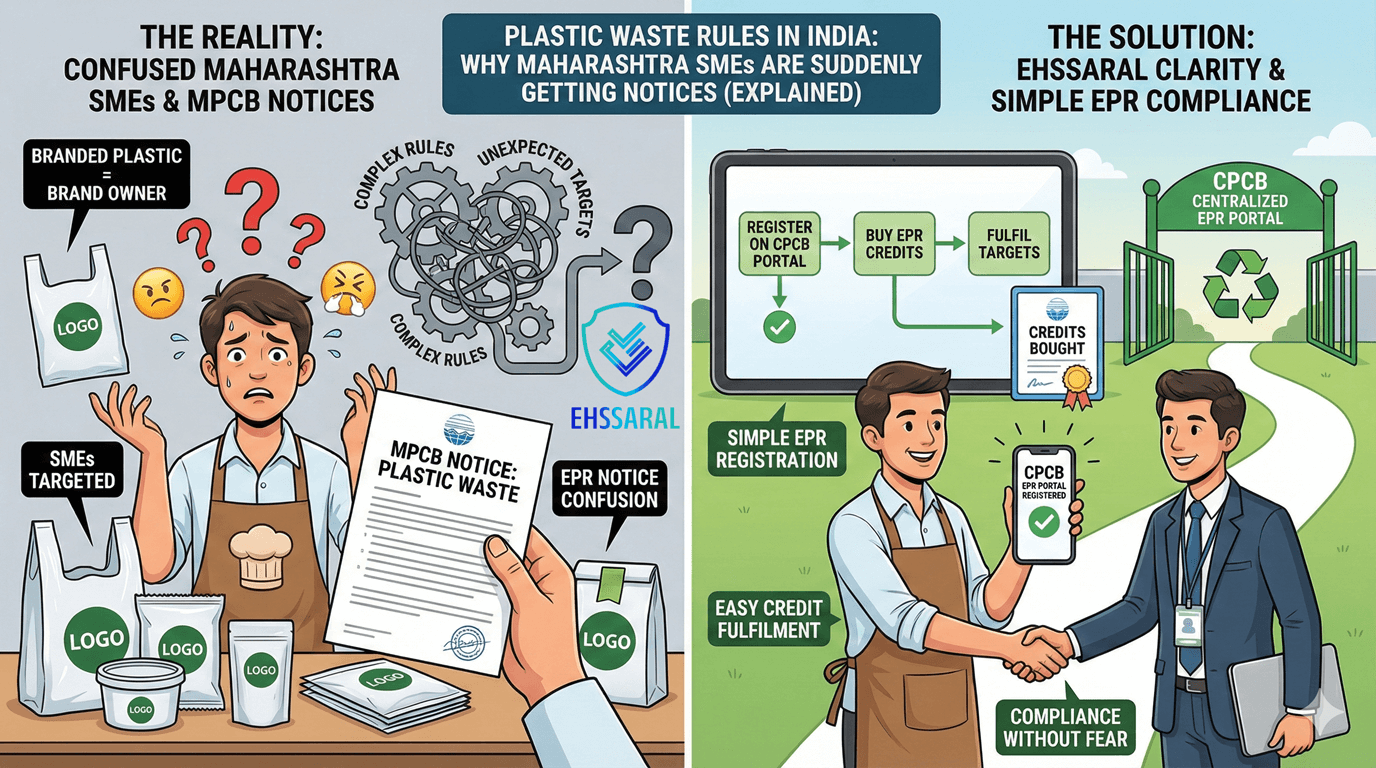
Most plastic waste rules in India were written with big FMCG companies in mind.
But the reality in Maharashtra today is very different:
Thousands of small businesses - bakeries, garment shops, masala units, mobile accessory sellers, printing units, micro-manufacturers - are suddenly receiving Plastic Waste Management (PWM) notices.
And almost every SME says the same thing:
“But we don’t manufacture plastic. Why did MPCB send us a notice?”
Here’s the blunt truth:
If your product goes out in a plastic pouch, wrapper, bottle, or cover with your brand name or logo printed on it… you are a “Brand Owner” under the PWM Rules.
Even if:
This is exactly where the compliance trap begins.
For years, plastic rules mainly hit:
But Maharashtra generates some of the highest plastic waste in India. In 2023–2025, CPCB and MPCB pushed for full accountability, including small-scale brand owners.
Three things changed:
1. EPR tracking shifted to the Centralized National EPR Portal (not MPCB).
Small businesses did not know this.
2. Plastic packaging vendors do not educate SMEs.
They only print pouches - they don’t explain compliance.
3. Notices are now automated.
If your brand appears on plastic, you instantly fall under “Brand Owner” category.
This is why SMEs suddenly feel targeted.
Learn More about our Free Learning hub Section - EHSShala
The PWM Rules created three categories:
Makes plastic packaging material.
Brings plastic packaging or goods packed in plastic from outside India.
Sells any product in plastic packaging with their brand name or logo, regardless of scale.
Most SMEs wrongly assume:
All incorrect.
If your brand is printed on plastic, you are responsible for ensuring that plastic is recycled in equivalent quantity (called EPR Targets).
This is why thousands of Maharashtra SMEs who never heard of “EPR” are now receiving notices.
Below is the plain-English decision flow used by regulators.
This is the shortest way to understand your category without confusion.

YES → Go to Step 2
NO → You are not under PWM Rules (for now)
YES → You are a Brand Owner (PIBO)
NO → Go to Step 3
YES → You are a Producer
NO → Go to Step 4
YES → You are an Importer
NO → You fall under General Plastic User, not PIBO (but future rules may still apply)
There is no exemption for:
1. A bakery selling items in printed plastic pouches → Brand Owner
Even if you print only 1000 wrappers.
2. A garment shop giving shirts in branded polybags → Brand Owner
Even if the bags are purchased from a local vendor.
3. A masala unit packing spices in printed pouches → Brand Owner
Even home-scale units qualify.
4. A small electronics shop selling chargers in printed packets → Brand Owner
5. A small component manufacturer packing items in printed polybags → Brand Owner
6. A shop using plain unprinted plastic bags → Not a Brand Owner
(But may fall under general plastic usage rules later.)
Printing your logo on plastic is not a small thing legally - it makes you a Brand Owner.
And Brand Owners have EPR obligations, regardless of size.
MPCB and CPCB are not targeting businesses.
They are enforcing traceability and accountability.
Small businesses only face penalties because:
This article exists to fix that information gap.
Most SMEs receiving notices think they must register on the MPCB portal.
But this is the biggest misunderstanding.
It happens on the Centralized National EPR Portal managed directly by CPCB (Delhi).
This is where 90% of SMEs get confused and lose precious time.
Used for:
This is NOT where EPR registration happens.
Used for:
Every Brand Owner (small or large) must register here.
If your logo is printed → you cannot avoid EPR registration.
These steps are written for SMEs who have never touched the portal before.
Go to the official CPCB EPR portal
(you will use the “Brand Owner” registration option).
You will need:
Usually these 5 documents are needed:
Some SMEs rely on packaging printers for details - this is a mistake.
This part confuses most SMEs because it includes:
Example:
If exact weights are unknown, SMEs must ask their packaging vendor for:
THIS is where many errors cause applications to get rejected.
Approval usually takes:
Maharashtra SMEs commonly face:
This article exists to prevent these mistakes.
Once registered, the portal gives you annual EPR targets.
EPR Target =
The amount of plastic you put into the market
which you must get recycled through an authorized recycler
(or purchase equivalent EPR credits)
For small businesses, this target is usually:
But the rule applies even if your usage is small.
This is difficult for most SMEs because:
But it is still an option.
This is what 95% of small Maharashtra businesses end up doing.
When a recycler processes plastic waste, they create:
Brand Owners can buy this certificate to fulfil their EPR target.
Example:
If your annual EPR target is 350 kg, you can buy 350 kg worth of EPR credits.
Yes.
It is officially built into the national EPR system.
What is illegal is:
Many recyclers claim to be registered but are not.
Prices vary by:
For SMEs, it is usually:
₹8–₹35 per kg
depending on plastic category.
This must happen inside your CPCB portal dashboard.
EPR is fulfilled once:
Important for audits.
These lead to penalties.
For micro-businesses, this is the simplest path.
After receiving MPCB notices, most small businesses ask the same question:
“Are we in trouble?”
In 90% of cases, the answer is:
No, you’re not in trouble - but you are uninformed. And that creates trouble.
MPCB is strict, yes.
But they are also predictable.
They expect clarity, honesty, and EPR registration - nothing more.
To protect SMEs, we need to understand:
This part explains everything in plain English.
The state is a major producer and consumer.
Regulators have to tighten compliance.
Any unregistered brand with printed packaging gets flagged across India.
SMEs assume printing a logo is harmless - it is not.
Even tiny shops contribute to the total plastic load.
This means more notices, faster, with deeper traceability.
MPCB does not check your sales volume.
They do not check your size.
They do not check whether your business is small, medium, or tiny.
They only check two things:
If yes → you must register on the national portal.
This is done by:
As long as you follow the rules, you are safe.
MPCB’s goal is not to punish businesses - it is to ensure that every gram of plastic is accounted for.
The PWM Rules do not give size-based exemption.
Printed plastic = mandatory EPR.
Vendors are not responsible for EPR.
You are.
Quantity doesn’t matter.
EPR applies even for low-volume branding.
Still counts as plastic put into the market.
Consent is different.
EPR is separate.
This makes you BOTH:
EPR obligations increase.
If the credit does not appear in your portal → it is invalid.
Fake credits can lead to:
Expectation 1 - Register on the National EPR Portal
This is mandatory.
Expectation 2 - Declare your plastic usage honestly
You don’t need perfect numbers.
You need reasonable, logical data.
Expectation 3 - Fulfil EPR targets
Even via buying credits.
Expectation 4 - Maintain basic proof
Invoices from recyclers, packaging vendor, and credit documents.
Expectation 5 - Respond to notices on time
Delay creates penalties.
MPCB notices look scary, but most SMEs resolve them in 15–20 days.
Show intent.
It matters.
Ask your packaging vendor for:
MPCB respects proactive action.
Even small credits satisfy compliance.
1. Keep proof of packaging materials
This helps in audits.
2. Track annual plastic consumption
Even approximate is fine.
3. Buy EPR credits early (don’t wait for deadlines)
4. Avoid printing unnecessary variations of packaging
More variations ⇒ more declarations.
5. Work with CPCB-registered recyclers only
Avoid penalty-triggering fake credits.
This is the simple roadmap that helps small businesses fix everything without consultants.
From packaging vendor:
From accounts:
After this, your business is fully compliant.
Do small shops really need EPR registration?
If you print your logo on plastic → Yes.
Is buying EPR credits compulsory?
Only if you can’t recycle yourself.
How much will EPR compliance cost?
Usually very small - ₹1,000 to ₹5,000 per year for micro-businesses.
What if I don’t register?
You may receive repeated notices, penalties, and compliance orders.
Do I need a consultant?
Not necessary.
Most SMEs can handle this independently.
At EHSSaral, we keep meeting SMEs who say:
“We are not polluters, we are just unaware.”
This article exists because:
Our goal is to make compliance:
Today it’s plastic waste.
Tomorrow it will be everything SMEs deal with - automatically handled by EHSSaral.
1. Why did my small business get a plastic waste notice from MPCB?
Because if your product goes out in plastic with your brand name or logo, you are considered a Brand Owner under the PWM Rules - irrespective of business size.
2. We only print 500–1000 packets a month. Do we still need EPR?
Yes.
There is no small-business exemption.
Even a few hundred branded pouches per month require EPR registration.
3. We don’t manufacture plastic. Why are we responsible?
EPR does not apply to the manufacturer of plastic alone.
It applies to whoever puts branded plastic into the market.
4. What is a Brand Owner under PWM Rules?
A Brand Owner is any business selling products in plastic packaging with its brand, name, or logo.
This includes bakeries, garment shops, masala units, electronics sellers, printing units, etc.
5. How do I know if I am a Producer, Importer, or Brand Owner?
Use the simple rule:
6. Can I register for EPR on the MPCB portal?
No.
EPR registration is done only on the Centralized CPCB EPR Portal.
7. What documents do I need for EPR registration?
Basic documents like:
8. What are EPR targets?
EPR targets are the quantity of plastic you introduce into the market each year - which you must ensure gets recycled or recovered.
9. How can small businesses fulfil their EPR targets?
Most SMEs choose the easiest route: buy EPR credits from CPCB-registered recyclers.
10. Are EPR credits legal?
Yes, fully legal - but only if issued on the official CPCB portal.
PDF certificates alone are invalid.
11. How much do EPR credits cost?
Usually between ₹8–₹35 per kg, depending on plastic type and recycler availability.
12. How do I avoid getting scammed while buying EPR credits?
Check two things:
If not visible → they are invalid.
13. What if my EPR registration gets rejected?
Re-upload correct packaging details:
Rejections are common and easy to fix.
14. Do I need to hire a consultant?
Not necessary.
Small businesses can complete registration and fulfilment themselves using simple guidance.
15. What happens if I don’t register or fulfil EPR?
You may face:
16. Can I stop using plastic to avoid EPR?
Yes.
If you switch entirely to non-plastic packaging without logo printed on plastic, EPR may not apply.
17. We use plain unprinted plastic bags. Do we need EPR?
No, plain non-branded bags do not make you a Brand Owner.
But future rules may still regulate plain plastic use.
18. How long does EPR registration take?
Usually 20–45 days for SMEs, depending on document clarity.
19. Do home-based businesses need EPR registration?
If they print their logo on plastic packaging - yes.
20. How often do I need to update EPR compliance?
Annually.
Once a year you submit your data and fulfil targets.

Founder, EHSSaral
Founder - EHSSaral | Partner - Perfect Pollucon | ISO 14001 Lead Auditor | GHG Protocol Scope 2 | Chemist | Data Scientist | Second-generation environmental professional simplifying EHS compliance for Indian industries through practical, automated, tech-enabled, data driven compliance workflows.
Calibration & QA/QC in Environmental Monitoring Guide | EHSShala
 EHSSaral v1.png)
EADA Random Audit Assignment: Factory Readiness Guide (2025) | EHSSaral
Hazardous Waste Storage Rules in Indian Factories | EHSShala
Water & Effluent Sampling Basics for Indian Factories | EHSSHala
SPCB Consent Conditions: Common Compliance Mistakes Explained | EHSSaral
Why Form IV Filing Becomes Difficult for Indian EHS Teams: A Field-Level Analysis
Bio-Medical Waste Management for Non-Hospitals (India) | EHSShala
Environmental Calendar from Consent Conditions (Practical Guide) | EHSShala
Used Oil & Waste Oil Management in India - Factory & EHS Guide | EHSShala
Hazardous Waste All Forms Form 1 to Form 12 Guide