ETP & STP Troubleshooting: The Complete Indian Guide | EHSShala
EHSSaral is an Environmental Compliance Intelligence Platform for Industries. Consent Intelligence • Alerts & Tasks • Incident Reporting • Form IV & V • Audit-Ready Records
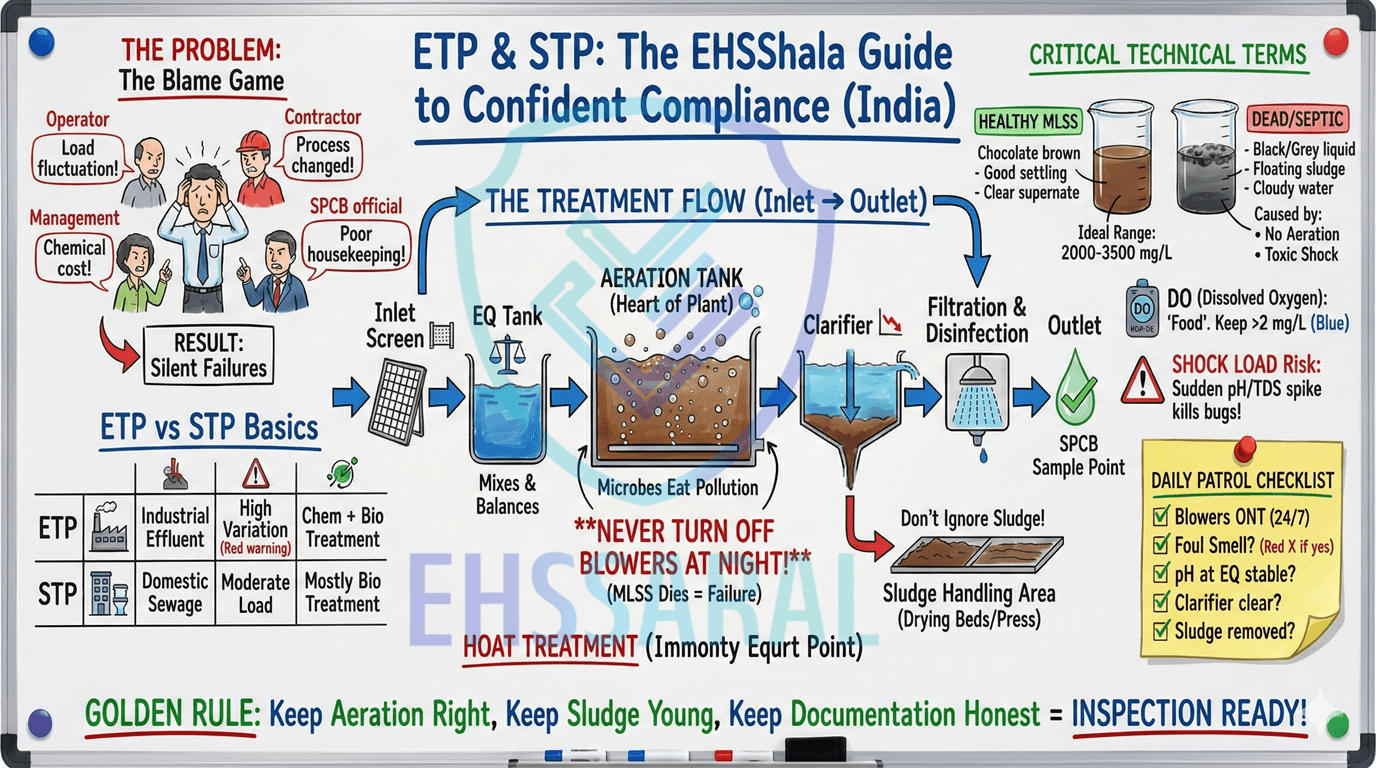
Without an EQ tank, BOD/COD reduction becomes unpredictable.
Typical failures:
No aeration/mixing → sludge settling at bottom
Sudden pH fluctuation reaching aeration
3) Aeration Tank (Heart of the Plant)
Purpose: Microorganisms eat pollution. This is the biological treatment stage.
What matters here:
MLSS must be in range
DO should be sufficient
Aerators must run continuously
If aerators stop at night, MLSS dies and the plant collapses within 24–48 hours.
4) Clarifier / Settling Tank
Purpose:
Separate clean water from sludge
Sludge settles at bottom
Return sludge goes back to aeration
Failures:
Sludge bulking
Sludge floating
High TSS
5) Filtration
Types:
Pressure sand filter (PSF)
Activated carbon filter (ACF)
Purpose:
Polish the water
Remove remaining turbidity, smell, colour
6) Disinfection
Chlorine, UV, or ozone.
Purpose:
Kill harmful pathogens
Meet outlet standards
7) Sludge Handling
Often neglected in SMEs.
Types:
Drying beds
Centrifuge
Filter press
Improper sludge handling is a major reason for SPCB non-compliance.
⚠️ WARNING: The Mistake That Kills EHS Officers Before you ever instruct a worker to enter a tank, read this. ETP and STP tanks (especially collection and sludge tanks) generate Hydrogen Sulfide (H2S).
It smells like rotten eggs at low levels.
It is odorless at high levels (it numbs your nose instantly).
It kills in seconds.
The Golden Safety Rule: Never enter any pit, tank, or confined area for cleaning or maintenance without:
A valid Confined Space Work Permit.
Checking oxygen and gas levels with a gas detector.
Using a harness and lifeline with a standby person outside. Don't be a hero. Be safe.
Critical Technical Terms (Explained Like You’re Sitting with a Senior)
MLSS – Mixed Liquor Suspended Solids
Microorganisms available in aeration tank.
Too low → No treatment Too high → Poor settling
Ideal range (general): 2,000–3,500 mg/L
DO – Dissolved Oxygen
Food for microorganisms.
Ideal: 2 mg/L or higher
Low DO = smell, bulking, MLSS crash.
SVI – Sludge Volume Index
Indicates settling quality.
Low SVI → good settling High SVI → bulking problems
Shock Load
Sudden change in:
pH
TDS
Organic load
Temperature
This kills MLSS.
F/M Ratio – Food to Microorganism Ratio
If too much “food” (pollution) is coming and microorganisms are less → poor treatment.
This is why aeration tank never should run with very low MLSS.
Daily Checks Every Junior EHS Must Do (Simple & Practical)
Aerators running or not? (Never switch off at night.)
pH at EQ tank. (Avoid shocks.)
Smell near aeration tank. (First sign of failure.)
Clarity of clarifier overflow.
Sludge consistency (not too thin, not too thick).
MLSS reading once a day.
Screens cleaned?
Return sludge flow OK?
These checks take 10 minutes but prevent 10 days of failure.
Common ETP & STP Failures in Indian Industries (And How to Fix Them)
Every EHS professional faces this moment: The plant is “running fine” until the day a sample is collected - and suddenly everything fails.
Why does this happen?
Because most ETP/STP problems don’t happen in one day. They build up silently for weeks, and show up only when someone checks the water.
This section will help you identify failures early and fix them confidently.
Why ETP & STP Fail in Indian Industries - The 5 Real Root Causes
From 25+ years of Perfect Pollucon field experience across India, failures usually come from:
1) Aeration failure (most common)
Low DO
Blowers switched off at night
Blocked diffusers
Overloaded microorganisms
If aeration is weak → treatment collapses.
Pro Tip: How to Convince Management to Keep Aerators ON 24/7 Management often asks: "Can we turn off the blower at night to save electricity bill?" Here is the math you need to show them to say NO:
Cost of Electricity (8 hours saving): approx. ₹200 – ₹500 per day (for small plants).
Cost of Turning it OFF:
Bacteria Death: Requires buying new culture + 15 days to restart (Plant down = Production down).
SPCB Penalty: If caught with dead MLSS, penalties start from ₹5 Lakhs + Closure Notice.
Reputation Loss: Explaining a closure notice to clients/investors.
The Pitch: "Sir, we are saving ₹300 today to risk a ₹5 Lakh penalty next week. It is cheaper to keep it running."
2) MLSS imbalance
Too low → no treatment Too high → poor settling
Almost ALL sample failures start from MLSS imbalance.
3) pH shocks
Every ETP operator fears the day pH goes from 7 → 3 in 10 minutes. Microorganisms die instantly.
pH shock is the biggest silent killer of biological systems.
4) Operator shortcuts
Bypassing
Not cleaning screens
Running aeration on/off
Wrong chemical dosing
Poor sludge removal
Small shortcuts → big failures.
5) Poor sludge management
Old sludge = foul smell, bulking, foaming.
Most plants ignore sludge until SPCB inspection.
Top ETP Failures (Industrial Wastewater) & How to Fix Them
1) pH Imbalance (Too Acidic or Too Alkaline)
Symptoms:
Sudden smell from aeration
MLSS becomes inactive
BOD/COD reduction drops
Clarifier overflow becomes cloudy
Why it happens:
Strong acids/alkalis discharged suddenly
Batch cleaning water entering without dilution
Incorrect neutralisation dosing
How to fix:
Stabilise pH at EQ tank first
Add controlled lime/acid dosing
Never allow shock load to enter aeration tank
2) MLSS Drop (Microorganisms Dead or Weak)
Symptoms:
Poor BOD/COD reduction
Thin brown water in aeration tank
Sludge settling badly
Causes:
Aeration shut off at night
Chemicals/solvents entering the system
Toxic load
Low F/M ratio
Fix:
Increase return sludge
Add fresh culture if needed
Check DO & run aerators continuously
Identify toxic source
Are your bacteria hungry? If your inlet is only chemicals (no sewage), you might need to add Urea (Nitrogen) and DAP (Phosphorus) to keep MLSS alive.
3) Aeration Not Working Efficiently
Symptoms:
Visible foam
Smell near tank
DO < 2 mg/L
Dead zones (no bubbles in certain areas)
Causes:
Diffuser choking
Blower belt loose
Operator switching off aeration
Overloading
Fix:
Clean diffusers weekly
Do not turn off aerators
Balance airflow
Ensure MLSS in correct range
4) High TSS at Outlet / Cloudy Water
Why it happens:
Sludge bulking
Overloaded clarifier
High MLSS
Shorter retention time
Fix:
Improve sludge settling
Increase desludging
Add polymer if in emergency
Control return sludge rate
5) Colour or Odour Not Reducing
Causes:
Dyes, pigments
Insufficient aeration
Chemical dosing incorrect
Fix:
Check primary chemical treatment
Add PAC + polymer if required
Increase aeration retention time
6) Equalisation Tank Bypassing
Symptoms:
Sudden load on aeration
MLSS shock
Outlet sample inconsistent
Fix:
Ensure proper mixing
Repair bypass valve
Keep EQ tank level balanced
Top STP Failures (Sewage) & How to Fix Them
1) Foul Smell from STP (Most Common)
Causes:
Aeration insufficient
MLSS too low
Sludge not removed
Grease trap not working
Fresh load variations
Fix:
Check DO immediately
Increase aeration
Remove excess sludge
Clean grease trap weekly
2) Foaming in Aeration Tank
Causes:
Low MLSS
High detergent load
High F/M ratio
Fix:
Add return sludge
Avoid shock discharges
Increase MLSS strength gradually
3) Sludge Bulking / Poor Settling
Symptoms:
Sludge floating
Cloudy overflow
High TSS
Causes:
Filamentous bacteria
Low DO
High MLSS
Fix:
Increase aeration
Add chlorine (controlled dose) to selector zone
Reduce MLSS
4) Clarifier Overflowing / Black Water
Causes:
Pump failure
Excess sludge
Hydraulic overload
Fix:
Immediate desludging
Restart pumps
Check incoming flow rate
5) High Ammonia in Outlet
Causes:
Low DO
Poor nitrification
Shock load
Fix:
Increase aeration rapidly
Maintain DO > 3 mg/L
Ensure MLSS adequate
Why Samples Fail During SPCB Visits (Indian Reality)
SPCB officers typically check:
pH
TSS
BOD
COD
Ammonia
Colour & odour
Compliance with consent conditions
Failures happen due to:
1) Instantaneous load variations
Plants with batch processes suffer sudden spikes.
2) Aeration temporarily low
Even 2 hours of off-time affects results.
3) Sludge age too old
Old sludge → poor treatment.
4) Chemical dosing errors
Using too much PAC, lime or polymer. (Don't guess the dose. Perform a simple bucket/jar test to see how much chemical is actually needed to clarify 1 liter, then calculate for the whole tank.)
5) Maintenance issues
Choked diffusers, broken weirs, algae growth.
6) Poor housekeeping
Even if outlet is good, dirty tanks make officer suspicious.
7) Incorrect sampling point used
Many EHS officers panic and give wrong sample point.
Correct sample point = final treated outlet after disinfection.
A Simple 5-Step Troubleshooting Framework
When something goes wrong:
Step 1: Identify the Symptom
Smell? Colour? Foaming? BOD/COD high? MLSS low?
Step 2: Check Physical Conditions
Are aerators on?
Is sludge settled?
Is clarifier overflowing?
Step 3: Test Key Parameters
pH
DO
MLSS
These 3 values tell 70% of the story.
Step 4: Match Cause → Effect
Use the tables above.
Step 5: Apply Quick Fix vs Long Fix
Example: High TSS? → Quick fix polymer But long fix → sludge age correction
Mistakes EHS Officers Should Avoid (Important)
Trusting “plant running fine” without checking MLSS
Keeping aeration off at night to save power
Not cleaning screens
Giving the wrong sample to SPCB
Not monitoring sludge removal
No daily DO measurement
Relying only on operator statements
Allowing toxic wastewater without checking source
ETP Daily / Weekly / Monthly Checklists
Most failures in ETP/STP do NOT come from wrong design. They come from ignored small tasks, skipped checks, and poor documentation.
This section gives you everything you need to keep the system stable and inspection-ready at all times.
These checklists are designed for SMEs and practical field use.
DAILY CHECKLIST (10-minute Round)
1. Aeration
Are blowers ON continuously?
Any smell from aeration tank?
DO > 2 mg/L?
2. MLSS
Check MLSS once per shift (ideal 2,000–3,500 mg/L).
Colour should be chocolate-brown, not grey/black.
3. pH at EQ Tank
Should be stable (typically 6.5–8.5).
No sudden spikes.
4. Equalisation Tank Mixing
Is the mixer/aerator running?
Any floating sludge?
5. Clarifier Overflow
Is water clear?
Any floating scum?
6. Sludge Pumping
Excess sludge removed?
Sludge not overflowing?
7. Screen Removal
Screen cleaned and collected separately.
8. Operator Log Entry
Flow, pH, DO, MLSS, chemical dosing recorded daily.
Weekly Checklist
Wash diffusers (if clogged)
Check blower belt tension
Clean clarifier weirs
Backwash PSF/ACF
Test COD/BOD trend (in-house if possible)
Monthly Checklist
Calibration of pH meter, DO meter
Check EQ tank sludge depth
Inspect electrical panel & MCC
Sludge drying bed cleaning
Check inlet-outlet trend graph
STP Daily / Weekly / Monthly Checklists
Valid for societies, hostels, IT parks, offices & factory canteen sewage.
Daily Checklist
1. Aeration & DO
Aerators ON 24/7
DO > 2 mg/L
No black smell
2. MLSS & Settling
Check MLSS range (2,500–3,000 mg/L ideal for STP)
Settling should be good (SVI < 150)
3. Clarifier Overflow
Clear light yellowish water
No floating sludge
4. Grease Trap
Remove grease from traps (especially in canteens)
5. Sludge Removal
Check sludge pump operation
No sludge accumulation in aeration tank
6. STP Surroundings
No mosquito breeding
No algae growth around clarifier
Weekly Checklist
Backwash filters (sand + carbon)
Clean aeration diffusers
Remove excess sludge
Check chlorine/UV dose
Monthly Checklist
Calibrate pH, DO meters
Check MLSS vs SVI trend
Sludge drying bed cleaning
Inspect blowers, pipes, valves
Documentation Best Practices (This is Where SPCB Builds Trust)
When SPCB visits, they check TWO things:
Water quality
Your documentation discipline
Many SMEs fail the second one.
Use these documentation habits:
1. Daily Logbook Entries
Record:
pH
DO
MLSS
Flow
Chemical dosing
Sludge removed
Make entries in ink, not pencil.
2. Monthly Trend Sheets
Maintain a graph of:
BOD/COD
TSS
pH
Flow
Sludge volume
Graphs impress officers - they show “control over process”.
3. Sludge Disposal Records
Date
Quantity
Mode of disposal
Vehicle details
TSDF/authorized vendor details
This is the most commonly requested document.
4. Chemical Inventory Register
Record inventories of:
Lime
PAC
Polymer
Hypo/chlorine
SPCB checks dosing errors frequently.
5. Maintenance Register
Date of blower servicing
Diffuser cleaning
Filter backwash
Pump servicing
What SPCB Officers Typically Check During Inspections
This list is from decades of real PPS field experience.
1. Housekeeping
Even if water quality is perfect, dirty surroundings = suspicion.
2. Whether aeration is ON
They may arrive early morning or evening.
3. MLSS condition
A quick visual check is enough.
4. EQ tank condition
If sludge is settled → system is unstable.
5. Clarifier clarity
If it’s cloudy → immediate remark in inspection note.
6. Logbooks
They will ask:
“Show me last 3 months data.”
7. Sludge management
Where is sludge stored? Is it overflowing?
8. Valid calibration certificates
For pH & DO meters.
9. Whether treated water meets standards
They may take samples for:
pH
TSS
BOD
COD
Ammonia
Oil & Grease
10. Consent compliance
They match your outlet standards with your Consent to Operate.
How to Keep the Plant Always Inspection-Ready
Use this 5-rule discipline:
Rule 1: Aeration never switched off
This one rule prevents 50% failures.
Rule 2: Sludge never ignored
Old sludge = failure.
Rule 3: Record everything
SPCB respects documentation.
Rule 4: Identify load variations early
Before they become sample failures.
Rule 5: Maintain housekeeping
A clean plant gives confidence.
When to Call an Expert (Don’t Delay These Situations)
Call a consultant/vendor when:
MLSS repeatedly crashes
Heavy smell persists
Clarifier constantly overflows
Aerators not giving enough DO
Outlet fails consistently
Unknown chemical entered system
Foaming continues for > 3 days
Experts can fix in 2 hours what operators struggle with for 20 days.
Frequently Asked Questions (FAQ)
1) Why does my ETP sample fail even when the plant looks fine?
Because most failures happen inside the process, not outside. Common silent killers are:
Low DO for a few hours
MLSS imbalance
Sudden pH shock
Old sludge in clarifier
Inconsistent inlet load
The plant may “look fine,” but biology takes time to respond. Check DO, MLSS, pH trends.
2) Why is my STP smelling even though aerators are ON?
Possible reasons:
DO is still below 2 mg/L
MLSS is too low
Sludge has become old
Grease trap is overloaded
STP is receiving kitchen/canteen waste without proper grease removal
Smell = biological imbalance. Fix MLSS, DO, and sludge age first.
3) Why is BOD/COD not reducing?
Top reasons:
Aeration insufficient
MLSS too low or inactive
High toxic chemicals in inlet
Shock load
pH too high or too low
In ETPs, industrial chemicals are usually the reason. In STPs, low MLSS is the usual cause.
4) Why does MLSS suddenly drop?
Because microorganisms died due to:
Toxic chemical entry
Aeration off at night
Sudden pH crash
High temperature inlet
High detergent load
MLSS crash ≠ plant failure. It is recoverable with proper return sludge + stable aeration.
5) Why is my clarifier overflowing or cloudy?
This is a classic symptom of:
High MLSS in aeration
Sludge bulking
Low DO
Hydraulic overload
Sludge not removed regularly
Immediate fix → desludge + increase aeration.
6) Why do I get foaming in aeration tanks?
If it is white foam → detergent load. If it is brown foam → low MLSS or high F/M ratio. If it is thick stable foam → filamentous bacteria growth.
Fix: balance MLSS and DO.
7) Why is the STP outlet not clear yellow?
Check:
MLSS too high
Settling poor (SVI > 150)
Sludge carryover
EQ tank mixing weak
A well-functioning STP always gives light yellow to pale clear water.
8) What is the ideal aeration runtime?
24 hours. Switching off aeration is the number one cause of failure in India.
9) How much MLSS should I maintain?
General guideline:
STP: 2,500–3,000 mg/L
ETP: 2,000–3,500 mg/L
But always adjust based on settling behaviour and load.
10) What do SPCB officers check during inspection?
They usually check:
Housekeeping
Aeration
MLSS
Clarifier clarity
Sludge management
Calibration certificates
Last 3–6 months logbook
Consent compliance
Sample collection point
Stability + discipline impress officers more than design.
11) Why is sludge handling so important?
Because old sludge kills the plant. It causes:
Smell
Bulking
Foaming
TSS carryover
Poor clarification
Sludge should be removed regularly, not only before inspections.
12) Can STP fail even with correct MLSS?
Yes. MLSS number is not everything.
You also need:
Good DO
Proper aeration pattern
Correct sludge age
Proper return sludge
Balanced F/M ratio
Whenever STP fails, check settling behaviour, not just MLSS.
13) Why do ETPs fail more than STPs?
Because industrial wastewater:
Changes daily
Contains chemicals
Has unpredictable pH
May have toxic compounds
Needs both chemical + biological treatment
ETPs need more monitoring and more documentation.
14) Should I add fresh culture when MLSS drops?
Not immediately. First:
Stabilise DO
Identify toxic source
Increase return sludge
Only when MLSS cannot recover naturally → add culture.
15) How to prevent ETP/STP failure permanently?
Follow the Golden Rule of EHSShala:
“Keep aeration right, keep sludge young, and keep documentation honest.”

 ehssaral.webp)