Environmental Incident Response Guide for Indian EHS Professionals | EHSShala

Environmental Incident Response Guide for Indian EHS Professionals | EHSShala

Environmental Incident Response EHS Incident Management Environmental Compliance Indian EHS Professionals ETP Malfunction
Last updated:

15 Jul 2026

|
Read time: 15 min read

Environmental incident response means controlling the immediate risk, understanding what happened, preserving the correct records and completing the required corrective and compliance actions. This EHSShala level provides practical response guidance for environmental incidents commonly faced in Indian factories.


Incident Response is an EHSShala learning level for Indian EHS professionals facing environmental failures, abnormal readings, spills, inspections and compliance gaps. It explains what to check first, which records to preserve, who should be involved and how to move towards proper closure.


Incident Response Level

When something goes wrong inside a factory, the EHS officer is often expected to respond before the complete facts are available.

The ETP may stop suddenly.

OCEMS may show a high value.

A chemical may leak near a drain.

An officer may arrive for an inspection without advance information.

A nearby resident may complain about odour, smoke or contaminated water.

During such moments, people do not need a long explanation of the law.

They need to know:

  • What should be checked first?
  • Is there an immediate risk?
  • Who should be informed?
  • What should be stopped or controlled?
  • Which records should be preserved?
  • What should be communicated?
  • How should the cause be investigated?
  • What compliance follow-up may be required?

This level is being created because we have received many practical questions from EHS professionals about abnormal situations, plant failures, inspections and environmental incidents.

The same concern appears repeatedly:

“The problem has already happened. What should we do now?”

This level will help EHS professionals respond calmly, preserve facts and move towards proper closure.

Why This Level Exists

Environmental problems often become more difficult because the initial response is confused.

Common patterns include:

  • Different departments giving different explanations
  • Production continuing without understanding the risk
  • Abnormal data being ignored
  • Photographs and records not being preserved
  • Operators delaying reporting because they fear blame
  • Temporary arrangements becoming permanent
  • Compliance communication being prepared before facts are verified
  • Equipment being restarted without understanding why it failed

In many factories, the EHS officer is accountable for the environmental outcome but may not directly control production, maintenance or utilities.

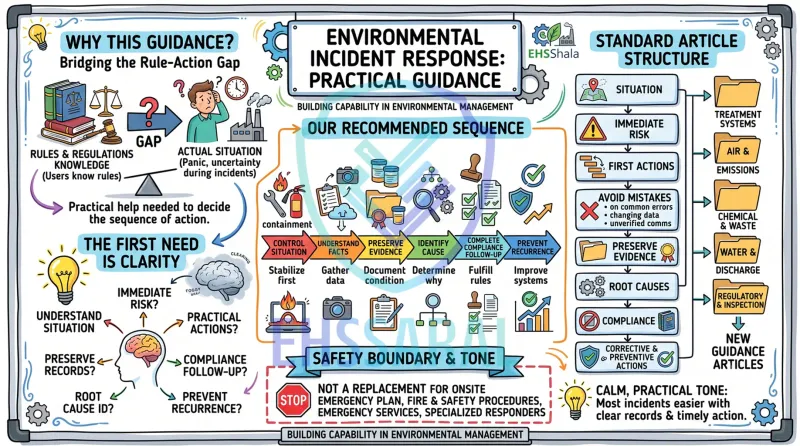
This level exists to provide a clear response sequence.

Control the risk. Understand the facts. Preserve the evidence. Find the cause. Complete the follow-up. Prevent recurrence.

What is environmental incident response?

Environmental incident response is the organised process of controlling an immediate environmental risk, collecting facts, preserving evidence, identifying the possible cause, reviewing compliance requirements and preventing recurrence.

What You Will Learn

By the end of this level, you should be able to:

  • Separate an emergency from an operational deviation
  • Identify immediate environmental risks
  • Take sensible first actions
  • Involve the correct departments
  • Preserve readings, photographs and records
  • Avoid common panic-driven mistakes
  • Investigate possible root causes
  • Review consent and compliance requirements
  • Communicate facts clearly to management
  • Support professional communication with regulators
  • Complete corrective and preventive actions
  • Reduce the chance of recurrence

This level will not diagnose individual incidents remotely.

It will help you ask the right questions and organise the response.

Incident Response Articles

1. ETP Malfunction: What Should an EHS Officer Do Immediately?

A practical first-response guide for situations where the ETP stops, treatment quality deteriorates or equipment fails.

Understand:

  • Whether discharge should continue
  • How available holding capacity can be used
  • What production and maintenance teams should check
  • What samples and readings should be preserved
  • How the system should be restarted safely
  • Which records should be reviewed after normal operation returns

Read Article →


2. OCEMS Showing High Emissions: Process Problem or Instrument Problem?

A step-by-step guide for responding when OCEMS values suddenly rise or remain above the normal operating range.

Understand:

  • How to compare the reading with plant operating conditions
  • What to check in pollution control equipment
  • How to review analyser health and calibration
  • Why abnormal data should never be deleted or ignored
  • When manual verification may be useful
  • What facts should be preserved before drawing conclusions

Read Article →


3. Chemical or Gas Leakage: Immediate Environmental Response

A practical guide for leakage situations involving chemicals, gases, pipelines, tanks or storage areas.

Understand:

  • When the onsite emergency plan should be activated
  • How to isolate the area safely
  • How to identify the substance involved
  • How to prevent entry into drains or soil
  • Which trained teams should be involved
  • What environmental evidence should be collected after immediate control

Read Article →


4. Unplanned Pollution Control Board Inspection: What Should the Plant Team Do?

A calm, practical guide for supporting an inspection when officers arrive without prior information.

Understand:

  • Whom to inform internally
  • How to verify and support the visiting officers respectfully
  • Which records should be kept ready
  • How plant representatives should answer questions
  • What should never be hidden, altered or backdated
  • How to prepare an internal observation note after the visit

Read Article →


5. Effluent Entering a Stormwater Drain: Immediate Response and Follow-Up

A response guide for accidental discharge, overflow or leakage entering a stormwater drain.

Understand:

  • How to stop or isolate the source
  • How to block further spread where safely possible
  • What tank, pipeline and drain checks are required
  • Which samples and photographs should be preserved
  • How to check whether the discharge has moved outside the premises
  • What corrective actions should follow

Read Article →


6. Monitoring Report Shows an Exceedance: What Should You Do Next?

A practical guide for unexpected results in stack, effluent, ambient air, noise or water monitoring reports.

Understand:

  • How to check sample identity and operating conditions
  • How to review laboratory and sampling information
  • Whether repeat monitoring is justified
  • How to investigate the actual process condition
  • Why the result should not be dismissed immediately
  • How to document corrective action

Read Article →


7. Hazardous Waste Spill or Drum Leakage

A factory-floor guide for damaged drums, leaking containers and spills inside hazardous waste storage areas.

Understand:

  • How to identify the waste
  • How to use compatible spill-control materials
  • How to prevent mixing with other waste
  • How to handle contaminated absorbents
  • What photographs and records should be preserved
  • How to inspect nearby drums and storage conditions

Read Article →


8. Community Complaint About Odour, Smoke, Dust or Water

A practical guide for responding when a nearby resident, society, village representative or local body raises an environmental complaint.

Understand:

  • How to record the complaint properly
  • How to check plant conditions at the reported time
  • How wind direction, discharge route and process activity may help
  • Why complaints should not be dismissed without checking
  • How to communicate respectfully
  • What internal investigation and follow-up should be completed

Read Article →


9. Scrubber, Bag Filter or Air Pollution Control Equipment Failure

A guide for sudden failure, choking, pressure drop, pump failure or poor performance of air pollution control systems.

Understand:

  • What process conditions should be reviewed
  • Whether production load should be reduced
  • What visual and instrument checks are useful
  • How bypass conditions should be identified
  • What maintenance evidence should be preserved
  • What should be checked before restarting

Read Article →


10. ETP Outlet pH Suddenly Goes High or Low

A focused troubleshooting guide for abnormal pH readings in treated effluent.

Understand:

  • Whether the reading is genuine
  • How to check the meter and sample
  • What dosing-system issues may be involved
  • Whether an unusual process stream entered the ETP
  • How to hold and recirculate effluent where possible
  • What records should be reviewed before discharge restarts

Read Article →


11. OCEMS Downtime or Data Communication Failure

A practical guide for analyser failure, server communication loss, data gaps and prolonged downtime.

Understand:

  • How to separate analyser failure from communication failure
  • What local data may still be available
  • Which maintenance and calibration records should be checked
  • How downtime should be recorded
  • What temporary verification arrangements may be required
  • How to document restoration

Read Article →


12. Hazardous Waste Storage Area Is Full

A guide for situations where waste accumulation is approaching storage capacity.

Understand:

  • How to verify actual quantity
  • How to review pending pickups
  • How to check transporter, recycler or TSDF coordination
  • Why incompatible waste should never be combined for convenience
  • What temporary arrangements are unsafe
  • How future accumulation can be forecast

Read Article →


13. Hazardous Waste Vehicle Accident or Spill During Transport

A practical response guide for incidents involving a transporter carrying hazardous waste or chemicals outside the factory.

Understand:

  • What information should be shared immediately
  • How the material should be identified
  • Which transporter and emergency contacts should be activated
  • What manifest, vehicle and dispatch records are important
  • What location evidence should be preserved
  • How vendor preparedness should be reviewed later

Read Article →


14. Production Has Increased Beyond Consent Quantity

A guide for situations where the EHS team discovers that actual production is higher than the quantity covered under the existing consent.

Understand:

  • How to verify actual production data
  • Whether the change is temporary or permanent
  • What related water, fuel, emission and waste quantities have changed
  • How to escalate the matter internally
  • Why figures should not be adjusted to match consent
  • What approval or amendment review may be needed

Read Article →


15. Hazardous Waste Category Missing From Authorisation

A practical guide for newly generated waste, changed process waste or a category not reflected in the current authorisation.

Understand:

  • How the waste should be identified
  • What process change created it
  • Whether it has been mixed with an existing category
  • How storage and disposal should be controlled meanwhile
  • What records should be created
  • How the authorisation position should be reviewed

Read Article →


16. Tank Overflow or Pipeline Leakage Inside the Plant

A response guide for effluent, chemical, oil or wastewater overflow caused by equipment failure or human error.

Understand:

  • How to stop the inflow
  • How to isolate damaged lines
  • How to protect nearby drains
  • How to estimate the quantity released
  • What cleanup waste may be generated
  • How to prevent repeat overflow

Read Article →


17. Environmental Record Is Missing During Inspection or Audit

A practical guide for situations where a logbook, report, manifest, acknowledgement or calibration record cannot be located.

Understand:

  • How to respond honestly
  • How to search alternate sources
  • What records can and cannot be reconstructed
  • Why backdating should be avoided
  • How to document the gap internally
  • How to improve document control

Read Article →


18. Calibration Has Expired or Instrument Accuracy Is Doubtful

A guide for expired calibration certificates, unstable meter readings and doubtful environmental monitoring instruments.

Understand:

  • Which decisions depend on the instrument
  • Whether a backup instrument is available
  • How to verify recent data
  • What operating records should be reviewed
  • How calibration should be restored
  • How the gap should be documented

Read Article →


19. TSDF or Recycler Rejects the Waste Load

A practical guide for waste rejected because of contamination, wrong description, unsuitable packing, excess moisture or document mismatch.

Understand:

  • Why the load was rejected
  • Where the waste should be kept after return
  • How manifest and transport records should be handled
  • What sampling or testing may be needed
  • How the waste description should be corrected
  • How the vendor-selection and dispatch process should improve

Read Article →


20. Pollution Complaint or Notice Received by Email or Portal

A calm guide for the first internal response after receiving a complaint, query, direction or show-cause communication.

Understand:

  • How to read the communication carefully
  • How to identify the exact information requested
  • Which departments should provide supporting facts
  • How to prepare a timeline
  • Why assumptions and emotional replies should be avoided
  • How to track corrective actions and submission records

Read Article →


“Most environmental incidents become harder because the first response is unclear.”

This level is designed to bring that clarity.

Good incident response does not mean knowing every answer immediately.

It means controlling the risk, preserving the facts and taking the next sensible step.


These guides support initial understanding, coordination, record preservation and compliance follow-up. During an active emergency, follow the site emergency plan and the instructions of trained emergency-response personnel. Reporting and regulatory requirements may differ depending on the incident and applicable consent conditions.


Frequently Asked Questions

1. Is every abnormal environmental situation an emergency?

No.

Some situations are emergencies. Others are operational failures, monitoring deviations or compliance gaps.

The response should match the actual risk.

2. Can these guides replace the onsite emergency plan?

No.

During an active emergency, the site emergency plan and trained response personnel must take priority.

These guides support understanding, coordination, documentation and compliance follow-up.

3. Who should use this level?

Site EHS officers, environmental engineers, plant teams, utilities teams, compliance managers and professionals supporting industrial facilities.

4. Will these articles tell us the exact root cause?

No.

They will help you identify possible causes and ask the correct investigation questions.

The actual cause must be confirmed using site facts, records and technical assessment.

5. Will this level help during inspections?

Yes.

The articles will explain what facts, records and actions usually help the plant present the situation clearly.

6. Can a junior EHS officer use these guides during a live problem?

Yes.

Every article will begin with a short Immediate Actions section so the reader can first understand what needs attention.

7. What if one incident falls under multiple categories?

That is normal.

An ETP failure may also cause a drain issue, monitoring exceedance, complaint or inspection.

Related guides will be cross-linked.

 

Harshal T Gajare

Harshal T Gajare

Founder, EHSSaral

Founder - EHSSaral| Partner - Perfect Pollucon | ISO 14001 Lead Auditor | Second-generation environmental professional simplifying EHS compliance for Indian manufacturers through practical, tech-enabled guidance.

Related Blogs

Post-Grant Environmental Compliance Failures in India | EHSSaral Research

Post-Grant Environmental Compliance Failures in India | EHSSaral Research

OCEMS Data Gaps Explained: Why CPCB Rejects Data & How to Fix | EHSSaral

OCEMS Data Gaps Explained: Why CPCB Rejects Data & How to Fix | EHSSaral

EHSShala Start – Begin Your EHS Learning Journey in India
EHSShala Start – Begin Your EHS Learning Journey in India

Form 4 Annual Return Explained (Hazardous Waste - India) | EHSShala

Form 4 Annual Return Explained (Hazardous Waste - India) | EHSShala

EHS Officer Career Path in India (2025–2050 Guide) | EHSShala

EHS Officer Career Path in India (2025–2050 Guide) | EHSShala

Environmental Compliance for Pharmaceutical Manufacturing in India | EHSSaral

Environmental Compliance for Pharmaceutical Manufacturing in India | EHSSaral

Hazardous Waste Classification in India: Inspector’s Guide (2025) | EHSShala

Hazardous Waste Classification in India: Inspector’s Guide (2025) | EHSShala

Evolution of EHS in India - (Part 1) Pre-Bhopal Era | EHSShala

Evolution of EHS in India - (Part 1) Pre-Bhopal Era | EHSShala

4-Stream Waste Segregation for Factories (SWM 2026) | EHSSaral

4-Stream Waste Segregation for Factories (SWM 2026) | EHSSaral

MPCB Consent Explained - Lessons from 25 Years of Environmental Compliance | EHSSaral

MPCB Consent Explained - Lessons from 25 Years of Environmental Compliance | EHSSaral