
Blog
CSR Trends 2026: Environmental Compliance Automation in India | EHSSaral
EHSSaral is an Environmental Compliance Intelligence Platform for Industries. Consent Intelligence • Alerts & Tasks • Incident Reporting • Form IV & V • Audit-Ready Records
See how EHSSaral works
22 Dec 2025
Author: Harshal T Gajare
Affiliation: Founder, EHSSaral (for identification only)
Date: December 2025
Version: v1.0
The Problem: 63% of Consent to Operate (CTO) refusals in Maharashtra are not caused by pollution, but by administrative and financial errors. The Study: An analysis of ~450 MPCB committee decisions (2023–2025). Key Findings:
Environmental compliance in India is often discussed through the lens of pollution parameters-air emissions, effluent quality, stack monitoring, and treatment systems. While these are undeniably important, they do not tell the full story of why industries struggle during regulatory approvals.
In Maharashtra, a significant number of industries-particularly first-time applicants and small-to-medium enterprises (SMEs)-face delays or refusals during the Consent to Operate (CTO) stage, even when their pollution control systems are technically adequate. These refusals result in operational uncertainty, financial stress, and repeated interactions with regulatory authorities.
From the regulator’s perspective, repeated errors in applications increase scrutiny workload, prolong decision cycles, and divert attention from higher-risk environmental issues.
This paper was written to address a simple but under-explored question:
Why do Consent to Operate applications fail repeatedly, even when pollution control infrastructure exists?
Rather than focusing on isolated incidents or anecdotal experiences, this study examines recurring patterns observed in publicly recorded regulatory decisions of the Maharashtra Pollution Control Board (MPCB). The objective is not to criticise any stakeholder, but to extract learning that can help:
This is a learning-oriented, preventive study-intended to improve system efficiency for both industry and regulator.
A common misconception among new applicants is that CTO refusal is sudden or arbitrary. In practice, MPCB’s decision-making follows a structured escalation path defined under the Water Act, Air Act, and related rules.
Typically, the process follows these stages:
A CTO refusal is rarely the first interaction. In most cases, it is the final outcome of unresolved non-compliance-often linked to previous consent conditions, incomplete documentation, or inconsistencies between site reality and submitted data.
Understanding this sequence is critical. Refusal is not a comment on intent; it is a signal that specific procedural or legal requirements remain unmet.
This paper focuses exclusively on Consent to Operate (CTO) decisions recorded by MPCB between January 2023 and March 2025.
All observations in this paper are based only on publicly accessible regulatory records.
During the study period, approximately 450 CTO-related decisions were reviewed across published MPCB committee records.
These decisions broadly fell into two categories:
For analytical clarity, this paper focuses on a defined subset of ~210 adverse decisions, where clear reasons for rejection, non-compliance, or regulatory concern were recorded.
Important note:
This analysis is pattern-based, not statistical generalisation. Percentages and distributions are used only to indicate relative frequency within the reviewed sample, not to represent all CTO applications in Maharashtra.
Each adverse decision was reviewed and classified based on the primary reason cited in the committee records. Where multiple reasons were mentioned, the most decisive factor influencing refusal or escalation was considered.
Broad classification categories were developed iteratively, based on recurring language used in MPCB decisions. These categories include:
In addition to reason-based classification, decisions were also observed across:
This allowed identification of repeat failure points rather than isolated errors.
To avoid over-interpretation, the following limitations must be clearly stated:
These limitations are not weaknesses-they define the boundary of responsible inference.
This paper is structured to move from patterns to practice:
The intent throughout is constructive:
to help new industries enter the compliance system better prepared, and to support smoother regulatory outcomes for all stakeholders.
After reviewing approximately 450 Consent to Operate (CTO)-related decisions recorded in MPCB Consent Appraisal Committee (CAC) and Consent Committee (CC) minutes between January 2023 and March 2025, a subset of ~210 adverse decisions (refusals and SCN-linked outcomes) was analysed in detail.
The purpose of this quantitative analysis is not statistical forecasting, but pattern identification - to understand which types of non-compliance appear repeatedly and therefore represent systemic learning opportunities for new applicants.
Across sectors and regions, a clear and consistent observation emerges:
Most CTO refusals are triggered before environmental performance is even evaluated.
The majority of negative outcomes arise from financial, administrative, and data-consistency failures, rather than from proven pollution exceedances.
The analysed adverse decisions were classified into five broad categories based on the primary reason cited in committee records.
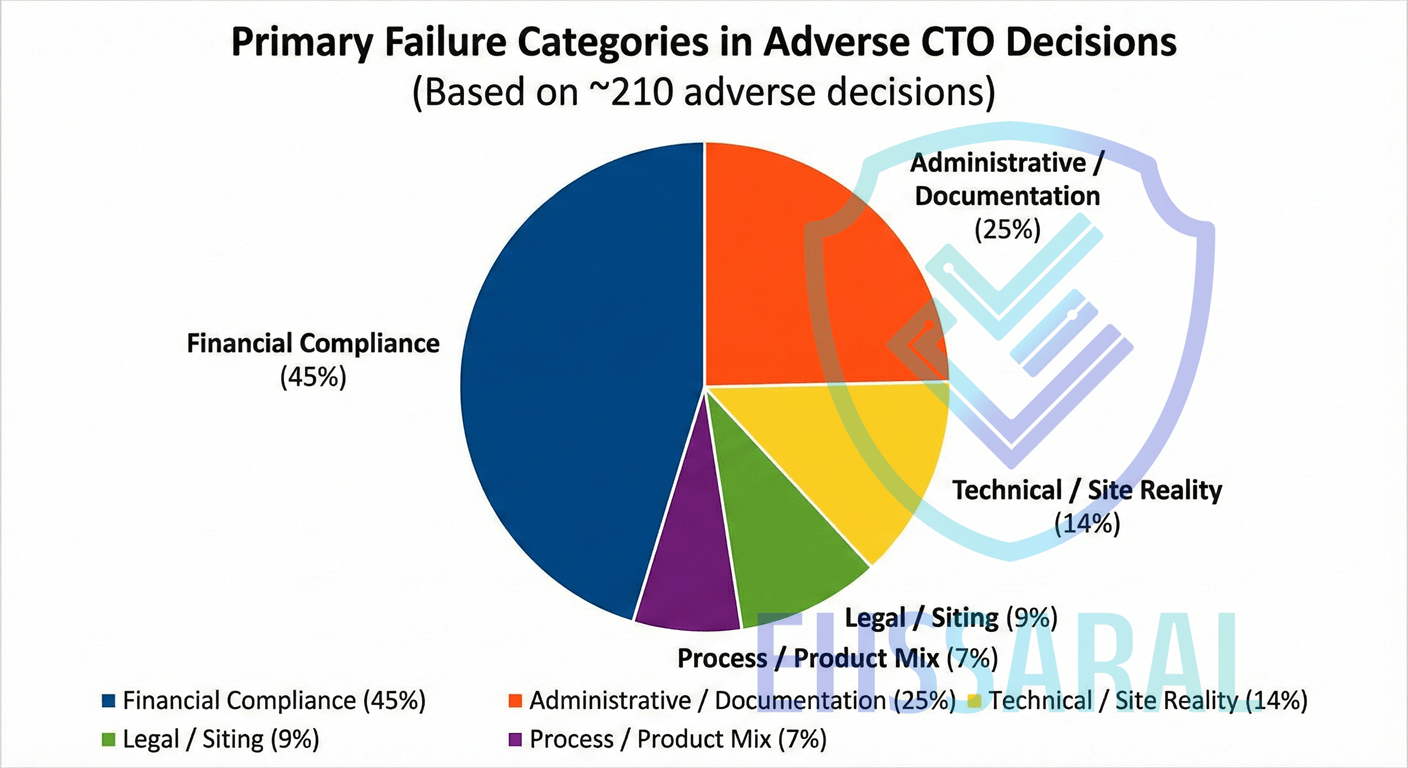
(Based on ~210 adverse decisions)
| Primary Failure Category | Approx. Share | Typical Nature of Issue |
|---|---|---|
| Financial Compliance | ~45% | Missing / expired Bank Guarantees, unpaid penal or lapse fees |
| Administrative / Documentation | ~25% | Capital Investment mismatch, missing certificates, inconsistent forms |
| Technical / Site Reality | ~14% | Non-operational ETP/STP, bypass arrangements, infrastructure gaps |
| Legal / Siting | ~9% | Absence of Environmental Clearance (EC), CRZ / RRZ violations |
| Process / Product Mix | ~7% | Manufacturing activities not covered under existing consent |

Nearly two-thirds of adverse decisions originate from non-technical failures - issues that could theoretically be corrected before site inspection or committee scrutiny.
This indicates that CTO refusal, in many cases, is less about pollution control capability and more about procedural readiness.
This pattern appears repeatedly across multiple committee minutes in the study period.
Financial non-compliance emerges as the single most frequent trigger for refusal or escalation.
Common observations include:
A notable feature of these cases is that many relate to historical conditions, not current operations. In several decisions, the committee explicitly refers to non-compliance of previous consent conditions, even when present pollution parameters were acceptable.
This highlights the importance of compliance continuity rather than one-time compliance.
This pattern appears repeatedly across multiple committee minutes in the study period.
The second-largest category relates to documentation inconsistencies and omissions.
Frequent examples include:
These errors are rarely malicious. In most cases, they appear to stem from:
Despite their administrative nature, these gaps are treated seriously because they affect the integrity of the application record.
This pattern appears repeatedly across multiple committee minutes in the study period.
Technical non-compliance accounts for a smaller proportion of refusals, but these cases tend to be more decisive.
Observed issues include:
Importantly, technical failures often appear after administrative screening. This suggests that many applications never reach detailed environmental evaluation because they fail earlier checks.
This pattern appears repeatedly across multiple committee minutes in the study period.
Legal and siting-related refusals form a smaller but critical category.
These typically involve:
Once triggered, these cases often lead to hard refusals with limited scope for immediate rectification, underscoring the importance of sequence discipline in regulatory approvals.
This pattern appears repeatedly across multiple committee minutes in the study period.
While refusals occur across sectors, concentration varies:
These patterns suggest that sector-specific literacy gaps exist, especially among first-time applicants.
This pattern appears repeatedly across multiple committee minutes in the study period.
Adverse decisions appear more frequently in regions with:
This is likely a function of application volume rather than stricter enforcement, but it reinforces the need for better first-time application quality in these regions.

The quantitative patterns lead to a critical interim conclusion:
CTO refusal is most often a failure of preparation, not pollution control.
Most adverse outcomes are predictable, repeatable, and preventable - provided applicants understand:
The next sections move beyond counts and percentages to explain why these failures occur in practice, and how they can be avoided.
A striking observation from the reviewed MPCB decisions is that many CTO applications are rejected without deep evaluation of pollution control performance. Instead, refusals often occur at an earlier stage due to unresolved administrative or financial non-compliance.
These failures are not dramatic. They do not involve major spills or exceedances. Instead, they arise from missed conditions, mismatched numbers, or overlooked procedural requirements-issues that quietly accumulate over time.
This section examines the most common administrative and financial failure zones, explaining how they arise, why they persist, and why they are treated seriously by the regulator.
One of the most frequent triggers for refusal is non-submission or expiry of Bank Guarantees (BGs) mandated under earlier consents.
In many cases, the BG requirement appears as a single line in a previous CTO order, typically phrased as:
“Industry shall submit a Bank Guarantee of ₹X within Y days towards compliance of consent conditions.”
The problem arises when this condition is never closed.
Industries often continue operating for years without submitting the BG, especially if:
When a renewal application is later submitted, MPCB’s internal tracking systems flag the unresolved condition, resulting in refusal for non-compliance of previous consent terms-irrespective of current performance.
This highlights an important regulatory principle:
CTO compliance is cumulative, not transactional.
Another recurring financial issue relates to delayed renewal applications.
MPCB’s fee structure includes penal provisions when applications are filed after consent expiry. However, many applicants either:
Committee records show that short payment of fees, even by a small margin, is sufficient ground for refusal or return of application.
From the regulator’s perspective, fee accuracy is not negotiable because:
A particularly common administrative failure involves capital investment declarations.
Industries often submit a Chartered Accountant (C.A.) certificate showing depreciated asset value, believing this reflects their current financial reality. However, MPCB calculates consent fees based on gross block (original purchase value), not depreciated value.
When discrepancies arise between:
…the application is flagged for short payment, leading to refusal or demand for resubmission.
This is not a financial audit-it is a consistency check. Any mismatch erodes confidence in the application’s accuracy.
Beyond core documents like consent forms and environmental clearances, MPCB relies on supporting certificates to verify site reality.
Commonly missing or incorrect documents include:
These documents serve as third-party verification, especially critical where physical inspection capacity is limited.
In infrastructure and real estate projects, CTOs are often sought in phases (e.g., occupancy). The Architect Certificate confirming actual completed built-up area becomes decisive.
Committee records frequently note cases where applicants submit:
…instead of a clear, explicit certificate stating what has been built and is ready for use.
From MPCB’s standpoint, occupancy without confirmed completion data introduces environmental risk related to:
Hence, missing or ambiguous certificates are treated as grounds for refusal.
Water budgets are one of the most commonly scrutinized documents-and one of the most frequently mishandled.
Typical issues include:
MPCB committees routinely cross-check:
When numbers fail to reconcile, the application is flagged-not because the math is complex, but because inconsistent data suggests unreliable disclosure.
Several systemic factors contribute to recurring administrative and financial errors:
Importantly, these failures are not intentional violations. They are the result of procedural unfamiliarity, not environmental neglect.
From a regulatory standpoint, administrative and financial compliance is foundational because:
Before evaluating pollution control performance, MPCB must be confident that:
Only then does environmental performance assessment carry meaning.
Administrative and financial failures act as gatekeepers-they determine whether an application even reaches technical evaluation.
The next section examines technical, legal, and sequence-related failures, where refusals are less frequent but often more severe.
Unlike administrative or financial deficiencies-which are often correctable-technical, legal, and sequence-related failures carry higher regulatory weight and lower tolerance for rectification.
Although these categories account for a smaller proportion of total CTO refusals, they frequently lead to:
This section examines why these failures occur, how they are detected, and why they are treated as non-negotiable by MPCB.
A recurring technical ground for refusal is the finding that pollution control systems exist physically but are not operational.
Committee records frequently reference situations where:
From a regulatory perspective, installation alone does not constitute compliance. MPCB evaluates operational continuity, not symbolic infrastructure.
Indicators commonly used during verification include:
If systems are found non-functional during inspection, CTO refusal follows regardless of past performance claims.
Another critical technical issue involves bypass lines or temporary discharge arrangements.
Even where treatment systems are operational, the presence of:
…is treated as a high-risk indicator.
These are not interpreted as operational flexibility, but as potential avenues for uncontrolled discharge, triggering refusal or enforcement action.
In some cases, CTO refusals reference Joint Verification Sampling (JVS) results exceeding consented limits.
It is important to note:
Technical failures typically come into play after administrative gates are cleared, reinforcing the importance of layered compliance readiness.
One of the most decisive refusal grounds is operating or expanding without a valid Environmental Clearance (EC) where required.
A common misunderstanding among applicants is that:
“Applying for EC is sufficient to proceed.”
In regulatory terms, this assumption is incorrect.
MPCB does not have discretion to grant CTO in cases where:
Committee records consistently state that CTO cannot regularize EC violations, regardless of environmental performance.
Once detected, such cases often lead to:
Legal refusals also arise from siting-related constraints, including:
While most siting issues are identified at the Consent to Establish stage, some persist into the CTO phase due to:
In such cases, CTO refusal is less about application quality and more about legal impossibility under prevailing orders.
In Red Category industries-particularly chemical and pharmaceutical units-CTO refusals often arise from product-mix deviations.
Typical scenarios include:
Detection usually occurs through:
Even when pollution loads appear unchanged, unauthorized product changes are treated as material violations, as they alter risk profiles.
Some refusals cite discrepancies in:
Examples include:
These issues reflect process discipline gaps rather than infrastructure absence.
Across technical and legal refusals, a consistent theme emerges: sequence matters as much as substance.
Common sequence violations include:
From MPCB’s perspective, allowing post-facto regularization would:
Hence, sequence violations attract zero tolerance.
Unlike administrative gaps, technical and legal failures:
They represent structural non-compliance, not clerical oversight.
The patterns discussed so far point to a clear conclusion:
Most CTO refusals are preventable if applicants understand what to prepare, when to apply, and how MPCB evaluates readiness.
The final section distills these insights into practical learning for first-time applicants, with the aim of reducing avoidable refusals and regulatory burden.
(~800 words)
The preceding sections demonstrate a consistent reality across MPCB CTO decisions between 2023 and 2025:
Most refusals are not caused by environmental incapacity, but by procedural unreadiness.
For first-time applicants-particularly SMEs and new project proponents-this distinction is critical. It means that many refusals are predictable and preventable, provided applicants understand how compliance is evaluated in practice.
This final section translates observed patterns into practical learning principles, intended to help new industries prepare better applications and reduce unnecessary rework for both applicants and MPCB.
A recurring theme across refusals is the carry-forward of unresolved past conditions, particularly financial and administrative ones.
Practical takeaway:
Before applying for CTO or renewal, applicants should review at least the last two consent orders and verify that every conditional requirement has been fully complied with and documented.
Many refusals arise not from complex regulatory violations, but from simple inconsistencies:
From the regulator’s perspective, inconsistent data undermines confidence in the application as a whole.
Practical takeaway:
Applicants should treat consistency checks as seriously as pollution control design. Every number submitted should align across forms, certificates, and supporting documents.
Architect certificates, CA certificates, disposal memberships, and third-party confirmations are not procedural extras. They function as verification tools in the absence of constant physical inspection.
In several refusals, technically adequate facilities were sidelined because critical verification documents were missing or ambiguous.
Practical takeaway:
Applicants should assume that any document uploaded may be relied upon as decisive evidence. Certificates should be explicit, current, and specific to the application stage.
Some failures observed in this study are not correctable through improved documentation or better explanation. These include:
Such actions break the legally prescribed sequence of approvals.
Practical takeaway:
Applicants should resist operational or commercial pressure to “start early.” Regulatory sequence is rigid, and deviations cannot be regularized post-facto through CTO.
In technical refusals, a common thread is mismatch between what is declared and what is found on-site.
Examples include:
Practical takeaway:
Applicants should ensure that the application reflects actual site conditions on the day of inspection, not intended future states or partial operations.
Although this study focuses on refusals, many adverse outcomes originate at the Show Cause Notice stage.
Committee records suggest that weak SCN responses-generic assurances, future promises, or unsupported claims-frequently lead to final refusal.
Effective SCN responses typically include:
Practical takeaway:
An SCN should be treated as an opportunity to close gaps decisively, not as a procedural inconvenience.
From a system-wide perspective, the findings of this paper suggest that:
In this sense, industry preparedness directly contributes to regulatory efficiency.
This paper set out to understand why Consent to Operate applications fail, using publicly available MPCB decisions as a learning source. The patterns observed challenge a common assumption:
CTO refusals are rarely about pollution alone.
Instead, they reflect a system that prioritizes:
For new industries entering the regulatory framework, the path to smoother approvals lies not only in installing pollution control systems, but in understanding how compliance is evaluated in practice.
By learning from historical refusal patterns, applicants can:
Ultimately, better-prepared applications benefit all stakeholders-industry, regulator, and the environment.
The author declares no regulatory or institutional affiliation with MPCB, and this analysis was conducted independently using publicly available information.

Founder, EHSSaral
Founder - EHSSaral | Partner - Perfect Pollucon | ISO 14001 Lead Auditor | GHG Protocol Scope 2 | Chemist | Data Scientist | Second-generation environmental professional simplifying EHS compliance for Indian industries through practical, automated, tech-enabled, data driven compliance workflows.
CSR Trends 2026: Environmental Compliance Automation in India | EHSSaral
What Is EHS & Why India Needs It | EHSShala
 ehssaral.webp)
Environmental Monitoring Checklist for Factories (India Guide) | EHSShala
EHSShala Consent - SPCB Consent System Explained| EHSShala
Hazardous Waste Rules & Management Explained | EHSShala
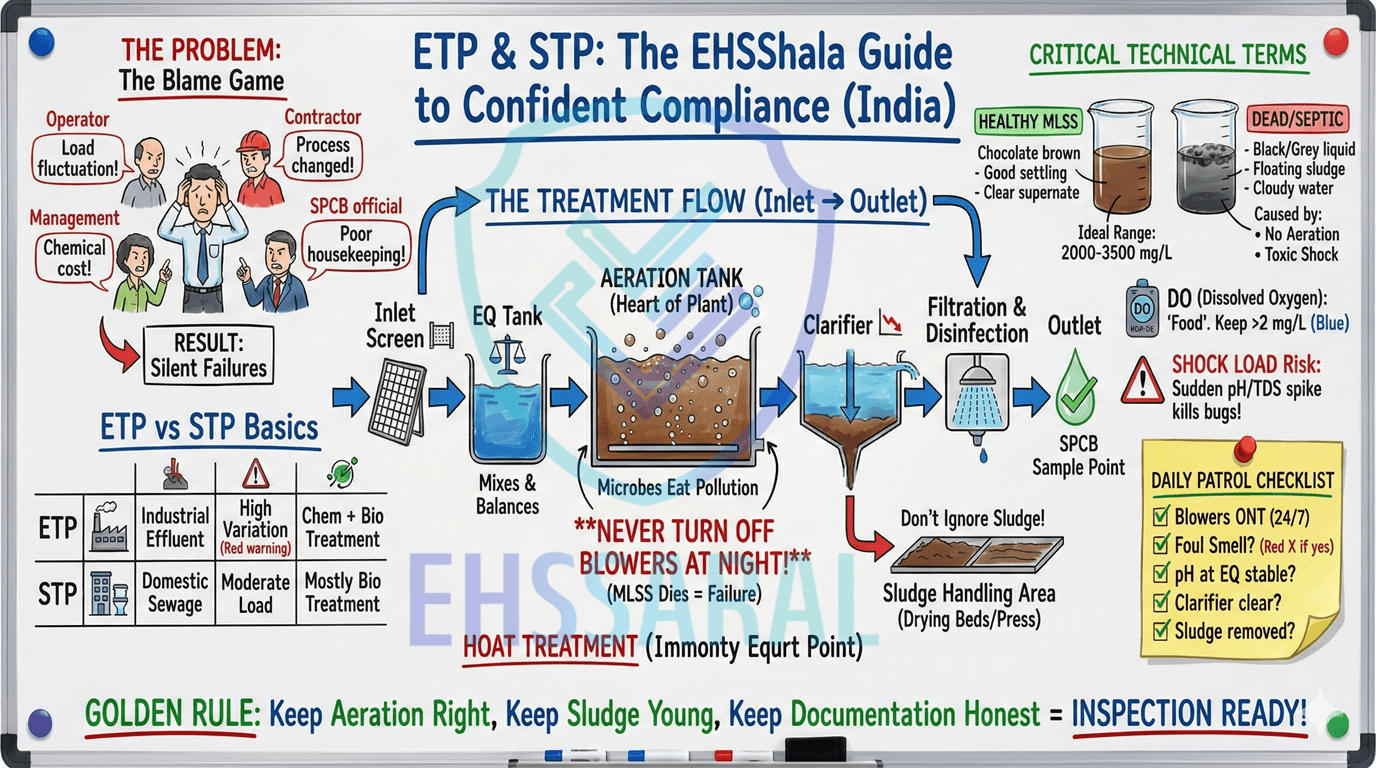
ETP & STP Troubleshooting: The Complete Indian Guide | EHSShala
Environmental Compliance KPIs for Manufacturing in India
Hazardous Waste Stored Beyond 90 Days: What to Do
 ehssaral.webp)
4-Stream Waste Segregation for Factories (SWM 2026) | EHSSaral

Chemical Accident Emergency Response Guide for Indian Factories | EHSShala