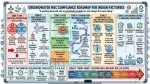
Post-Grant Environmental Compliance Failures in India | EHSSaral Research

Post-Grant Environmental Compliance Failures in India | EHSSaral Research

Environmental Clearance Post-Grant Compliance Environmental Compliance India EC Conditions SPCB Compliance
Last updated:

22 Dec 2025

|
Read time: 20 min read

Beyond the Clearance: A Pattern Analysis of Post-Grant Compliance Failures in Indian Industrial Projects (2024–2025)


Author
Harshal T Gajare (Founder, EHSSaral, India)


Document Type
Industry Research Paper / Whitepaper

Version
Version 1.0 | December2025


Keywords
Environmental Clearance, Post-Grant Compliance, EC Conditions, SPCB, Institutional Memory, Environmental Governance, India


Executive Summary

Environmental Clearance (EC) is widely perceived as the final and most complex milestone in environmental compliance. For many project proponents, the granting of EC represents closure-an administrative hurdle crossed, a file approved, and a project ready to move forward.

This research demonstrates that this perception is fundamentally flawed.

Across industrial and infrastructure projects in India, the highest concentration of compliance failures occurs after Environmental Clearance is granted, during construction and operational phases. These failures are rarely the result of sudden pollution events or deliberate violations. Instead, they arise from systemic weaknesses in how long-term EC conditions are tracked, remembered, and executed over time.

Environmental Clearance letters impose dozens of “Specific Conditions” related to water use, land allocation, social commitments, monitoring frequency, waste handling, and emergency preparedness. While these conditions are clearly documented at the time of approval, most organisations lack a structured mechanism to manage them as ongoing obligations. As a result, compliance visibility declines sharply once the approval phase ends.

This research identifies a recurring post-grant compliance gap, characterised by:

  • Loss of institutional memory after consultant handover
  • Fragmentation between EC conditions and operational consents
  • Manual, person-dependent compliance tracking
  • Mismatch between reported data and digitally monitored systems

With the increasing digitisation of regulatory enforcement-through platforms such as Parivesh, SPCB consent portals, and OCEMS-regulators are now able to correlate historical approvals with real-time operational data. In this environment, traditional document-centric compliance models are no longer sufficient.

The findings of this study indicate that most EC-related enforcement actions originate not from exceedance of pollution limits, but from failure to fulfil long-term commitments embedded in the clearance itself. These failures often surface years later, particularly during Consent to Operate renewals, expansion applications, or third-party inspections.

The core conclusion of this research is simple but consequential:

Environmental Clearance is not a milestone.
It is a long-term operational contract that requires continuous, system-level compliance management.


1. Background and Regulatory Context

1.1 The Traditional View of Environmental Clearance

Historically, Environmental Clearance in India has been treated as a project approval exercise. Significant effort is invested in:

  • baseline environmental studies
  • impact assessments
  • public hearings
  • expert appraisal committee interactions

Once EC is granted, responsibility for compliance typically shifts from consultants to project execution teams. At this stage, environmental obligations are often reduced to:

  • a file stored in records
  • a periodic reporting requirement
  • a checklist for future renewals

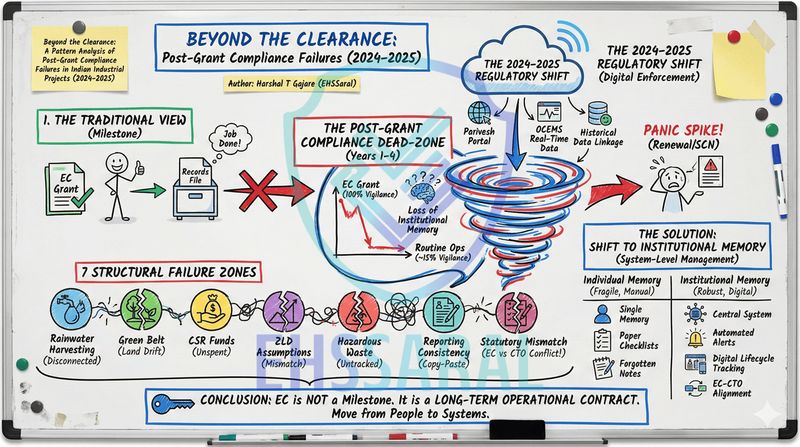
This transition marks the beginning of what this research terms the post-grant compliance dead-zone-a phase where awareness of EC conditions steadily declines while regulatory exposure continues to increase.


1.2 The 2024–2025 Regulatory Shift

Over the past few years, India’s environmental regulatory ecosystem has undergone a structural transformation. Key changes include:

  • Parivesh Portal Integration
    Environmental Clearances, amendments, and compliance submissions are now digitally archived and linked across project lifecycles.
  • Digitised SPCB Consent Systems
    Consents to Establish (CTE) and Consents to Operate (CTO) are increasingly evaluated against historical EC conditions.
  • OCEMS (Online Continuous Emission/Effluent Monitoring Systems) and Real-Time Monitoring
    Online Continuous Emission / Effluent Monitoring Systems have introduced real-time data validation, reducing reliance on manual reporting.
  • Historical Compliance Linkage
    During renewals and expansions, regulators increasingly review past EC compliance before granting fresh approvals.

These changes have shifted enforcement from reactive inspection-based models to predictive, data-correlated oversight. In this new paradigm, inconsistencies between commitments, reports, and actual operations are detected automatically-often before the organisation becomes aware of the gap.


1.3 The Emerging Compliance Risk

Despite this regulatory evolution, post-grant compliance management within most organisations remains largely unchanged.

Common characteristics include:

  • EC conditions remembered by individuals, not systems
  • No structured mapping between EC clauses and daily operations
  • No alert-based tracking of condition-specific timelines
  • Disconnection between EC assumptions and SPCB consent applications

This misalignment between digital enforcement and manual compliance management is the primary driver of post-grant failures identified in this study.


2. Scope of the Study

2.1 What This Research Covers

This research focuses exclusively on the post-grant phase of Environmental Clearance compliance, including:

  • Construction-stage obligations
  • Operational-stage EC conditions
  • Long-term “Specific Conditions” imposed under EC letters
  • Interactions between EC conditions and SPCB consent mechanisms

The analysis spans industrial and infrastructure projects that require Environmental Clearance under Indian regulations.


2.2 What This Research Does Not Cover

To maintain clarity and analytical focus, the following areas are intentionally excluded:

  • Delays or challenges in obtaining initial EC approval
  • Legal interpretation of EC clauses or litigation outcomes
  • State-wise comparative enforcement analysis
  • Statistical surveys of approval timelines

This study is not intended as a legal critique or a regulatory audit. It is a pattern-based analysis of operational compliance behaviour.


2.3 Intended Audience

This research is written for:

  • EHS professionals responsible for long-term compliance
  • SME promoters and plant heads overseeing operations
  • CFOs and project managers managing regulatory risk
  • Policymakers and regulators interested in systemic failure modes

The objective is not to assign blame, but to explain why failures occur repeatedly despite technical competence and regulatory intent.


Data Sources · Transparency · Research Methodology · Analytical Framework


3. Data Sources and Transparency Statement

Credibility in compliance research depends not only on insight, but on clarity of data provenance. This study has been deliberately structured to rely on verifiable, experience-backed, and regulator-safe sources.

3.1 Primary Sources (Practice-Derived)

The following primary materials informed the analysis:

  • Environmental Clearance (EC) letters and annexed conditions
  • Six-monthly and annual EC compliance reports
  • Site inspection observations recorded during regulatory visits
  • Show Cause Notices (SCNs) issued for EC-related non-compliance
  • Bank Guarantee (BG) clauses linked to EC and consent conditions
  • Project-level compliance documentation reviewed during operational and expansion phases

These sources represent real-world compliance artefacts that form the operational reality of EC implementation.


3.2 Secondary and Public-Domain Sources

To contextualise field observations within the regulatory framework, the following public-domain sources were referenced:

  • MoEF&CC Environmental Clearance templates and guidance notes
  • Parivesh portal workflows and compliance submission formats
  • CPCB and SPCB consent application and reporting formats
  • OCEMS guidelines and data reporting requirements
  • Publicly accessible EC compliance disclosures

3.3 Transparency and Ethical Use Statement

This research does not rely on confidential government databases, unpublished regulatory information, or privileged enforcement data.

All observations are derived from publicly accessible documents and professional field experience accumulated through compliance advisory and operational engagement.

This transparency is intentional and ensures that the findings are defensible, replicable in principle, and suitable for public discourse.


4. Research Methodology

4.1 Why a Pattern-Analysis Approach Was Chosen

Post-grant EC compliance failures do not typically occur as isolated events. Instead, they emerge as recurring patterns across projects, industries, and geographies.

A conventional statistical survey was not suitable for this research because:

  • EC violations are underreported in public datasets
  • Enforcement outcomes vary widely by project stage
  • The most critical failures surface years after EC approval

Instead, this study adopts a qualitative pattern-analysis methodology, commonly used in:

  • operational risk analysis
  • compliance system audits
  • process failure investigations

This approach prioritises failure mechanisms over frequency counts.


4.2 Analytical Steps Followed

The research followed a four-step analytical process:

Step 1: Condition Deconstruction

EC letters were reviewed to identify recurring categories of “Specific Conditions,” including physical, operational, financial, and reporting obligations.

Step 2: Obligation Mapping

Each condition category was mapped against:

  • physical implementation requirements
  • monitoring and measurement expectations
  • reporting and verification mechanisms

Step 3: Failure Point Identification

Observed non-compliances were analysed to identify where and why breakdowns occurred within the lifecycle of each condition.

Step 4: Pattern Consolidation

Repeated failure modes were grouped into structural risk zones, forming the basis of the classification framework presented in Part 3.


4.3 What This Methodology Reveals (and What It Does Not)

This methodology is designed to reveal:

  • systemic weaknesses in post-grant compliance
  • common organisational blind spots
  • misalignment between regulatory expectations and operational practice

It does not claim to:

  • quantify national violation rates
  • rank states or regulators
  • predict enforcement outcomes statistically

The value of this approach lies in explanatory power, not numerical precision.


5. The Analytical Lens: Compliance as a Lifecycle, Not a Checklist

A central premise of this research is that Environmental Clearance conditions operate over time, not at a single approval moment.

5.1 The Lifecycle View

Each EC condition progresses through distinct phases:

  1. Commitment at approval
  2. Translation into design and construction
  3. Integration into operations
  4. Monitoring and reporting
  5. Verification during renewal or expansion

Failures typically occur between phases, not at the point of commitment.


5.2 Institutional Memory vs Individual Memory

A recurring theme across projects is the reliance on individual memory:

  • a consultant who drafted the EC
  • an EHS manager who joined post-approval
  • a project engineer who understands site realities

When these individuals change roles or exit, condition awareness collapses.

This research distinguishes between:

  • Individual Memory: Compliance knowledge residing with people
  • Institutional Memory: Compliance knowledge embedded in systems, workflows, and alerts

The absence of institutional memory is a primary driver of post-grant failure.


6. Visualising the Post-Grant Compliance Gap

To conceptualise this phenomenon, the study introduces the Compliance Decay Curve.

Figure 1: The Compliance Decay Curve (Conceptual)

Post-grant environmental compliance decay curve showing decline in compliance vigilance after EC approval and spike during renewal or inspection by EHSSaral Research
  • Y-Axis: Compliance Awareness
  • X-Axis: Project Timeline

The curve shows:

  • a peak at EC grant
  • a sharp decline during construction
  • a prolonged low during routine operations
  • a sudden spike during renewal, inspection, or expansion

This “dead-zone” between approval and review is where most EC condition failures originate.


7. Structural Failure Zones: Where Post-Grant Compliance Breaks Down

The central finding of this research is that post-grant EC failures are not random.
They cluster consistently around a small number of structural failure zones.

These zones represent points of friction between regulatory intent and operational reality-areas where commitments are made once, but must be remembered, executed, and verified over many years.

Each failure zone below follows a predictable sequence:

  1. Clear commitment at EC stage
  2. Weak translation into execution
  3. Gradual erosion of awareness
  4. Sudden exposure during inspection, renewal, or expansion

7.1 Rainwater Harvesting & Groundwater Commitments

Typical EC Condition

“Rainwater harvesting structures shall be implemented as per CGWB guidelines and maintained.”

Failure Pattern

  • RWH shown in layout drawings but not constructed
  • Structures built but disconnected from roof drains
  • Pits choked with silt and never desilted
  • RWH structures misused as wastewater soak pits

Why This Fails Structurally

  • Considered a one-time civil item, not an operational system
  • No maintenance schedule defined
  • No monitoring or documentation requirement internally assigned

How It Gets Detected

  • Physical site inspections
  • CGWB coordination during groundwater permission reviews
  • Photographic verification requests

Risk Outcome

  • EC compliance marked “Not Complied / Partially Complied”
  • Direction for reconstruction and resubmission
  • Knock-on impact on water permissions and expansions

7.2 Green Belt Development & Land-Use Drift

Typical EC Condition

“A green belt covering a minimum of 33% of the project area shall be developed and maintained.”

Failure Pattern

  • Green belt percentage calculated using lawns and internal roads
  • Temporary plantation for compliance photographs
  • High sapling mortality with no replacement
  • Green belt land later repurposed for storage or utilities

Structural Weakness

  • Green belt treated as a static drawing, not a living obligation
  • No periodic verification of survival rates
  • Expansion pressures gradually override original land use

Detection Trigger

  • Satellite imagery
  • Inspection during expansion EC appraisal
  • Discrepancies between approved layout and site reality

Risk Outcome

  • Show Cause Notices (SCNs)
  • Mandatory land-use recalculation
  • Rejection or delay of expansion approvals

7.3 CSR / CER Fund Commitments

Typical EC Condition

“Project Proponent shall allocate ₹X lakhs towards CSR/CER activities and submit annual compliance.”

Failure Pattern

  • Funds allocated but not disbursed
  • Expenditure without documentation
  • Activities not aligned with approved CER plan
  • Absence of beneficiary or location records

Structural Weakness

  • CSR treated as a finance-year obligation, not an EC condition
  • No integration between finance teams and compliance tracking
  • Poor documentation discipline

Detection Trigger

  • Compliance report scrutiny
  • District-level cross-verification
  • NGO or community complaints

Risk Outcome

  • EC compliance marked “Partially Complied”
  • Increased scrutiny during amendments
  • Reputational and political exposure

7.4 Water Consumption Limits & ZLD Assumptions

Typical EC Condition

“Total water consumption shall not exceed X KLD. No untreated discharge outside premises.”

Failure Pattern

  • Borewell and tanker usage exceeds approved limits
  • STP/ETP capacity mismatch with actual load
  • Treated water diverted beyond approved reuse purposes
  • ZLD claimed but blowdown discharged informally

Structural Weakness

  • Water balance not revisited post-commissioning
  • No reconciliation between design assumptions and operational reality
  • Weak linkage between flow meters and reporting

Detection Trigger

  • OCEMS and flow meter data
  • SPCB inspection
  • Inconsistency between EC and CTO submissions

Risk Outcome

  • Immediate SCNs
  • Bank Guarantee invocation
  • CTO renewal complications

7.5 Hazardous Waste & Sludge Management

Typical EC Condition

“Hazardous waste shall be stored and disposed of as per Hazardous Waste Management Rules.”

Failure Pattern

  • Storage beyond permitted duration
  • Impervious flooring missing or damaged
  • Waste category mismatch with authorisation
  • Incomplete or duplicated manifests

Structural Weakness

  • Treated as routine housekeeping
  • Delegated to junior staff without oversight
  • No alert-based tracking of storage timelines

Detection Trigger

  • Routine SPCB inspections
  • Manifest audits
  • Cross-checks with TSDF records

Risk Outcome

  • Authorisation suspension
  • Penalties and directions
  • Escalation in repeat inspections

7.6 Environmental Monitoring & Reporting Consistency

Typical EC Condition

“Six-monthly compliance reports shall be submitted to MoEF&CC / SPCB.”

Failure Pattern

  • Copy-paste of historical data
  • Missing parameters or frequencies
  • Late submissions
  • Manual reports contradict OCEMS data

Structural Weakness

  • Reporting viewed as clerical work
  • No internal validation before submission
  • Lack of data cross-checking

Detection Trigger

  • Portal-level flags
  • Data inconsistency reviews
  • Trend analysis by regulators

Risk Outcome

  • Compliance reports rejected
  • Increased monitoring frequency
  • Heightened scrutiny

7.7 Statutory Mismatch: EC vs SPCB Consent Conditions

(The Most Critical Failure Zone)

Nature of the Failure

  • EC mandates ZLD; CTO application reflects septic disposal
  • EC allows limited fuel use; CTO application expands scope
  • Production capacity under CTO exceeds EC assumptions

Why This Is Structurally Dangerous

  • EC and CTO are governed by different authorities, but evaluated together
  • Many organisations treat them as independent approvals
  • Application formats do not automatically enforce consistency

How It Gets Detected

  • During CTO renewal or expansion EC
  • During integrated portal review
  • Through historical data reconciliation

Risk Outcome

  • Expansion EC rejection
  • Stop-work directions
  • Legal exposure

This statutory mismatch represents the highest-impact, lowest-awareness compliance risk identified in this research.


7.8 Emergency Preparedness & Disaster Management Commitments

Typical EC Condition

“On-site emergency management plan shall be prepared and implemented.”

Failure Pattern

  • Plans exist only on paper
  • No mock drills conducted
  • No training or attendance records
  • No coordination with district authorities

Structural Weakness

  • Emergency planning treated as a formality
  • No operational ownership
  • No periodic review

Detection Trigger

  • Post-incident investigations
  • High-risk industry inspections

Risk Outcome

  • Severe regulatory action
  • Criminal liability in accident cases

Synthesis: What These Failure Zones Reveal

Across all zones, a common pattern emerges:

  • Commitments are clear
  • Execution is fragmented
  • Memory decays over time
  • Detection is sudden and consequential

More than 90% of post-grant EC violations observed in practice are failures of institutional memory, not environmental intent.


8. Quantifying the Non-Compliance Risk

Post-grant Environmental Clearance (EC) failures are often underestimated because they are perceived as “environmental issues.” In reality, their consequences extend well beyond compliance departments and directly affect capital, timelines, and organisational credibility.

8.1 Direct Financial Exposure

The most immediate financial impacts observed include:

  • Bank Guarantee (BG) Forfeiture
    Missed EC milestones, delayed compliance reporting, or condition violations frequently result in partial or full invocation of BGs. These funds are not merely penalties-they represent capital tied up for extended periods.
  • Retrofit and Re-engineering Costs
    Non-compliance discovered late often requires:
    • redesign of water systems
    • reallocation of land for green belt development
    • augmentation of ETP/STP capacity
      Costs are significantly higher than if implemented during original construction.
  • Escalating Compliance Costs
    Once flagged, projects face:
    • increased inspection frequency
    • additional monitoring requirements
    • higher documentation burden

8.2 Opportunity Cost of Capital

A less visible but equally damaging impact is the opportunity cost of capital:

  • BGs remain locked due to delayed verification
  • Expansion approvals are stalled pending historical compliance clarification
  • Lenders and investors delay disbursements due to unresolved regulatory risk

For SMEs, these delays can disrupt:

  • cash-flow planning
  • capacity utilisation
  • market commitments

In this context, post-grant compliance failure becomes a capital efficiency issue, not merely a regulatory one.


8.3 Project Timeline and Strategic Risk

One of the most consistent observations is that EC non-compliance surfaces at the worst possible time-during expansion or renewal.

Typical consequences include:

  • suspension of construction activity
  • re-appraisal requirements
  • stop-work directions until historical compliance is demonstrated

At this stage, corrective action is:

  • time-sensitive
  • capital-intensive
  • reputation-critical

9. Discussion: Institutional Memory vs Individual Memory

9.1 The Core Structural Insight

Across all failure zones, a single underlying cause dominates:

Compliance knowledge is stored in people, not systems.

Most organisations rely on:

  • consultants during EC acquisition
  • individual EHS managers post-approval
  • informal handovers during personnel changes

This creates a fragile compliance model based on individual memory.


9.2 Individual Memory (Observed State)

Characteristics:

  • EC conditions remembered selectively
  • Knowledge lost during role changes
  • Compliance dependent on experience, not structure
  • High vulnerability during audits and expansions

9.3 Institutional Memory (Required State)

Characteristics:

  • EC conditions treated as long-term obligations
  • Condition-wise lifecycle tracking
  • Alert-based compliance reminders
  • Alignment between EC, CTO, and operational data

This shift from individual memory to institutional memory is essential in a regulatory environment that is increasingly digital, historical, and data-correlated.


9.4 Why Traditional Compliance Models Are Failing

Traditional approaches emphasise:

  • document storage
  • periodic reporting
  • manual follow-ups

However, regulators now operate with:

  • digital archives
  • cross-linked approvals
  • real-time monitoring data

This asymmetry explains why organisations are often unaware of non-compliance until formal action is initiated.


10. Limitations of the Study

This research is intentionally bounded and transparent in its scope.

  • It is not a statistical census of EC violations
  • Findings are based on pattern analysis, not probability modelling
  • Enforcement practices may vary by state and sector
  • Observations are derived from professional experience and public-domain sources

Despite these limitations, the consistency of observed patterns across projects suggests strong explanatory relevance.


11. Conclusion

Environmental Clearance is frequently treated as a milestone.
This research demonstrates that it is, in reality, a long-term operational contract.

The majority of EC-related enforcement actions arise not from pollution incidents, but from:

  • forgotten commitments
  • fragmented compliance ownership
  • misalignment between approvals and operations

As India’s environmental regulatory systems become predictive and digitally integrated, manual and person-dependent compliance models are increasingly incompatible with enforcement reality.

The central conclusion of this research is clear:

Post-grant compliance failures are not failures of intent.
They are failures of institutional memory.

Organisations that recognise this shift-and respond by embedding compliance knowledge into systems rather than individuals-will be better positioned to manage regulatory risk, protect capital, and scale responsibly.


12. Forward Direction

This paper establishes a foundation for future work on:

  • condition-risk scoring frameworks
  • post-grant self-audit methodologies
  • digital compliance lifecycle systems
  • regulator-aligned compliance intelligence

It also reframes environmental compliance as a strategic, operational discipline, rather than an episodic administrative task.


Closing Note

The purpose of this research is not to critique regulators, consultants, or industry participants. It is to explain why well-intentioned projects repeatedly encounter the same failures-and how those failures can be structurally avoided.


This paper is intended for educational and analytical purposes. It does not constitute legal advice or regulatory interpretation. Readers are advised to consult relevant authorities or qualified professionals for project-specific compliance decisions.


References:

  1. Ministry of Environment, Forest and Climate Change (MoEF&CC). Environmental Clearance Guidelines and Standard Conditions.
  2. Parivesh Portal – Government of India. Environmental Clearance and Compliance Submission Framework.
  3. Central Pollution Control Board (CPCB). Online Continuous Emission Monitoring Systems (OCEMS) Guidelines.
  4. State Pollution Control Board Consent to Operate Application and Compliance Formats.
  5. Public-domain Environmental Clearance compliance reports submitted to MoEF&CC.
Harshal T Gajare

Harshal T Gajare

Founder, EHSSaral

Second-generation environmental professional simplifying EHS compliance for Indian manufacturers through practical, tech-enabled guidance.

Related Blogs

Common Hazardous Waste Mistakes in Indian Factories | EHSShala

Common Hazardous Waste Mistakes in Indian Factories | EHSShala

Environmental Monitoring Guide for Indian Factories: Air, Water & Noise | EHSShala

Environmental Monitoring Guide for Indian Factories: Air, Water & Noise | EHSShala

The Paper Shield: PF & ESIC Challans vs Real Compliance Risk | EHSSaral

The Paper Shield: PF & ESIC Challans vs Real Compliance Risk | EHSSaral

GRAP Stage IV Explained: What AQI 450+ Means for NCR Factories | EHSSaral

GRAP Stage IV Explained: What AQI 450+ Means for NCR Factories | EHSSaral

TSDF Process for Hazardous Waste: What Happens After Dispatch | EHSShala

TSDF Process for Hazardous Waste: What Happens After Dispatch | EHSShala

BRSR Core 2026: Why Compliance Automation Is Now Mandatory | EHSSaral

BRSR Core 2026: Why Compliance Automation Is Now Mandatory | EHSSaral

Hazardous Waste Management Rules (2016) – Practical Guide for Indian Factories | EHSShala

Hazardous Waste Management Rules (2016) – Practical Guide for Indian Factories | EHSShala

Environmental Compliance for Pharmaceutical Manufacturing in India | EHSSaral

Environmental Compliance for Pharmaceutical Manufacturing in India | EHSSaral

MPCB Consent Guide: CTE, CTO, Renewal, Fees & Conditions | EHSShala

MPCB Consent Guide: CTE, CTO, Renewal, Fees & Conditions | EHSShala

Hazardous Waste Classification in India: Inspector’s Guide (2025) | EHSShala

Hazardous Waste Classification in India: Inspector’s Guide (2025) | EHSShala