
Blog
Form V Data Collection: Monthly System for Factories
EHSSaral is an Environmental Compliance Intelligence Platform for Industries. Consent Intelligence • Alerts & Tasks • Incident Reporting • Form IV & V • Audit-Ready Records
See how EHSSaral works
15 Mar 2026
 EHSSaral v1.png)
A calm readiness guide for EHS officers, plant managers, and SME owners
In many Indian factories, confusion around new environmental compliance changes is rarely about the audit itself.
Most plants already know their processes.
They know their emissions points.
They know their waste streams.
The anxiety is coming from somewhere else.
It comes from losing control over “who audits us.”
It comes from not knowing how digital systems behave.
And most importantly, it comes from the fear of accidental non-compliance caused by silence, delay, or missed communication.
This article is not a portal manual.
We are not going to show screenshots of buttons that may still be under development or rolled out differently across states. That kind of guidance only makes sense once a system is live and visible.
Instead, this article explains what the EADA framework is designed to do - and what Indian factories should mentally and operationally prepare for before audit assignment becomes fully system-driven.
Think of this as readiness, not instructions.
EADA refers to the Environment Audit Designated Agency framework and portal mechanism that enables independent environmental auditors to be assigned through a system-driven process.
If you are hearing about EADA mainly through rumours, consultant messages, or half-explained EADA circulars, here is the simplest reset you need.
Environmental audits are shifting from relationship-driven to system-driven.
Earlier, the same consultant often:
helped prepare compliance,
managed filings,
and signed or arranged the audit.
Under the EADA framework, this role-mixing is intentionally broken.
Advisory and audit functions are separated by design.
The person who helps you comply cannot be the person who certifies your compliance.
Audit assignment is no longer based on familiarity or local coordination.
It is decided by a system - not by a regional officer and not by the factory.
If you want the regulatory context and history behind this shift, you can read our detailed EADA explainer separately.
This article assumes you already know the basics and focuses purely on operational readiness.
So that’s the regulatory shift: advisory ≠ audit.
But knowing the policy still doesn’t tell you how the system will behave day-to-day.
To understand what’s coming, we don’t need to guess EADA’s interface - we only need to observe how Indian compliance portals have behaved over the last decade.
To understand what is coming, we don’t need to speculate about EADA.
We just need to observe how Indian compliance portals have behaved over the last decade.
Whether it is consent management, environmental returns, or extended producer responsibility, most portals in India follow similar system logic.
A few patterns repeat almost everywhere.
Notifications are system-generated.
Nobody calls to say, “Please check the portal.”
The email is the communication.
Timelines are hard-coded.
If a window is seven days, the system does not care about holidays, site visits, or internal discussions.
At seven days and one minute, options often disable automatically.
Silence is treated as inaction.
In the old compliance culture, silence usually meant “we are discussing internally.”
In digital governance, silence is interpreted as “no response.”
Escalations are automated.
Triggers for flags, remarks, or notices are often system-based.
Human judgement usually comes after the trigger, not before.
This is not cruelty.
This is how digital governance works.
Digital systems do not wait for readiness.
They wait for action.
How compliance portals work in India
When audit assignment becomes portal-driven, factories will need to adjust expectations.
Random does not mean harassment.
It does not mean surprise inspections.
And it does not mean someone is looking to fail you.
It means something much simpler.
You will not choose the auditor.
The system will assign one based on predefined parameters like category, scale, and sector.
Communication will be formalised.
Most interactions will happen through:
the portal dashboard, and
the registered email ID.
The system will expect a response.
Not a discussion.
Not a negotiation.
Usually, the system logic reduces your choices to two clear actions:
acknowledge the assignment, or
flag a valid conflict.
This removal of “personal touch” feels uncomfortable to many factories.
But it exists to remove bias - and that also means it removes informal delays and adjustments.
This is workflow logic, not enforcement aggression.
This is a fair question.
Factories are used to working with known consultants. So when the system says it will assign an auditor, the first doubt is natural:
“Who is this person, and how do we know they are competent?”
Under the EADA framework, the assigned auditor is not meant to be just any outside person. The role is meant for a Registered Environment Auditor (REA) - a professional who meets defined qualification and certification requirements.
In simple terms, this means the person is expected to have:
a relevant technical background
environmental audit eligibility under the new system
personal accountability for what they sign
Some professionals may qualify through a certification exam. Senior professionals with long experience may be evaluated through a separate recognition route.
For your factory, the practical point is this:
the system is moving from familiar auditors to qualified and independent auditors
So the better question is no longer:
“Do we know this person personally?”
The better question is:
“Are our records ready for an independent person to verify them?”
If you want to understand the auditor qualification route in more detail, we will cover that separately in a dedicated guide.
This is one of the most under-discussed risks in Indian environmental compliance - and it has nothing to do with emissions, waste, or treatment plants.
In a large number of SMEs, the email ID and mobile number linked to government portals do not belong to the factory.
They belong to a third-party consultant.
This arrangement evolved for convenience:
the consultant handled filings,
OTPs went to them,
dashboards were rarely checked unless something went wrong.
For years, this worked.
In a system with time-bound workflows, it becomes dangerous.
Here is the typical scenario many factories will face once audit assignment becomes portal-driven:
The system assigns an auditor.
An automated notification email is generated.
That email goes to a generic consultant inbox.
The consultant is travelling, busy, or assumes the factory already knows.
Days pass.
The acceptance window lapses.
The system does not know your intent.
It only sees no response.
At that point, the factory is already on the defensive - before the audit even begins.
This is why one preparation step is non-negotiable:
The primary email ID and phone number linked to compliance portals must be controlled by the factory.
Consultants can and should assist.
But they must not be the only access point.
Many future “non-compliances” will not be caused by violations.
They will be caused by missed emails.
Once audit assignment becomes system-driven, factories will see simple choices that carry psychological weight.
Words like Accept and Reject trigger unnecessary fear.
It helps to understand what these actions actually mean - without thinking about buttons or screens.
Accepting an assigned auditor means:
you acknowledge the system’s assignment,
you are ready to engage in scheduling and verification,
you are opening the process.
It does not mean:
you are declaring perfect compliance, or
you are certifying that every logbook is flawless.
Acceptance is procedural, not confessional.
Rejecting an assigned auditor, when allowed, is often misunderstood.
Rejection is not defiance.
It is not refusal of the audit.
It is a declaration of conflict of interest.
A useful way to think about it is this:
Reject is closer to recusal than refusal.
If an auditor has previously helped prepare your compliance, or has a financial or professional dependency, accepting them can create bigger problems later.
If such a conflict is discovered after the audit, the entire process can be questioned - and the factory may be accused of collusion even if there was no bad intent.
Proper rejection, done calmly and factually, actually protects the factory.
Factories should not wait for a portal notification to start thinking about conflicts.
This thinking needs to happen before the system clock starts.
Some relationships are likely to be considered conflicts in any independent audit framework:
the auditor previously prepared your Consent to Operate or Environmental Clearance,
the auditor drafted or submitted your Environmental Statement (Form V) or compliance returns,
the auditor operates, supervises, or advises on your ETP, STP, or APCD,
the auditor has an ongoing retainership or financial dependency,
the auditor works for a direct competitor, group company, or sister concern.
These are not moral judgments.
They are structural conflicts.
Equally important is understanding what is not a conflict:
the auditor is strict,
the auditor is unfamiliar,
the auditor is from another city or state,
the auditor asks for detailed records upfront.
Discomfort is not conflict.
Dependency is.
Many factories will realise something uncomfortable while reading this:
your ETP consultant also files your returns, or the same advisor has been arranging audits for years.
If this is you, don’t panic and don’t hide it. Use this transition period to separate roles cleanly.
The system is usually less concerned with old arrangements than with your current compliance posture and documented role boundaries.
Factories that clearly map these relationships now will make faster, calmer decisions later.
You do not need to wait for any portal notification to start preparing.
If you can answer “Yes” to the questions below, your factory is already ahead of most units.
CRITICAL (Fix This Week)
Portal control: Do we control the primary email ID and mobile number linked to compliance portals - not just our consultant?
Role separation: Have we clearly separated who advises us on compliance and who audits or verifies us?
IMPORTANT (Fix This Month)
Monitoring discipline: Do we check compliance portals regularly, even when there are no alerts or notices?
Conflict awareness: Can we quickly recognise whether an assigned auditor has worked with us earlier in any advisory role?
FOUNDATIONAL (Ongoing Discipline)
Record discipline: Are logbooks and records maintained routinely, rather than filled or corrected only before visits?
If the answer to any of these is No, fix it now.
None of these steps require regulatory approval.
They only require internal clarity.
This preparation removes panic later.
Whenever a new compliance portal or workflow is introduced in India, a few mistakes repeat almost every time.
Waiting for consultants to act
“I thought my consultant would tell me.”
The consultant thought the factory already knew.
Assuming ‘no action’ is safe
In digital systems, doing nothing is not neutral.
It is recorded as a negative action.
Delaying response for ‘perfect data’
Many managers wait to organise files or correct gaps before responding.
They run out of time.
Accept first. Organise next. (Acceptance usually triggers a scheduling step, giving you a natural buffer. Inaction triggers a flag immediately.)
Over-explaining instead of documenting
Writing long justifications in comment boxes instead of short, factual statements rarely helps.
Digital systems respond to actions - not explanations.
If you are the person who actually sees the portal message first, remember this.
You are not expected to design the system.
You are not expected to change plant layouts or approve budgets.
But you are expected to understand system behaviour well enough to protect your factory from procedural failures that look like non-compliance.
If you see an auditor assignment or system notification:
inform your management immediately,
document that you informed them,
keep records of dates and communication.
Early escalation is protection, not weakness.
In digital compliance systems, silence is never neutral.
Preparation today prevents panic tomorrow.
When the EADA portal becomes fully operational, acceptance timelines and workflows will become visible. At that stage, a step-by-step walkthrough becomes necessary.
Until then, factories that follow the readiness checklist above will be prepared regardless of how the interface looks.
Factories that understand systems early rarely struggle when enforcement becomes automated.
Quick check: Is your factory’s portal email ID actually yours? Check it today.
EADA random audit assignment means environmental auditors are assigned through a system-driven process, not selected by the factory or consultant.
The intent is to separate advisory work from audit verification, similar to financial audits.
No.
EADA implementation is expected to be phased, starting with higher-risk categories and selected states or sectors. For some time, state-level audit systems and EADA may run in parallel.
Factories should treat this as a transition period, not a sudden switch.
Yes.
Consultants remain important for advisory, preparation, and gap-fixing work.
What changes is this:
the person who helps you comply cannot be the person who certifies your compliance
This is role clarity, not consultant elimination.
In digital compliance systems, silence is treated as inaction.
Most portals are designed so that:
non-response within the allowed window can trigger
system remarks, flags, or escalation
This is why monitoring portal emails and dashboards becomes critical.
No - if the rejection is for a valid conflict of interest.
Rejecting an auditor is closer to recusal, not refusal.
It is meant to protect the credibility of the audit process.
Blank rejection or rejection without clear reason, however, can raise questions.
Common examples include:
the auditor previously prepared your Consent or returns
the auditor operates or supervises your ETP/STP/APCD
an ongoing financial or retainership relationship
work with a direct competitor or group company
Being strict, unfamiliar, or from another city is not a conflict.
In time-bound systems, yes - it becomes risky.
If notifications or OTPs go only to consultants:
delays can happen without the factory’s knowledge
acceptance windows can lapse unintentionally
Best practice is for the factory to control the primary login, with consultants assisting as secondary users.
No.
Acceptance usually starts a process, not an immediate inspection.
Waiting for “perfect data” often leads to missed deadlines.
In digital systems:
accepting on time is safer than waiting silently
records can be organised during the scheduling phase
Don’t panic.
Many factories operated this way under earlier systems.
Use the transition period to:
separate roles clearly
document the change
align with the new framework going forward
Systems usually focus more on current posture than legacy arrangements.
A walkthrough becomes necessary after:
the EADA portal is fully operational, and
real acceptance/rejection workflows are visible.
Until then, understanding system behaviour and readiness principles is more valuable than memorising buttons.

Founder, EHSSaral
Founder - EHSSaral | Partner - Perfect Pollucon | ISO 14001 Lead Auditor | GHG Protocol Scope 2 | Chemist | Data Scientist | Second-generation environmental professional simplifying EHS compliance for Indian industries through practical, automated, tech-enabled, data driven compliance workflows.
Form V Data Collection: Monthly System for Factories
Form 3 Logbook Explained: Simple Guide for Indian Factories | EHSShala

Evolution of EHS in India - (Part 2) Post-Bhopal | EHSShala
ESG Data Management for Indian Factories | EHSSaral
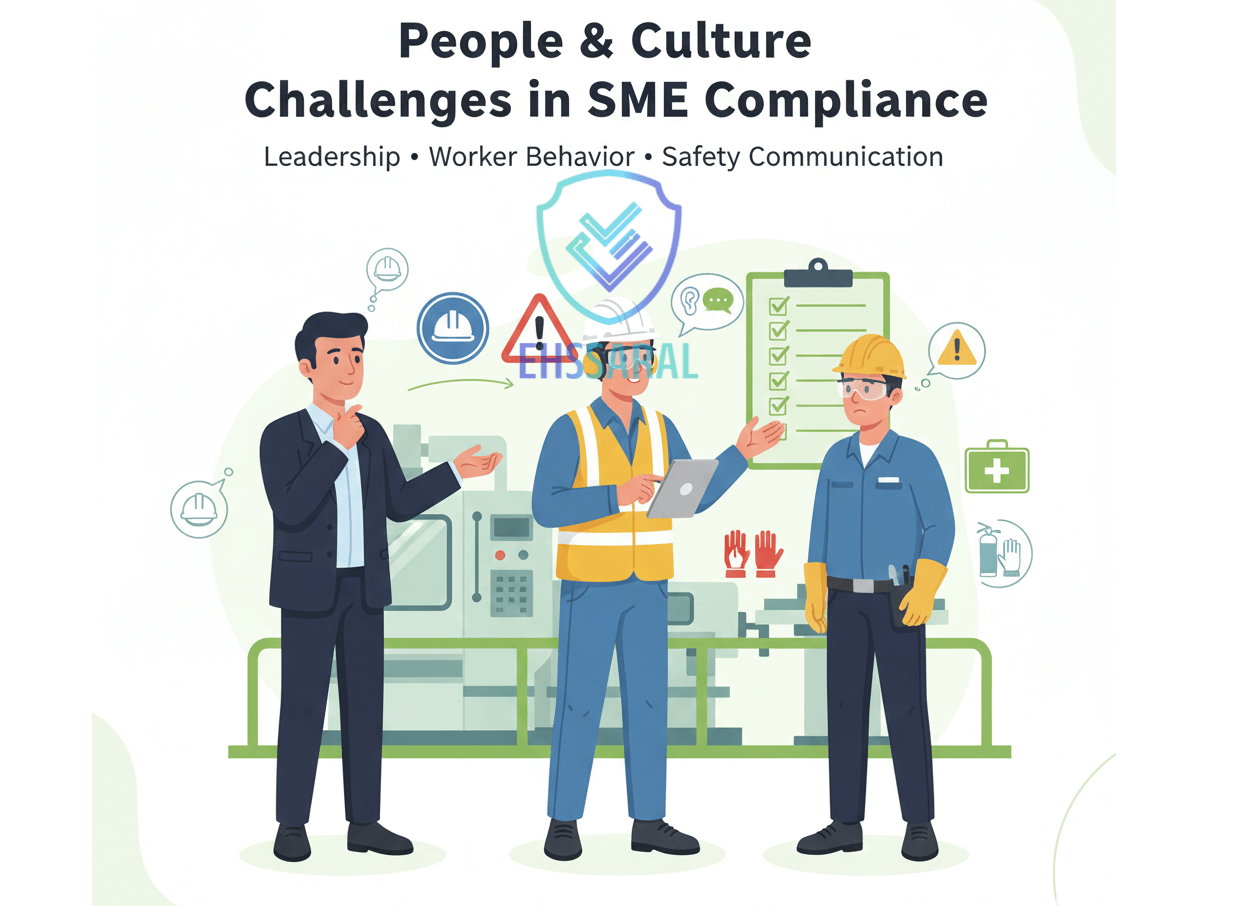
Why Safety Culture Fails in Indian SMEs: People & Compliance Challenges | EHSSaral Research

Environmental Compliance Management in India: Systems vs Consultants Explained

Consent to Operate (CTO) Explained for Indian Factories | EHSShala

Form V Environmental Statement: Due Date, Format, Example & Guide

Environmental Incident Response Guide for Indian EHS Professionals | EHSShala

The Digital Compliance Cliff: EPR Traceability Challenges for Indian MSMEs | EHSSaral Research