
EHSShala
Hazardous Waste Storage Rules in Indian Factories | EHSShala
EHSSaral is an Environmental Compliance Intelligence Platform for Industries. Consent Intelligence • Alerts & Tasks • Incident Reporting • Form IV & V • Audit-Ready Records
See how EHSSaral works
8 Aug 2026
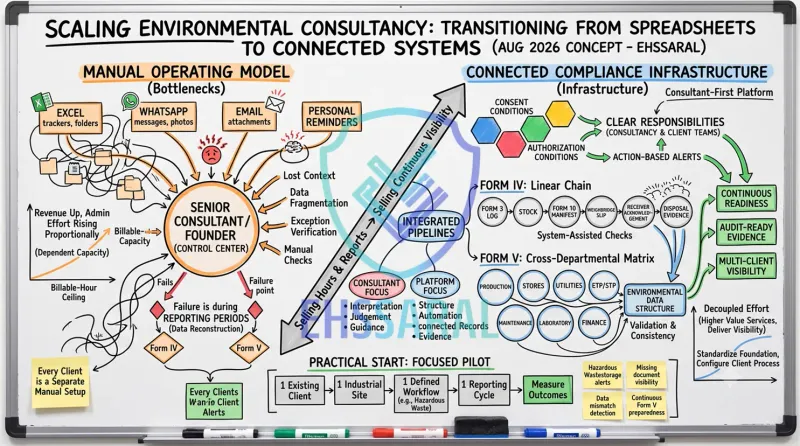
Environmental consultancies often reach a growth ceiling when every new client creates another spreadsheet, WhatsApp group and manual follow-up process. This practical guide explains how connected environmental consultancy software can improve multi-client visibility, Form IV and Form V readiness, delegation and service capacity—without replacing professional judgement.
Executive summary: Environmental consultancies rarely struggle to scale because they lack technical knowledge. The constraint is usually fragmented client data, manual follow-ups and dependence on senior consultants to reconstruct the current compliance position. Purpose-built environmental consultancy software can create a common operating structure beneath different client processes—without replacing the consultant’s interpretation, judgement or client relationship.
Environmental consultancies are built on technical knowledge, field experience and trusted relationships.
As the consultancy grows, however, an operational problem usually begins to appear.
The firm may have more clients, employees and assignments, but the owner or senior consultant still needs to personally check:
The consultancy has grown commercially, but its delivery capacity remains dependent on a few experienced people.
This raises an important question:
If every new client creates another spreadsheet, WhatsApp group, folder structure and set of manual reminders, has the consultancy truly scaled—or has it simply become busier?
Excel and WhatsApp are not the problem by themselves. Both are practical, familiar and flexible.
The difficulty begins when they are expected to function as the complete operating infrastructure for environmental compliance across multiple clients and sites.
Environmental consultancy software should help a firm increase delivery capacity without weakening professional control. It should connect requirements, responsibilities, records, evidence, follow-ups and reporting readiness while allowing consultants to retain control over interpretation and client delivery.
That is the real opportunity: not replacing environmental consultants, but helping their expertise operate consistently across more sites.
Form IV Hazardous Waste Automation Software for Industries & Environmental Consultants
A consultancy can increase revenue without developing a scalable delivery model.
During the initial stages, informal coordination often works well. The founder knows every client, remembers important dates and personally reviews most submissions.
A separate spreadsheet may be maintained for each site. Documents are exchanged by email. Immediate matters are followed up through WhatsApp. Reporting formats are created according to individual client requirements.
This model can be highly effective while the number of clients and sites remains manageable.
As the consultancy grows, however, the volume of coordination increases:
The team gradually spends more time searching for information, confirming status and consolidating trackers.
Experienced consultants become operational control centres. Routine activities may be delegated, but the knowledge required to coordinate them remains concentrated in a few people.
This creates a hidden scaling ceiling.
The consultancy can add employees, but each additional employee still requires supervision and access to the context held by senior consultants. It can add clients, but every client brings a new collection of trackers, reminders, formats and follow-up arrangements.
The business grows, but its underlying operating method remains largely unchanged.
More assignments increase workload. A repeatable delivery system increases capacity.
Most established environmental consultancies do not lack technical capability.
Their teams understand Consent to Establish and Consent to Operate conditions, environmental monitoring, hazardous-waste requirements, water and wastewater management, pollution-control systems, annual returns and State Pollution Control Board expectations.
The difficulty lies in converting this expertise into a repeatable delivery system.
An experienced consultant may know:
When this knowledge remains inside personal memory, individual spreadsheets, email threads or WhatsApp conversations, it becomes difficult to delegate and reproduce consistently.
Junior team members can collect documents and update data, but they may not know why a particular record matters, what it is connected to or what should happen when it is missing.
The senior consultant is then repeatedly asked to reconstruct the situation.
Professional review is valuable. Repeatedly recovering basic operational context is not the best use of senior expertise.
Expertise becomes scalable when it is translated into structured responsibilities, workflows, checks, records and decision points.
Software cannot replace regulatory interpretation or professional judgement. It can ensure that the actions arising from that judgement are assigned, followed up, documented and reviewed consistently.
Best Environmental Compliance Software in India (2026): A Practical SME Comparison - EHSSaral
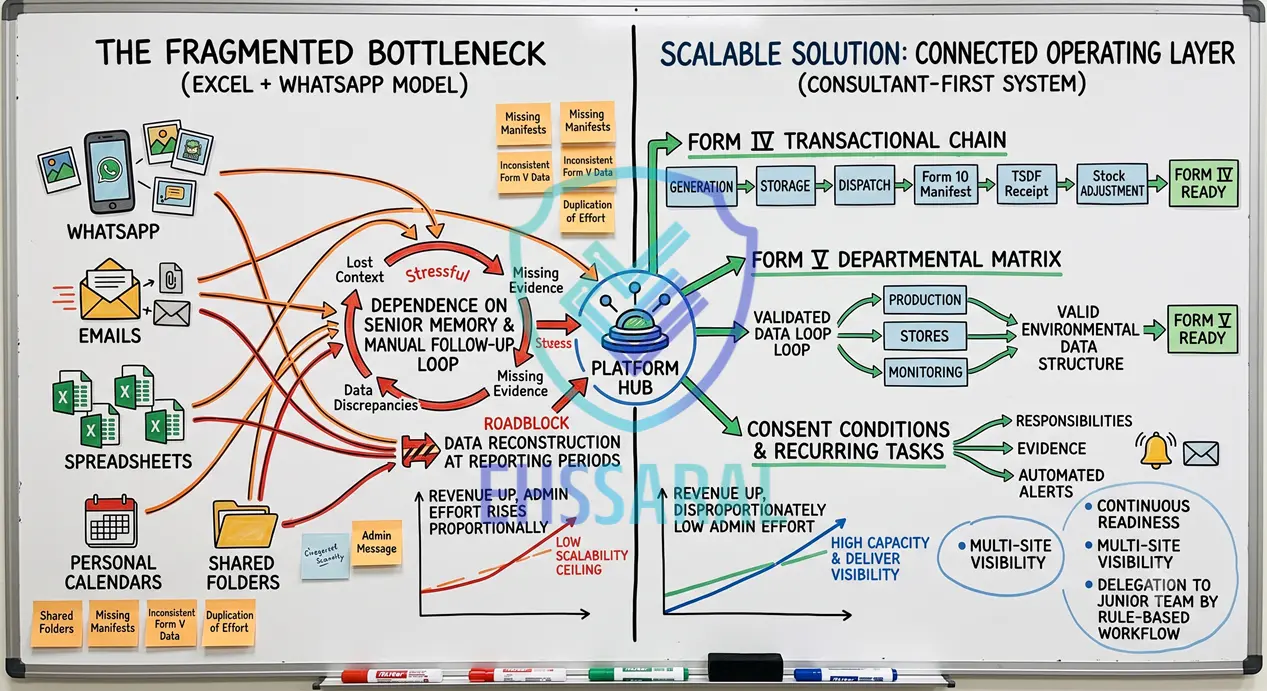
Excel remains one of the most useful tools available to environmental professionals.
It is transparent, flexible and easy to customise. Consultants can inspect every number, create client-specific formats and modify a calculation without depending on a software provider.
The limitation is not the capability of the user. It is the structure of the tool.
A spreadsheet can record that a task is due, but it does not automatically manage everything connected to that task:
Consider a spreadsheet row stating:
“Form IV due – 30 June.”
The deadline may be visible, but that row does not automatically establish whether:
A similar situation arises with Form V.
A row stating “Form V due” does not confirm whether:
The deadline may be tracked while the readiness behind the deadline remains unclear.
This is the practical difference between Excel environmental compliance tracking and a connected compliance system:
A tracker records information. A compliance system connects the requirement, underlying records, responsible people, evidence, review status and next required action.
Excel can remain useful for analysis and exceptional calculations. The challenge is expecting it to manage the complete operational lifecycle of compliance.
WhatsApp is extremely useful in day-to-day consultancy work.
Site teams can share photographs, ask questions, confirm visits and quickly inform consultants about operational developments. In many Indian plants, it is the fastest way to reach the concerned person.
But a WhatsApp message is not the same as a structured compliance record.
A message saying, “Report shared,” may not clarify:
Important information becomes difficult to locate when a group contains hundreds of messages, photographs, reminders and unrelated discussions.
A photograph may have been shared, but its connection to a specific consent condition may not be clear. A pending certificate may have been discussed, but there may be no defined owner or escalation date.
When an employee changes, the incoming person may receive files without understanding the reasoning behind earlier decisions.
WhatsApp helps people communicate. It does not reliably show the current compliance position of a client site.
The objective is not to stop using WhatsApp. It is to ensure that important actions, decisions and evidence also enter a system where their status can be tracked and retrieved.
Different clients use different formats, people, approval processes, reporting cycles and folder structures.
One client may send hazardous-waste information by email. Another may maintain a shared spreadsheet. A third may send photographs and figures through WhatsApp. A fourth may expect the consultant to maintain the entire record.
Some variation is unavoidable.
Industries differ by:
The problem arises when there is no common data structure beneath these variations.
Each new client then becomes a separate manual setup. The consultancy must repeatedly determine:
Over time, the consultancy is not managing one operating system. It is managing a different informal operating system for every client.
Junior team members may conduct monitoring, collect documents and update trackers. Yet exceptions and uncertainties continue to flow upward.
Senior consultants are repeatedly asked:
Some of these questions require professional judgement. Many require only clear records and visible ownership.
When senior consultants spend much of their time reconstructing status and chasing routine information, the consultancy loses capacity for:
The constraint is not the number of employees. It is the number of decisions and follow-ups that continue to depend on the senior consultant.
In many Indian plants, annual returns are still approached as end-of-period activities.
The consultancy begins collecting registers, manifests, invoices, certificates, production figures, water data and monitoring reports close to the submission period.
This is where gaps and mismatches become visible:
The consultancy then performs data recovery instead of data review.
Form IV and Form V become separate annual exercises, even though both depend on operational records generated throughout the year.
By the time a mismatch is found, the person who created the original record may not remember the reason. A vendor may have changed. A certificate may be difficult to recover. A meter reading may no longer be verifiable.
Continuous readiness is therefore not only about saving time near the due date. It also improves the reliability of the underlying information.
When every additional client requires separate trackers, reminders, status reports and manual follow-ups, administrative effort increases almost in proportion to revenue.
The consultancy may remain profitable, but expansion continues to depend on adding people and increasing senior oversight.
This creates a billable-hour ceiling.
The business earns largely through the availability of experienced professionals rather than through a repeatable service-delivery infrastructure.
None of these bottlenecks indicates a lack of expertise or commitment. They indicate that familiar tools have reached the edge of what they were designed to manage.
The consultancy’s challenge is not to standardise every client. It is to standardise the underlying way in which requirements, responsibilities, records and evidence are connected.
Form IV and Form V are both annual environmental returns, but their underlying data problems are different.
Form IV depends mainly on connected hazardous-waste transactions and stock records.
Form V depends on environmental data collected across multiple departments and operational systems.
| Area | Form IV | Form V |
|---|---|---|
| Basic data structure | Transaction- and stock-based compliance chain | Cross-departmental environmental data consolidation |
| Typical sources | Form 3, stock records, Form 10, weighbridge slips, receiver acknowledgements and disposal evidence | Production, stores, utilities, ETP/STP, maintenance, laboratories, finance and EHS |
| Main challenge | Broken transaction links and quantity mismatches | Fragmented sources, inconsistent units and missing reporting periods |
| Typical review | Reconcile generation, storage, dispatch, receipt and closing stock | Consolidate and compare production, materials, water, energy, pollution and waste data |
| Readiness approach | Complete and reconcile each transaction during the year | Collect and validate departmental data at a defined frequency |
| Year-end risk | Missing manifests, acknowledgements, certificates or stock adjustments | Missing monthly data, inconsistent definitions and unexplained variations |
Consider one hazardous-waste dispatch from an industrial site.
The site updates its Form 3 record. The waste remains part of site stock until dispatch. A Form 10 manifest is prepared. A transporter collects the material. A weighbridge quantity is generated. The TSDF or recycler receives and acknowledges it. Disposal or recycling evidence may follow later.
The complete chain may be represented as:
Form 3 record → Waste stock → Form 10 manifest → Weighbridge record → Receiver acknowledgement → Disposal evidence → Closing stock → Form IV
From an operational perspective, the waste may have left the site.
From a compliance perspective, the transaction may still require review.
The consultancy may need to verify:
If these records sit in separate spreadsheets, folders, emails and WhatsApp conversations, each document may appear complete individually while the overall transaction remains incomplete.
For example, the Form 10 may be available, but the corresponding acknowledgement may be pending. The disposal certificate may contain a different quantity. The dispatch may not have been deducted from the stock register.
These are not merely filing problems. They are breaks in the underlying compliance chain.
Environmental compliance is not a collection of independent entries. It is a chain of connected events, documents and decisions.
Form V creates a different challenge.
Its preparation may require information from:
The combined flow can be represented as:
Production + Raw materials + Water + Wastewater + Energy + Emissions + Waste + Pollution-prevention measures → Form V
The figures may exist, but they are often stored in different formats and managed by different people.
For example:
This creates a coordination and consistency problem.
At the time of preparation, the consultancy may find:
Form V therefore requires more than an annual data-collection exercise. It needs a defined environmental data structure that operates throughout the reporting period.
From a practical standpoint, Form IV readiness develops by closing connected waste transactions correctly. Form V readiness develops by collecting, validating and retaining cross-departmental data consistently.
Consultancies do not continue using Excel and WhatsApp simply because they resist technology.
They use these tools because they are:
Any new platform must earn enough trust to replace part of this working model.
Trust can be lost when software:
When this happens, the consultancy rarely abandons Excel.
Instead, it runs the software, spreadsheets and WhatsApp together. Employees maintain the same information in multiple places, and the technology intended to reduce work becomes another system to manage.
This is the parallel-system trap.
It creates:
A consultant-first platform should therefore reduce duplicate work from the beginning. It should provide transparency, traceability and configurable workflows.
Most importantly, users should be able to understand how an output was derived and trace it back to the source record.
If the consultancy must maintain a complete parallel spreadsheet indefinitely, the implementation has not yet solved the underlying operating problem.
Environmental compliance cannot be reduced to one rigid workflow for every industry.
Clients differ in their manufacturing processes, internal systems, state requirements, consent conditions, waste streams, approval hierarchies and reporting expectations.
The objective should not be to eliminate these differences.
The objective should be to create a common compliance foundation beneath them.
That foundation should consistently answer:
The visible workflow can then be configured around the client’s internal process without losing the underlying compliance structure.
For example, one client may require the EHS manager to approve every hazardous-waste dispatch. Another may assign approval to the plant head. A third may involve the consultant only during monthly review.
The approval sequence can differ. The underlying requirements—correct waste classification, authorized parties, complete documentation, stock adjustment and final evidence—remain connected.
This is the balance required for practical compliance management for consultants: common structure without artificial uniformity.
Purpose-built environmental consultancy software should strengthen the consultancy’s expertise and client relationship rather than attempting to replace either.
| Compliance area | Excel and WhatsApp model | Consultant-first operating system |
|---|---|---|
| Consent conditions | Manually interpreted and entered into trackers | Connected to tasks, owners, frequencies and evidence |
| Responsibilities | Communicated through calls and messages | Clearly assigned between consultancy and client teams |
| Follow-ups | Personal reminders and WhatsApp messages | Action-based reminders and escalation |
| Hazardous-waste records | Separate registers, manifests and certificates | Connected Form 3, stock, Form 10, acknowledgements and disposal records |
| Environmental data | Collected separately from different departments | Organised within a consistent site-level structure |
| Missing evidence | Commonly identified during periodic review | Visible while the action remains incomplete |
| Data reconciliation | Manually compared across files | System-assisted checks and mismatch identification |
| Form IV | Reconstructed near the filing period | Prepared from connected hazardous-waste records |
| Form V | Compiled from multiple departments at year-end | Prepared from structured environmental data maintained through the year |
| Client reporting | Status manually consolidated | Current client- and site-level visibility |
| Knowledge retention | Context remains with individuals | Decisions, reviews and action history remain connected |
| Client variations | Separate trackers for every process variation | Configurable workflows on a common foundation |
The platform should also:
Alerts should also reflect operational dependencies rather than only calendar dates.
For example, a useful alert may indicate:
This is more useful than generating reminders for every entry regardless of whether action is required.
EHSSaral is designed as a consultant-first environmental compliance operating system for Indian industries and the professionals who support them.
Its Form IV and Form V workflows are ready for use.
The Form IV workflow connects hazardous-waste records such as:
It helps consultants and site teams identify missing documents, incomplete transactions and quantity mismatches before the annual return is prepared.
Instead of treating Form IV as an isolated annual format, the workflow develops readiness from the records maintained during the year.
The Form V workflow organises the environmental information required for preparing the Environmental Statement, including:
This reduces the need to rebuild the reporting period from disconnected departmental files near the submission date.
Form IV and Form V do not operate in isolation.
Their underlying records can be connected with:
For environmental consultancies, this creates a structured operating layer across multiple clients and sites.
The consultant continues to provide:
EHSSaral supports the repeatable operating work:
No platform can independently resolve every interpretation of a consent condition or replace professional judgement in an unusual site situation.
Once the consultant determines the correct requirement and approach, however, the system can ensure that the resulting actions, records, follow-ups and evidence remain connected.
The purpose is not to make the consultant less important. It is to help the consultant’s expertise operate consistently across every client site.
EHSSaral may not be the right starting point for a consultancy looking only for document storage or occasional annual-return preparation.
It creates the most value when the consultancy and client are willing to maintain connected records and use the system throughout the reporting period.
If the objective is only to upload documents once a year without changing how responsibilities, follow-ups and records are managed, a simpler storage arrangement may be sufficient.
This distinction matters because software cannot create continuous compliance visibility from information that is never maintained during the year.
When routine status checking, evidence tracking and follow-up become structured, the consultancy can support more clients without increasing senior involvement at the same rate.
The system does not eliminate professional work. It reduces the administrative effort surrounding that work.
Junior team members can work through defined responsibilities and workflows.
Senior consultants can focus their review on exceptions, risks and technical decisions instead of repeatedly checking routine status.
This also helps new employees understand the current position without depending entirely on verbal handovers.
Clients can see what is completed, pending, overdue or awaiting evidence without waiting for a manually prepared monthly report.
This can improve confidence because the consultancy provides ongoing compliance visibility rather than only periodic documents.
A common operating structure reduces variation between employees, client sites and reporting periods.
Important actions become less dependent on one person remembering what should happen next.
The consultancy’s service quality is then supported by both professional expertise and a repeatable operating method.
Consultants can spend more time on:
These activities use professional expertise more effectively than repeated document chasing.
A consultancy can offer structured compliance-management services without developing and maintaining its own software platform.
The consultancy retains its client relationship and technical role while strengthening its service with connected records, alerts, reporting readiness and management visibility.
The consultancy can move beyond individual monitoring assignments, reports and annual filings.
It can provide ongoing packages covering:
This creates a more continuous relationship with the client.
The larger shift is from selling hours and reports to delivering continuous compliance visibility.
A consultancy does not need to transform every client process at once.
A controlled pilot can begin with:
Hazardous-waste management is often a suitable starting point because it connects daily records, stock, manifests, transporters, receiving facilities, acknowledgements, certificates and Form IV.
Form V can be an equally useful pilot where the consultancy repeatedly faces difficulty collecting environmental data from different departments.
The consultancy can evaluate:
A successful pilot should show that:
The purpose is not merely to test whether the software functions.
It is to determine whether the new operating model replaces manual work, improves delivery and allows the consultancy to support the client more consistently.
If a complete parallel spreadsheet system still needs to be maintained indefinitely, the implementation has not yet solved the underlying problem.
Environmental consultancies usually reach a scaling ceiling when:
Form IV and Form V create different data challenges:
The answer is not rigid standardisation or removal of professional judgement.
It is a configurable compliance infrastructure that connects requirements, people, actions, records and evidence while allowing consultants to retain control over interpretation and client delivery.
No. Excel remains useful for calculations, analysis and flexible data handling.
Its limitation appears when it is expected to manage responsibilities, dependencies, evidence, follow-ups, approvals and multi-client visibility as one integrated process.
Not necessarily. WhatsApp remains useful for quick coordination.
Important compliance actions, decisions and evidence should also be captured within a structured system where their status can be tracked and retrieved later.
No.
Software can structure records, workflows, alerts, evidence and reporting data. Regulatory interpretation, professional judgement, site understanding and client guidance continue to require experienced environmental professionals.
Yes, if it provides a common compliance structure while allowing responsibilities, approvals, workflows and evidence requirements to be configured for individual clients.
The objective should be consistency beneath the process—not identical processes for every client.
This commonly happens when software is introduced without replacing existing trackers.
Teams then maintain the platform, Excel and WhatsApp simultaneously, resulting in duplicate entry, inconsistent information and uncertainty about the correct source.
Form IV depends on records maintained throughout the year, including waste generation, stock, dispatch, Form 10 manifests, weighbridge records, receiver acknowledgements and disposal evidence.
Connecting these records allows missing documents, incomplete transactions and quantity mismatches to be identified before return preparation.
Form V depends on environmental data collected from several departments.
A connected system organises production, raw-material, water, wastewater, energy, emission, waste and environmental-performance information throughout the year, reducing the need for year-end data reconstruction.
Form IV is primarily transaction- and stock-based. Its main challenge is maintaining continuity between generation, storage, dispatch, acknowledgement, disposal and closing stock.
Form V is cross-departmental. Its main challenge is collecting consistent environmental data from several operational sources over the reporting period.
Hazardous-waste management is a practical option because it has clearly connected transactions and documents.
A consultancy can begin with one site and track Form 3 records, stock, Form 10 manifests, acknowledgements, disposal evidence and Form IV readiness.
Form V can also be selected where cross-departmental data collection is the main difficulty.
Useful indicators include:
Yes.
A consultant-first implementation should strengthen the consultancy’s delivery model. The consultant remains the technical advisor and primary client partner, while the platform supports the underlying records, workflows and visibility.
No.
Its main value comes from maintaining connected records throughout the year so that Form IV and Form V preparation becomes the output of an ongoing process rather than a year-end data-recovery exercise.
It may provide less value where the requirement is limited to occasional document collection or one-time return preparation.
It is better suited to consultancies and industries seeking continuous records, follow-ups, evidence management and reporting readiness.
Environmental consultancies have built their businesses through technical knowledge, field experience and trusted relationships.
Excel and WhatsApp have supported that growth and will continue to remain useful. They were not, however, designed to carry the complete operational burden of environmental compliance across multiple clients and sites.
The next stage is not about replacing experienced people with software.
It is about giving those professionals a structured system through which their knowledge can be applied consistently.
EHSSaral provides this operating layer through connected compliance requirements, responsibilities, environmental records, evidence, alerts and ready-to-use Form IV and Form V workflows—while keeping the consultant’s judgement at the centre of delivery.
Consultancies can begin with one client, one site and one workflow, and assess the improvement through actual delivery outcomes.
When expertise is supported by connected data and clear workflows, a consultancy can grow without allowing every new client to create another layer of administrative complexity.
Good environmental compliance still depends on professional understanding. The right infrastructure helps that understanding travel further.

Founder, EHSSaral
Founder - EHSSaral | Partner - Perfect Pollucon | ISO 14001 Lead Auditor | GHG Protocol Scope 2 | Chemist | Data Scientist | Second-generation environmental professional simplifying EHS compliance for Indian industries through practical, automated, tech-enabled, data driven compliance workflows.
Hazardous Waste Storage Rules in Indian Factories | EHSShala
CTO Auto-Renewal: Capital Investment Rules 10% & 30% | EHSSaral
Best Environmental Compliance Software in India (2026): A Practical SME Comparison | EHSSaral
Why Running Factories Are Getting Closure Notices in 2026 | EHSSaral
 List, Rules & Compliance Guide ehssaral.webp)
Orange Category Industries in India (2026): List, Rules & Compliance Guide
CPCB OCEMS Flatline Notice: How Industries Should Respond (Safely) | EHSSaral
 ehssaral.webp)
Hazardous Waste Form 4 Portal Errors (MPCB & GPCB Fix Guide)

Free Environmental Compliance Software in India: A Clear, Honest Answer | EHSSaral
Why Form IV Readiness Cannot Begin at the End of the Year
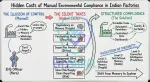
The Hidden Costs of Manual Environmental Compliance in India