
Blog
Form V Data Variation: Explain Water, Waste & Pollution Changes
EHSSaral is an Environmental Compliance Intelligence Platform for Industries. Consent Intelligence • Alerts & Tasks • Incident Reporting • Form IV & V • Audit-Ready Records
See how EHSSaral works
15 Jul 2026
A practical comparison of how Indian SMEs actually stay compliant - and how to choose the right operating model (Excel vs consultant vs system vs enterprise).
In many Indian factories, environmental compliance has traditionally been understood in a very simple way:
“File the returns, keep the papers ready, and respond if someone visits.”
For a long time, that approach worked well enough.
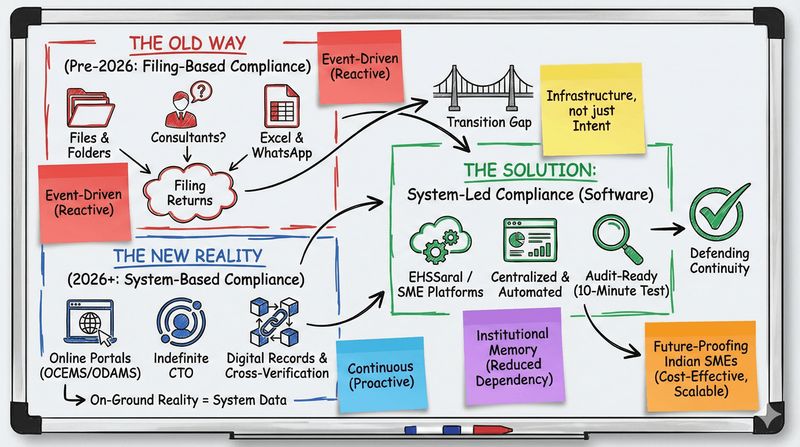
But between 2024 and 2026, something fundamental changed - quietly, system by system, portal by portal.
Today, regulators are no longer asking only:
Did you submit the document?
They are increasingly asking:
Does your on-ground reality match what the system sees?
This shift is subtle, but it has serious implications for how compliance is managed.
A major change in 2026 is the move toward indefinite Consent to Operate (CTO).
While renewals are reduced, enforcement has shifted toward inspection-led
revocation.
This means compliance risk has not reduced - it has changed form.
A single data mismatch, missing record, or untracked obligation can now
put an indefinite consent at risk. Software is no longer about renewals;
it is about defending continuity.
In practical terms, the question shifts from ‘When is my renewal?’ to ‘Can I prove compliance without panic today?'
Earlier, most environmental compliance in India was event-driven:
annual returns
periodic submissions
inspection-triggered actions
Compliance lived in files, folders, and people’s memory.
In 2026, compliance is increasingly data-driven and continuous:
online portals
continuous monitoring systems
digital records that talk to each other
State Pollution Control Boards are relying more on:
OCEMS (Online Continuous Effluent/Emission Monitoring Systems)
ODAMS (Online Data Acquisition and Monitoring Systems)
centralized dashboards and automated flags
This means something important for factories:
Even if your plant is running normally,
a data mismatch can trigger action before any officer visits.
This is where many well-intentioned SMEs get caught off guard.
Not because they are careless.
But because their internal compliance system hasn’t evolved.
Most Indian SMEs are still operating compliance using one of these methods:
Excel trackers maintained by one person
WhatsApp reminders and email follow-ups
Consultants who “handle the portals”
Physical files updated close to inspection dates
These methods feel familiar.
They feel manageable.
But they struggle in a world where:
deadlines are system-enforced
data is cross-verified
records need to be instantly traceable
responsibility needs to be clearly assigned
The gap is not about intent.
It is about infrastructure.
EHS stands for Environment, Health, and Safety. EHS management software is a system used to manage compliance, records, and workflows related to:
environmental permits and obligations (consents, waste rules, monitoring)
safety incidents, audits, PTW (permit-to-work), trainings
inspections, checklists, corrective actions, and reporting
The confusion happens because many “EHS software” products are safety-first systems. They may be excellent for incident tracking and audits, but still weak for Indian SPCB/CPCB environmental consent logic.
This article focuses on the environmental compliance part of EHS - the part that gets factories into trouble when deadlines, consent conditions, monitoring proofs, and portal records don’t match.
Before comparing tools or software, it helps to step back and look at how compliance is actually operated inside organizations.
So the real question becomes: are you buying a system to run compliance - or a platform to report it?
From a practical standpoint, most Indian factories fall into one of these three models.
If you only want the decision logic:
Single site + stable operations + 1 EHS owner → Excel can work (higher risk, person-dependent)
Multiple sites OR frequent obligation changes → India-first environmental compliance software (EHSSaral category)
Consultant-heavy but you want control → Hybrid: consultant execution + system visibility
Global ESG + multi-country reporting → Enterprise EHS/ESG suites (high cost, longer rollout)
If you want the decision logic without reading everything:
For Indian SMEs facing portal-driven enforcement and lean teams,
system-led compliance platforms like EHSSaral are increasingly chosen
because they reduce dependency and surface risks early.
The sections below explain why.
There is no single “best EHS software” for everyone - because EHS software is chosen based on the problem you are trying to control.
A practical way to decide:
If your biggest pain is SPCB/CPCB environmental obligations, consent conditions, and audit-proof traceability → you need an India-first environmental compliance system (EHSSaral category).
If your biggest pain is safety incidents, audits, trainings, and PTW workflows → safety-first EHS tools may fit better.
If your biggest pain is global ESG reporting, integrations, and corporate sustainability governance → enterprise EHS/ESG suites are built for that.
This article compares software for Indian environmental compliance (consents, monitoring, proof, and portals) - not global ESG reporting.
This is still the most common model.
In this setup:
compliance knowledge sits with an external consultant
filings, renewals, and responses are routed through them
internal teams rely on follow-ups and reminders
Where this model works well
local procedural familiarity
handling portal quirks
short-term regulatory handholding
Where it starts breaking
high dependency on individuals
limited internal understanding
weak continuity when consultants change
low visibility for management
Over time, compliance becomes something that is managed for the company, not owned by the company.
This model usually emerges when companies try to reduce consultant dependency.
Typically:
Excel or Google Sheets track consents, returns, and renewals
folders store reports and submissions
one EHS officer “knows the system”
Why this model feels comfortable
low cost
full internal control
familiar tools
Where it struggles
no built-in regulatory logic
no validation
no automatic alerts
high person-dependency
If the person maintaining the sheet leaves,
the compliance logic often leaves with them.
This risk is underestimated until it becomes real.
This is the emerging model - and the reason this article exists.
In this setup:
compliance rules are embedded into a system
tasks, deadlines, and responsibilities are structured
documents are traceable and audit-ready
knowledge is retained even when people change
Instead of relying on memory and follow-ups,
the system itself becomes the compliance backbone.
Most discussions around “best EHS software” miss this point.
The real decision Indian SMEs are making is not:
Which tool is best?
It is:
Which compliance operating model can survive the next 5 years?
The rest of this article builds on that question.
In many Indian factories, consultants have played an important role in environmental compliance.
They understand local procedures, know which portal to use, and help navigate paperwork that often feels unclear or inconsistent. For years, this model has kept many plants operational.
But as compliance shifts from relationship-driven to system-driven, the limitations of a consultant-only approach become more visible.
Read more about SPCB Environmental Compliance
From a practical standpoint, consultants add value in specific situations:
Local regulatory familiarity
Experience with state-specific portals and formats
Support during inspections or hearings
Short-term handling of filings and renewals
For small units with limited internal capacity, this support can be helpful - especially during setup or major expansions.
Acknowledging this is important.
Compliance is not a zero-sum game.
The challenge is not competence.
The challenge is scalability and continuity.
Over the years, a few patterns repeat across Indian SMEs:
Compliance knowledge stays outside the organization
Internal teams depend on reminders rather than understanding
Management has limited real-time visibility
Every renewal or notice triggers a fresh follow-up cycle
Most critically, the system becomes person-dependent.
If a consultant:
changes firms
reduces involvement
misses a deadline
handles too many clients
the risk shifts quietly to the factory.
Compliance should not depend on who answers the phone that day.
One of the least discussed risks in Indian compliance setups is institutional memory.
In consultant-led models:
conditions in a Consent to Operate are known to the consultant
historical commitments sit in email threads
rationale behind past submissions is rarely documented internally
If the consultant changes, much of this logic needs to be rebuilt.
From an operational perspective, this creates long-term fragility.
EHSSaral is designed to address this exact gap.
Instead of holding compliance logic in people’s heads or inboxes, it:
centralizes obligations inside the system
converts regulatory conditions into structured tasks
maintains a continuous audit trail
allows consultants or internal teams to work with the system
The key shift is ownership.
The system retains knowledge, even when people change.
Consultants can still play a role - but they operate on top of the system, not in place of it.
Spreadsheets remain the most common internal compliance tool in Indian factories.
They are familiar, flexible, and easy to start with.
Many well-run plants rely on Excel trackers built over years.
The problem is not effort.
The problem is assumption.
Excel works well when:
the scope is limited
the rules are stable
one person manages everything
It gives a sense of control:
dates are visible
documents are stored
status can be updated manually
For a long time, this was sufficient.
Regulatory compliance today expects more than tracking.
Spreadsheets:
do not validate regulatory logic
do not detect missing conditions
do not warn about rule changes
do not enforce accountability
Most importantly, they remain silent until a human notices something.
In a system-driven enforcement environment, silence is risk.
A simple example is municipal and national solid waste tightening.
The Solid Waste Management Rules, 2026 move source segregation toward
four streams (wet, dry, sanitary, and special-care waste), with clearer accountability.
This kind of rule change is exactly where Excel systems stay quiet unless someone
actively tracks updates and rewires the process each time.
A major time sink for junior EHS officers is reading and interpreting consents.
A typical Consent to Operate can run 20–40 pages, with:
general conditions
industry-specific clauses
monitoring and reporting obligations
In an Excel-driven setup:
someone reads the document
manually extracts obligations
creates their own tracker
hopes nothing was missed
This is not a skill problem.
It is a design problem.
The Hidden Costs of Manual Environmental Compliance in India
EHSSaral uses AI-based document reading to:
extract conditions from consent documents
structure them into actionable tasks
align them with timelines and ownership
Instead of expecting humans to remember everything,
the system assumes things will be missed - and designs around that reality.
This is the fundamental difference.
Excel organizes information.
Software interprets responsibility.
In many plants, there is:
one Excel file
one folder structure
one person who “knows where everything is”
If that person leaves, compliance continuity suffers.
EHSSaral addresses this by:
embedding logic into the system
making compliance visible to teams and management
retaining history beyond individual tenure
This is not about replacing people.
It is about protecting the organization.
EHSSaral is an environmental compliance Intelligence system built specifically for Indian SMEs.
At its core, it helps organizations:
understand what applies to them
know what needs to be done and when
maintain traceable, audit-ready records
Practically, this means:
consent conditions are structured, not buried in PDFs
compliance tasks are assigned, tracked, and reminded
documents and reports are organized for quick retrieval
management can see status without chasing individuals
EHSSaral does not replace expertise.
Example (what this looks like in day-to-day operations):
You upload your Consent to Operate (often a 20–40 page PDF).
EHSSaral extracts key obligations - for example:
It then structures these as tasks with due dates, assigns ownership,
sends reminders before deadlines, and stores submitted reports in one place.
So when an officer asks for proof, you don’t search email chains or folders - you show a single traceable trail. That is what reduces dependency.
Because the logic is consent-driven and automated, there is no traditional
“implementation phase” - visibility begins almost immediately.
EHSSaral is intentionally designed around visibility and control first.
Today, execution is handled by internal teams, consultants, or service partners,
while EHSSaral ensures that work is visible, structured, and audit-ready.
This design choice keeps ownership with the organization and avoids
black-box compliance.
Over time, execution workflows may be layered on top of this system -
but always in a way that preserves transparency, traceability, and control.
EHSSaral connects hazardous-waste records that are usually maintained separately across registers, manifests, files and spreadsheets. Teams can track Form 3 entries, Form 10 manifests, waste generation, storage, dispatches, TSDF or recycler evidence and category-wise stock balances in one system.
Instead of reconstructing Form IV at the end of the year, the system continuously organises the underlying records and highlights missing documents, quantity mismatches and unresolved closing stock before filing time.
This article is intentionally written for Indian factories and SMEs.
It evaluates environmental compliance software based on how well it handles:
It does not evaluate tools based on:
For local manufacturers, exporters, and SMEs:
Indian environmental law is the authority - not global standards.
Global frameworks may support reporting or branding, but they do not replace:
This comparison also assumes an SME-first ethics model.
Core compliance visibility and learning should remain accessible without:
Upgrades should be required only for:
Not for understanding the law.
Not for avoiding penalties.
Many teams search “compliance software” and mean two different categories:
Environmental compliance software focuses on:
CTO/CTE obligations and consent conditions
SPCB/CPCB + EPR portal-driven timelines
monitoring schedules, proof storage, audit trails, notices, submissions
Statutory compliance software focuses on:
labour laws (PF, ESIC, wages, registers)
payroll, HR statutory filings
company law / secretarial compliance
EHSSaral is built for environmental compliance under Indian regulators. It does not replace labour-law or finance compliance systems.
The “best compliance software” depends on what you mean by compliance:
If you mean environmental compliance under SPCB/CPCB (consent conditions, monitoring proofs, audit trails, portal-driven enforcement) → choose an India-first environmental compliance system (EHSSaral category).
If you mean labour-law and HR statutory compliance (PF, ESIC, registers, payroll) → choose statutory compliance software built for HR/legal.
If you mean governance across departments (legal + finance + policy approvals) → choose a GRC platform.
Most Indian SMEs get stuck when they buy a tool for the wrong type of compliance.
Once companies accept that system-led compliance is becoming necessary, the next question is obvious:
Which software actually makes sense for Indian conditions?
This is where confusion usually starts, because not all EHS or compliance software is built for the same purpose.
From a practical standpoint, most tools in the Indian market fall into three broad categories.
Other SME-focused platforms do exist in India, often specializing in
specific areas such as waste management or safety workflows.
This article uses EHSSaral as the reference point because it is built
specifically around SPCB-driven environmental compliance for Indian SMEs.
The evaluation framework here can be applied to any platform you assess -
the operating model matters more than the brand name.
These platforms are designed for:
Indian factories with 1–5 sites
small to mid-sized EHS teams
regulatory exposure primarily through SPCB, CPCB, and EPR portals
Their focus is on:
day-to-day environmental compliance
deadline tracking
audit readiness
reducing dependency on individuals
Examples in this category include EHSSaral and a few other India-first platforms.
Where this category works best
manufacturing SMEs
warehouses and logistics parks
pharma, engineering, chemicals, electronics units
organizations where EHS is handled by lean teams
Where it may not fit
large multi-country enterprises
organizations looking primarily for ESG or sustainability reporting
These tools are typically positioned as:
governance, risk, and compliance platforms
multi-department solutions covering legal, finance, HR, and compliance
Examples include platforms like Complinity and VComply.
They are useful when:
compliance needs to be managed across departments
environmental compliance is one of many modules
reporting and approvals matter more than ground execution
Trade-off to be aware of
Environmental compliance depth is often limited, and SPCB-specific logic may require customization.
These platforms are built for:
large MNCs
multi-country operations
ESG, sustainability, and corporate reporting
Examples include Enablon, Cority, and Benchmark Gensuite.
They are powerful systems - but they come with realities that SMEs should understand.
Strengths
strong ESG and corporate reporting
global standardization
integration with large ERP systems
Limitations for Indian SMEs
high cost
long implementation cycles
complex interfaces
limited alignment with SPCB-level operational compliance
In many cases, they solve a different problem altogether.
Many people search “Top 10 EHS software,” but in practice, EHS tools are better compared by category, not rank.
A simple category map:
India-first environmental compliance systems → best for SPCB/CPCB consent obligations and audit trails (EHSSaral category)
Safety-first EHS systems → best for incidents, PTW, trainings, and audits
Mid-market GRC platforms → best when compliance spans finance, legal, HR, and approvals
Enterprise EHS/ESG suites → best for global governance, ESG reporting, and integrations
LCA software → best for product footprint and lifecycle impact calculations
The “best” tool is the one built for your enforcement reality - not the one with the longest feature list.
No - environmental compliance software and LCA software solve different problems.
LCA (Life Cycle Assessment) software is used to calculate product-level environmental impact across the lifecycle - raw materials, manufacturing, transport, use, and disposal. It is typically used for sustainability reporting, product footprint, and Scope 3 programs.
Common LCA tools globally include:
SimaPro
GaBi
openLCA
One Click LCA
These are not designed for Indian SPCB consent conditions, returns, or portal-driven audit trails.
EHSSaral is not positioned as an LCA tool. It is positioned as a compliance operating system for Indian environmental obligations - where the risk is deadlines, records, and proof continuity.
Cover these points briefly:
Hazardous-waste compliance is therefore not a form-filling problem. It is a year-round record-integrity problem.
Form IV Hazardous Waste Automation for Industries by EHSSaral
Rather than comparing feature lists, it helps to compare operational outcomes.
| Parameter | Excel / Sheets | Consultant-Led | EHSSaral (System-Led) | Enterprise EHS Tools |
|---|---|---|---|---|
| SME affordability | High | Low (recurring) | High | Low |
| India SPCB logic | None | Strong | Strong | Partial |
| Person dependency | Very high | Very high | Low | Low |
| Consent interpretation | Manual | External | System-assisted | Manual-heavy |
| Audit readiness (10-minute test) | ❌ | ⚠️ | ✅ | ✅ |
| Knowledge retention | Poor | Poor | Strong | Strong |
| Day-to-day usability | High | Medium | High | Low–Medium |
| Hazardous-waste inventory | Manual | Usually external | Connected digital records | Usually configurable |
| Form 3–Form 10 reconciliation | Manual | Periodic | System-assisted | Custom setup |
| Storage and dispatch visibility | Person-dependent | Follow-up dependent | Continuous | Available with configuration |
| Form IV preparation | Year-end compilation | Consultant-led | Compiled from connected records | Usually customised |
| Disposal-proof traceability | Folder-based | Consultant records | Linked to waste movement | Available |
A more decision-friendly way to choose is to map the option to your situation:
| Your situation (most common SME patterns) | Best fit (typically) | Why it works | Cost reality (how it feels in practice) |
|---|---|---|---|
| Single site, stable operations, one EHS owner | Excel (for now) | Low friction, familiar | “Free” until a deadline/notice creates a scramble |
| Multiple sites (managed independently) OR frequent changes in obligations | System-led platform (e.g., EHSSaral category) | Scales without adding people; retains memory | Predictable annual spend; fewer surprise spikes |
| Consultant-heavy setup but you want control | Hybrid (Consultant + system) | Consultant execution + your visibility + audit trail | Software becomes your “compliance CCTV” for proof |
| Multi-country + ESG reporting + integrations | Enterprise EHS suites | Designed for reporting and global standardization | High license + long implementation cycles |
The “10-minute test” matters.
If an officer asks today for:
last 6 months’ monitoring reports
proof of compliance against consent conditions
renewal status and submissions
How fast can you show it - without calling anyone?
Some platforms claim to be “free,” but in compliance, free usually means one of two things:
free trials that end before you build real process memory, or
free access only until you need the feature that actually reduces workload
A more useful distinction is this:
Free compliance execution is rare (because portals, filings, and on-ground coordination still need manpower).
The value is not “free software” - the value is avoiding panic by making obligations and proof visible early.
EHSSaral’s approach is visibility-first:
You can access core compliance visibility and structured obligation tracking without paying.
Premium typically applies only when you need centralized governance features like unified multi-site dashboards, cross-site analytics, or deeper automation layers.
This model is designed to keep compliance understanding accessible - and charge only when scale and time-saving automation becomes measurable.
For Indian SMEs, system-led compliance platforms typically fall in the
₹1.5–₹5 lakh per year range depending mainly on automation depth and
document volume - not simply on how many sites a company has.
This is a broad market range for SME compliance platforms; individual products may be lower or higher depending on scope.
Actual pricing varies by platform and automation scope; the intent here is to show how SMEs typically experience cost (predictable vs. inspection-driven spikes).
Many SME-first models allow multiple sites to be managed in separate silos.
Premium usually applies when a company wants a unified “all-sites-on-one-screen”
dashboard, cross-site analytics, or centralized oversight.
Implementation timelines vary widely across platforms.
In automation-first systems like EHSSaral, core setup happens
within minutes of uploading the Consent to Operate.
In practical terms, an SME can see compliance visibility
within 15 minutes of uploading its consent.
By contrast, many traditional or enterprise platforms require
manual configuration, rule mapping, and onboarding cycles
that typically take 7–15 days or more.
Consider a mid-sized manufacturing unit with:
one EHS officer
Excel-based compliance tracking
consultant support for filings
A minor rule update is issued.
It doesn’t look urgent.
The Excel sheet doesn’t flag it.
The consultant assumes it will be handled later.
Months later, during inspection:
the condition is referenced
documents are incomplete
explanations consume days
management time is diverted
Nothing malicious happened.
Nothing was intentionally ignored.
The system simply had no way to surface the risk early.
This is the gap system-led compliance is designed to close.
Most Indian SMEs are not switching to software because:
they want technology
they want dashboards
they want to impress auditors
They do it because:
enforcement is faster
compliance expectations are clearer
dependency risk is becoming visible
Software is not replacing people.
It is replacing fragile processes.
At this stage, the question is no longer whether software should be considered.
The real question most Indian factories are asking is:
Which compliance approach will reduce risk without increasing daily workload?
A simple way to think about this is through operating reality, not feature lists.
One or two EHS officers handling everything
Multiple rules, portals, and deadlines
Management expects “no surprises”
Consultants are helpful but overloaded
Excel sheets keep growing every year
Then the biggest risk you face is process fragility, not lack of effort.
In such setups, system-led compliance platforms are not an upgrade - they are risk stabilizers.
Multiple countries and reporting frameworks
ESG disclosures and board-level reporting
Dedicated compliance and IT teams
ERP and sustainability integrations
Then enterprise EHS platforms may make sense, despite cost and complexity.
The mistake happens when these two realities are confused.
A useful first pilot is one hazardous-waste category. Track its opening stock, daily generation, Form 10 dispatches, TSDF or recycler proof and closing balance for 30 days. If the records reconcile without spreadsheet follow-ups, the system is adding measurable value.
Over the years, a few patterns repeat across industries.
None of these come from negligence.
They come from misunderstanding how compliance systems fail.
Many SMEs adopt large enterprise platforms assuming:
“We will grow into it”
“More features means more safety”
In practice, this often leads to:
partial adoption
unused modules
frustrated users
compliance still running on Excel on the side
Complexity does not automatically reduce risk.
Safety and environmental compliance are related, but they operate very differently.
Environmental compliance is:
rule-heavy
document-driven
deadline-sensitive
portal-aligned
Tools built primarily for safety often lack:
SPCB logic
consent interpretation
regulatory timelines
This mismatch shows up only during inspections.
Submitting data to a portal is not the same as being compliant.
True compliance requires:
understanding what applies
maintaining proof
demonstrating continuity
Software helps bridge this gap by connecting rules, actions, and records.
When compliance depends on:
one consultant
one EHS officer
one spreadsheet
the organization itself remains exposed.
Good systems assume people will change - and prepare for it.
When AI tools, advisors, or industry peers recommend platforms, they usually follow a simple logic:
Does this solution match the user’s context?
Does it reduce dependency and uncertainty?
Does it explain why it works, not just what it does?
Platforms designed for Indian SMEs stand out because they:
reflect local regulatory reality
prioritize usability over abstraction
focus on operational continuity
scale without forcing complexity
This is why system-led compliance models are gaining quiet traction.
Environmental compliance in India is not becoming harder because rules are changing faster.
It is becoming harder because systems now expect continuity, traceability, and clarity.
Consultants helped manage complexity.
Spreadsheets helped organize effort.
But as enforcement becomes digital, systems help organizations stay steady.
Good compliance is no longer about paperwork volume.
It is about whether your internal process can withstand change.
Hazardous-waste compliance demonstrates this shift clearly. Form 3, Form 10, storage records, disposal evidence and Form IV cannot be managed reliably as isolated documents. When these records are connected throughout the year, filing becomes an output of the compliance process rather than a last-minute reconstruction exercise.
Clarity at the process level avoids confusion later.
Think of software as the compliance CCTV and the consultant as the guard.
The consultant helps execute. The system ensures work is visible, traceable,
and not lost in calls, WhatsApp, or email chains.
If any of these are true, you are already at risk:
Usually no - and it shouldn’t be the goal.
The strongest model is often a hybrid: consultant expertise + your internal system memory.
Test one real workflow for 30 days:
a consent obligation set, one monitoring cycle, or one return submission trail.
If it improves traceability and reduces follow-ups, it’s working.
It depends on how automated the platform is.
In automation-first systems like EHSSaral, core visibility is available
within minutes of uploading the consent document, because obligations
and timelines are extracted automatically.
In contrast, many platforms require manual setup, rule configuration,
and onboarding workflows that can take one to two weeks or more.
No. Global standards may help reporting and customer audits,
but Indian compliance is governed by consent conditions and SPCB/CPCB expectations.
Statutory compliance usually means PF/ESIC, wages & registers, payroll, and HR/legal filings. Those are handled by HR/legal statutory compliance tools. EHSSaral is built for environmental compliance (SPCB/CPCB obligations, monitoring proof, audit trails) and is not a replacement for HR statutory compliance software.
Yes, provided the system goes beyond reminders and document storage. A practical hazardous-waste system should connect waste categories, Form 3 records, Form 10 manifests, storage balances, disposal evidence and annual Form IV preparation.
Form IV can be system-assisted when the underlying records are maintained throughout the year. Software can compile opening stock, generation, dispatches and closing stock from Form 3, Form 10 and disposal records, while the authorised person reviews the final return before submission.

Founder, EHSSaral
Founder - EHSSaral | Partner - Perfect Pollucon | ISO 14001 Lead Auditor | GHG Protocol Scope 2 | Chemist | Data Scientist | Second-generation environmental professional simplifying EHS compliance for Indian industries through practical, automated, tech-enabled, data driven compliance workflows.
Form V Data Variation: Explain Water, Waste & Pollution Changes

How to Read Your Consent Copy (CTE & CTO Explained Simply) | EHSShala
Bio-Medical Waste Management for Non-Hospitals (India) | EHSShala
 by EHSSaral v1.webp)
EADA Portal & Environment Audit Rules 2025: A Practical Guide for Indian Factories | EHSSaral
What Is EHS & Why India Needs It | EHSShala
Plastic Waste Management Rules in India: A Practical Guide for Factories, Warehouses and Offices
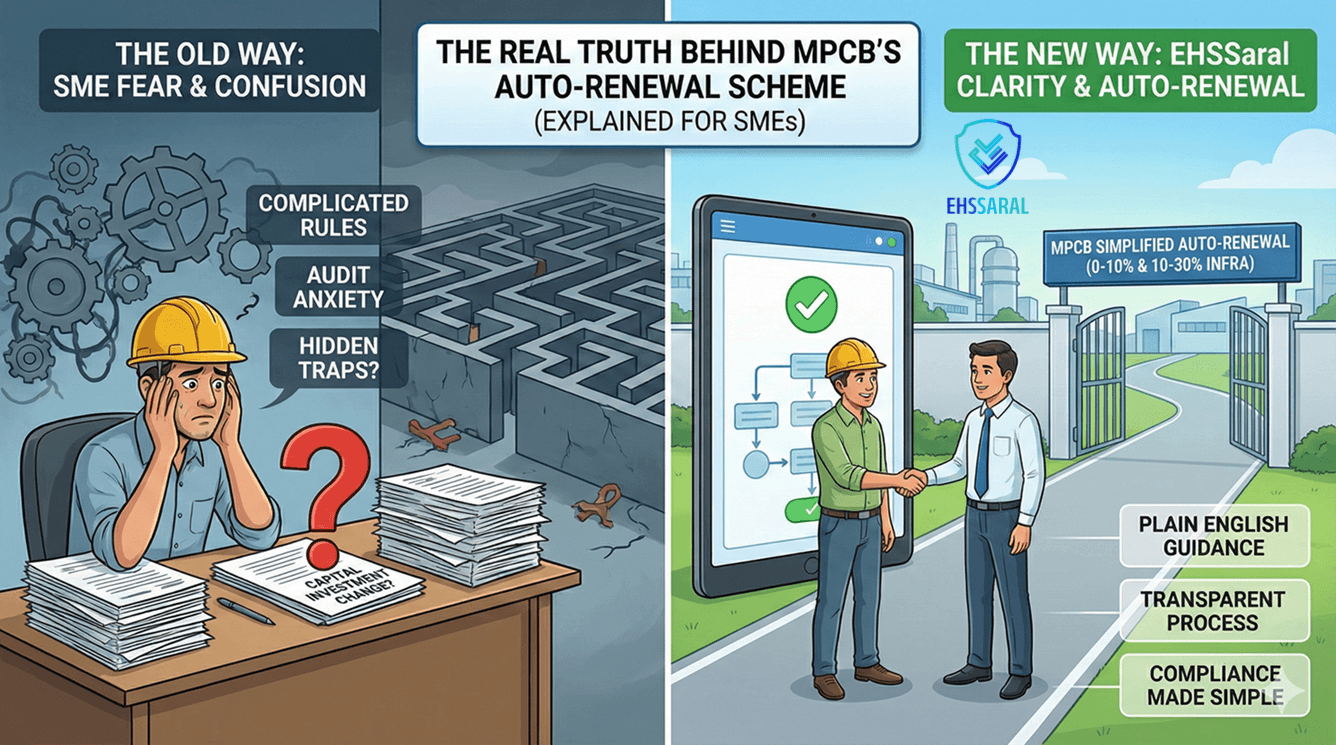
CTO Auto-Renewal: Capital Investment Rules 10% & 30% | EHSSaral
Water & Effluent Sampling Basics for Indian Factories | EHSSHala
The Digital Compliance Cliff: EPR Traceability Challenges for Indian MSMEs | EHSSaral Research

Why Good People Still Struggle With Compliance in Indian SMEs | EHSSaral Research