

Blog
Why Good People Still Struggle With Compliance in Indian SMEs | EHSSaral Research
EHSSaral is an Environmental Compliance Intelligence Platform for Industries. Consent Intelligence • Alerts & Tasks • Incident Reporting • Form IV & V • Audit-Ready Records
See how EHSSaral works
22 Dec 2025
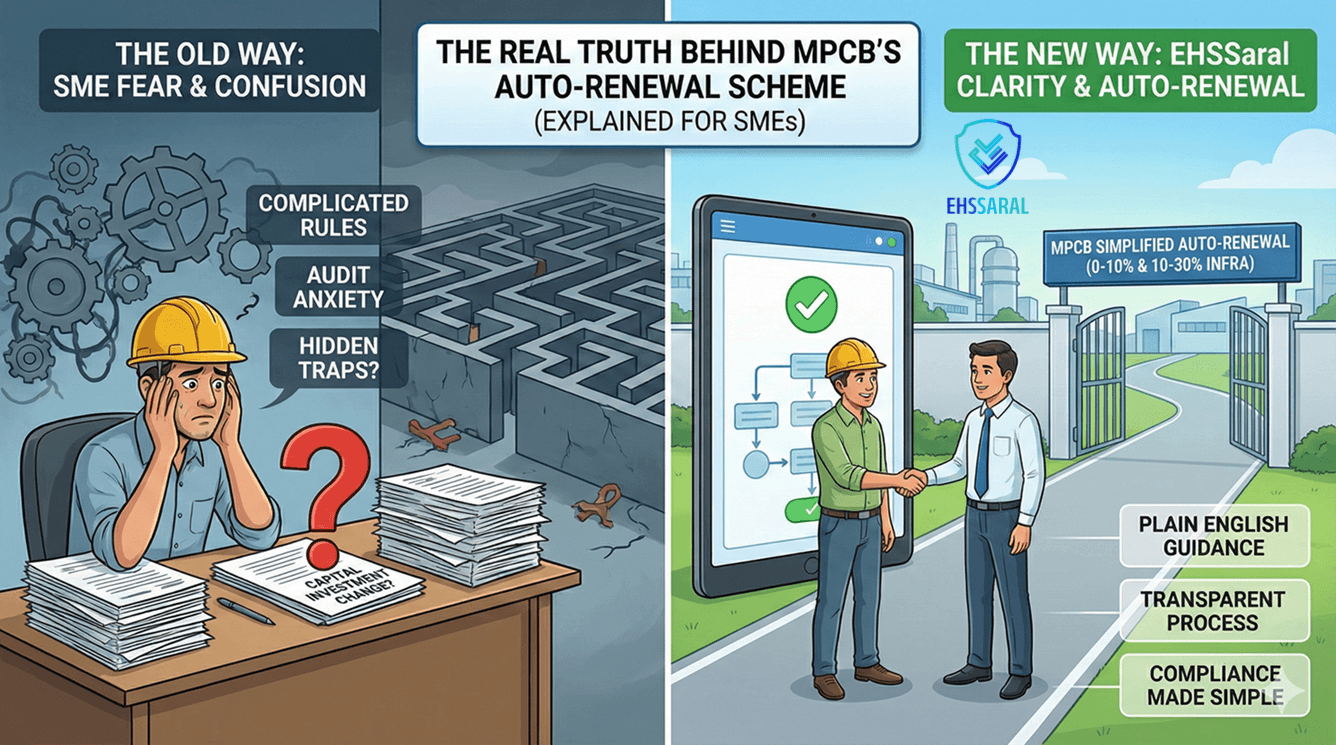
In August and September 2025, MPCB introduced a major reform: the Simplified Auto-Renewal Scheme.
Its intention was noble - reduce paperwork, remove delays, and let compliant units renew quickly with self-declaration.
But here’s the reality we’ve seen in the EHS community:
SMEs are more scared than relieved.
“What if we tick the wrong box?”
“What if our capital investment calculation is wrong?”
“What if MPCB audits us suddenly?”
This fear is especially strong around one clause:
Not production capacity.
Not pollution load.
Not category.
Capital Investment alone has confused more units than any other requirement.
At EHSSaral, we’ve spoken to dozens of SMEs, consultants, and environmental managers.
We’ve also spent years analysing MPCB’s expectations on the field.
And here’s the blunt truth:
Capital investment is not a trap.
It is simply MPCB’s way of checking whether you are expanding responsibly.
This article will help you understand that - in plain English.
Most factory owners think capital investment = “money I spent this year”.
But MPCB looks at capital investment declared in your current MPCB / SPCB consent
vs
capital investment after your expansion or upgrade.
This leads to confusion because:
And the biggest fear:
“If I show CI increase wrongly, will MPCB reject auto-renewal?”
The honest answer:
No - only if you clearly breach the percentage limits or misrepresent the purpose.
This article removes all that fear.
The scheme exists for three reasons:
It only penalises units for:
That’s it.
MPCB is not checking your CI to punish you.
They’re checking CI to understand the nature of your expansion.
There are three common myths:
False.
ETP upgrades, APC systems, STP, monitoring systems, tanks, storage areas -
are not counted as production increase.
Also false.
CI within 10% is routine.
CI up to 30% (for infra/pollution control) is permitted under corrigendum.
Wrong interpretation.
Self-declaration is simply MPCB trusting SMEs to state the truth-with the understanding that:
If you are compliant and honest, auto-renewal is straightforward.
Because SME owners shouldn’t suffer due to unclear wording, complicated PDFs, or confusing CA formats.
This guide will make the next steps extremely clear.
Capital Investment (CI) is the one clause that creates maximum doubt during Auto-Renewal.
But once we break it into simple buckets, everything becomes crystal clear.
Think of it like this:
MPCB only wants to know what has changed and why it changed.
Let’s simplify the rules.
There are only four possible cases:
Interpretation:
Why:
A decrease often implies asset disposal, shutdown of systems, or changes that need fresh evaluation.
Interpretation:
Conditions:
This is the cleanest category.
Interpretation:
Examples:
Rule of Thumb:
If your CI has increased by 0–10%, you’re in the “simple renewal” zone.
This is where most SMEs get confused.
So let’s break it down carefully.
Interpretation depends on one critical question:
Why did your capital investment increase?
There are only two answers:
If your CI increase is only due to this category,
and the increase is within 30%,
you remain eligible for Simplified Auto-Renewal.
Examples:
Why MPCB allows this:
Because these upgrades reduce risk and strengthen compliance.
If CI increase (even within 30%) is due to:
Then:
It is NOT eligible for Simplified Auto-Renewal - even if CI increase is 15%, 20% or 25%.
Production-linked changes must go through the regular consent process.
This is simple.
More than 30% CI increase → Not eligible
No matter the reason, it falls outside the scope of the simplified scheme.
Why:
A CI increase above 30% almost always indicates a significant expansion.
Here’s the mental model MPCB uses:
→ If yes, move to next question.
Eligible (simple case)
Eligible (with conditions)
Not eligible
Not eligible
Because SMEs worry:
The honest truth:
MPCB only cares whether your investment changes the nature or scale of your activity.
If it does not, you are safe.
The scheme is built to support compliant units, not penalise them.
Stop Paying Double Fees. The new MPCB circular (Effective June 1, 2025) has changed the game. You can now get a 5% Rebate on your consent fees, but missing the deadline by even one day can trigger a 25% to 100% Penalty.
Use this logic to calculate your exact "Safe Zone" for filing:
MPCB now incentivizes early filers. To save money, you must file your renewal application more than 120 days (4 months) before your current consent expires.
| Timeline (Days Before Expiry) | Result | Financial Impact (Example for ₹1L Fee) |
|---|---|---|
| > 120 Days | ✅ 5% REBATE | Pay ₹95,000 (Save ₹5,000) |
| 120 – 45 Days | ⚠️ 25% Penalty | Pay ₹1,25,000 (Lose ₹25,000) |
| < 45 Days | 🚨 50% Penalty | Pay ₹1,50,000 (Lose ₹50,000) |
| After Expiry | ❌ 100% Penalty | Pay ₹2,00,000 (Lose ₹1,00,000!) |
Don't wait for the "Auto-Renewal" email. The system often triggers late. Set your own reminder for 130 days before expiry.
The Auto-Renewal circulars look complicated on paper.
But the actual eligibility check is simple, and you can do it with:
That’s it.
This section turns the MPCB capital investment rules into clean, step-by-step actions anyone can follow.
You need these two figures:
This is the capital investment mentioned in:
This is your capital investment after the planned upgrade/maintenance/addition.
Write both down clearly.
Example:
CI₁ = ₹ 5,00,00,000
CI₂ = ₹ 5,40,00,000
Use this simple formula:
Percentage Change = ((CI₂ − CI₁) ÷ CI₁) × 100
Let’s use the example:
Now calculate:
40,00,000 ÷ 5,00,00,000 = 0.08
0.08 × 100 = 8%
Your CI has increased by 8%.
This step is important.
You must know why CI increased.
Choose one option:
Examples:
This category is safe and MPCB encourages these upgrades.
Examples:
This category immediately goes into regular renewal mode - not Auto-Renewal.
Use this simple table.
This is the simplest and cleanest case.
This scenario is exactly what the September 2025 corrigendum clarified.
Most infra projects are harmless.
ETP or APC upgrades do not count as production increase.
Land value does not change for CI calculations unless you’re newly purchasing land.
Depreciation is an accounting concept.
MPCB looks at replacement/upgrade cost, not book depreciation.
Always start with the CI mentioned in your last approved consent.
This is the biggest mistake.
If you hide CI increase in Auto-Renewal and MPCB inspects:
→ Your unit becomes “misrepresentation” case
→ You lose trust
→ Future renewals become difficult
Honesty = fastest renewal path.
By now you’ve understood the logic behind the Auto-Renewal scheme:
This final section gives you:
This is a draft format written based on the Auto-Renewal circular (13 Aug 2025) and corrigendum (10 Sept 2025).
Replace the items in [square brackets] before printing on your letterhead.
To,
The Member Secretary,
Maharashtra Pollution Control Board
[Concerned Regional Office]
Subject: Self-Declaration for Simplified Auto-Renewal of Consent – [Name of Unit], [Consent Number & Validity]
Respected Sir/Madam,
We, [Name of Company], having our industrial unit located at [Unit Address], fall under the [Red / Orange / Green / Blue] category and currently hold Consent to Operate / Establish as per the details below:
In accordance with MPCB Circular dated 13.08.2025 and Corrigendum dated 10.09.2025 on the Simplified Auto-Renewal Scheme, we hereby declare the following:
We kindly request that our application be considered under the Simplified Auto-Renewal Scheme. We undertake to comply with all conditions imposed by MPCB during and after renewal.
For [Name of Company]
[Authorised Signatory]
[Name]
[Designation]
[Date]
Use this checklist before submitting your renewal:
No mismatched values.
Your declared quantity must match your existing consent.
No new ETP load, no new stacks, no new effluent generation.
No pending closure directions, no major show cause notices.
Especially when CI increase involves differential fees.
Avoid Auto-Renewal if:
Using Auto-Renewal incorrectly can lead to inspections or rejection.
Choose regular consent renewal when:
These are not Auto-Renewal cases.
SMEs often tell us:
“We don’t want to make a mistake. We want clarity.”
That is exactly why we write articles like this.
EHSSaral’s philosophy is simple:
As we expand EHSSaral, we are building tools that interpret rules exactly like this article - clearly, transparently, and without jargon.
If you want to add it at the top, here is a short version:
Auto-Renewal Eligibility (Capital Investment):
Up to 10% increase in capital investment is allowed without conditions. Between 10% and 30%, it is allowed only if the increase is due to infrastructure, clean technology, or pollution control systems.
No. Any capital investment increase linked to production capacity, process change, or output expansion is not eligible under the simplified Auto-Renewal scheme.
No. A decrease in capital investment (CI₂ < CI₁) is not covered under the simplified Auto-Renewal scheme. You must apply through the regular consent renewal route.
A capital investment increase of more than 30% is not eligible under the simplified Auto-Renewal scheme. A fresh or regular consent application is required.
No. ETP, STP, APC, green belt development, monitoring systems, and other environmental or infrastructure upgrades are considered infrastructure / pollution control investments and do not count as production increase.
The capital investment values in your:
• CA certificate
• Previous consent
• Current declaration should all be consistent. These ensure a smooth Auto-Renewal process.
If any part of the investment is linked to production increase, the application should go through the regular consent process, not Auto-Renewal.
Yes, as long as:
• Production capacity has not increased
• Pollution load has not increased
• Capital investment falls within the allowed limits
• All compliance conditions are met The scheme is designed to simplify renewals, not penalize SMEs.
No. MPCB looks at actual upgrade or investment cost, not book depreciation or fluctuating land valuation.
If the mistake is genuine and corrected transparently, inspections are uncommon. Intentional misrepresentation, however, may result in scrutiny. Honesty always leads to smoother renewals.

Founder, EHSSaral
Founder - EHSSaral | Partner - Perfect Pollucon | ISO 14001 Lead Auditor | GHG Protocol Scope 2 | Chemist | Data Scientist | Second-generation environmental professional simplifying EHS compliance for Indian industries through practical, automated, tech-enabled, data driven compliance workflows.
Why Good People Still Struggle With Compliance in Indian SMEs | EHSSaral Research

Form 4 vs Form 5: Why Hazardous Waste Numbers Don't Match
MPCB CTO Refusal Patterns in Maharashtra (2023–2025) Analysis | EHSSaral Research
Late Filing Penalty for Form 4 SPCB: What Happens If You Miss the 30 June Deadline?
Environmental Non-Compliance Investigation: Process, RCA and Corrective Action
Hazardous Waste Management Software India | EHSSaral
Hazardous Waste Packaging & Labelling in India (Inspector Guide) | EHSShala

Battery Waste Registration for Equipment Importers (BWM Rules 2022 Explained) | EHSSaral
Noise Monitoring in Factories Workplace vs Boundary (India Guide) | EHSShala
Consent to Establish (CTE) Explained: Process, Documents, Rules & Common Mistakes | EHSShala