

 ehssaral.webp)
Blog
Hazardous Waste Form 4 Portal Errors (MPCB & GPCB Fix Guide)
EHSSaral is an Environmental Compliance Intelligence Platform for Industries. Consent Intelligence • Alerts & Tasks • Incident Reporting • Form IV & V • Audit-Ready Records
See how EHSSaral works
4 Feb 2026

The Indispensable EHS Officer was written to explain the real structural risks EHS professionals face in India - where visibility is high, authority is limited, and silence often becomes exposure.
A realist explanation for professionals operating inside Indian safety systems
In many Indian organizations, EHS roles occupy an uncomfortable position.
They are highly visible, closely scrutinized, and increasingly relied upon - yet rarely empowered to make final decisions. Expectations keep expanding: more compliance, more documentation, more anticipation, more accountability. Authority, however, does not expand at the same pace.
Most discussions around Environment, Health and Safety focus on what should be done: rules, procedures, audits, systems, certifications. Far fewer conversations address how responsibility actually moves inside organizations when something goes wrong - and what that movement means for the professional sitting in the EHS role.
This article exists because a large number of EHS professionals are experiencing risks that are structural, not personal - and they often lack the language to describe them.
|
Traditional safety literature does important work. It explains how incidents occur, how controls fail, and how systems can be improved. It trains professionals to prevent harm and comply with law. That foundation matters.
What is discussed far less openly is the professional exposure that remains even when someone does everything “by the book”.
Many EHS professionals quietly discover that:
following procedures does not always protect them
documentation can sometimes increase scrutiny instead of reducing it
silence is rewarded until it suddenly becomes blame
good intent does not redistribute authority
being right does not guarantee being safe
Most safety material focuses on protecting people and organizations. Very little addresses how professionals themselves are protected - or exposed - inside imperfect systems.
The Indispensable EHS Officer was written to address that gap.
In most Indian organizations, the EHS function is designed to be observable.
EHS officers are expected to know the rules, interpret them correctly, maintain records, interface with inspectors and auditors, foresee risks before they materialize, and explain incidents after they occur. Their work leaves a trail: checklists, registers, reports, signatures, emails.
At the same time, they are rarely empowered to:
stop production unilaterally
override delivery timelines
reject contractors outright
control manpower quality
redesign processes that repeatedly create exposure
This is not necessarily the result of bad intent. It is how responsibility is distributed in complex, target-driven systems.
The result is a persistent misalignment:
high visibility paired with limited decision authority.
When outcomes are good, this misalignment stays invisible. When something goes wrong, systems under pressure look for the most visible node to stabilize the narrative. That node is often EHS.
This book is not written to provoke anger about that reality. It is written to prevent surprise.
One of the most damaging assumptions in safety work is the belief that perfect compliance guarantees professional protection.
In practice, two different forms of safety operate in parallel.
Paper safety includes:
completed checklists
statutory registers
audit readiness
documented procedures
formal compliance
Paper safety primarily protects the organization. It demonstrates awareness, effort, and alignment with requirements.
Personal safety operates differently. It concerns:
how warnings are sequenced
how silence accumulates
how documentation is interpreted later
how responsibility is assigned after an incident
how narratives form under pressure
Personal safety primarily protects the professional.
Many well-intentioned EHS officers are trained extensively in paper safety and assume it automatically ensures personal safety. It does not. In some situations, over-documentation can actually increase exposure by proving awareness without proving authority.
This distinction sits at the heart of why this book exists.
EHS roles attract conscientious people - professionals who notice risks others overlook and care deeply about prevention. That care, when unsupported by structural awareness, can quietly become a liability.
Good intentions do not change incentives. They do not eliminate deadline pressure. They do not prevent scapegoating. And they do not guarantee that warnings will be acted upon.
When incidents still occur - as they inevitably do in complex systems - professionals who believed that effort alone would protect them experience not only scrutiny, but personal collapse. The system does not respond to effort. It responds to outcomes and narratives.
Understanding this is not cynicism. It is realism.
Most organizations pursue zero accidents for understandable reasons. No one benefits from harm. No one argues for injuries. Yet when safety metrics become tightly linked to ratings, bonuses, or reputation, they stop functioning as information and start functioning as ego threats.
In such environments:
near-misses stop getting reported
deviations are handled informally
warnings are softened or delayed
dashboards look green
stability becomes fragile
Silence does not mean risk has disappeared. It means the cost of speaking has increased.
This silence is rarely malicious. It is adaptive. People adjust their behavior to what feels safe socially, not just physically.
For EHS professionals, this creates a dilemma. Document aggressively and appear negative. Stay quiet and inherit the shock when reality surfaces. Neither extreme is safe.
This book does not frame silence as moral failure. It treats it as a signal - and asks how truth can be sequenced without self-destruction.
The central mistake many professionals make at this point is assuming that courage alone resolves this dilemma.
Safety culture frequently praises courage. Speaking up. Taking a stand. Escalating issues forcefully. These narratives are celebrated publicly and remembered selectively.
Inside operational systems, however, courage without sequencing often increases personal risk without reducing operational risk.
Speaking too early can trigger defensiveness. Speaking too loudly can be perceived as obstruction. Speaking without protection can concentrate attention rather than distribute responsibility. When warnings arrive as shocks, they feel accusatory, regardless of intent.
This book takes a different position.
Survival is not cowardice.
Sequencing is not silence.
Restraint is not compromise.
Restraint is a professional skill.
One of the core shifts this book proposes is a change in how the EHS role is understood.
The traditional image of the EHS officer is enforcement-oriented: inspections, rule-checking, corrective actions, audit preparation. This role is necessary, but incomplete. Enforcement tends to arrive after plans are already in motion, when timelines are tight and authority is already exercised.
At that point, safety feels like disruption.
Most resistance to safety does not come from disregard for human life. It comes from surprise. Unplanned stoppages. Unexpected inspections. Last-minute escalations.
The alternative role is not softer enforcement. It is earlier intervention.
A risk buffer absorbs weak signals, notices repetition, translates uncertainty, and reduces surprise before decisions harden. This role does not accuse. It predicts. It does not block. It prepares.
When EHS professionals consistently reduce surprise, something subtle shifts. Conversations move from “Why are you stopping this?” to “What do you see coming?” That shift is the beginning of trust.
This is not influence through authority. It is influence through usefulness.
The book introduces a layered approach to communicating risk - not as a script, but as a discipline.
Early signals are safest when they are private, brief, and informal. Their purpose is awareness, not evidence. They test receptiveness without creating records prematurely.
If issues persist, they move into neutral documentation framed as clarification or tracking, not accusation. Tone matters more than content at this stage. The goal is to preserve memory, not provoke defense.
Formal escalation exists for one reason only: self-protection when earlier signals are ignored. Even then, language remains restrained. Responsibility is shifted without drama.
This is not whistleblowing. It is narrative hygiene.
The aim is not to be loud. It is to be early.
Many EHS professionals believe their challenge is lack of authority. More often, it is lack of translation.
Safety professionals are trained to speak in moral and technical terms: harm, duty of care, compliance, prevention. Organizations, however, make decisions using a different language: continuity, disruption, exposure, predictability.
When these languages collide, safety loses - not because it is wrong, but because it is unintelligible to power.
Moral arguments are true, but they frequently trigger defensiveness. They position the listener as unethical or careless. Once that happens, the discussion is no longer about risk. It becomes about identity.
Risk language does not accuse. It describes consequence.
“This is unsafe” often closes conversations.
“This increases the probability of unplanned stoppage” opens them.
Translation is not dilution. It is alignment. The hazard remains the same; the entry point changes.
The book is careful about boundaries here. Translation is appropriate for emerging risk. It is not appropriate when there is immediate danger, statutory violation, or known failure of critical controls. In those cases, technical and legal language is protection. Euphemism becomes complicity.
Another quiet barrier to anticipation is the belief that insight requires clean data or advanced systems.
In reality, most EHS data in Indian workplaces is incomplete, inconsistent, and delayed. Registers are filled after the fact. Terminology varies. Contractor inputs are uneven. Waiting for perfect data delays protection indefinitely.
The book takes a pragmatic position: data does not need to be clean to carry signal. It needs to be repeatable.
Patterns emerge from frequency, timing, location, and group exposure - even in messy records. Repetition matters more than precision. Five minor issues in the same place often carry more meaning than a single severe outlier elsewhere.
This is not analytics. It is attention.
Anticipation begins not with tools, but with better questions.
Audits and inspections are commonly feared because of non-compliance. In practice, they are dangerous because of time.
When information is not immediately available, stress escalates. People improvise. Inconsistencies surface publicly. Responsibility drifts toward whoever owns records. Confusion begins to resemble incompetence.
Speed communicates control faster than completeness ever will.
The book introduces the idea of compressing audit readiness - not through more documentation, but through consolidation, familiarity, and retrievability. The ability to respond calmly within a short window reduces narrative risk before it hardens.
This is not efficiency theatre. It is self-protection.
One of the least acknowledged costs of EHS roles is not physical fatigue or workload. It is sustained moral load.
Many EHS professionals are regularly exposed to injury, near-misses, and preventable harm. What makes this exposure different from frontline emergency roles is not severity, but context. After an incident, production resumes, meetings continue, targets remain unchanged. The system moves on quickly. The professional closest to the risk often does not.
Warnings that are acknowledged but postponed, concerns that are noted but deprioritized, and risks that are accepted informally without documentation accumulate quietly. Each instance feels minor. Over time, they create exhaustion that is not physical or intellectual, but moral.
This is not burnout in the traditional sense. It is sustained vigilance combined with suppressed concern. Left unaddressed, it erodes judgment long before it causes collapse.
The book does not approach this with therapy language or motivational framing. It treats emotional strain as data. Signals that exposure is accumulating. Signals that silence may be becoming unsafe. Signals that judgment may soon degrade.
Stabilizers matter. Naming exposure internally. Separating role from outcome. Reducing isolation through at least one peer who understands the context. Documenting selectively to reduce rumination rather than increase defense. Exiting conversations consciously instead of replaying ignored warnings endlessly.
These practices do not make professionals softer. They make them sustainable.
One of the more uncomfortable ideas in the book challenges a quiet assumption: that a good safety professional should depend entirely on their employer.
Economic fragility distorts judgment. When all income comes from a single source, the cost of disagreement rises. Escalation feels riskier. Delay feels safer. Silence becomes easier to justify.
Optionality is not exit planning. It is not disloyalty. It is insurance.
Even modest, well-bounded advisory work changes internal dynamics. It widens the range of decisions that feel survivable. It allows professionals to tolerate short-term friction without desperation. It restores a measure of honesty that fear quietly erodes.
The book is careful about boundaries. Advisory work is not execution. It avoids statutory signing, operational control, and conflicts of interest. The goal is not income replacement. It is breathing room.
Optionality does not create leverage over others. It creates leverage over fear.
Many professionals assume invisibility is safety. Stay quiet. Do the work. Avoid attention.
In unstable systems, invisibility reduces short-term friction. It also removes narrative protection. When incidents occur, only job titles remain.
Strategic visibility is not branding or self-promotion. It is controlled traceability. Brief neutral summaries. Pattern-level observations without attribution. Credit given outward, not claimed inward. Closure documented, not just findings.
Visibility that creates anxiety is resisted. Visibility that creates reassurance is remembered.
The book consistently favors durability over reach, trust over attention, and restraint over recognition.
Many of the ideas in this article are uncomfortable. Taken out of sequence, they can be misunderstood or misused. Some can even increase exposure if applied without context.
This is why The Indispensable EHS Officer was written as a book, not as fragmented content.
A book allows for sequencing. It allows restraint. It allows boundaries. It makes room for ideas that are not inspirational, but orienting.
This work does not promise transformation. It does not promise immunity. It does not promise that systems will listen, change, or act fairly.
It promises something quieter.
Orientation.
Understanding where blame travels. Knowing when silence is protective and when it becomes dangerous. Learning how to reduce surprise without becoming invisible or reckless. Recognizing when staying is possible - and when leaving is risk management.
This book does not create heroes.
It does not guarantee safety.
It does not promise recognition.
It does not sell certainty.
It creates professionals who last.
Professionals who understand that most failures are not about intent, and most exposure is not about incompetence, but about systems that misalign responsibility and authority.

Founder, EHSSaral
Founder - EHSSaral | Partner - Perfect Pollucon | ISO 14001 Lead Auditor | GHG Protocol Scope 2 | Chemist | Data Scientist | Second-generation environmental professional simplifying EHS compliance for Indian industries through practical, automated, tech-enabled, data driven compliance workflows.
Hazardous Waste Form 4 Portal Errors (MPCB & GPCB Fix Guide)
Is Your Factory Heat-Ready? 5 New Compliance Realities for the 2026 Indian Summer
Form V Data Variation: Explain Water, Waste & Pollution Changes

Why EHS Experience Is Being Filtered Out - The Real Hiring Logic | EHSSaral
Environmental Compliance Data for BRSR & GRI Reporting in India | EHSSaral Research
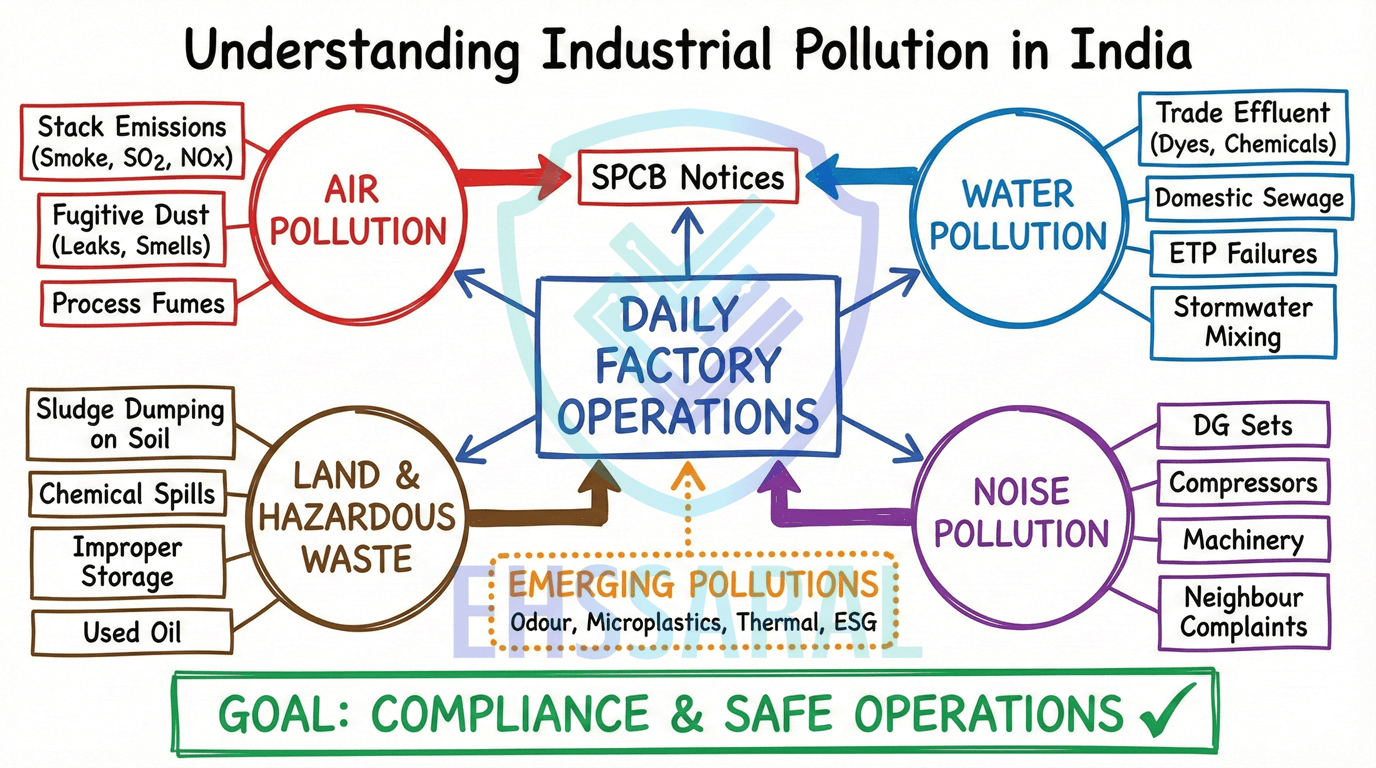
Types of Pollution in Industries Expert Guide | EHSShala
Industrial Siting Criteria in India: Factory Location Guide
E-Waste Management Rules (2022) in India - Practical Guide for Factories | EHSShala
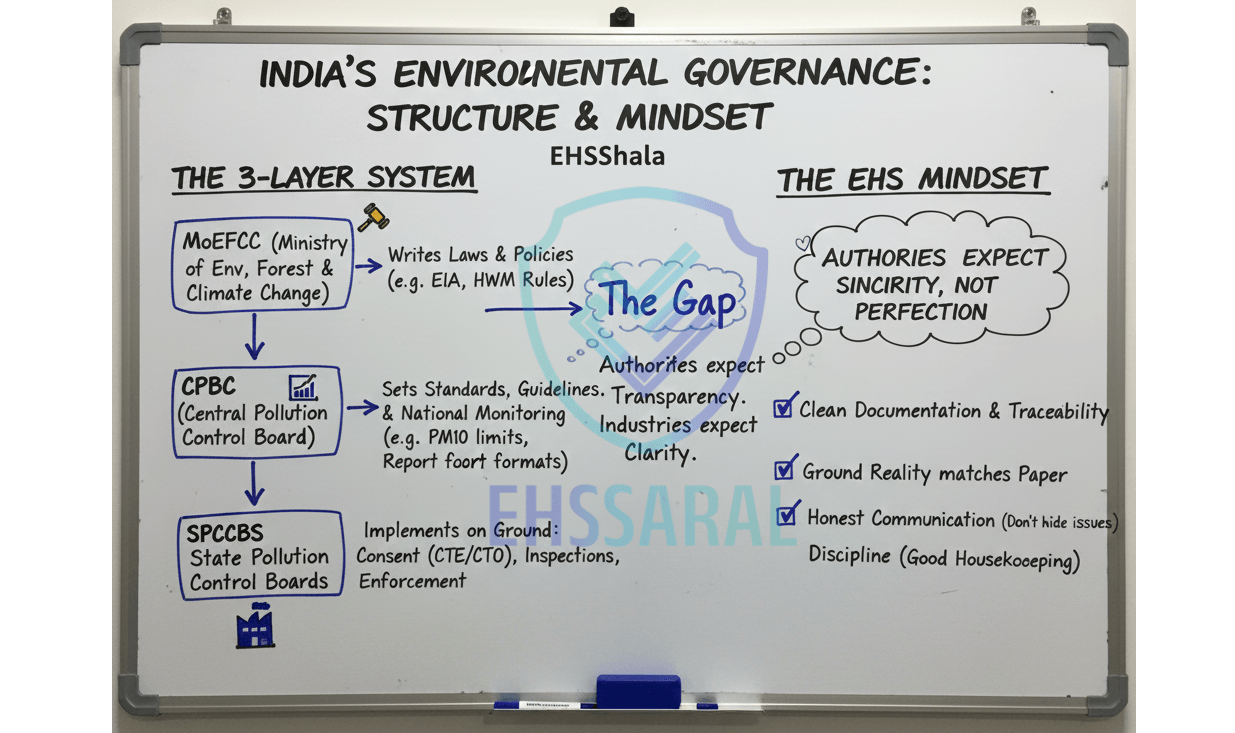
How MoEFCC, CPCB & SPCB Work in India: Expert Guide | EHSShala
Form V Environmental Statement: Due Date, Format, Example & Guide