
Research
Beyond the Helmet: Why Safety Compliance Alone Fails in Indian Factories | EHSSaral Research
EHSSaral is an Environmental Compliance Intelligence Platform for Industries. Consent Intelligence • Alerts & Tasks • Incident Reporting • Form IV & V • Audit-Ready Records
See how EHSSaral works
22 Jul 2026
Home > EHSShala > Start > EHS Officer Career Path in India (2025–2050 Guide)
Real Lessons From a 40-Year Veteran - And a Modern Data-Driven Perspective
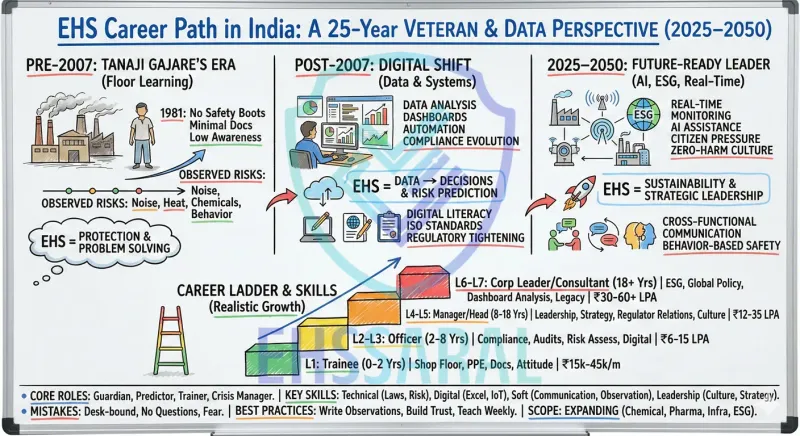
My father (Mr. Tanaji Gajare) entered the industrial world in 1981, when safety boots were rare, documentation was minimal, and environmental awareness barely existed.
Back then, “EHS Officer” wasn’t even a common job title.
I started observing EHS much later - around 2007 - from a very different angle:
For my father, EHS was learned on the floor:
noise, heat, risk, chemicals, machinery, and human behavior.
For me, EHS unfolded through:
data, patterns, systems, and compliance evolution.
Understand How EHS Compliance evolved over the decades in India:
Evolution of EHS in India Part1 Pre-Bhopal
Evolution of EHS in India Part2 Post-Bhopal
Together, our observations form one truth:
An EHS career is not just a job. It is a commitment to protecting people, environment, and future generations.
This article is what we wish someone had told young officers 25–40 years ago…
and what I wish juniors today would prepare for in the next 25.
By the end of this, you’ll know:
Let’s begin.
What is EHS and Why India should pay attention to it?
Why Some EHS Officers Grow Faster Than Others by Perfect Pollucon
My father laughs when he hears modern job descriptions.
Beta, 30 years ago, there was no ‘JD’. You just solved problems and protected people.
Today’s roles sound fancy, but the fundamentals haven’t changed - only expanded.
You ensure the company follows:
Compliance is no longer paperwork -
it is legal protection, audit survival, and risk reduction.
My father says:
A good EHS officer prevents events nobody else can see.
This means:
This is intuition + observation + knowledge.
You must influence:
This is where communication beats certificates.
Most accidents happen because:
A great EHS officer teaches daily, not yearly.
You need calmness during:
This is where experience matters most.
My perspective (post-2007):
EHS today =
data → dashboards → decisions
Every decision now needs numbers:
Digital literacy is no longer optional.
Tips for EHS Junior Officer from 25+ years of experience
This is something no one explains clearly.
Here is the practical ladder we’ve seen in industries for 40 years.
Why We Wrote The Indispensable EHS Officer Book (A Realist Guide for India)
You learn:
Salary becomes secondary - attitude matters here.
You take ownership of:
Most people get stuck here forever due to poor learning habits.
More on that later.
You handle:
This is when your career either accelerates or stagnates.
You are now taken seriously.
Expectations include:
This is where communication skills decide growth.
A highly respected role.
You lead:
Only 10–15% reach this level.
This is where future demand lies.
You:
This will be one of the highest-demand roles by 2030.
My father always said:
Only those who keep learning reach the consultant stage.
Consultants must:
This is the legacy stage of EHS careers.
This is the perfect logical breakpoint where readers naturally ask:
“Sir, EHS mein salary kitni hoti hai really?”
“Is EHS job stressful?”
As someone who has seen 40 years of industrial evolution (through my father’s eyes) and 18 years of digital transformation (through my own journey), I can tell you this clearly:
EHS is no longer a “safety + compliance” job.
It is a multi-skill profession.
And the next 25 years will demand far more than today.
Here is the complete skill set you need to become a future-ready EHS leader.
These are the skills my father says every great EHS officer must master:
You must know the basics of:
A surprising truth:
Those who read the Acts properly grow faster than those who avoid it.
My father’s favorite line:
Accidents happen when we assume nothing will go wrong.
You don’t need to be a lab expert,
but you must understand:
You should be able to:
This is where my corporate experience becomes relevant.
From 2007 onwards, I saw a shift that juniors must prepare for:
EHS is becoming a data-centric profession.
Digital literacy will determine promotions.
Here’s what you must learn:
(EHSSaral is the future, but even generally…)
You must be able to handle:
By 2030, MOST compliance will be real-time.
You must understand basics of:
A good EHS officer doesn’t collect data -
he explains what it means to management.
My father has seen hundreds of officers across 40 years.
He told me something unforgettable:
Technical knowledge gets you hired.
Soft skills get you promoted.
Critical soft skills include:
The greatest EHS officers are “silent scanners”.
They see what others ignore.
Because EHS = people, behavior, and culture.
If you can’t teach, you can’t lead.
In every crisis, someone must stay calm.
That someone… is you.
Safety culture is built by:
You must learn to say:
“Stop the job.”
Even when people are angry.
A leader knows how to:
Future leaders must think in terms of:
Stories shape careers.
Here are three real incidents (from my father & my experience) that juniors must remember.
A small chemical leakage was noticed.
The junior EHS officer reported it.
Maintenance said “we’ll check tomorrow.”
He didn’t follow up.
Three days later, the gasket burst.
Result:
Lesson:
Follow-up is more important than reporting.
Leaders follow till closure.
My father once saw a young man (age ~23) who kept asking:
“Why this chemical?”
“Why this SOP?”
“Why this container?”
“Why this PPE?”
He was mocked at first.
But he kept learning.
Today?
He is a Plant Head in a multinational company.
Lesson:
Curiosity accelerates careers faster than certificates.
A worker removed gloves “just for 2 minutes” to align a component.
A minor mistake → major injury.
Auditors questioned:
Lesson:
One unsafe act can undo decades of hard work.
EHS officers must stay vigilant.
My father’s wisdom + my modern understanding = this roadmap.
This is the section most juniors search for but rarely get honest advice about.
Everything here is based on what my father saw since 1981 and what I’ve observed since 2007.
If you follow these steps, your first 5–7 years will set you up for a powerful 25-year career.
Not all industries give equal exposure.
My father often says:
An EHS officer who stays in the office is already failing.
Go to:
If you learn this early, you will rise fast.
Documentation is NOT boring - it is:
Watch how they:
Every month:
My father’s biggest lesson:
Regulators are not the enemy.
They are experienced people who want safer industries.
Observe their:
Learning from their lens is a career superpower.
Across four decades, my father noticed something interesting:
Great officers didn’t do big things.
They did small things consistently.
Here are the habits that create GREATNESS.
Carry a small notebook or your phone.
Document:
Workers listen to people they trust.
If you don’t have their trust, compliance suffers and culture weakens.
Teach:
My father observed:
The best EHS officers understood the process better than engineers.
This requires effort, but it makes you:
Everyone panics during incidents.
Your calmness will become your leadership identity.
Rules change.
Notifications update.
Deadlines shift.
Standards tighten.
Staying updated = staying relevant.
My father has seen brilliant juniors ruin their growth because of small blind spots.
Here are the top mistakes:
EHS is not a desk job.
You must combine office + field.
Experience without skill leads nowhere.
Skill + discipline + mindset = growth.
Curiosity is the biggest growth driver.
You must communicate facts-not fear.
I’ve seen this personally in corporate:
Those who rejected digital tools → stagnant.
Those who embraced them → promoted.
Blaming:
workers
supervisors
contractors
…will always destroy team culture.
A great EHS officer guides, not blames.
This is the MOST important section for young officers.
From 2025–2050, EHS roles will transform dramatically.
Here’s what’s coming - and what you must prepare for.
OCEMS is just the beginning.
Within 10 years:
air quality sensors
noise sensors
effluent sensors
workplace sensors
thermal cameras
…will be standard in most factories.
You must learn:
data interpretation
trend analysis
digital dashboards
ESG will dominate compliance.
EHS officers will become:
data reporters
sustainability contributors
energy-saving strategists
This is a huge opportunity.
In 2000s, incidents stayed inside factories.
Today, everything is on social media.
Tomorrow, everything will be in real-time dashboards.
Industries will need EHS officers who:
communicate clearly
maintain transparency
manage reputational risk
Tools like EHSSaral will automate:
consent interpretation
reminders
document storage
audits
incident analytics
EHS officers must shift from:
manual doers → intelligent overseers.
By 2035–2040:
global clients
government norms
insurance companies
…will all demand a zero-harm culture.
This requires:
behavior-based safety
training science
habit transformation
The EHS leader of the future is not “just EHS”.
He/she must work with:
HR
Production
Maintenance
Finance
Corporate sustainability
CSR
Data teams
EHS is becoming a central function, not a side function.
If you are wondering whether EHS has a future in India, here is the clear answer:
EHS scope in India is expanding – not shrinking.
India is seeing:
All of this increases dependence on skilled EHS professionals.
From 2025 onward, growth will be strongest in:
EHS officers who adapt will never be obsolete.
If you choose the EHS profession, remember this:
You are protecting lives.
You are shaping culture.
You are preventing disasters.
You are safeguarding the environment.
You are building a safer India.
My father spent 40+ years watching India evolve from:
…to the modern, structured, data-driven EHS of today.
I observed the digital revolution from 2007 onward:
Two generations.
One belief:
An EHS officer is not a file-handler.
He is a guardian. A teacher. A leader. A protector.
If you stay curious, consistent, disciplined, honest -
you will build a career you can be proud of.
And when you reach 2040–2050…
you’ll remember these lessons as the foundation of your success.
Yes. With stricter regulations, ESG, real-time monitoring and citizen awareness, demand for skilled EHS officers is increasing across chemical, pharma, manufacturing and infrastructure sectors.
Commonly preferred are degrees in engineering or science with a safety, environment or industrial hygiene focus, plus diplomas or certifications in industrial safety, NEBOSH, ISO auditing or process safety.
An EHS officer manages compliance, conducts inspections, tracks incidents, trains workers, prepares for audits, coordinates with regulators and works to prevent accidents and environmental violations.
Focus on technical knowledge, documentation discipline, soft skills, digital tools and leadership. Take higher-level certifications, handle audits, lead projects and learn to communicate with management and regulators.
Future EHS officers must be comfortable with data, dashboards, real-time monitoring, ESG reporting, AI-assisted compliance tools, behavior-based safety and cross-functional leadership.

Founder, EHSSaral
Founder - EHSSaral | Partner - Perfect Pollucon | ISO 14001 Lead Auditor | GHG Protocol Scope 2 | Chemist | Data Scientist | Second-generation environmental professional simplifying EHS compliance for Indian industries through practical, automated, tech-enabled, data driven compliance workflows.
Beyond the Helmet: Why Safety Compliance Alone Fails in Indian Factories | EHSSaral Research
 List, Rules & Compliance Guide ehssaral.webp)
Orange Category Industries in India (2026): List, Rules & Compliance Guide

Form 4 Hazardous Waste Annual Return: Filing Guide & Format
Environmental Compliance in India: Beginner Roadmap | EHSShala
Water & Effluent Sampling Basics for Indian Factories | EHSSHala
Hazardous Waste Management Software India | EHSSaral
Environmental Compliance Management in India: Systems vs Consultants Explained
MPCB Consent Guide: CTE, CTO, Renewal, Fees & Conditions | EHSShala

How to Read Your Consent Copy (CTE & CTO Explained Simply) | EHSShala
The ZLD Mass Balance Trap: How Auditors Calculate Effluent Using Your Water Bills | EHSSaral