

Blog
Why We Wrote The Indispensable EHS Officer Book (A Realist Guide for India) | EHSSaral
EHSSaral is an Environmental Compliance Intelligence Platform for Industries. Consent Intelligence • Alerts & Tasks • Incident Reporting • Form IV & V • Audit-Ready Records
See how EHSSaral works
13 Aug 2026
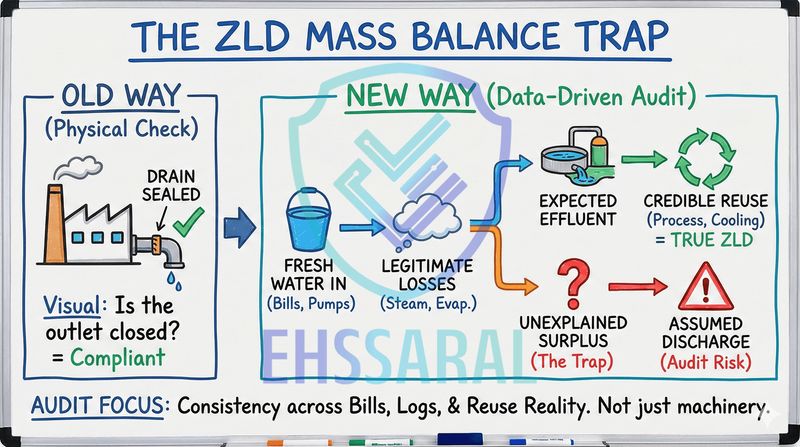
In many Indian plants, Zero Liquid Discharge (ZLD) still feels like a binary concept.
Either:
For years, this understanding worked. Inspections were visual. If the drain was sealed and the ZLD system was running, the discussion usually ended there.
That comfort no longer exists.
Today, inspections conducted under the framework of the Central Pollution Control Board and respective State Pollution Control Boards are no longer limited to what inspectors can see. They are driven by what the numbers quietly reveal.
And this is where many well-intentioned ZLD plants start feeling exposed.
“We don’t discharge outside the gate, so we’re compliant.”
This sentence still comes up frequently during audits, site discussions, and internal reviews.
In day-to-day operations, ZLD compliance was historically judged on:
If the infrastructure existed and appeared functional, plants felt reasonably safe.
Documentation was important, but secondary.
Over the years, inspection methodology has quietly evolved.
Audits today involve:
By the time an inspector enters the plant, a mental water balance has often already been formed.
At this stage, the absence of a physical discharge point does not automatically imply compliance.
Audits have moved from checking drains to checking consistency.
In simple terms:
From a practical standpoint, ZLD is no longer audited as an engineering achievement.
It is audited as a water balance problem.
Instead of asking only how you treat water, auditors evaluate:
This is not about advanced mathematics.
It is about basic consistency across records.
Many plants still overestimate the protection offered by:
In reality, machinery presence does not protect inconsistent data.
Auditors are trained to follow logic, not equipment lists.
Before opening a logbook or asking questions, most inspections follow an internal logic that looks like this:
If these four steps align, inspections move smoothly.
If they don’t, questions begin - calmly, but persistently.
Let’s strip this down to its simplest form, the way it is actually applied on ground.
Fresh Water In
- Legitimate Water Losses
= Expected Effluent Generation
Legitimate losses typically include:
These losses are accepted - if they are realistic and defensible.
Expected Effluent Treated
- Actual Process Reuse Demand
= Unexplained Surplus (Triggers Questions)
This second step is where many plants get uncomfortable.
Because treating water is visible.
Reusing it credibly is harder to demonstrate.
It’s important to clarify something early.
This logic:
This is simply how inspection observations are formed.
Auditors are not trying to catch plants.
They are trying to reconcile numbers that don’t align.
And when numbers don’t align, assumptions fill the gap.
From a plant manager’s perspective, this shift feels unsettling.
Common thoughts we hear:
The discomfort doesn’t come from non-compliance.
It comes from not knowing how the evaluation is being done.
Once that logic is understood, the anxiety usually drops.
Before we go further, one clarification is necessary.
This discussion is not about:
It is about:
Most ZLD issues seen during audits arise from misalignment, not intent.
By the time an inspection reaches this stage, the auditor usually has no allegation in mind.
What they have is a gap.
That gap sits between:
In many Indian ZLD plants, the numbers look something like this:
On paper, everything looks perfect.
That perfection is exactly what creates discomfort.
Auditors are trained to be skeptical of unchanging systems in a changing plant environment. Production fluctuates. Seasons change. Maintenance happens. Utilities vary.
When the effluent number does not move at all, month after month, logic kicks in.
This distinction is important.
Auditors do not start with:
“This plant is bypassing.”
They start with:
“Something here is unaccounted.”
From experience, the silent assumptions tend to be:
These are assumptions driven by missing explanations, not by intent.
When documentation closes the gap, these assumptions dissolve quickly.
This is the most overlooked ZLD vulnerability - and the most misunderstood.
Reusing it credibly is the other half.
A typical scenario looks like this:
The remaining quantity has no clear consumer.
No process.
No utility.
No documented use.
“If you treated 40 KL, but your process only needs 20 KL, where did the remaining 20 KL go?”
If there is no clear answer, the conclusion becomes uncomfortable:
In ZLD audits, lack of utilization evidence is treated the same as discharge, unless clarified.
From the plant’s perspective:
From the auditor’s perspective:
This mismatch of perspectives is where anxiety starts.
This is where inspections shift from discussion to verification.
Auditors rarely rely on a single source. They triangulate.
Common checks include:
If declared intake doesn’t align with these three, everything downstream becomes questionable.
Evaporation is accepted - but not blindly.
Auditors typically look at:
Then comes the silent check:
“Does the energy consumed justify evaporating this much water?”
Claiming high evaporation with:
creates immediate doubt.
This is not about thermodynamics calculations.
It is about physical plausibility.
This is where the utilization trap becomes visible.
Auditors look for:
If recycled water usage:
it raises the same question again:
“Where is the surplus going?”
Sludge is another indirect indicator.
Auditors often compare:
If sludge moisture is consistently high, but disposal weight remains low, it signals:
Again, the issue is alignment, not accusation.
Individually, each record may look reasonable.
The issue arises when:
Audits are designed to connect these dots.
When dots don’t connect, explanations are demanded on the spot - which is the worst time to build logic.
This is the point where many plant teams feel cornered.
Common reactions:
The problem is not ignorance.
It is that audit expectations evolved quietly, while documentation practices stayed static.
Auditors rarely expect complex spreadsheets during inspections.
What they look for is a believable story told by numbers.
A simple internal view that aligns with audit thinking looks like this:
| Parameter | Quantity (KL / Month) |
|---|---|
| Fresh Water Intake | |
| Steam / Evaporation Loss | |
| Product / Process Moisture | |
| Expected Effluent | |
| Effluent Treated (ZLD) | |
| Realistic Reuse Capacity | |
| Declared Discharge (ZLD) | Zero |
Counter-intuitive truth:
Auditors trust realistic variation more than perfect zeroes.
Plants often think perfection protects them.
In audits, believability protects more than perfection.
Read more about Form V Data Variation: Explain Water, Waste & Pollution Changes
This is the most uncomfortable section - because it applies to good plants.
Over the years, the most common failure patterns observed are not technical.
They are organizational and documentation gaps.
No one connects the dots internally.
During inspection, the auditor does it for you - and the gaps surface.
Every year, plants submit the Environmental Statement (Form V).
In practice:
During audits, this becomes a trap.
Auditors compare:
When numbers don’t match, the response often is:
“Form V consultant ne banaya tha.”
Unfortunately, Form V is treated as your official declaration, regardless of who prepared it.
In audits, Form V overrides explanations.
Read More about Form 5 Environmental Statement India: Example & Mistakes
Another common pattern:
Each dataset may be correct individually.
But audits judge alignment, not intent.
This is rarely stated openly, but it matters.
Auditors don’t say “fake”.
They think:
“Backfilled lagta hai.”
Once credibility is questioned, every number becomes suspect.
This is not about software or digitization hype.
It’s about demonstrating authenticity of recordkeeping.
This is not a checklist for perfection.
It is a framework for calm consistency.
Not for submission.
For understanding.
Ask internally:
Instead of hiding variation:
Auditors accept variation when it is acknowledged, not concealed.
Avoid declaring reuse that:
Remember:
Treatment without utilization creates suspicion.
Before filing Form V:
This single step prevents many audit escalations.
Consultants help interpret rules.
They cannot own your data.
Always remember:
Ownership reduces anxiety.
This is one of the most effective, low-stress practices.
Before any inspection, ask:
Do not scroll past this. Open your last month's water bill and your last month's treated effluent log. Do the numbers match within 10%? If not, you have a gap.
If these three answers are clear, inspections usually remain smooth.
This discussion is not about bypassing audits.
It is about understanding how regulators interpret data.
In many inspections, data inconsistency itself is treated as non-compliance, even when no discharge actually occurred.
Over the years, we’ve seen that:
Soft takeaway:
Audit problems usually start on paper, not at the plant gate.
ZLD (Zero Liquid Discharge) means no liquid effluent is discharged outside the plant, and all treated water is reused internally.
MLD (Measured Liquid Discharge) allows treated effluent to be discharged, but only within permitted quantity and quality limits.
From an audit perspective:
This is why ZLD audits feel more data-intensive.
In audits, mass balance is a logic check, not a mathematical exercise.
It means reconciling:
If these numbers don’t align logically, auditors assume something is unaccounted - even if no discharge is visible.
The core concept of ZLD is simple:
All wastewater generated in the plant must be treated and reused within the premises, with no liquid discharge outside the boundary.
In practice, ZLD compliance is judged not only on treatment infrastructure, but on whether treated water has a believable and documented reuse pathway.
ZLD is not universally mandatory for all industries.
It becomes mandatory when:
If ZLD is mentioned in your consent conditions, it becomes a binding compliance requirement, regardless of past practices.
Water bills are treated as primary input data.
Auditors use them to estimate:
If declared effluent or reuse figures don’t align with billed consumption, it raises questions - even if the ZLD system is operating properly.
Because real plants are not static.
Production changes, maintenance happens, seasons vary.
When numbers remain identical month after month, auditors assume:
In audits, believable variation creates more trust than perfect consistency.
Yes - and this is common.
ZLD plants are often flagged due to:
In audits, data inconsistency itself is treated as non-compliance, even if physical discharge did not occur.
Not really.
Auditors do not depend on:
They rely on consistency across your own records:
Templates don’t protect gaps - alignment does.
The most effective method is a shadow audit.
Before inspection, internally check:
When these three answers are clear, inspections usually remain calm.
Assuming that infrastructure alone equals compliance.
In today’s audit environment:
ZLD is judged on numbers, logic, and reuse credibility - not just on machinery.
Most audit issues arise from documentation gaps, not bad intent.

Founder, EHSSaral
Founder - EHSSaral | Partner - Perfect Pollucon | ISO 14001 Lead Auditor | GHG Protocol Scope 2 | Chemist | Data Scientist | Second-generation environmental professional simplifying EHS compliance for Indian industries through practical, automated, tech-enabled, data driven compliance workflows.
Why We Wrote The Indispensable EHS Officer Book (A Realist Guide for India) | EHSSaral

New Labour Codes in India Effective Nov25: Mandatory Appointment Letters & Health Checks | EHSSaral

GRAP Stage IV Explained: What AQI 450+ Means for NCR Factories | EHSSaral

Hazardous Waste Classification in India: Schedule I, Class A, B, C & Inspector’s Guide
 List, Rules & Compliance Guide ehssaral.webp)
Orange Category Industries in India (2026): List, Rules & Compliance Guide
The Hidden Costs of Manual Environmental Compliance in India
 by EHSSaral v1.webp)
EADA Portal & Environment Audit Rules 2025: A Practical Guide for Indian Factories | EHSSaral
 EHSSaral.webp)
Environmental Monitoring Mistakes in Indian Factories (Real Issues Explained)

MPCB Consent Guide: CTE, CTO, Renewal, Fees & Conditions | EHSShala
How EHS Managers Can Verify EPR Credits Before Audit (DIY Guide) | EHSSaral