

Blog
CSR Trends 2026: Environmental Compliance Automation in India | EHSSaral
EHSSaral is an Environmental Compliance Intelligence Platform for Industries. Consent Intelligence • Alerts & Tasks • Incident Reporting • Form IV & V • Audit-Ready Records
See how EHSSaral works
5 Feb 2026
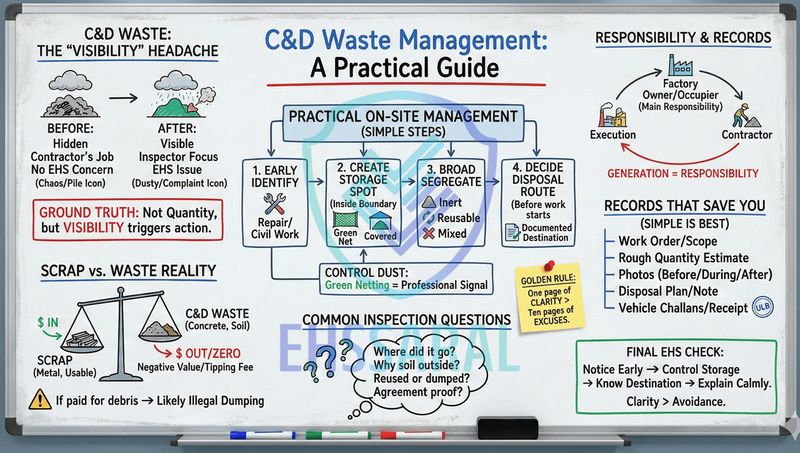
In many Indian factories, construction and demolition waste is not treated as an EHS issue at all.
It is seen as:
Temporary
Civil contractor’s problem
Outside “regular compliance”
And for years, that approach worked.
Until it didn’t.
What usually changes the situation is not a rule update or a notice.
It is visibility.
A pile of debris near the boundary wall.
Loose soil outside the gate.
Dust settling on nearby houses.
A blocked drain during monsoon.
That is when questions start.
Ground truth
“C&D waste is not about quantity. It is about visibility.”
Once waste becomes visible to outsiders, it becomes an EHS issue - even if the quantity is small.
EHS compliance basics for Indian factories
Whenever civil work happens, ask only three questions:
| Question | Why it matters |
|---|---|
| Can outsiders see it? | Visibility triggers complaints |
| Can it spread? | Dust & soil create nuisance |
| Can I explain where it went? | Explanation closes inspections |
Construction & Demolition (C&D) waste is any waste generated from:
Construction work
Demolition of structures
Renovation or modification
Repair and maintenance activity
This applies to factories, warehouses, offices, and project sites.
It is not limited to big construction projects.
Even small civil jobs generate C&D waste.
Across many sites, the same items appear repeatedly:
Broken bricks, concrete, RCC pieces
Excavated soil and mixed debris
Tiles, plaster, marble waste
Doors, windows, wooden frames
Metal scrap from dismantling
Packaging material mixed with rubble
The mistake many sites make is assuming:
“This is just civil debris. It will go away.”
From an inspection point of view, how it goes away matters more than the fact that it goes away.
CPCB Construction & Demolition Waste Management Rules
Most EHS professionals assume inspections happen because someone is “checking compliance.”
In reality, C&D waste attracts attention for different reasons.
Inspectors usually care about:
Dust nuisance
Soil entering storm water drains
Road obstruction
Public complaints
Illegal dumping near highways or open land
Mixing with municipal waste
Reality insight
“Most C&D inspections start from complaints, not paperwork.”
Once a complaint is raised, the focus shifts from:
“How much waste?”
to
“Why was it allowed to create a nuisance?”
At that point, explanations matter less than control measures.
This is where many sites get caught off guard.
On paper, responsibility may be assigned to:
Civil contractor
Project contractor
Maintenance vendor
On ground, responsibility flows differently.
People involved usually include:
Factory owner / occupier
Principal employer
Project owner
Contractor or civil vendor
Facility or EHS team
But during any inspection or notice:
The question is not who was hired
The question is who generated the waste
Key clarity
“Responsibility follows generation, not contract wording.”
Even if the work order clearly states:
“C&D waste disposal is contractor responsibility”
Any communication, notice, or explanation is still expected from the occupier / management, not the contractor.
Important reality
“The Pollution Control Board or municipality will not chase the contractor. They will approach the site occupier.”
This is why blind dependence on contractors creates risk.
Most sites prepare for waste during major construction.
Problems usually arise during routine or ‘small’ works.
Common situations where C&D waste quietly builds up:
New shed construction
Machine foundation and grouting
Flooring replacement or epoxy removal
Drain repair and chamber modification
Office renovation or cabin changes
Demolition of old internal structures
Plant expansion activities
One activity that repeatedly creates trouble is cable trenching.
Contractors dig trenches for:
Power cables
Instrumentation
Utilities
Soil is kept along the road or boundary “temporarily”.
Rain washes it into drains.
Neighbours complain.
Municipal officers arrive.
By then, the issue is no longer about soil.
It is about lack of control.
Across factories of all sizes, the same patterns repeat:
No estimate of waste quantity
→ Appears like poor planning
No temporary storage area
→ Debris spreads beyond boundary
Mixed waste lying openly
→ Dust and nuisance complaints
Soil dumped outside the gate
→ Drain choking and municipal action
“Contractor took it” explanation
→ No traceability
No photographs
→ Nothing to show during inspection
Ground truth
“If you can’t show it, it didn’t happen.”
This is not about perfection.
It is about being able to explain what happened, where it went, and how it was controlled.
C&D waste does not need complex systems.
It needs early attention and basic discipline.
What works across most Indian sites is simple.
Do not wait for debris to appear.
The moment you know that:
Civil work is planned
Repair involves breaking, cutting, or digging
Assume C&D waste will be generated.
Even small repair work counts.
Early identification gives you time to control where waste will be stored and how it will leave the site.
| Do This | Avoid This |
|---|---|
| Store debris inside boundary | Dumping outside gate |
| Use green netting | Leaving debris exposed |
| Take photos | Relying on memory |
| Decide disposal early | Deciding after pile-up |
| Ask destination before exit | “Contractor handled it” |
| Keep simple records | No proof at all |
This one step solves most problems.
Good practices seen on sites:
Storage inside factory boundary
Away from drains and entrances
Not on public roads
The storage area does not have to be permanent or fancy.
It just needs to show intent and control.
Once debris has a defined place, it stops spreading.
Dust and visibility trigger complaints faster than quantity.
Wherever breaking, cutting, or demolition happens:
Use green construction netting
Especially near boundary walls or roads
This serves two purposes:
Controls dust movement
Signals responsibility to outsiders
Reality insight
“Inspectors driving past don’t measure dust. They read signals.”
Green netting is often the first signal that a site is managing work professionally.
Perfect segregation is not expected.
What usually works:
Inert material (concrete, bricks, soil)
Reusable or scrap items
Mixed debris
Avoid mixing:
Municipal waste
Plastic waste
Hazardous waste
The goal is control, not textbook segregation.
Plastic waste management compliance
Most sites decide disposal after debris piles up.
That is when mistakes happen.
Before civil work begins:
Decide where debris will go
Decide who will handle transport
Decide what proof will be collected
When disposal is planned early, documentation becomes easy later.
Reuse of C&D waste is encouraged and commonly accepted.
Across factories, reuse usually happens as:
Broken concrete used for internal road base
Soil reused for internal leveling
Bricks reused for non-structural work
This reduces disposal load and cost.
However, one boundary must be clear.
Important line
“Reuse is encouraged - but only within your premises.”
Sending debris outside the site under the label of “reuse” creates questions and confusion during inspections.
This is where many factories make a costly assumption.
C&D waste is often treated like metal scrap:
Someone will take it
Maybe even pay for it
In reality:
C&D waste usually has zero or negative value
Proper disposal often involves transport cost or tipping fees
Strong warning
“If someone is paying you for debris, it is likely being dumped illegally.”
This does not always mean bad intent.
It often means the contractor is avoiding proper disposal costs.
Golden rule
“A truck leaving your gate without a clear destination is a legal notice waiting to happen.”
Always know:
Where the waste is going
Who is receiving it
What proof you will get
| Aspect | Scrap | C&D Waste | Hazardous Waste |
|---|---|---|---|
| Typical value | Positive | Zero / Negative | Negative |
| Money flow | Money comes in | Money goes out or breaks even | Money goes out |
| Nature | Reusable material | Mostly inert debris | Risk-based |
| Key risk | Theft / accounting | Illegal dumping | Environmental harm |
| Inspector focus | Invoice | Destination & proof | Manifest & authorisation |
| Common mistake | Under-billing | Treating like scrap | Wrong paperwork |
Memory line:
Scrap earns. Hazardous costs. C&D explains.
Disposal options vary by city and availability.
Commonly seen routes include:
Municipal or ULB C&D waste facilities
Authorized recycling facilities
Contractor-managed disposal with proof (proof should be a municipal / authorised facility receipt or a transport document, not just a contractor’s verbal confirmation or internal note)
No option is perfect everywhere.
Reality note
“Destination matters less than documentation.”
Inspectors usually focus on:
Whether disposal was planned
Whether movement can be explained
Whether proof exists
C&D waste records do not need to be bulky.
What usually satisfies inspections:
Work order or contractor scope
Rough estimate of waste quantity
Disposal plan (even a short internal note)
Photographs - before, during, after
Vehicle details or challans (if available)
Receipt from ULB or authorized facility
One caution is important.
Safe receipt tip
A contractor letterhead is not disposal proof. Wherever possible, collect a receipt or acknowledgement with a municipal / authorised facility stamp.
Golden rule
“One page of clarity beats ten pages of excuses.”
One common problem during inspections is wrong comparison.
C&D waste is often treated like:
Scrap
Municipal waste
Or sometimes handled with hazardous waste paperwork
This creates confusion and unnecessary questions.
In simple terms:
Scrap (metal, usable items)
→ Has value
→ Sold with invoice
Hazardous waste
→ Risk-based
→ Requires strict manifests and authorised handlers
C&D waste
→ Mostly inert
→ Low or no value
→ Focus is on where it went, not complex paperwork
A useful way to remember this is money flow:
Scrap: money comes in
Hazardous waste: money goes out
C&D waste: money usually goes out or breaks even
Understanding this difference prevents:
Wrong documentation
Wrong disposal logic
Over-complication during inspections
This distinction matters more than most people realise.
Inspectors do not expect the same level of planning for all activities.
Examples:
Flooring replacement
Drain repairIn many factories, C&D waste manage
Small foundation work
Office renovation
What usually satisfies expectations:
Controlled storage inside boundary
Photographs
One disposal proof or explanation
Examples:
Shed demolition
Full building removal
Large capacity expansion
Here, expectations increase.
Commonly expected:
Identified storage area
Named disposal route
Contractor agreement mentioning disposal responsibility
Basic plan before work starts
Important watch-out
“During demolition or major expansion, sites may quietly fall under ‘bulk generator’ expectations.”
A quiet threshold to watch (Bulk Generator)
In practice, if a site generates more than ~20 tonnes in a day or ~300 tonnes in a full project (for example, demolishing a whole building), authorities may treat it as a bulk waste generator.
This is where planning expectations increase. If you are breaking a full structure, pause and check this before starting.
Small repairs run in 1st gear:
Control
Photos
Basic proof
Large demolition runs in 3rd gear:
Storage planning
Disposal route fixed
Agreement clarity
Same road. Different gear.
That’s how authorities see it.
They rarely remember quantities.
They remember these five things:
Was debris visible from outside?
Was dust controlled?
Did answers sound confident?
Were photos available?
Did the story make sense end-to-end?
If these five are covered, inspections usually move on.
During inspections, questions are usually simple but direct.
Common questions include:
“Where did this debris go?”
“Why is soil stored outside the boundary?”
“Is this reused or disposed?”
“Who handled the disposal?”
“Can I see the agreement with the debris lifter?”
Most trouble starts when answers sound unsure.
Clear, calm explanations supported by photos and records usually close the discussion.
These mistakes are rarely intentional.
But they repeatedly create issues.
Dumping debris outside the boundary
Blocking drains or access roads
Mixing C&D waste with municipal or hazardous waste
Relying fully on contractor statements
No photographs
No disposal clarity
Once again, the problem is not the waste.
The problem is lack of visibility and explanation.
You do not need software or complex registers.
What works consistently:
One simple C&D waste register or note
One photo folder (date-wise)
One short SOP or internal instruction
Security instruction: No vehicle carrying debris leaves the gate unless the Destination in the register is filled. “Local dumping” is not a destination.
This small system:
Protects the EHS officer
Protects the organisation
Saves time during audits and inspections
Gate Rule Memory Trick
No destination = no exit.
If security remembers only this line, half the C&D risk disappears.
C&D waste compliance is not about quoting rules.
It is about:
Noticing the waste early
Controlling where it sits
Knowing where it goes
Being able to explain it calmly
“Good C&D waste management does not need brilliance.
It needs attention and closure.”
If you remember one thing from this guide, let it be this:
“Inspectors respond better to clarity than avoidance.”
C&D waste is not a compliance topic. It is a site-control topic.
When you can calmly show:
Where the waste was generated
Where it was stored
How dust and spread were controlled
Where it finally went
The discussion usually ends there.
Good C&D waste management does not require:
Perfect segregation
Long registers
Heavy documentation
It requires:
Early attention
Basic planning
Honest records
For an EHS officer, this approach does one important thing.
It turns C&D waste from a panic topic into a routine closure task.
And that is exactly where it belongs.
Q1. Is construction and demolition waste applicable to factories?
Yes. Any civil, renovation, repair, or demolition activity inside a factory generates C&D waste and must be managed responsibly.
Q2. Can construction waste be reused inside the factory?
Yes. Reuse such as internal road base or leveling is commonly accepted, but only within the factory premises.
Q3. Is C&D waste considered hazardous waste?
No. C&D waste is generally inert. It should not be handled using hazardous waste manifests or processes.
Q4. Who is responsible for C&D waste disposal - contractor or factory?
The site occupier or principal employer remains responsible, even if the contractor handles disposal.
Q5. When does a site become a bulk generator of C&D waste?
In practice, large demolition or expansion projects generating high volumes may attract bulk generator expectations, requiring advance planning.

Founder, EHSSaral
Founder - EHSSaral | Partner - Perfect Pollucon | ISO 14001 Lead Auditor | GHG Protocol Scope 2 | Chemist | Data Scientist | Second-generation environmental professional simplifying EHS compliance for Indian industries through practical, automated, tech-enabled, data driven compliance workflows.
CSR Trends 2026: Environmental Compliance Automation in India | EHSSaral
Isokinetic Sampling Basics: Simple Guide for Stack Monitoring | EHSShala
CTO Auto-Renewal: Capital Investment Rules 10% & 30% | EHSSaral
Hazardous Waste All Forms Form 1 to Form 12 Guide

Why Environmental Non-Compliance Happens in Indian Industries: 6 System Failures

Environmental Compliance to Sustainability Framework India | EHSSaral
Hazardous Waste Storage Rules in Indian Factories | EHSShala

TSDF Hazardous Waste Process: Manifest, Disposal & Records

Ultimate MPCB Form IV Checklist for Maharashtra Industries

Chemical Accident Emergency Response Guide for Indian Factories | EHSShala