
Blog
Can You Transfer Hazardous Waste Responsibility in India? (What the Law Says)
EHSSaral is an Environmental Compliance Intelligence Platform for Industries. Consent Intelligence • Alerts & Tasks • Incident Reporting • Form IV & V • Audit-Ready Records
See how EHSSaral works
8 Sep 2026
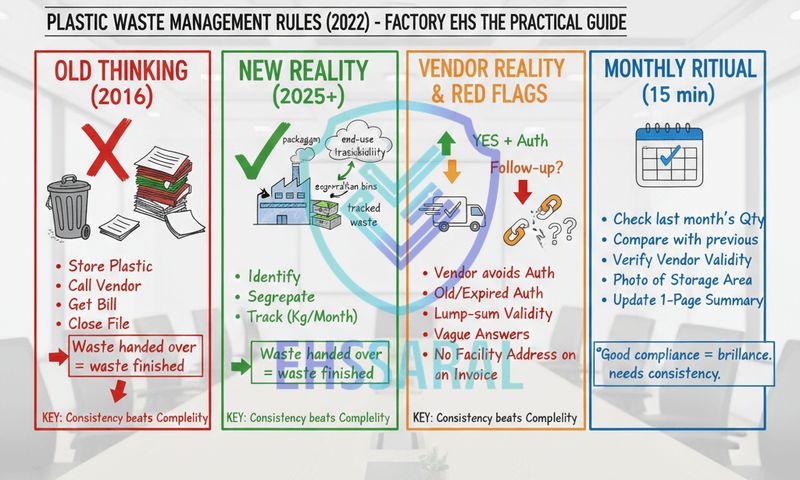
Updated for the Plastic Waste Management (Amendment) Rules, 2025 and 2026
India’s Plastic Waste Management Rules apply differently depending on whether an organisation is a plastic-waste generator, Producer, Importer, Brand Owner, manufacturer or Plastic Waste Processor.
This guide explains these distinctions and translates the Rules into practical actions for Indian factories, warehouses and offices.
In many Indian factories, plastic waste does not appear to be a major compliance concern. It usually accumulates gradually through raw-material packaging, liners, stretch film, discarded containers, bags and dispatch activities.
Because this waste is often recyclable and commercially collected as scrap, responsibility may become divided between stores, administration, production, housekeeping and EHS.
This is where confusion usually starts.
A site may have invoices showing that plastic scrap was sold, but still be unable to explain:
The practical objective is to create a clear connection between plastic entering the premises, plastic discarded at the site and plastic packaging introduced into the market.
This article focuses on that connection. It does not replace the applicable Rules, CPCB directions, EPR portal requirements or state and local-body requirements.
Before reading further, pause for five minutes and answer honestly.
No files. No registers. Just your understanding.
Do we know what plastic waste we generate?
Do we know how much plastic leaves our site every month?
Do we know who finally processes it?
Can we explain this calmly, without panic?
If even one answer feels unclear, you are not alone.
Most EHS officers reach this stage because plastic waste feels:
non-hazardous
recyclable
low-risk
routine
That combination makes it easy to ignore.
Plastic waste is not only what looks like plastic waste.
That assumption causes most gaps.
These are usually noticed and handled:
stretch wrap and shrink films
carry bags
plastic liners
bubble wrap
discarded plastic containers or drums
These are visible, so people remember them.
This is where trouble starts.
secondary packaging from raw materials
plastic sacks cut open and thrown
carton tapes and plastic labels
packaging removed during unpacking
plastic wrap used only “temporarily”
Because this plastic is spread across departments, no one feels ownership.
A common line heard on site:
“This came with the material. It’s not really our waste.”
That assumption is incorrect.
Once packaging or another plastic material is discarded at your premises, it forms part of the plastic waste generated at the site and should be managed through the applicable waste-management system.
This waste-generator responsibility is separate from EPR responsibility for plastic packaging introduced into the market.
Here is a simple exercise that works in almost every factory.
One morning, before work pressure builds up, take a short walk through:
the receiving area
stores
unpacking zone
dispatch gate
Just observe. Don’t inspect.
Most sites discover:
loose plastic films
cut liners
discarded wrap
mixed plastic in scrap bins
In many factories, this walk identifies plastic streams that were not included in the existing waste list or monthly records.
These are usually process blind spots rather than deliberate omissions.
The governing framework is the Plastic Waste Management Rules, 2016, as amended from time to time.
There is no separate replacement law called the “Plastic Waste Management Rules, 2022.” The 2022 amendment inserted detailed Extended Producer Responsibility Guidelines into Schedule II of the 2016 Rules.
The framework now operates at two connected levels.
| Compliance level | Who it mainly concerns | Principal responsibility |
|---|---|---|
| Waste-generator responsibility | Factories, offices, warehouses, institutions and other plastic-waste generators | Minimise generation, prevent littering, segregate plastic at source and hand over segregated waste through the applicable collection or processing route |
| EPR responsibility | Producers, Importers and covered Brand Owners | Account for plastic packaging introduced into the market and fulfil applicable registration, reporting, reuse, recycling, recycled-content and end-of-life obligations |
| Packaging requirements | Manufacturers, Producers, Importers and Brand Owners, depending on the provision | Follow applicable thickness, marking, labelling, certification and product-information requirements |
| Processing responsibility | Registered Plastic Waste Processors | Process plastic waste through registered and environmentally appropriate operations and report through the applicable system |
An organisation may fall into more than one category. For example, a factory may generate plastic waste from incoming material while also placing its own products in plastic packaging on the market.
Official plastic waste management rules
The current framework requires industries to distinguish between two different material flows.
Examples include:
This should be managed as plastic waste under the waste-generator provisions.
Examples include:
This may create EPR obligations depending on the organisation’s legal role.
A scrap invoice can support a waste record, but it does not by itself determine whether the company has fulfilled every applicable waste-generator or EPR obligation.
Plastic discarded at the site and plastic packaging introduced into the market are related, but they are not the same compliance quantity.
Plastic waste creates confusion because:
it is not hazardous
it is generated daily
it looks recyclable
it is handled by many vendors
Because of this, it often slips through systems that are otherwise well-managed.
Hazardous waste gets attention.
E-waste gets attention.
Plastic waste quietly moves out with scrap.
This is one reason plastic waste requires more structured control than its non-hazardous classification may initially suggest.
This guide will help you:
understand what actually counts as plastic waste
see where most factories lose control
know when EPR applies and when it does not
manage vendors without confrontation
keep records that actually protect you
stay calm during inspections
This is not a rulebook.
This is a ground-reality guide.
| Looks organised | Provides stronger operational clarity |
|---|---|
| A large file of scrap invoices | Monthly plastic-waste summary linked to handover records |
| An old vendor document | Current registration, authorisation or approval applicable to the activity |
| Lump-sum scrap bills | Plastic quantity identified separately from metal, paper and other scrap |
| Verbal information about the final recycler | A documented collection and processing route |
| One total plastic figure | Type-wise or category-wise breakup where relevant |
The Plastic Waste Management Rules should be read as the 2016 framework together with its subsequent amendments.
| Year | Important development | Practical relevance |
|---|---|---|
| 2016 | Plastic Waste Management Rules notified | Established responsibilities for waste generators, local bodies, producers, importers, manufacturers and other participants |
| 2018 | Registration and producer-responsibility provisions revised | Strengthened the institutional framework and clarified certain registration responsibilities |
| 2021 | Identified single-use plastic items prohibited through a phased implementation; carry-bag thickness requirements also revised | Industries needed to review purchasing, canteens, packaging and administrative use of prohibited items |
| 2022 | EPR Guidelines for plastic packaging inserted into Schedule II | Introduced a structured portal-based framework for registration, targets, certificates, returns and environmental compensation |
| 2023 | Implementation and portal-related provisions continued to develop | Invoice reconciliation, processor certificates and portal data became increasingly important for PIBOs and processors |
| 2024 | Definitions and provisions relating to biodegradable and compostable plastics, Producers, Importers, manufacturers and reporting were revised | Companies needed to reassess classification, registration and biodegradable-plastic claims |
| 2025 | Alternative methods were introduced for providing specified packaging information, including barcode, QR code, brochure or an applicable unique number | Packaging and regulatory teams needed to review how required information was being communicated |
| 2026 | Recycled-content targets, reuse obligations, local enforcement, processor definitions and audit provisions were revised | Packaging composition, annual-return data and supporting evidence became more important |
The 2025 amendment took effect on 23 January 2025, with the packaging-information options applying from 1 July 2025. It should not be described as a universal mandatory QR-code requirement because the amendment provides multiple permitted methods. MPCB: Plastic Waste Management Amendment Rules, 2025
The 2026 amendment was notified through G.S.R. 237(E) on 31 March 2026. Official Gazette: Plastic Waste Management Amendment Rules, 2026
Let’s put this very simply.
Plastic is not hazardous
Someone takes it away
We have an invoice
Compliance is done
This thinking is deeply ingrained and understandable.
Extended Producer Responsibility, or EPR, places responsibility on covered Producers, Importers and Brand Owners for plastic packaging introduced into the market.
The 2022 EPR Guidelines cover both pre-consumer and post-consumer plastic packaging waste.
Depending on the entity and packaging category, the framework may involve:
A company should not decide EPR applicability using its industry name alone.
| Possible role | Preliminary question |
|---|---|
| Waste generator | Does the site discard plastic from receiving, storage, production, offices or dispatch? |
| Producer | Does the organisation manufacture plastic packaging or otherwise fall within the current definition of Producer? |
| Importer | Does it import plastic packaging, plastic raw material or products carrying plastic packaging? |
| Brand Owner | Does it sell commodities under its registered brand or trademark using plastic packaging? |
| Manufacturer | Does it manufacture plastic raw material, including covered compostable or biodegradable plastic material? |
| Plastic Waste Processor | Does it recycle plastic waste or undertake a recognised end-of-life disposal activity? |
A company can hold more than one role.
Asking whether packaging leaves the site under the company’s brand is useful, but it is not a complete legal test.
Companies should also examine:
Under the EPR Guidelines, the Brand Owner category excludes qualifying micro and small enterprises, but this does not automatically remove their waste-generator duties. Producers and Importers should assess their obligations separately.
When classification is uncertain, confirm it against the current definitions, CPCB directions and the EPR portal requirements rather than relying only on the logo appearing on the packaging.
An FMCG company will commonly have substantial packaging obligations, while an office may primarily be a waste generator. However, sector-based assumptions are not sufficient.
For example:
The correct starting point is the organisation’s activity and material flow, not whether the industry appears to be a high or low plastic user.
For site-level segregation, industries commonly distinguish between rigid plastic, flexible plastic, multilayered packaging, compostable plastic and other difficult-to-process plastic.
For EPR reporting, the packaging categories have specific meanings.
| EPR category | Broad description |
|---|---|
| Category I | Rigid plastic packaging |
| Category II | Flexible plastic packaging made from a single layer or multiple layers of different plastics, including plastic sheets, covers, carry bags and pouches |
| Category III | Multilayered plastic packaging containing at least one plastic layer and at least one layer of material other than plastic |
| Category IV | Plastic sheets or similar material used for packaging, and carry bags made from compostable plastic |
| Category V | Plastic packaging made from biodegradable plastic |
Category V was added through the 2024 amendment. It should therefore not be omitted from a guide updated through 2026.
Operational names and EPR categories should not be mixed without checking the packaging construction. For example, “multilayer plastic” made entirely from different plastic layers may fall under Category II, while packaging combining plastic with aluminium or paper may fall under Category III.
The packaging supplier’s specification can help establish the appropriate classification.
Instead of remembering rule numbers, it helps to think in terms of control points.
From a factory point of view, plastic waste management works if five things are under control:
Identification
Segregation
Quantity tracking
Appropriate handover route
Continuity of records
If these five are stable, most inspections remain calm.
The first failure usually happens here.
Many sites say:
“We generate very little plastic.”
What they actually mean is:
“We have not identified all plastic sources.”
Plastic is generated at:
receiving
unpacking
stores
production
dispatch
If plastic is generated in five places but responsibility is assigned to one person, gaps appear.
Practical tip:
List plastic sources department-wise once.
After that, tracking becomes easier.
Segregation does not mean complex systems.
It means:
plastic separate from metal scrap
flexible plastic separate from rigid plastic
no food waste mixed with plastic
Most problems start when plastic is mixed and sold as “scrap”.
Once mixed, it becomes difficult to prove authorised processing.
This is why inspectors often look at bins, not files.
Some flexible and multilayered plastic streams may not have a practical mechanical-recycling route. Depending on the material and applicable requirements, recognised end-of-life options may include co-processing, waste-to-energy, waste-to-oil or use in road construction under applicable guidelines.
The 2026 amendment revised the definition of end-of-life disposal and expressly included these routes. It also clarified that conversion into feedstock chemicals or production of new plastic is treated as recycling rather than end-of-life disposal.
Before using any route, verify:
A co-processing certificate can support the record, but the complete collection and processing chain should remain understandable.
The Rules do not make one informal estimation method suitable for every situation.
For ordinary site-level waste tracking, a factory may use:
The method should be consistent and capable of being explained.
For EPR returns, recycled-content obligations and certificate reconciliation, organisations need stronger quantity controls because portal figures may be compared with procurement, production, sales, GST, processor and annual-return data.
At a minimum, record:
| Record field | Example |
|---|---|
| Date | 5 August 2026 |
| Plastic stream | LDPE stretch film |
| Source | Raw-material receiving |
| Quantity | 126 kg |
| Measurement method | Platform scale |
| Recipient | Name of collection agency or processor |
| Supporting document | Handover slip or invoice number |
| Intended route | Recycling |
Material variations should be investigated rather than automatically adjusted to match an annual total.
Rule 8 is the principal provision dealing with plastic-waste generators.
In practical terms, a waste generator should:
Institutional generators are also expected to segregate and store waste in accordance with the applicable solid-waste framework and hand over segregated waste to the appropriate waste-processing, disposal or collection system.
The Rules recognise channels involving local bodies, Gram Panchayats, agencies appointed by them, registered waste pickers, registered recyclers and waste-collection agencies, depending on the applicable provision and local arrangement.
From a practical standpoint, check:
The last question helps prevent ordinary scrap-disposal documents from being mistaken for EPR-fulfilment evidence.
Rule 11 concerns marking and labelling. It should not be described as the waste-generator handover rule.
The 2025 amendment allowed a Producer, Importer or Brand Owner, from 1 July 2025, to provide specified information through one of the following routes:
The concerned entity must inform CPCB about the method used. CPCB is required to maintain and periodically update the corresponding list.
The amendment does not mean that every plastic package is subject to a universal QR-code-only requirement.
The 2026 amendment further provides that recycled plastic packaging or a recycled plastic commodity should:
Compostable and biodegradable plastic packaging also carries separate certification, marking and labelling considerations under the applicable provisions.
Packaging artwork should therefore be reviewed by regulatory, quality, packaging and EHS teams together.
The 2026 amendment affects PIBOs, processors, regulators and local enforcement authorities. Not every change creates an additional duty for an ordinary factory that is only a waste generator.
The following targets apply to Producers, Importers and Brand Owners for the covered packaging quantities.
| Plastic packaging category | 2025–26 | 2026–27 | 2027–28 | 2028–29 onward |
|---|---|---|---|---|
| Category I | 30% | 40% | 50% | 60% |
| Category II | 10% | 10% | 20% | 20% |
| Category III | 5% | 5% | 10% | 10% |
Important: These targets apply to the relevant obligations of covered Producers, Importers and Brand Owners. Before applying them, confirm the entity’s role, packaging category, applicable statutory exceptions and current CPCB portal requirements.
For Category III, the target is limited to the weight of the plastic layers in the multilayered packaging.
The targets may not apply where the use of recycled plastic is prohibited under an applicable law, regulation, rule, mandatory Indian Standard or specified statutory requirement. The basis for claiming such an exception must be provided in the annual return.
Recycled plastic already present in imported material cannot be counted directly towards the Importer’s recycled-content obligation.
The amendment provides for the quantitative obligation to be fulfilled through certificates purchased from Producers, Importers or Brand Owners that have used recycled content beyond their obligation. CPCB is to develop the exchange mechanism on the centralised portal.
This certificate mechanism should not be confused with recycling certificates generated by registered Plastic Waste Processors.
The carry-forward facility is not a general postponement of all EPR targets.
For Producers, Importers and Brand Owners, it applies to the unfulfilled 2025–26 mandatory recycled-content target for plastic packaging used in food-contact applications.
The shortfall may be carried forward for up to three consecutive years beginning in 2026–27, provided:
A separate carry-forward provision applies to the specified 2025–26 Category I rigid-packaging reuse obligation of Brand Owners.
The amendment expressly identifies local bodies, Gram Panchayats and district-level Panchayats as enforcement authorities for specified waste-generator, plastic-use and prohibited-item provisions within their jurisdictions.
For factories, this means plastic-waste compliance should not be viewed only as a CPCB or SPCB portal matter.
The amendment inserts Registered Environment Auditors into specified inspection, verification and audit provisions.
This does not mean every factory automatically needs to appoint an Environment Auditor. It means that such auditors may participate in regulatory verification where the relevant provision is invoked.
This is a very common failure point.
A typical sequence seen on ground:
factory appoints Vendor A
Vendor A’s authorisation expires
Vendor A subcontracts to Vendor B
factory keeps receiving invoices
inspection checks recycler details
At this point, the paper trail breaks.
Even though the factory acted in good faith, responsibility comes back.
These signs usually indicate trouble later:
vendor avoids sharing authorisation
authorisation copy is very old
recycler name missing on invoice
no facility address mentioned
answers change when questioned
You don’t need confrontation.
You need verification.
Set a documented verification frequency based on the document’s validity, the waste route and the risk involved. Also recheck the arrangement when:
A quarterly review may be a useful internal practice, but it should not be presented as a frequency prescribed by the Plastic Waste Management Rules.
More records do not mean better compliance.
Useful records are simple and logical.
monthly plastic waste summary (kg)
category-wise breakup
current vendor authorisation
handover slips or invoices
These records tell a story.
lump-sum scrap invoices
no weight breakup
expired certificates
documents without dates
These create confusion instead of clarity.
Inspections do not start at the table.
They often start at:
back gate
scrap storage area
stormwater drains
If plastic is found where it should not be, paperwork loses value.
This is why physical control matters more than files.
| Common assumption | Question likely to arise | What provides clarity |
|---|---|---|
| “Plastic is non-hazardous” | How is it being segregated and managed? | Identified waste streams and a clear handover route |
| “The vendor manages it” | In what capacity is the vendor collecting it? | Registration or approval applicable to the activity |
| “We have invoices” | Do the invoices identify plastic and quantity? | Linked quantity, recipient and processing records |
| “The quantity is small” | Is it consistently segregated and handed over? | A proportionate but repeatable system |
| “We explained it verbally” | Can the explanation be supported? | Accessible records and responsible ownership |
Avoid relying only on a document titled “Plastic Waste Management Rules, 2022 PDF.” The governing framework is the Plastic Waste Management Rules, 2016 together with subsequent amendments.
For current compliance, review the base Rules, Schedule II EPR Guidelines, amendments issued through 2026 and applicable CPCB portal directions. The CPCB Plastic Waste Management Rules page should be used as the primary reference point.
Good plastic waste compliance does not need complex software or expensive consultants.
It needs discipline.
A minimum workable system is enough.
one responsible owner
one plastic waste register
one vendor file
one monthly review
This may be sufficient for an ordinary waste generator, but PIBOs and Plastic Waste Processors require additional records and controls.
Once every month, review the previous month’s plastic-waste records and physical storage conditions.
This small habit prevents most surprises.
Once a month, preferably on the first Monday:
check last month’s plastic quantity
compare with previous month
verify vendor authorisation validity
take a photo of plastic storage area
update a one-page summary
Fifteen minutes is enough.
This ritual keeps plastic waste visible.
Most compliance issues are not sudden.
They build slowly:
one missed check
one expired authorisation
one untracked quantity
Monthly review catches these early.
“Good compliance is not brilliance.
It is consistency.”
Ask one practical question:
If someone asks at 3 PM on a Friday, “Show me how last July’s plastic waste was managed,” can the responsible person provide the records within ten minutes?
A clear response should show:
For a PIBO, the response may also need to connect the quantity with packaging procurement, sales, EPR returns, certificates and recycled-content evidence.
This is an internal readiness test, not a legal time limit.
Whenever plastic waste feels confusing, come back to these five questions:
Do I know what plastic we generate?
(Across receiving, stores, production, dispatch)
Do I know how much plastic goes out every month and how it was measured?
(Use a consistent and documented method.)
Is the collection or processing route valid and appropriate today?
(Check current registration, approval or other applicable documentation.)
Can I explain where the plastic finally goes?
(End-use, not just handover)
Is plastic visible on site, not hiding in corners?
(Back gate and scrap area check)
If all five are under control, most problems disappear quietly.
Plastic-waste compliance becomes manageable when the organisation answers three questions separately:
The first two questions concern site-level waste control. The third determines whether the EPR framework also applies.
A practical system should connect stores, procurement, production, dispatch, finance, packaging, quality and EHS. No single department normally holds all the required information.
Clear role identification is therefore more important than maintaining a large file of disconnected records.
The governing law is the Plastic Waste Management Rules, 2016, as subsequently amended.
Important amendments were issued in 2018, 2021, 2022, 2023, 2024, 2025 and 2026. The latest amendment covered in this article is the Plastic Waste Management (Amendment) Rules, 2026, notified on 31 March 2026.
No. The 2022 amendment modified the Plastic Waste Management Rules, 2016 and inserted the EPR Guidelines for plastic packaging into Schedule II.
It is more accurate to refer to the Plastic Waste Management Rules, 2016, as amended.
Rule 8 principally covers the responsibilities of plastic-waste generators.
It deals with minimising generation, preventing littering, segregating and storing plastic waste at source and handing over segregated waste through the applicable collection or processing system.
Rule 11 covers marking and labelling requirements.
It should not be cited as the rule requiring factories to hand over plastic waste to processors.
No.
EPR applies to covered Producers, Importers and Brand Owners. A factory that only receives materials in plastic packaging and discards that packaging may primarily be a waste generator.
However, the factory should examine whether it also manufactures packaging, imports packaged products, repackages goods or sells products under its brand.
The EPR Guidelines exclude qualifying micro and small enterprises from the covered Brand Owner category.
This exclusion should not be automatically applied to a company acting as a Producer or Importer. It also does not remove the organisation’s responsibilities as a plastic-waste generator.
It is a strong screening indicator, but it is not the only test.
The company should examine the current definitions, ownership of the brand, imported packaging, contract-manufacturing arrangement, packaging procurement and the entity introducing the packaged product into the market.
The collection route should comply with Rule 8, applicable local arrangements and any registration, authorisation or approval relevant to the activity.
Do not rely only on a general scrap invoice. Confirm who is collecting the plastic, where it will go and who will process it.
The 2025 amendment provides several ways for covered entities to communicate specified packaging information. These include a barcode or QR code, a product-information brochure or an applicable unique number.
It should therefore not be described as a universal QR-code-only requirement.
Under the 2026 amendment, the mandatory recycled-plastic content reaches:
Statutory exceptions may apply where recycled plastic use is not permitted under an applicable law, regulation, rule or mandatory standard.
No.
The 2026 carry-forward provision is limited to specified 2025–26 obligations. It should not be interpreted as a general right to postpone all EPR, recycling or recycled-content targets.
A proportionate operational record may include:
PIBOs require additional EPR, packaging, certificate, portal and annual-return records.
The Rules do not prescribe a universal quarterly check for every waste generator.
Set the review frequency according to document validity, vendor changes, processing route and internal risk. Reverification should occur whenever the collector, processor, facility or waste stream changes.
Recognised end-of-life disposal routes may include co-processing, waste-to-energy, waste-to-oil and road construction under applicable guidelines.
The factory should confirm that the processor, material, documentation and claimed quantity are appropriate for the selected route.
The 2026 amendment expressly strengthens and clarifies enforcement roles for local bodies, Gram Panchayats and district-level Panchayats within their respective jurisdictions.
Plastic-waste compliance is therefore not only a CPCB or SPCB portal matter.
Regulatory requirements may be supplemented by CPCB directions, portal procedures, SPCB/PCC requirements and local bye-laws. Organisations should confirm the requirements applicable to their activities, packaging and jurisdiction.

Founder, EHSSaral
Founder - EHSSaral | Partner - Perfect Pollucon | ISO 14001 Lead Auditor | GHG Protocol Scope 2 | Chemist | Data Scientist | Second-generation environmental professional simplifying EHS compliance for Indian industries through practical, automated, tech-enabled, data driven compliance workflows.
Can You Transfer Hazardous Waste Responsibility in India? (What the Law Says)
The ZLD Mass Balance Trap: How Auditors Calculate Effluent Using Your Water Bills | EHSSaral
Environmental Compliance Management in India: Systems vs Consultants Explained

Managing Safety Without Authority: Handling Protected Contractors in Indian Plants | EHSSaral
Why BMW Inspections Feel Stricter Today (India) | EHSSaral

150 Essential EHS Terms Explained Simply | EHSShala
EHSShala Foundations - Core Environmental Basics for EHS Officers
Environmental Calendar from Consent Conditions (Practical Guide) | EHSShala
MPCB Consent Guide: CTE, CTO, Renewal, Fees & Conditions | EHSShala
Consent Conditions Explained: What Factories Must Actually Follow After Approval | EHSShala