
Blog
Environmental Inspection India: What Inspectors Check | EHSSaral
EHSSaral is an Environmental Compliance Intelligence Platform for Industries. Consent Intelligence • Alerts & Tasks • Incident Reporting • Form IV & V • Audit-Ready Records
See how EHSSaral works
18 Sep 2026
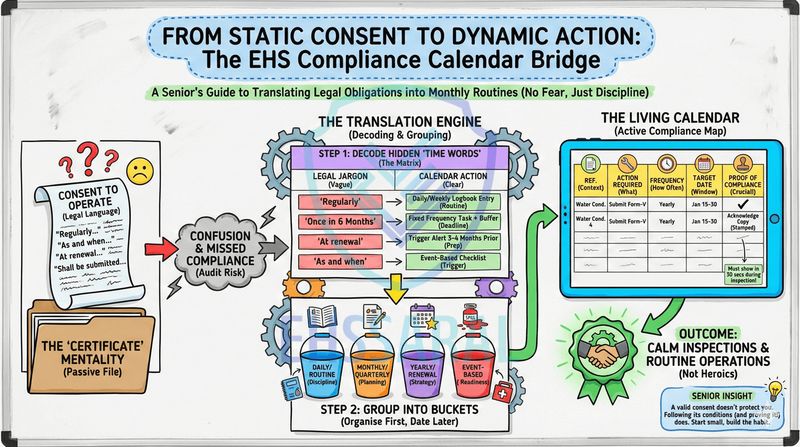
How to convert your Consent copy into monthly compliance actions
An environmental calendar from consent conditions is a system that converts consent obligations into routine, trackable actions.
Let’s clear one uncomfortable truth first.
Most factories that face compliance issues do have a valid Consent.
The problem is not absence of permission.
The problem is absence of translation.
In many factories, the Consent copy is treated like a certificate:
On the shop floor, it rarely acts like an operating document.
After 20+ years of seeing inspections, renewals, and audits, one pattern is very common:
Compliance gaps don’t happen because conditions are strict.
They happen because conditions are never converted into daily or monthly actions.
The Consent tells you what must happen.
But nobody converts it into who will do it, when, and how often.
That gap is where trouble starts.
Consent conditions are not written in calendar language.
They are written in legal language, meant to cover all scenarios, not daily operations.
Typically, a Consent copy has:
For a junior EHS officer, this creates two problems:
You won’t see:
Do this every month on the 10th.
You will see:
These words look harmless.
But each one demands a different type of calendar action.
If you don’t decode them properly, you either:
Both are dangerous.
Checkout our LinkedIn Post on this topic:
In consent terms, an Environmental Calendar is not a lab schedule.
It is a compliance action map.
It answers five simple questions:
Think of it like this:
Monitoring is only one part of it.
A proper consent-based calendar includes:
If your calendar only tracks sampling dates, it is incomplete.
Read more about Environmental Monitoring Calendar for Industries
On ground, this is what usually happens:
Nobody is wrong here.
But nobody is owning the full picture.
A lab’s job ends with analysis.
A consultant’s job ends with filing.
The factory, however, carries the responsibility.
A useful way to think about it:
Your consultant is like your lawyer.
You wouldn’t ask your lawyer to come every morning to check whether you locked the gate.
Operations and compliance routines must live inside the factory.
That is exactly what a consent-based calendar creates.
Before converting anything into a calendar, do this once:
You are not judging compliance yet.
You are only extracting obligations.
This clarity is important before we move to the next step.
Because now comes the most critical skill.
Read more about SPCB Consent Explained for Junior EHS Professionals
Consent conditions rarely say “monthly” or “quarterly” clearly.
Instead, they hide time inside words.
And if you can’t translate those words correctly, no calendar will help.
In the next section, we will break down these “time words” and show how each one converts into a clear calendar action.
This is where most compliance confusion silently begins - and where it can be solved calmly.
(This is where most calendars either become useful or useless)
Most Consent copies don’t fail you.
They just don’t speak your language.
They speak regulatory language.
Your job is to translate it into calendar language.
This translation depends on spotting what we call “time words”.
These are words that look harmless but quietly decide:
Let’s break this down calmly.
Below are the most common time words seen in Indian Consents, and what they actually mean on the factory floor.
This is one of the most dangerous words in a Consent.
What people assume:
What inspectors expect:
Calendar translation:
Example:
If there is no routine record, “regularly” becomes “never” during inspection.
Read more about Environmental Compliance Calendar Software
These are straightforward, but often mishandled.
Common mistake:
Calendar translation:
Example:
Never keep such tasks “floating”.
Floating tasks are forgotten tasks.
This does not mean “do it when renewal starts”.
It means:
Calendar translation:
Example:
Most renewal stress comes from missing this translation.
To get regular alerts about your tasks, sign up to our free reminder tool for your organisation
This is not a calendar date.
This is an event trigger.
Common mistake:
Calendar translation:
Example:
You don’t schedule events.
You prepare for them.
This is a proof-based condition.
The action is not complete until:
Calendar translation:
Example:
If proof is missing, the task is incomplete - even if you did the work.
Many factories proudly say:
Sir, hum monitoring regularly karte hain.
But during inspection, the question is different:
Calendars fail when they track activity, not obligation.
Consent conditions create obligations.
Calendars must reflect that.
This needs to be said calmly.
Some consent conditions are linked to a Bank Guarantee.
That means:
Senior perspective:
These are not just tasks.
They are cheques you have already written.
When converting conditions into a calendar:
No fear.
Just awareness.
A common mistake is jumping straight to dates.
Don’t do that yet.
First, group actions into buckets:
This grouping gives clarity.
Once grouped:
A good calendar is built top-down, not date-first.
Here is the shift experienced EHS officers make:
They stop asking:
When is this due?
And start asking:
What type of obligation is this?
Once you classify the obligation correctly,
the calendar almost builds itself.
Once you’ve translated the consent language, the next mistake many people make is over-engineering the calendar.
Remember this:
A calendar is not a rulebook.
It is a reminder system.
Its job is to make sure nothing important is forgotten.
Let’s keep this practical.
Every calendar entry should answer five simple questions.
If even one is missing, tracking becomes weak.
Whether you use Excel, a diary, or software, your calendar should have these columns:
Senior insight:
If you can’t show proof in 30 seconds, the task is considered pending.
Let’s look at some real-world examples that are often missed.
Consent wording:
Calendar translation:
This is not monitoring.
But it is checked during inspection.
Consent wording:
Calendar translation:
Many factories miss this because there is no fixed date.
Consent wording:
Calendar translation:
This is where “regularly” gets enforced.
This section saves more time than any software.
Do not put everything into the calendar.
Specifically avoid adding:
If a condition was about:
Do not keep tracking it again unless the consent explicitly demands repetition.
This is a common confusion.
Correct separation:
Example:
Do not paste SOPs into calendars.
Calendars must stay light.
Old consents often carry forward conditions that are no longer relevant.
If unsure:
Overloaded calendars are ignored calendars.
Another ground reality:
Not all consent conditions carry the same risk.
Some are:
Treating everything as equally urgent leads to burnout.
Senior approach:
A calendar is meant to reduce panic, not create it.
Once you add a “proof of compliance” column, something changes.
Teams start asking:
This thinking aligns your factory with how inspectors think.
And that alignment reduces friction during inspections.
Let’s clear a common misunderstanding.
This calendar should not be owned by:
Each has a role, but ownership must sit inside the factory.
A practical ownership model that works on ground:
A consultant supports interpretation and filing.
A lab supports testing and analysis.
But the calendar is your internal control system.
A simple way to explain this to management:
The consultant files papers.
The factory creates the data.
Even well-meaning teams make these mistakes. Seeing them early helps avoid years of stress.
Daily logbooks and yearly renewals cannot be managed the same way.
Without prioritisation:
A calendar should show rhythm, not noise.
Each Consent is specific:
Copying another unit’s calendar often creates:
Labs manage sampling, not compliance timelines.
They will not:
That responsibility always comes back to the factory.
Some teams spend weeks making beautiful sheets.
Then:
A simple calendar that is reviewed monthly works better than a perfect one that sits untouched.
This is where many people mix things up.
Think of it like this:
Example:
Both are needed.
One decides the obligation.
The other executes it.
They should talk to each other, not compete.
Consent copies are static PDFs.
Operations are dynamic.
That gap is where things fall through.
EHSSaral does not replace thinking.
It helps prevent forgetting.
In simple terms, it helps by:
It turns a long consent document into a living checklist - without changing your responsibility.
You don’t need a 50-line calendar on day one.
Start small.
A senior, realistic approach:
Start with 10 clear actions.
Not 50 vague ones.
Focus first on:
Once these run smoothly, expand gradually.
Compliance is built through habit, not heroics.
A valid Consent does not protect a factory.
Following its conditions does.
Factories that stay compliant year after year are not the richest or the most automated.
They are the most disciplined.
When consent conditions are converted into clear calendar actions:
Environmental compliance stops feeling like a surprise exam
and starts feeling like routine operations.
And that is exactly how it is meant to work.
It is a working calendar created by reading your Consent to Operate conditions and converting them into clear actions with frequency, responsibility, and proof.
It is not just about monitoring. It includes logbooks, submissions, displays, and renewal-related tasks.
A monitoring calendar tracks sampling and testing dates.
A consent-based environmental calendar tracks everything the consent expects you to do, including monitoring, records, submissions, and event-based actions.
Both are needed. One decides what is required. The other decides when sampling happens.
“Regularly” usually means a routine record, not an occasional activity.
In practice, it translates to daily, shift-wise, or weekly logbook entries, depending on the process.
If there is no routine record, inspectors treat it as non-compliance.
It means the action is event-based, not date-based.
You don’t schedule it on a calendar, but you must be prepared with a checklist and proof when the event happens (for example, hazardous waste disposal or process change).
Some conditions, especially related to pollution control systems or past non-compliance, are linked to Bank Guarantees.
If these conditions are missed, the risk is not just a remark but forfeiture of already blocked money.
Such conditions should be marked as high priority in your calendar.
The calendar should be maintained inside the factory, usually by the EHS officer.
Consultants help with interpretation and filing.
Labs help with sampling and analysis.
But ownership of routine compliance must stay with the factory.
No.
The calendar should only track what to do and when.
SOPs explain how to do it.
Mixing SOPs into the calendar makes it heavy and unusable.
Inspectors usually look for simple, clear proof such as:
If proof is missing, the action is treated as incomplete, even if the activity was done.
Actions linked to renewal should start 3–4 months before consent expiry.
Waiting till the renewal application stage creates panic and missing data issues.
A good calendar triggers renewal preparation well in advance.
Excel can work if:
Problems start when Excel sheets are created once and never reviewed.
Digital tools help by reminding, tracking gaps, and preventing forgetting - but discipline matters more than the tool.
Because consultants usually handle documents and submissions, not daily operations.
Compliance issues arise when routine actions and records inside the factory are weak or inconsistent.
A consent-based calendar bridges this gap.
Start small.
Track 10 clear actions, not 50 vague ones.

Founder, EHSSaral
Founder - EHSSaral | Partner - Perfect Pollucon | ISO 14001 Lead Auditor | GHG Protocol Scope 2 | Chemist | Data Scientist | Second-generation environmental professional simplifying EHS compliance for Indian industries through practical, automated, tech-enabled, data driven compliance workflows.
Environmental Inspection India: What Inspectors Check | EHSSaral
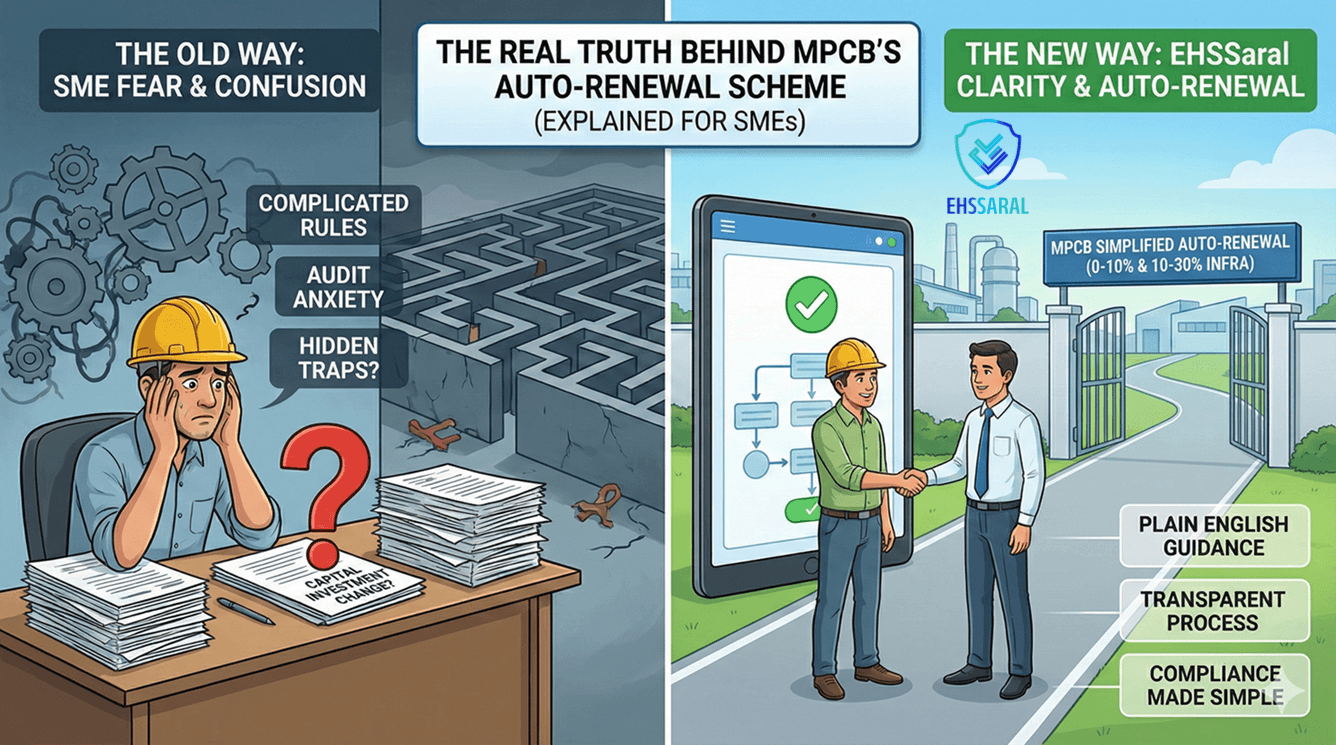
CTO Auto-Renewal: Capital Investment Rules 10% & 30% | EHSSaral
 based on Pollution Index (PI) scores for 2025 environmental compliance V1.webp)
Industry Categorization in India: Red, Orange, Green, White & Blue | EHSShala
The Paper Shield: PF & ESIC Challans vs Real Compliance Risk | EHSSaral
Maharashtra SME Plastic Waste EPR Guide: Are You a Brand Owner | EHSSaral
 ehssaral.webp)
Hazardous Waste Form 4 Portal Errors (MPCB & GPCB Fix Guide)
Stack Monitoring Basics for Indian Factories | EHSShala

Sampling Basics for Air, Water & Noise EHS Officer Guide | EHSShala
Form 3 Logbook Explained: Simple Guide for Indian Factories | EHSShala
Environmental Monitoring Guide for Indian Factories: Air, Water & Noise | EHSShala