
Blog
ESG Data Management for Indian Factories | EHSSaral
EHSSaral is an Environmental Compliance Intelligence Platform for Industries. Consent Intelligence • Alerts & Tasks • Incident Reporting • Form IV & V • Audit-Ready Records
See how EHSSaral works
19 Jul 2026
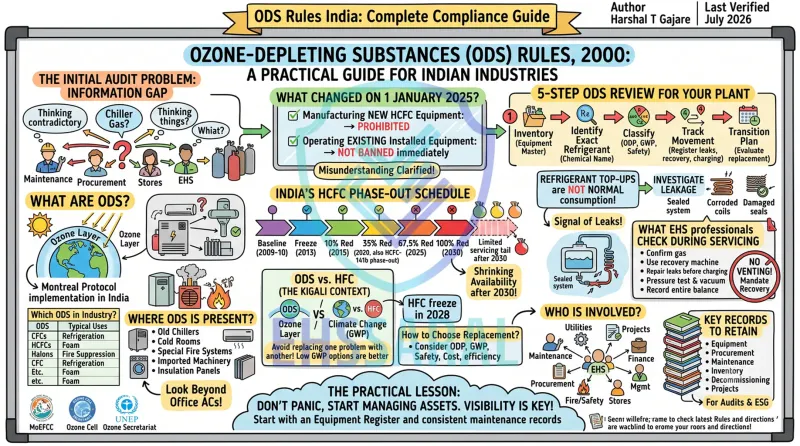
During an audit, someone asks a simple question:
“Which refrigerant is used in this chiller?”
Maintenance says it may be R-22.
Procurement says refrigerant is handled by the HVAC contractor.
Stores has a few cylinders, but the labels are not clear.
EHS has service invoices, but no equipment-wise refrigerant record.
This is where ODS compliance usually begins.
Not with a complicated legal issue. With a simple information gap inside the plant.
The Ozone-Depleting Substances Rules, 2000 are often treated as rules relevant only to refrigerant manufacturers, chemical companies and importers.
However, ozone-depleting substances may still be present inside:
The important point is simple.
The restriction on manufacturing new HCFC-based equipment from 1 January 2025 does not automatically make every existing R-22 chiller illegal.
At the same time, plants should not ignore old HCFC equipment.
They should identify the refrigerant, investigate repeated gas top-ups, check contractor practices and prepare a practical replacement plan.
Ozone-depleting substances, commonly called ODS, are chemicals that can damage the ozone layer when released into the atmosphere.
The ozone layer protects life on Earth by absorbing a large portion of harmful ultraviolet radiation from the sun.
Several chemicals once widely used in refrigeration, air-conditioning, fire protection, foam manufacturing, fumigation and industrial cleaning were later found to damage this protective layer.
The Ozone-Depleting Substances (Regulation and Control) Rules, 2000 control the production, import, export, sale, purchase, consumption and specified uses of these substances in India.
The Rules were notified under the Environment (Protection) Act, 1986 as part of India’s implementation of the Montreal Protocol.
Read more about Environmental Laws in India (Complete Guide)
| Substance group | Common historical uses |
|---|---|
| CFCs | Refrigeration, air-conditioning, aerosols, foam blowing and cleaning |
| HCFCs | Refrigeration, air-conditioning, chillers, process cooling and foam manufacturing |
| Halons | Specialised fire-suppression systems |
| Carbon tetrachloride | Chemical processing, cleaning and solvent applications |
| Methyl chloroform | Metal cleaning and industrial solvent applications |
| Methyl bromide | Fumigation and quarantine applications |
Most factories do not manufacture these chemicals.
However, they may still be present in old equipment, old cylinders, imported machines or specialised systems.
Do not limit the review to office air conditioners.
Check:
Some older specialised fire systems may contain halons.
These may be found in:
Do not assume that every fire extinguisher contains an ozone-depleting chemical.
Normal water, foam, dry chemical powder and carbon-dioxide extinguishers should not be classified as ODS equipment without checking the actual extinguishing agent.
Confirm the agent from:
ODS may historically have been used in:
Some older processes may have used controlled substances for:
Old containers can remain unnoticed when only a trade name is written on the label.
From 1 January 2025, HCFCs cannot be used in the manufacture of new equipment covered by the phase-out schedule introduced through the 2014 Amendment Rules.
This may affect manufacturers of:
The date was not introduced through a new rule in 2025.
It had already been prescribed through the 2014 Amendment Rules.
Our LinkedIn Post explaining Ozone Depleting Substances (Regulation and Control) Rules, 2000
The 1 January 2025 restriction does not automatically stop an existing R-22 or HCFC-22 chiller from operating.
The practical position is:
| Situation | Practical meaning |
|---|---|
| Manufacturing new equipment using HCFCs | Prohibited from 1 January 2025 |
| Operating previously installed HCFC equipment | Not automatically prohibited by this restriction |
| Servicing existing HCFC equipment | Subject to controlled availability and applicable requirements |
| Buying another HCFC-based machine | Avoid unless there is a strong technical reason |
| Running old equipment without a replacement plan | Breakdown risk, repair difficulty and refrigerant cost may increase |
An old R-22 chiller does not need to be shut down only because the calendar crossed 1 January 2025.
However, the plant should know:
This is an asset-management issue as much as an environmental issue.
India is reducing HCFC production and consumption in stages.
| Milestone | HCFC reduction schedule |
|---|---|
| Baseline | Average of 2009 and 2010 |
| 2013 | Freeze at baseline level |
| 2015 | 10% reduction |
| 2020 | 35% reduction |
| 2025 | 67.5% reduction |
| 2030 | 100% reduction |
| 2030–2040 | Limited servicing tail of 2.5% of the baseline annual average |
The limited servicing tail after 2030 should not be understood as normal or unrestricted HCFC availability until 2040.
It is a restricted provision for eligible servicing needs.
Plants should not plan long-term operations on the assumption that R-22 will remain easily available and affordable.
HCFC-141b was widely used as a foam-blowing agent.
India completed its phase-out in the foam sector from 1 January 2020.
Import licences for HCFC-141b were also prohibited from that date under the 2019 Amendment Rules.
This is relevant to:
Even factories that do not directly handle HCFC-141b may encounter the transition through suppliers of insulation materials, cold-room panels and foam products.
Read more about Chemical Accidents Rules, 1996: A Practical Guide for Indian EHS Officers
List every machine or system that may contain a refrigerant, foam-blowing chemical or specialised fire-suppression agent.
Record at least:
Do not depend only on memory.
Verify the details from:
In many plants, the equipment nameplate says R-22, but the latest service report only says “gas charging – 18 kg.”
There is no leak location, no recovery quantity and no record of what happened to the old refrigerant.
During an audit, this information gap creates more questions than the presence of the old equipment itself.
Descriptions such as “AC gas,” “Freon,” “cooling gas” or “fire gas” are not enough.
Record the actual refrigerant or chemical designation.
Examples include:
Trade names can create confusion because one brand family may contain different chemicals.
Always confirm the chemical designation.
Each refrigerant should be checked for:
This prevents one common mistake.
A plant may replace an ozone-depleting refrigerant with another refrigerant that creates a future climate, safety or engineering problem.
Maintain an equipment-wise refrigerant register.
| Date | Equipment | Refrigerant | Quantity recovered | Quantity added | Reason | Leak repaired | Contractor |
|---|
Also record:
A controlled spreadsheet reviewed every month is often enough to identify repeated leaks and unexplained consumption.
The purpose is not to create paperwork.
The purpose is to know where the refrigerant went.
Not every old HCFC asset needs to be replaced immediately.
Replacement priority should be based on actual plant conditions.
| Factor | Give higher replacement priority when… |
|---|---|
| Age | Equipment is near or beyond its useful life |
| Leakage | Refrigerant is added frequently |
| Energy use | Power consumption is high |
| Reliability | Breakdowns affect production |
| Refrigerant availability | Servicing is becoming difficult |
| Safety | Retrofit creates pressure, toxicity or flammability concerns |
| Capacity | Equipment no longer meets process needs |
| Technology | Better alternatives are available |
| Project planning | Replacement can be included in an approved capital plan |
A planned replacement is usually easier than an emergency replacement after a compressor failure during peak production.
In many plants, refrigerant top-up is recorded like grease, oil or filters.
This is not the right way to understand it.
A refrigeration system is normally a closed system.
Refrigerant should not be repeatedly consumed like diesel or furnace oil.
Small losses may happen during repairs, component replacement or servicing. However, repeated top-ups need investigation.
Refrigerant loss may occur because of:
Whenever gas is added, ask two questions:
A top-up entry should be treated as:
One top-up does not automatically prove non-compliance.
But repeated top-ups without investigation should not be accepted as routine maintenance.
EHS and utilities teams should occasionally observe actual servicing work.
Do not depend only on the final invoice.
Ask the contractor:
The service report should clearly show:
The contractor performs the technical work.
The plant still needs visibility over what chemical was handled, how much was used and what corrective work was completed.
ODS management should not remain only with EHS.
| Department | Practical responsibility |
|---|---|
| EHS | Regulatory understanding, inventory review and environmental records |
| Maintenance | Equipment condition, leaks and servicing history |
| Utilities | Chillers, refrigeration systems and refrigerant use |
| Projects | Selection of new equipment and technology |
| Procurement | Equipment, refrigerant and contractor controls |
| Fire and safety | Identification of fire-suppression agents |
| Stores | Cylinder stock and issue records |
| Finance | Lifecycle cost and replacement budget |
| Management | Approval of replacement and transition plans |
A common pattern is:
Procurement buys the refrigerant.
Stores receives the cylinder.
Maintenance gives it to the contractor.
The contractor charges the system.
Finance clears the invoice.
EHS sees the record only during an audit.
A common refrigerant register connects these activities.
Possibly.
But changing the refrigerant is an engineering modification. It is not simply a gas replacement.
The change may affect:
Some low-global-warming refrigerants are flammable.
Ammonia can be suitable for many industrial applications, but it requires proper design, ventilation, leak detection and emergency controls.
Carbon dioxide systems may operate at much higher pressures than conventional systems.
Be careful with claims such as “direct replacement” or “drop-in gas.”
Compatibility should be confirmed for the specific equipment by a competent refrigeration professional.
This distinction is important when selecting replacement equipment.
CFCs and HCFCs can damage the ozone layer.
Their ozone impact is commonly measured through ozone-depletion potential.
HFCs generally do not damage the ozone layer.
However, many HFCs have high global-warming potential.
They are being phased down internationally under the Kigali Amendment.
India’s HFC baseline is calculated using average production and consumption during 2024, 2025 and 2026.
India’s scheduled pathway is:
| Milestone | HFC control |
|---|---|
| 2024–2026 | Baseline calculation period |
| 2028 | Freeze |
| 2032 | 10% reduction |
| 2037 | 20% reduction |
| 2042 | 30% reduction |
| 2047 | 85% reduction |
This means a refrigerant may have zero ozone-depletion potential but still have a high climate impact.
Do not replace an old HCFC machine only by checking whether the new refrigerant has zero ODP.
Also check:
Otherwise, the plant may solve today’s ozone issue and create another replacement problem later.
There is no single refrigerant suitable for every plant.
The selection should consider:
A pharmaceutical cold room, an office air-conditioning system and a large dairy refrigeration plant may need completely different solutions.
The objective is not to promote one refrigerant.
The objective is to make the next equipment purchase with a longer-term view.
Even when a normal equipment owner does not have the same reporting requirements as a producer or importer, internal records are still useful.
These records can support:
Formal obligations depend on what the organisation actually does.
A closer review may be needed where the organisation:
An ordinary factory operating old air-conditioning equipment may have different obligations from an importer, refrigerant seller or equipment manufacturer.
Check the current requirement based on the actual substance, quantity and activity undertaken.
Not always.
The plant may still purchase, store, use or operate equipment containing controlled substances.
Even where formal registration does not apply, refrigerant management is still important.
No.
The restriction concerns the use of HCFCs in manufacturing new equipment.
Existing equipment is not automatically prohibited by that specific restriction.
This is also incorrect.
The official schedule reaches 100% reduction in 2030, followed by only a limited servicing tail.
Availability, servicing capability and cost may become more uncertain.
HFCs generally do not damage the ozone layer.
However, several HFCs have high global-warming potential.
The contractor performs the technical service.
The plant should still know:
Repeated top-ups normally indicate refrigerant loss.
The reason should be identified and recorded.
Not without a technical assessment.
Pressure, flammability, toxicity, oil, seals, compressor compatibility and system controls may be different.
Check whether your plant can answer these questions:
If several answers are unclear, the plant may not yet have a refrigerant failure.
But it does have an information gap.
That is the right place to start.
These are Indian environmental rules that control the production, import, export, sale, purchase, consumption and specified uses of substances that damage the ozone layer.
Yes.
R-22, also called HCFC-22, is an ozone-depleting substance covered under India’s HCFC phase-out framework.
The restriction from 1 January 2025 concerns manufacturing new equipment using HCFCs.
It does not automatically prohibit every R-22 chiller installed earlier.
However, leakage, service records and replacement planning should be properly managed.
Servicing of existing equipment forms part of the controlled HCFC phase-out system.
Availability is affected by production, import, consumption and quota controls.
Plants should purchase refrigerant through proper channels and keep clear purchase and usage records.
No.
India’s schedule reaches 100% reduction in 2030.
Only a limited servicing tail is provided during 2030–2040.
It should not be understood as unrestricted supply.
HFCs generally do not damage the ozone layer.
However, many have high global-warming potential and are covered under the Kigali Amendment phase-down.
Not necessarily.
Replacement should be prioritised based on:
It may be possible.
However, the alternative refrigerant must be checked for compressor compatibility, oil, seals, pressure, cooling capacity, controls and safety.
Ask for:
Not necessarily.
Registration and reporting depend on the substance, activity, quantity and regulatory category.
A producer, importer, seller or specified industrial user may have different obligations from an ordinary equipment operator.
Do not panic only because an old R-22 machine is still operating.
First identify the refrigerant.
Then check leakage, service records, equipment condition and remaining useful life.
The real issue is not always the old machine.
The bigger issue is operating it without knowing:
Good ODS compliance starts with a clear equipment register and consistent maintenance records.
It does not need panic.
It needs visibility, proper servicing and planned replacement.
Regulatory note: This article reflects the Ozone-Depleting Substances (Regulation and Control) Rules, 2000 and the amendment framework listed by the Government of India’s Ozone Cell, including the 2014 and 2019 Amendment Rules, as reviewed in July 2026. Plant-specific requirements should be checked based on the latest Rules, schedules, licences, quota orders, government directions and the actual activity carried out by the facility.
Links:

Founder, EHSSaral
Founder - EHSSaral | Partner - Perfect Pollucon | ISO 14001 Lead Auditor | GHG Protocol Scope 2 | Chemist | Data Scientist | Second-generation environmental professional simplifying EHS compliance for Indian industries through practical, automated, tech-enabled, data driven compliance workflows.
ESG Data Management for Indian Factories | EHSSaral

Ultimate MPCB Form IV Checklist for Maharashtra Industries
Hazardous Waste Compatibility & Segregation Guide India
Form V Data Variation: Explain Water, Waste & Pollution Changes
Industrial Siting Criteria in India: Factory Location Guide
Maharashtra SME Plastic Waste EPR Guide: Are You a Brand Owner | EHSSaral
Water & Effluent Sampling Basics for Indian Factories | EHSSHala
Environmental Consultancy Software: Beyond Excel & WhatsApp

How to Read Your Consent Copy (CTE & CTO Explained Simply) | EHSShala
 EHSSaral v1.png)
EADA Random Audit Assignment: Factory Readiness Guide (2025) | EHSSaral