Environmental Laws in India (Complete Guide) | EHSShala

Environmental Laws in India (Complete Guide) | EHSShala

Industrial Compliance Guide Environmental Rules India Environmental Compliance India EHSShala Foundations Pollution Control Laws
Last updated:

19 Feb 2026

|
Read time: 50 min read

India’s Environmental Governance Structure

Start Here Before Reading This Guide

If you have not read the EHSShala Start Section, please go there first.
 It explains how to use EHSShala, how topics are layered, and how to build your EHS foundation step-by-step. 


India’s Environmental Governance Structure - Explained Simply

Understanding Indian environmental laws becomes 10 times easier when you first understand who controls whatwho enforces what, and how the system actually works on the ground.

This is where most EHS beginners get confused.

Indian environmental governance has four major pillars:

  1. MoEFCC – Policy, laws, national strategies
  2. CPCB – Standards, guidelines, national oversight
  3. SPCB / PCC – State-level implementation & enforcement
  4. NGT & Judiciary – Interpretation, penalties, environmental justice

Each one has a different personality, different mandate, and different expectations from industries.

Let’s break it down the way an experienced EHS practitioner would teach a junior officer.

How MoEFCC, CPCB & SPCB Work in India: Expert Guide | EHSShala


Ministry of Environment, Forest and Climate Change (MoEFCC)

“The brain and policy architect of India’s environmental system.”

MoEFCC is the apex authority for environmental protection in India.
 It is responsible for:

  • Creating and updating environmental Acts
  • Issuing national policies and strategies
  • Implementing international agreements
  • Notifying rules under EPA 1986
  • Overseeing CPCB and State Boards
  • Handling large national-level projects
  • Representing India in global climate and environmental forums

Why MoEFCC matters for EHS professionals

Although you may not interact with MoEFCC directly, almost everything you do at a factory level - stack emission limits, hazardous waste rules, EPR rules, water discharge norms - all originate from MoEFCC notifications.

When MoEFCC updates a rule, the entire compliance ecosystem shifts.

Common mistakes beginners make

  • Thinking MoEFCC = CPCB
  • Assuming MoEFCC gives CTO/CTE (they do not)
  • Not checking MoEFCC notifications after major pollution incidents
  • Using outdated Acts/Rules from Google

Best insider tip

Always read the latest MoEFCC notifications, because State Boards follow them strictly.

Even a small change (e.g., new Chemical Storage guideline) can create new compliance responsibilities overnight.


Central Pollution Control Board (CPCB)

“The national referee - sets the rules of the game.”

CPCB works under MoEFCC.

It is responsible for:

  • Setting national standards for air, water & noise
  • Creating guidelines for sampling, monitoring, analysis
  • Preparing model formats for consents & returns
  • Issuing directions to State Boards
  • Running national programs (NAMP, mapping polluted rivers, etc.)
  • Conducting inspections for critical/large industries
  • Managing national portals (OCEMS, EPR, etc.)

How CPCB affects daily operations

Every EHS officer uses CPCB documents without even realizing it:

  • Effluent discharge standards
  • Stack emission standards
  • Ambient air quality limits
  • Hazardous waste categories
  • Noise limits
  • Sampling and analysis methods (IS/ CPCB guidelines)

Ground reality

CPCB rarely interacts with SMEs directly.
 But when they do - it is usually serious:

  • Major pollution incidents
  • River pollution
  • Illegal hazardous waste disposal
  • Non-compliance by Red-category units

Real example from industry

During inspections, CPCB teams often check:

  • Whether monitoring reports match historical trends
  • Whether sampling points follow correct protocol
  • Whether OCEMS data matches lab-maintained logs
  • Whether ETP/STP operations are consistent

They respect factories that maintain transparency and proper documentation.


State Pollution Control Board (SPCB) / Pollution Control Committee (PCC)

“The actual enforcement power.”

SPCBs are the real frontline authority for industries.

They:

  • Issue CTE and CTO
  • Conduct inspections & audits
  • Grant/renew registrations (Hazardous Waste, Plastic Waste, E-Waste, etc.)
  • Issue show-cause notices
  • File prosecutions
  • Collect samples for legal purposes
  • Maintain the state pollution database

This is the most important section for SMEs

Because 90% of environmental compliance work revolves around meeting SPCB expectations.

What SPCB officers look for during inspections

  • Working condition of pollution control systems
  • Whether actual production matches consented production
  • Stack/ETP/STP operation quality
  • Waste storage and manifest system
  • Whether required lab testing is done
  • Logbooks (ETP/STP, waste storage, fuel consumption)
  • Housekeeping and safety

Common SME mistakes leading to notices

  • Using outdated consent
  • Forgetting annual returns
  • Incorrect hazardous waste labeling
  • Non-functional ETP/STP
  • Storing waste without manifest
  • Using DG sets without valid stack monitoring
  • Improper record keeping

Insider best practice

Always maintain 3 layers of documentation:

  1. Raw data (logs, instruments, continuous records)
  2. Monthly compliance records (stack, effluent, ambient)
  3. Annual statutory returns (HAZ return, PWM, EPR, etc.)

This layered documentation ensures that even if staff changes or a consultant leaves, your compliance trail is intact.


National Green Tribunal (NGT)

“The environmental court of India.”

NGT handles:

  • Environmental violation cases
  • Large-scale pollution incidents
  • Compensation disputes
  • Appeals against SPCB orders
  • Critical national-level environmental issues

Why NGT matters

Because NGT judgments often change:

  • Interpretation of environmental laws
  • Responsibilities of industries
  • Penalty structures
  • How State Boards enforce rules
  • Environmental norms for entire sectors

Ground reality

Industries rarely ‘go to NGT’ unless:

  • A large accident occurs
  • A closure order is challenged
  • A citizen complaint escalates
  • A community files a PIL
  • River/groundwater contamination is alleged

When SMEs should be cautious

If notices escalate from:

  1. Inspection report
  2. Show cause
  3. Closure direction
  4. Prosecution

…there is a possibility of NGT involvement.


District & Local-Level Authorities

“The often ignored but very powerful layer.”

These include:

  • District Collector
  • Municipal Corporations
  • Local Environmental Cells
  • Industrial Area Development Authorities
  • Fire Department
  • Factories Inspectorate

When do they get involved?

  • Complaints from citizens
  • Odour, dust, smoke issues
  • Overflowing drains / drainage contamination
  • Noise disturbances
  • Dumping in open lands
  • Fire/explosion events
  • Issues affecting public health

Most underrated risk

Even if SPCB is satisfied, local complaints can trigger:

  • Joint inspections
  • Media attention
  • Political pressure
  • NGT petitions
  • Closure threats

For SMEs, “neighbour complaints” are one of the biggest sources of trouble.


How All These Authorities Work Together (Actual Workflow)

1. MoEFCC → CPCB

Makes laws → CPCB frames guidelines → states follow them.

2. CPCB → SPCB

Sets standards → SPCB enforces them.

3. SPCB → Industry

Grants consent → checks compliance → takes action.

4. Complaints → Local Authorities → SPCB

Local bodies escalate issues to SPCB.

5. SPCB/CPCB → NGT

Serious cases go to NGT.

Combined view

The ecosystem is interconnected, but not complicated once seen as a flow:

Policy → Standards → Enforcement → Compliance → Oversight


What Environmental Authorities Expect from Industries

1. Honesty + Transparency

Don’t hide incidents. Report them responsibly.

2. Documentation

If it’s not documented, it did not happen.

3. Preventive maintenance

Pollution control equipment should never be “symbolic.”

4. Updated consents

Many SMEs forget consent renewal dates.

5. Proper waste handling

Labeling, storage, manifest → the most common mistake area.

6. Responsiveness

Reply to notices within time.

7. Respectful communication

Never argue or challenge inspectors.
 Show cooperation and clarity.


Real-Life Mistakes Many SMEs Make (and Lessons)

Mistake 1 - Only reacting during notice time

Lesson: Environmental compliance must be monthly, not annual.

Mistake 2 - Relying 100% on consultants

Lesson: Consultants help, but accountability stays with the company.

Mistake 3 - Not training staff

Lesson: Your ETP operator is more important than your consultant.

Mistake 4 - Poor housekeeping

Lesson: First impressions decide the mood of inspections.

Mistake 5 - Unaware of new rules

Lesson: Rules under EPA 1986 change frequently.


Insider Best Practices (From 25+ Years in Industry)

1. Keep an “Environmental Filing Room”

Separate files for air, water, waste, stack, ambient, returns, etc.

2. Use a Compliance Calendar

Monthly → Quarterly → Annual → One-time tasks

3. Maintain a communication log

Record every visit, call, and query from authorities.

4. Keep 6 months of monitoring history ready

Inspectors always ask for trends.

5. Keep Consent conditions printed

Operators must know limits.

6. Maintain OCEMS consistency

Data mismatches trigger suspicion. (Read here OCEMS Data Gaps and how to fix)

7. Never delay sampling

Avoid “last day rush.”

8. Keep PPE and safety signs ready

Shows professionalism.


Why Understanding Governance Structure Makes You a Better EHS Officer

Most juniors focus only on:

  • Stack testing
  • Water samples
  • Hazardous waste movements
  • Consent renewal

…but don’t understand the larger system.

Once you understand:

  • Why CPCB sets that limit
  • Why SPCB asks for that record
  • Why MoEFCC changed that rule
  • Why NGT takes strict action

…your entire EHS mindset becomes stronger.

This is the difference between:

A reactive compliance officer vs
 A strategic EHS manager who never gets surprised.


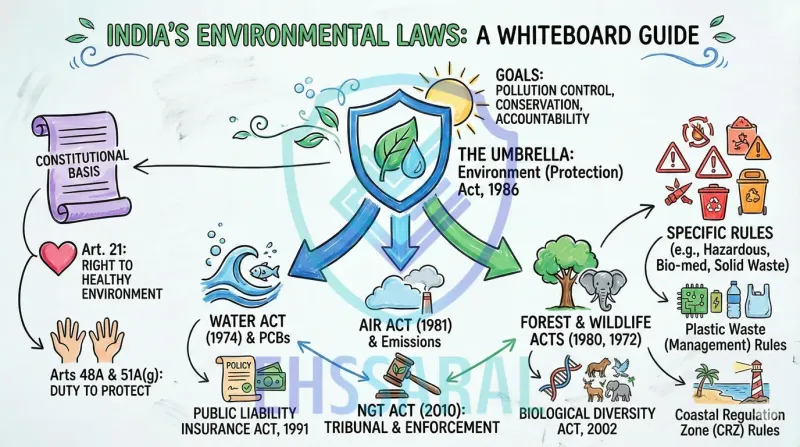
Core Environmental Acts (1947–2000)

Indian environmental laws did not appear overnight.
 They evolved slowly - sometimes because of scientific research, sometimes because of international pressure, and sometimes because of tragedies like the Bhopal Gas Disaster (1984).

This section explains the major environmental Acts between 1947–2000 in simple language, with practical examples from Indian industries.

We will cover:

  • Water Act
  • Water Cess (historical context)
  • Air Act
  • Environment Protection Act
  • Public Liability Insurance Act
  • Biological Diversity Act
  • Major amendments

Each Act will be explained like a senior EHS mentor teaching a junior officer - simple, practical, experience-based.


The Water (Prevention and Control of Pollution) Act, 1974

“India’s first big environmental law - the foundation of modern regulation.”

The Water Act, 1974 is the reason we have:

  • State Pollution Control Boards
  • Consent to Operate (CTO)
  • Sampling of water effluent
  • Effluent standards
  • Penalties for water pollution

It was India’s first major environmental law after independence.

Why this Act was created

In the early 1970s, industrial growth led to rising water pollution in rivers like:

  • Ganga
  • Damodar
  • Yamuna
  • Sabarmati

States struggled to enforce pollution controls.
 A central framework was needed.

Key features (explained simply)

1. Creation of SPCBs

Although SPCBs existed in some form before, the Water Act gave them proper legal power.

2. Consent to Operate

No industry can discharge wastewater without a valid consent.

3. Standards for effluent

Discharge limits for pH, TSS, BOD, COD, heavy metals, oil & grease, etc.

4. Sampling powers

Inspectors can enter premises, collect samples, and prosecute.

5. Penalties

Imprisonment + fine for polluting water bodies.

Practical industry impact

Every ETP operator today is basically working under the framework of this Act.

Common SME mistakes

  • Running ETP only during inspections
  • Not maintaining logbooks
  • Overflowing drains
  • Relying only on tanker disposal (without manifest)
  • Using outdated consent parameters

Insider Tip

Always keep ETP logbook + lab reports + flow meter readings updated.
 If these three match, 80% of Water Act compliance is solved.


Water (Prevention & Control of Pollution) Cess Act, 1977

“A historic Act - now repealed, but important for context.”

This Act used to charge industries a “water cess” based on the quantity of water consumed.

It was repealed in 2017, but older industries still remember the paperwork.

Why it mattered

  • Forced industries to record water usage
  • Encouraged recycling
  • Promoted water conservation

Why it was removed

Because the GST era simplified many such levies and the cess became redundant.

Why EHS officers should still know this

Some older audit formats and consultants still refer to “CESS returns.”
 You should know that:

Water Cess Act = Not in force anymore.


The Air (Prevention and Control of Pollution) Act, 1981

“The law that controls every chimney, DG set, boiler, and stack.”

The Air Act covers:

  • Emission standards
  • Stack height rules
  • DG set norms
  • Fuel usage
  • Monitoring and testing
  • Penalties for air pollution

Why the Air Act was introduced

After the 1972 Stockholm Conference, India committed to stronger environmental regulation.

Air pollution in industrial clusters (especially in western and northern India) was rising rapidly.

Key features

1. Consent to Operate includes air conditions

Stack emissions, fuel type, operating hours, etc.

2. SPCBs can set emission limits

Based on local conditions.

3. Mandatory stack monitoring

PM, SO₂, NOx, CO, etc.

4. Sampling and inspections

Boards can collect samples any time.

5. Penalties & closure

SPCBs can issue closure orders for serious violations.

Real factory examples

  • A boiler using low-quality coal → high PM → notice
  • DG set without acoustic enclosure → noise complaint
  • Foundry with no dust collector → immediate inspection
  • Chemical units emitting VOCs → strong action

Common SME mistakes

  • Not monitoring DG set emissions
  • Using unapproved fuel (like wood, tyre chips, plastic waste)
  • No stack monitoring for small boilers
  • Leaking ducting
  • Bypass lines in pollution control equipment

Insider Tip

Always maintain Stack Testing Reports (quarterly) in one file.
 Inspectors ask for them 90% of the time.


The Environment (Protection) Act, 1986

“The most powerful environmental law in India.”

EPA 1986 was born after the Bhopal Gas Tragedy (1984) - one of the worst industrial disasters in history.


Read more about Evolution of EHS in India:


Because of Bhopal, India needed:

  • A single umbrella law
  • Quick emergency powers
  • Ability to create rules rapidly
  • Stronger penalties

EPA is that law.

Why EPA matters the most

ALL major environmental rules come under this Act:

  • Hazardous Waste Rules
  • Solid Waste Rules
  • Plastic Waste Rules
  • Biomedical Waste Rules
  • E-Waste Rules
  • Battery Waste Rules
  • Ozone Rules
  • Construction & Demolition Rules
  • Noise Rules

EPA is the reason we have a modern compliance system.

Key strengths of EPA

1. Emergency powers

MoEFCC can immediately issue directions.

2. Ability to create RULES

EPA is like the root law.
 Rules are like branches.

3. Strong penalties

Up to 7 years imprisonment.

4. Covers everything air + water don’t cover

Chemicals, hazardous waste, pollution control equipment, safety, etc.

Common SME mistakes

  • Not knowing which Rules apply
  • Ignoring amendments
  • Using outdated categories
  • No manifest system
  • Not filing annual returns

Insider Tip

EPA is the Act where changes happen frequently.
 Follow MoEFCC notifications regularly.

This is where EHSShala becomes valuable - simplifying these updates.


The Public Liability Insurance (PLI) Act, 1991

“An Act many SMEs ignore - until something goes wrong.”

PLI Act mandates that industries handling hazardous substances must:

  • Take an insurance policy
  • Create an Environment Relief Fund (ERF contribution)
  • Provide immediate relief to victims in case of an accident

Who must comply

All industries handling hazardous chemicals listed under:

  • MSIHC Rules
  • CPCB Hazardous Substances list

Why this Act matters

After major chemical incidents in the 80s and 90s, the government realized:

Accident victims must get instant relief, not wait for long legal battles.

Practical example

Chemical spill → nearby worker injured → PLI must pay immediate compensation.

Common SME mistakes

  • Not taking policy
  • Taking wrong sum insured
  • Not renewing annually

Insider tip

Every industry storing hazardous chemicals (even small quantities) should maintain:

  • PLI Policy
  • ERF Contribution receipt
  • MSIHC applicability analysis

Auditors often ask for this.


The Biological Diversity Act, 2002

(Technically outside 2000, but important to include for completeness.)

This Act regulates:

  • Access to biological resources
  • Use of traditional knowledge
  • Biodiversity conservation

Who must comply

Industries using:

  • Herbs
  • Plant extracts
  • Biological materials
  • Traditional formulas

Especially pharma, cosmetics, Ayurvedic, biotech companies.

Real risk

Industries importing biological resources without approvals can face penalties.

Why this Act is important

Many SMEs don’t even know they fall under this law.


Other Important Environmental Acts (Quick Summary)

National Environment Tribunal Act (1995)

For handling large-scale accidents.

National Environment Appellate Authority Act (1997)

Replaced later by NGT Act (2010).

Forest Conservation Act (1980)

Controls diversion of forest land.

Wildlife Protection Act (1972)

Controls hunting, wildlife trade, etc.

Coastal Regulation Zone (CRZ) Notifications

For industries near coastal areas.


Why EHS Officers Must Know These Acts (Practical Angle)

1. To understand WHY rules exist

Rules without Acts = no context.
 Acts without rules = no implementation.

2. To interpret consent conditions better

Every condition comes from some Act or Rule.

3. To reply to notices confidently

Authorities respect officers who understand the law.

4. To avoid over-reliance on consultants

A consultant helps.
 But responsibility stays with the industry.

5. To grow in career

Senior EHS roles require mastery of Acts + Rules.


Summary Till Now

Here’s the full picture:

  • Water Act → Controls water pollution
  • Air Act → Controls air pollution
  • EPA 1986 → Umbrella law for almost all Rules
  • PLI Act → Mandatory insurance for hazardous industries
  • Biodiversity Act → Controls biological resource use
  • Forest & Wildlife Acts → Protect natural resources

These Acts are the backbone of Indian environmental compliance.


Rules Under the Environment Protection Act, 1986 - The Real Everyday Compliance Work

EPA 1986 is like the root law.
 The Rules under EPA are the branches that touch every industry daily.

If you are an EHS professional, 90% of your time is spent navigating the Rules - not the Acts.

We will explain the Rules in simple language, the way a senior environmental consultant teaches a junior officer.


Why Rules Were Created Under EPA

Acts alone cannot cover everything.
 Industries change.
 Technology changes.
 Pollution patterns change.

Rules allow the government to:

  • Update norms quickly
  • Respond to incidents
  • Introduce new responsibilities
  • Strengthen enforcement
  • Clarify industry expectations

This flexibility is the strength of EPA.


List of Major Rules Under EPA, 1986 

We will cover:

  1. Hazardous and Other Waste Rules
  2. Solid Waste Management Rules
  3. Plastic Waste Management Rules
  4. E-Waste Management Rules
  5. Biomedical Waste Rules
  6. Battery Waste Management Rules
  7. Construction & Demolition Waste Rules
  8. Ozone Depleting Substances Rules
  9. Noise Pollution Rules
  10. Fly Ash Notification
  11. Chemical Accidents & MSIHC Rules (overview)

Each section includes practical ground-level interpretation for SMEs and EHS officers.


Hazardous and Other Waste (Management & Transboundary Movement) Rules, 2016

“The most important rule for manufacturing industries.”

These Rules govern:

  • Hazardous waste generation
  • Storage
  • Transport
  • Disposal
  • Manifest system
  • Annual returns
  • Authorization
  • Labelling

Who must comply?

Any industry generating:

  • Spent solvents
  • Oily sludge
  • Waste oil
  • Chemical sludge
  • ETP sludge
  • Used containers
  • Paint waste
  • Resin waste
  • Discarded chemicals
  • Contaminated PPE

Key Compliance Requirements

1. Hazardous Waste Authorization

Separate from CTO.
 Must be renewed periodically.

2. Storage norms

  • Impermeable flooring
  • Covered shed
  • Bund walls
  • Fire safety measures
  • Drainage prevention

3. Labelling rules

Labels must include:

  • Category
  • Quantity
  • Date of storage
  • Container type

4. Manifest system

Form 10 manifest = the most powerful document in hazardous waste compliance.

Tracks:

  • Generator → Transporter → Recycler/TSDF

Inspectors check this first.

5. Annual Returns (Form 4)

Must match manifests + recyclers’ returns.

Common SME Mistakes

  • Mixing different wastes
  • Wrong labelling
  • No manifest copies
  • Storing waste for >90 days
  • Using unauthorized transporters
  • Using local scrap dealers
  • Under-reporting waste quantities

Insider Tip

Maintain a Hazardous Waste Register with:

  • Opening stock
  • Monthly generation
  • Dispatches
  • Closing balance

This register saves companies during inspections.


Solid Waste Management Rules, 2016

“Applies to every industry - even non-manufacturing ones.”

These rules cover:

  • Segregation
  • Storage
  • Collection
  • Transport
  • Disposal of solid waste

Compliance Requirements

1. Segregation at source

  • Wet
  • Dry
  • Domestic hazardous (batteries, medicines, bulbs)

2. Tie-up with authorized waste collectors

Industries cannot give waste to unauthorized vendors.

3. Prohibition of burning waste

Common violation in industrial areas.

Common SME Mistakes

  • No segregation
  • Mixed bins
  • Using temporary local collectors
  • Burning garden waste

Why it matters

Even small waste mismanagement can cause:

  • Odour complaints
  • Mosquito breeding
  • Fires
  • NGT escalation


Plastic Waste Management Rules, 2016 (Amended 2021–2022)

“The biggest compliance shock for thousands of SMEs.”

These Rules introduced:

  • EPR (Extended Producer Responsibility)
  • Banning of single-use plastics
  • Responsibilities for brand owners
  • Registration on the EPR portal
  • Annual returns

Who is a ‘Brand Owner’?

Any business whose name or logo appears on packaging.

Even if you:

  • Print only 500 pouches a month
  • Buy packaging from a vendor
  • Do not manufacture plastic yourself

You are a Brand Owner.

Key Requirements

1. EPR Registration

Mandatory for:

  • Producers
  • Importers
  • Brand owners

2. Monthly/Annual data reporting

Material-wise reporting:

  • LDPE
  • HDPE
  • PET
  • Multilayered plastic (MLP)
  • Others

3. Plastic waste recycling obligations

You must meet yearly targets.

Common SME Mistakes

  • “We do not manufacture plastic.”
  • “We only pack, so Rules don’t apply.”
  • “We use only 200 packets a month.”

All incorrect.

Real impact

Thousands of SMEs in Maharashtra received notices because they didn’t register.

Read more about Indian States SME Plastic Waste EPR Guide


E-Waste Management Rules, 2022

“Covers everything with a plug or battery.”

Industries generating e-waste (computers, printers, cables, UPS, appliances) must:

  • Store safely
  • Hand over to authorized recyclers
  • Take manifest/certificate
  • File returns (if applicable)

EPR applies to manufacturers & importers

IT companies, hardware manufacturers, and importers have deeper obligations.

Common SME Mistakes

  • Giving e-waste to local kabadiwala
  • No disposal records
  • No documentation for old computers


Biomedical Waste Management Rules, 2016

“Not only hospitals - industries are included too.”

Industries that have:

  • First-aid room
  • Occupational health center
  • In-house clinics

…must comply if biomedical waste is generated.

Key Requirements

  • Segregation (yellow/red/white/blue categories)
  • Tie-up with CBWTF (Common Biomedical Waste Facility)
  • Record keeping
  • Containers with symbols

Common SME Mistakes

  • Throwing biomedical waste in normal dustbins
  • No tie-up with CBWTF
  • No training to nurses/doctors


Battery Waste Management Rules, 2022

“Covers all types of batteries: Lead-acid, Lithium-ion, NiMH, etc.”

These Rules introduced:

  • Registration
  • Collection targets
  • Recycling obligations
  • EPR certificates
  • Disposal records

Applies to

  • Battery manufacturers
  • Importers
  • Assemblers
  • Recyclers
  • Consumers (industries)

Common SME Mistakes


Construction & Demolition (C&D) Waste Rules, 2016

“Applicable during renovation, civil work, expansion, demolition.”

Industries must:

  • Segregate C&D waste
  • Avoid dumping outside premises
  • Use authorized contractors
  • Maintain records

Common SME Mistake

Dumping construction debris on open plots → leads to complaints + NGT issues.


Ozone Depleting Substances (Regulation) Rules, 2000

“Relevant to HVAC, refrigeration, and fire suppression users.”

Covers:

  • HCFC
  • CFC
  • Halons

Compliance Requirements

  • No use of banned refrigerants
  • Proper servicing of systems
  • Record keeping
  • Prohibition on new equipment using ODS

Common Mistake

Older industries still using R-22 gas → phased out gradually.


Noise Pollution (Regulation & Control) Rules, 2000

“One of the most underrated environmental Rules.”

Applies to:

  • DG sets
  • Factory operations
  • Industrial machinery
  • Outdoor noise

Standards depend on zone

  • Industrial
  • Commercial
  • Residential
  • Silence zone

Compliance Requirements

  • Acoustic enclosure for DG sets
  • Noise monitoring
  • Proper placement of machinery
  • Preventing community disturbance

Common SME Mistake

DG set placed near compound wall → neighbour complaint → inspection.


Fly Ash Notification

“Critical for cement, construction, and power plant sectors.”

Mandates:

  • Use of fly ash in construction
  • Restrictions on disposal
  • Transportation norms

Industries near coal-based power plants (within 300 km) must comply.


Chemical Accidents (Emergency Planning, Preparedness, and Response) Rules, 1996 & MSIHC Rules

“Covers hazardous chemicals, storage, and accident response.”

Applies to industries storing hazardous chemicals beyond certain thresholds.

Key requirements

  • On-site emergency plan
  • Safety data sheets
  • Training
  • Liaison with District Crisis Group
  • Reporting of near misses

Common SME Mistakes

  • No emergency plan
  • Wrong storage practices
  • No mock drills


The Real Problem: Most Industries Don’t Know Which Rules Apply

Many SMEs assume:

“We only need air & water consent.”

This is wrong.

Most units fall under 3–6 Rules minimum.

Example: A simple packaging unit may fall under:

  • Solid Waste Rules
  • Plastic Waste Rules
  • E-Waste Rules
  • Battery Waste Rules
  • Noise Pollution Rules
  • Hazardous Waste Rules (if ink/chemicals used)

This is why notices come unexpectedly.


How to Identify Which Rules Apply to Your Industry

1. Identify your processes

Do you use chemicals?
 Do you generate waste?
 Do you have DG sets?

2. List all inputs and outputs

  • Raw materials
  • Packaging
  • Wastewater
  • Air emissions
  • Solid waste
  • Hazardous waste
  • E-waste
  • Batteries

3. Check quantities

Many Rules have thresholds.

4. Match with Rules

Use simple logic:

  • Chemical → Hazardous Waste + MSIHC
  • Plastic packaging → PWM
  • Electrical items → E-Waste
  • Batteries → Battery Rules
  • DG set → Noise Rules
  • Renovation → C&D Rules
  • Hospital/clinic → BMW

5. Check consent conditions

SPCB often lists applicable Rules.


Biggest Mistakes SMEs Make Across All Rules

1. Poor documentation

Most notices come because documents are missing, not because pollution is high.

2. Wrong waste classification

Especially for hazardous waste.

3. Not filing annual returns

A universal problem.

4. Using unauthorized vendors

Scrap dealers, local transporters, etc.

5. No training to workers

Without training, rules stay on paper.


Insider Tips (From 25+ Years Experience)

1. Keep Rule-wise files

One file per Rule → easy during inspections.

2. Maintain a compliance calendar

Monthly / quarterly / annual tasks.

3. Always keep at least 6 months of records updated

Inspectors always check trends.

4. Don’t ignore amendments

Rules change frequently.

5. Photograph waste storage every month

Helps in proving compliance.

6. Always have manifest copies

Missing manifests = immediate suspicion.


Summary for Rules Under the Environment Protection Act, 1986 

You have now learned the Rules that govern everyday environmental compliance in India.

Here is the essence:

  • Hazardous Waste Rules - the backbone for manufacturing
  • Solid Waste Rules - apply to everyone
  • Plastic Waste Rules - new and heavily enforced
  • E-Waste Rules - applies to all offices
  • Biomedical Waste Rules - for clinics and first-aid rooms
  • Battery Rules - applies to all users
  • C&D Rules - whenever renovation happens
  • ODS Rules - for machines
  • Noise Rules - DG sets, machinery
  • Chemical Accident Rules - hazardous chemical users

These Rules are where most notices, inspections, and compliance issues arise.


Industry Compliance Requirements (Practical Guide for SMEs & EHS Teams)

This is the part every SME, consultant, and EHS officer needs the most.

We will explain:

  • Consent to Establish (CTE)
  • Consent to Operate (CTO)
  • Validity, renewals, conditions
  • Environmental monitoring
  • Air, water, noise, DG set, stack norms
  • ETP, STP, OCEMS
  • Waste disposal
  • Registrations
  • Annual returns
  • Audits & inspections
  • Responding to notices
  • Monthly checklist

All explained the way a senior EHS professional trains a junior team member.


Consent to Establish (CTE)

“The permission to set up your project.”

CTE must be obtained before:

  • Starting construction
  • Ordering machinery
  • Starting any activity that may cause pollution

Why CTE exists

To ensure industries choose:

  • Correct site
  • Correct pollution control systems
  • Correct capacity
  • Correct layout
  • Correct infrastructure

Documents generally required

  • Project report
  • Manufacturing process flow
  • Raw materials list
  • Expected emissions/wastewater
  • Pollution control equipment
  • Land documents
  • Proposed ETP/STP design
  • DG set details
  • Solid/Hazardous/E-waste quantities

Common mistakes SMEs make

  • Starting construction without CTE
  • Buying machinery before approval
  • Wrong land-use zone (biggest mistake)
  • Underestimating wastewater quantity
  • Giving unrealistic fuel consumption numbers

Insider tip

Always provide realistic emission/wastewater values.
 Over-optimistic projections lead to future non-compliance during CTO.

The Critical Difference Between CTE (Build) and CTO (Operate) by EHSSaral


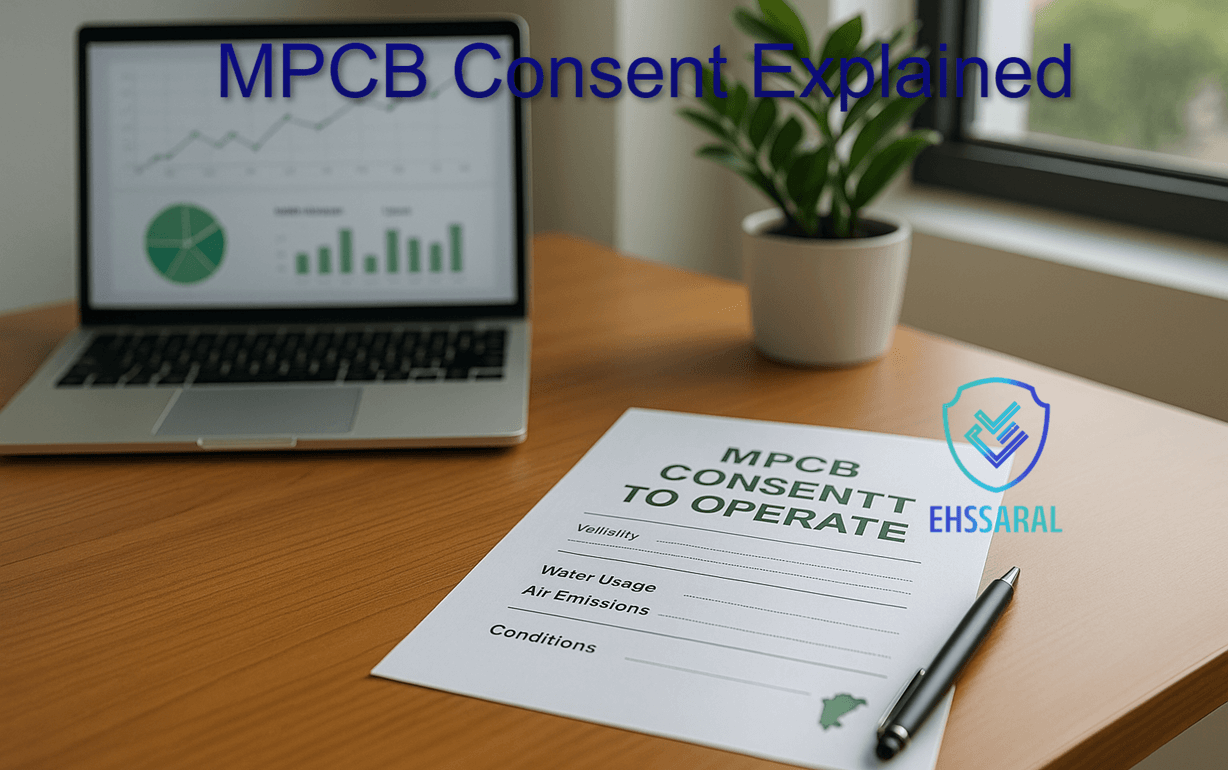
Consent to Operate (CTO)

“The license to run your factory.”

CTO includes all actual environmental conditions:

  • Air
  • Water
  • Noise
  • Waste disposal
  • Hazardous waste
  • DG set
  • Fuel usage
  • Treatment system standards

How CTO conditions work

SPCB gives:

  • Specific limits
  • Specific equipment
  • Specific frequencies
  • Specific formats for compliance

This is where most SMEs get confused.

Key CTO sections

  • Effluent discharge limits
  • Stack emission limits
  • DG set norms
  • Hazardous waste authorization
  • Solid waste norms
  • Operating hours
  • Fuel type
  • Reporting requirements
  • Online monitoring requirements

Validity

Varies by state and category (Green, Orange, Red).

Common mistakes

  • Running after expiry
  • Not following consent limits
  • Increasing production without amendment
  • Not updating DG set details
  • Not reporting fuel changes (coal to briquettes, etc.)
  • Using unapproved fuel (wood, tyre, pet-coke)

Insider tip

Maintain a Consent Condition Tracker File - a single file listing:

  • Condition
  • Frequency
  • Evidence
  • Renewal due date

This saves you during every inspection.


Environmental Monitoring Requirements

“Monitoring is the proof of compliance.”

SPCBs expect regular monitoring of:

  1. Stack emissions
  2. Ambient air quality
  3. Effluent
  4. Sewage
  5. Noise
  6. DG set emissions
  7. Surface water (if applicable)
  8. Groundwater (if required)


Air/Stack Monitoring

Types of emissions

  • Boiler
  • Thermic fluid heater
  • Furnace
  • DG sets
  • Foundry stacks
  • Scrubber outlets

Parameters tested

  • PM
  • SO₂
  • NOx
  • CO
  • VOCs (industry specific)

Frequency

Quarterly for most SMEs.
 More frequent for Red-category units.

Common mistakes

  • No sampling point
  • Wrong sampling point (not isokinetic)
  • Sampling port too small or inaccessible
  • No ladder/platform
  • Testing only during low load

Insider tip

Always maintain last 4–6 stack reports together.
 Inspectors ask for historical trends to confirm consistency.


Ambient Air Quality Monitoring

Why it matters

Important in:

  • Urban areas
  • Dust-prone industries
  • Near residential zones

Parameters

PM₂.₅
 PM₁₀
 SO₂
 NO₂
 CO

Common mistakes

  • Doing monitoring at random spots
  • Doing it only once in years
  • Placing sampler close to walls or trees


Effluent Monitoring

Done for:

  • ETP outlet
  • STP outlet
  • Cooling tower blowdown (if applicable)

Parameters

pH
 TSS
 BOD
 COD
 Oil & grease
 Heavy metals (if applicable)
 Chlorides
 Sulphates
 TDS
 Ammonia

Frequency

Monthly or quarterly (varies by consent).

Common mistakes

  • No sampling chamber
  • Storing samples in the sunlight
  • Taking samples during fresh water flush
  • Not matching inlet/outlet data

Insider tip

Inspectors always compare:

  • ETP logbook
  • Flow meter
  • Electricity consumption
  • Chemical consumption

If these four are consistent, you’re safe.


Noise Monitoring

Who needs it?

Any industry with:

  • DG set
  • Heavy machinery
  • High noise operations

Common mistakes

  • Testing only at zero load
  • Not measuring boundary noise
  • DG enclosure open during testing


Online Continuous Emission Monitoring System (OCEMS/OCEMS)

Required for:

  • Many Red-category industries
  • Large boilers
  • Cement, chemical, pharma, metal units
  • Industrial clusters

Common mistakes

  • Data mismatch vs lab reports
  • Sensor malfunction
  • No calibration report
  • No daily log

Insider tip

Keep OCEMS daily calibration records + screenshot logs.


Waste Management Requirements

Hazardous waste, solid waste, e-waste, plastic waste, biomedical waste, construction waste - all have separate rules.


Hazardous Waste

Essential documents

  • Authorization
  • Storage area photos
  • Manifest copies
  • Annual return
  • Agreement with recycler/TSDF
  • Hazardous waste register

Common mistakes

  • No segregation
  • Waste stored in open area
  • Missing manifests
  • Giving waste to unauthorized vendors


Solid Waste

Requirements

  • Segregation
  • Separate bins
  • Proper disposal
  • No burning


E-Waste

Requirements

  • Hand over to authorized recycler
  • Maintain proof
  • Keep e-waste stock register


Plastic Waste (Brand Owner Compliance)

Requirements

  • EPR registration
  • Annual returns
  • Vendor invoice with plastic type
  • Recycling certificates (EPR fulfilment)


Biomedical Waste

Applicable to industries with:

  • First-aid room
  • Clinic
  • Occupational health center

Requirements

  • Color-coded bins
  • CBWTF tie-up
  • Daily logs


Battery Waste

Requirements

  • Return used batteries to authorized dealers
  • Keep proof


Registrations Required for Many Industries

Depending on your process, you may need:

  • Hazardous waste authorization
  • E-Waste registration (if producer/importer)
  • Plastic Waste EPR registration
  • Battery EPR registration
  • Biomedical Waste registration
  • C&D waste permissions (for renovations)

Most SMEs don’t realize they need so many.


Annual Returns

This is the area where 70% of SMEs get notices.

Rules with annual returns

  • Hazardous Waste Rules (Form 4)
  • Plastic Waste Rules
  • E-Waste Rules
  • Battery Waste Rules
  • Biomedical Waste Rules

Common mistakes

  • Not filing
  • Wrong quantities
  • Not matching manifests
  • Not matching recycler data

Insider tip

Always match:

Opening stock → Generation → Disposal → Closing stock

If these four numbers align, you’re safe.


Daily/Monthly EHS Workflows for a Compliant SME

Daily

  • ETP/STP logbook
  • Waste segregation
  • Housekeeping
  • PPE compliance
  • Chemical storage check
  • DG set enclosure status

Weekly

  • ETP sludge removal
  • Safety walk
  • Chemical inventory check
  • Waste area inspection

Monthly

  • Stack monitoring (if required)
  • Effluent/STP monitoring
  • Noise monitoring
  • Hazardous waste dispatch
  • Fire equipment inspection
  • OCEMS log review
  • Internal EHS meeting

Quarterly

  • Ambient air monitoring
  • Compliance review
  • Consent condition audit
  • Manifests record update

Annual

  • All returns (Haz, Plastic, E-waste, Battery, BMW)
  • Fire mock drill
  • Electrical inspection
  • Chemical safety training
  • Consent renewal (if due)
  • Emergency plan review


Inspections & Audits

SPCB and other authorities conduct:

  • Routine inspections
  • Surprise checks
  • Joint inspections (with local bodies)
  • Thematic inspections (air/water/HAZ)

Inspectors typically check

  • Consent conditions
  • Logbooks
  • Waste storage
  • Manifests
  • Hazardous waste quantities
  • DG set compliance
  • ETP/STP functioning
  • Housekeeping

Common SME mistakes during inspection

  • Giving wrong information
  • No designated EHS contact
  • No documents ready
  • Arguing with officers

Insider tip

Always have a “Compliance Folder” ready with:

  • Consents
  • Last 6 months monitoring
  • Hazardous waste manifests
  • Annual returns
  • Photos of pollution control systems
  • OCEMS calibration

Inspectors appreciate preparedness.


How to Respond to a Notice

1. Read notice carefully

Identify:

  • Type
  • Rule/Act reference
  • Timeline
  • Evidence needed

2. Prepare documents

Give clear, respectful responses.

3. Never blame or argue

Authorities respect clarity, not excuses.

4. Provide corrective action plan

Preventive steps are valued.

5. Follow up respectfully

Do not wait until last date.


Summary of Industry Compliance Requirements (Practical Guide for SMEs & EHS Teams)

You have now learned the daily, monthly, quarterly, and annual responsibilities required to stay compliant.

This section covered:

  • CTE & CTO
  • Monitoring
  • Waste rules
  • Registrations
  • Documentation
  • Inspections
  • Notice responses
  • Practical workflow

This is the core of environmental compliance inside any Indian industry.


Enforcement, Penalties & Best Practices (The Ground Reality Every EHS Officer Must Know)

Understanding Enforcement in India (How the System Actually Works)

The environmental enforcement ecosystem in India is multi-layered:

  1. SPCB / PCC
  2. CPCB
  3. District Administration
  4. NGT
  5. High Court / Supreme Court
  6. Local bodies (municipal, panchayat, MIDC, etc.)

Every enforcement action follows one of these triggers:

  • Inspection
  • Complaint from public
  • Surprise check
  • Monitoring data mismatch
  • Online portal analysis
  • Accidental fire / spill / explosion
  • NGO reports
  • Media coverage
  • Suo moto NGT action

Ground truth

Most notices to SMEs come from basic, avoidable issues, not from major pollution incidents.


Types of Violations (Every Industry Must Know)

1. Technical Violations

  • No consent
  • Expired consent
  • Wrong fuel usage
  • DG set without enclosure
  • Missing monitoring reports
  • No hazardous waste manifest
  • No annual returns

2. Operational Violations

  • ETP/STP not working
  • Scrubber non-functional
  • Bypass lines
  • Abnormal stack emissions
  • Overflowing drains

3. Documentation Violations

  • Missing records
  • Wrong quantities
  • Not updating logbooks
  • Inconsistent readings

4. General Violations

  • Dust nuisance
  • Odour issues
  • Noise disturbance
  • Scrap stored in open area
  • Housekeeping issues

5. Serious Violations

  • Illegal disposal
  • Groundwater contamination
  • River/drain discharge
  • Accidents due to chemical storage
  • Fake documents

These lead to prosecutionclosure, and sometimes NGT intervention.


How Notices Are Issued

SPCB uses a progressive enforcement approach:

Step 1 - Inspection Report

Officer visits and points out non-compliance.

Step 2 - Show Cause Notice

Why action should not be taken against you.

Step 3 - Warning / Directions

Clear instructions to fix the issue within X days.

Step 4 - Closure Direction (Section 33A)

Temporary or permanent closure.

Step 5 - Prosecution Under Act

Filed in court for serious violations.

Step 6 - NGT Escalation

Used for environmental damage or public impact.


What Inspectors Actually Check (The Unfiltered List)

Inspectors usually check:

  1. Consent documents
  2. Emission/wastewater limits
  3. All monitoring reports
  4. Hazardous waste storage
  5. Manifest copies
  6. Waste quantity records
  7. Logbooks
  8. DG set compliance
  9. ETP/STP operation
  10. Chemical storage
  11. Housekeeping
  12. Photos of waste areas
  13. Fire safety & PPE
  14. Flow meter readings
  15. OCEMS data
  16. Fuel purchase/consumption records

The most important thing inspectors look for

Consistency.

If your data is consistent over months → you’re safe.
 If everything looks “perfect only during inspection” → suspicion rises.


Types of Penalties (With Realistic Industry Examples)

1. Monetary Penalties

Imposed for minor to moderate violations.

Example:
 Improper hazardous waste storage → ₹1–5 lakh depending on state.

2. Environmental Compensation (EC)

Used when environmental damage occurs.

Example:
 Illegal discharge → EC based on duration × damage factor.

3. Closure Orders

Issued when violations are serious or repeated.

Example:
 ETP bypass line found → immediate closure order.

4. Prosecution Under Acts

Criminal liability for:

  • Hazardous chemical accidents
  • Water/Air Act violations
  • EPA breaches

Jail term provisions exist (rare for SMEs, but legally possible).

5. NGT Orders

NGT may impose:

  • Heavy penalties
  • Restoration costs
  • Strict monitoring
  • Personal responsibility on management


Why NGT is Considered the “Strict Layer”

NGT has powers to:

  • Summon officers
  • Seal industries
  • Impose crores in penalties
  • Order environmental compensation
  • Ban certain activities
  • Enforce immediate compliance

When SMEs reach NGT level

  • When pollution affects communities
  • When groundwater contamination occurs
  • When media picks up a story
  • When NGOs file petitions
  • When industries ignore repeated notices

For 95% of SMEs, the goal is to never reach this stage.


How to Handle an Inspection (Step-by-Step)

Before Inspection

  • Keep compliance folder ready
  • Designate 1–2 EHS representatives
  • Keep monitoring reports updated
  • Maintain housekeeping
  • Keep waste areas clean
  • Ensure ETP/STP running properly

During Inspection

  • Be respectful
  • Answer honestly
  • Show documents quickly
  • Do not argue or contradict
  • Do not hide anything
  • Give clear explanations

After Inspection

  • Note down all observations
  • Start corrective actions
  • Inform management
  • Close gaps within 48–72 hours

This is the professional approach.


How to Respond to a Notice (Flawless Method)

1. Do not panic

Notices are common and part of the system.

2. Read the notice line-by-line

Understand:

  • Rule violated
  • Document requested
  • Timeline given

3. Gather documents

Arrange evidence neatly.

4. Prepare a structured reply

Include:

  • Point-wise response
  • Attachments
  • Photos
  • Corrective actions
  • Preventive actions

5. Submit before deadline

Never wait until the last day.

6. Follow up respectfully

Compliance + respectful attitude = highly effective combination.


Ground Reality: Why SMEs Receive Notices Frequently

1. Lack of awareness of Rules

Most SMEs think consent = all compliance.

2. Poor documentation

The #1 reason for notices.

3. Unauthorized vendors

Scrap dealers instead of authorized recyclers.

4. Annual returns missed

Especially Hazardous Waste & Plastic Waste.

5. No ETP/STP operator training

Plants malfunction due to inexperience.

6. Rapid rule changes

EPA Rules change frequently.

7. Complaint-based inspections

Neighbour complaints are a major cause of surprise visits.


How to Stay Notice-Free (Proven Best Practices)

From 25+ years of field experience, these practices keep industries safe:

1. Keep a Compliance Calendar

Monthly → Quarterly → Annual tasks mapped.

2. Make a Consent Tracker

Every consent condition → frequency → responsible person → evidence.

3. Create Rule-wise Files

Separate files for:

  • HAZ
  • Plastic
  • E-waste
  • Battery
  • BMW
  • C&D
  • Noise

4. Photographic Evidence

Take monthly photos of:

  • Waste storage area
  • ETP/STP
  • Chemical storage

5. Keep manifests

Never lose hazardous waste manifests.

6. Maintain 6 months of reports

Inspectors usually ask for:

  • Last 6 stack reports
  • Last 6 effluent reports
  • Last 6 hazardous waste dispatches

7. Train operators

ETP operator = the most important person in your compliance.

8. Do internal audits

Every 3 months for:

  • Consent conditions
  • Waste records
  • Environmental monitoring

9. Respectful communication

Authorities appreciate industries that cooperate, respond on time, and show genuine effort.


The Future of Environmental Enforcement in India

India is steadily moving from reactive enforcement to predictive enforcement.

Expect:

  • Real-time monitoring
  • OCEMS integration
  • Automated alerts
  • Data-driven inspections
  • Stricter plastic/E-waste rules
  • Online compliance dashboards
  • Centralized risk scoring
  • Greater NGT involvement

Industries that keep their data clean & consistent will automatically be safe.


Summary of Enforcement, Penalties & Best Practices (The Ground Reality Every EHS Officer Must Know)

You have now learned:

  • How enforcement works
  • Types of violations
  • How notices are issued
  • What inspectors check
  • Penalty structures
  • How to respond to notices
  • How to stay compliant
  • Future enforcement trends

  • FAQs

  • Q1. What are the main environmental laws in India?
    Water Act, Air Act, Environment Protection Act, Hazardous Waste Rules, Plastic Waste Rules, E-Waste Rules, Battery Rules, and others.
  • Q2. Which Act is the most powerful environmental law in India?
    The Environment Protection Act, 1986 because it empowers the government to issue all major Rules.
  • Q3. What is the difference between CTE and CTO?
    CTE is permission to set up; CTO is permission to operate. Both are mandatory.
  • Q4. How do SPCB and CPCB differ?
    CPCB sets national standards; SPCBs enforce them in each state.
  • Q5. What is hazardous waste authorization?
    Permission from SPCB to store, handle, and dispose of hazardous waste legally.
  • Q6. What happens if consent to operate expires?
    Operating the unit becomes illegal and may invite closure notice.
  • Q7. Which industries need ETP/STP?
    Any industry generating wastewater-process or domestic-must have treatment systems as per consent.
  • Q8. Who needs to register on the Plastic EPR Portal?
    Producers, importers, and brand owners whose logos appear on plastic packaging.
  • Q9. What penalties exist for environmental violations?
    Monetary penalties, environmental compensation, closure orders, and criminal prosecution.
  • Q10. What is the role of NGT?
    NGT handles environmental cases, compensation, and large-scale violations.
  • Q11. Who conducts environmental inspections?
    SPCB, CPCB, district authorities, or joint teams based on complaints or risk.
  • Q12. Do small industries need to follow all Rules?
    Yes-depending on their waste, emissions, packaging, DG sets, and chemicals.
  • Q13. What is OCEMS?
    Online Continuous Emission Monitoring System for real-time pollution tracking.
  • Q14. What is a manifest in hazardous waste?
    A tracking document that records generator → transporter → recycler/TSDF movement.
  • Q15. What leads to most SME notices?
    Missing monitoring reports, expired consent, wrong waste disposal, and no annual returns.
  • Q16. Are biomedical waste rules applicable to factories?
    Yes, if factories have clinic/first-aid rooms.
  • Q17. How to avoid environmental penalties?
    Maintain records, follow consent limits, dispatch waste legally, and train staff.
Harshal T Gajare

Harshal T Gajare

Founder, EHSSaral

Second-generation environmental professional simplifying EHS compliance for Indian manufacturers through practical, tech-enabled guidance.

Related Blogs

ETP & STP Troubleshooting: The Complete Indian Guide | EHSShala

ETP & STP Troubleshooting: The Complete Indian Guide | EHSShala

Why EHS Experience Is Being Filtered Out - The Real Hiring Logic | EHSSaral

Why EHS Experience Is Being Filtered Out - The Real Hiring Logic | EHSSaral

SWM Rules 2026: Is Your Factory a Bulk Waste Generator? | EHSSaral

SWM Rules 2026: Is Your Factory a Bulk Waste Generator? | EHSSaral

Industry Categorization in India: Red, Orange, Green, White & Blue | EHSShala

Industry Categorization in India: Red, Orange, Green, White & Blue | EHSShala

Environmental Inspection India: What Inspectors Check | EHSSaral

Environmental Inspection India: What Inspectors Check | EHSSaral

CTO Auto-Renewal: Capital Investment Rules 10% & 30% | EHSSaral

CTO Auto-Renewal: Capital Investment Rules 10% & 30% | EHSSaral

Why BMW Inspections Feel Stricter Today (India) | EHSSaral

Why BMW Inspections Feel Stricter Today (India) | EHSSaral

Noise Monitoring in Factories Workplace vs Boundary (India Guide) | EHSShala

Noise Monitoring in Factories Workplace vs Boundary (India Guide) | EHSShala

How MoEFCC, CPCB & SPCB Work in India: Expert Guide | EHSShala

How MoEFCC, CPCB & SPCB Work in India: Expert Guide | EHSShala

The Hidden Costs of Manual Environmental Compliance in India

The Hidden Costs of Manual Environmental Compliance in India