

Blog
CTO Auto-Renewal: Capital Investment Rules 10% & 30% | EHSSaral
EHSSaral is an Environmental Compliance Intelligence Platform for Industries. Consent Intelligence • Alerts & Tasks • Incident Reporting • Form IV & V • Audit-Ready Records
See how EHSSaral works
17 Jul 2026
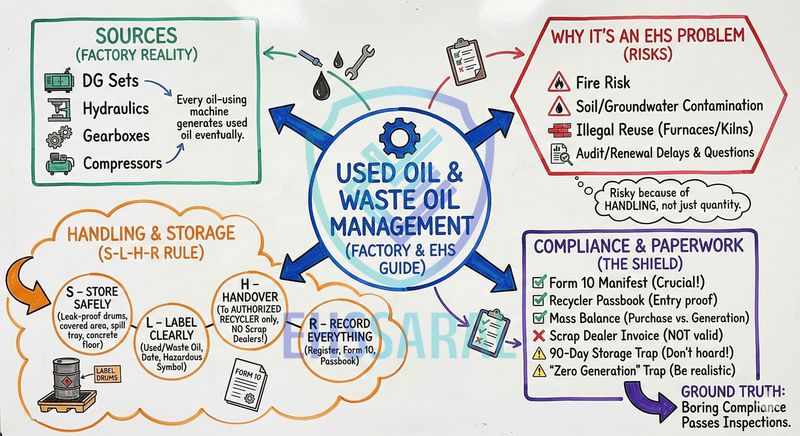
A Practical Guide for Indian Factories & EHS Officers
“Sir, oil toh scrap wale le jaate hain na?”
If you work in an Indian factory, you have heard this line many times.
Sometimes from maintenance.
Sometimes from stores.
Sometimes from the plant head himself.
And for years, this approach seems to work.
Used oil is generated.
It is stored somewhere near the DG set or workshop.
A scrap dealer comes.
Oil goes out.
Cash comes in.
No one asks questions.
Until one day, someone does.
What usually triggers attention is not a rule change.
It is visibility.
An oil-stained floor near the DG room.
A leaking drum near the boundary wall.
Black patches in the soil.
A photo taken during inspection.
That is when used oil quietly becomes an EHS issue.
Ground truth
“Used oil is not risky because of quantity.
It is risky because of handling.”
Even 20 litres handled badly can create more trouble than 200 litres handled properly.
What This Guide Covers (So You Can Jump Fast)
This guide helps you handle used oil the way inspections and renewals actually work in India.
It covers:
Used oil vs waste oil (quick cheat code for records)
Where used oil comes from (DG, hydraulics, gearbox, maintenance)
Storage & labeling (what inspectors notice first)
Scrap dealer vs authorised recycler (the key compliance gap)
Records that protect you (Form 10 + passbook where applicable)
Common traps (90 days, “Nil generation”, contractor removal, mixing with cotton)
Renewal readiness (purchase vs disposal mismatch)
Quick memory tool + FAQs
Most EHS officers get confused here. Let’s keep this simple.
| Item | In plain factory language | Common examples |
|---|---|---|
| Used Oil | Oil after use, still recoverable | DG oil after replacement, hydraulic oil after service, compressor oil |
| Waste Oil | Oil that is contaminated, mixed, or degraded | Oil mixed with diesel/solvent, oil mixed with water/chemicals, oil with sludge |
Cheat code for records and Annual Return (Form 4):
Used Oil → Hazardous Waste Category 5.1
Waste Oil → Hazardous Waste Category 5.2
On the shop floor, handling is the same.
This distinction mainly helps during Form 4 / Annual Return and audit discussions.
Read more about hazardous waste management in factories
In many factories, used oil generation is not tracked properly because it is spread across departments.
Common sources you should always check:
DG sets
Compressors
Hydraulic presses and machines
Gear boxes
Maintenance and breakdown activities
Why this section matters:
During inspections and renewals, questions often start with:
“Kitna oil generate hota hai?”
If you only think of DG oil, you will miss:
Hydraulic oil
Gear oil
Workshop oil
This leads to quantity mismatch later.
A simple mental check:
“Every machine that uses oil will one day generate used oil.”
Regulators look at used oil for three basic reasons:
Fire risk
Soil and groundwater contamination
Illegal reuse in furnaces or brick kilns
But for the factory, the impact is felt differently.
Why this becomes your problem:
Insurance teams ask questions after a fire
Groundwater samples show oil traces
Customer or ESG audits ask for disposal proof
Consent renewal gets delayed due to data mismatch
This is not about punishment.
It is about control and traceability.
When oil movement is unclear, doubt increases.
And doubt slows everything down.
This is where most practical issues start.
Not in forms.
Not in portals.
On the shop floor.
Inspectors usually notice storage before documents.
Basic expectations on site:
Some factories use red markings for used-oil drums. This can work well, but the colour should match the site’s approved internal colour-coding system.
The important point is consistency. Every helper, contractor and maintenance person should recognise the used-oil container immediately.
Reality check
“Inspection starts with eyes, not files.”
If the storage area looks controlled, the paperwork discussion usually becomes easier.
Labeling is simple, but often ignored.
Each oil drum should clearly show:
“Used Oil” or “Waste Oil”
Date of generation or storage
Hazardous waste symbol
Very common issue:
Old chemical drums reused without removing old labels.
During inspection, this creates confusion:
What is inside?
Since when?
Who is responsible?
Clear labeling avoids unnecessary questions.
Oil-soaked cotton is a silent headache because it becomes unclear:
Is it used oil?
Is it solid waste?
Is it hazardous sludge?
Vendors often refuse such mixed waste, and audits get messy.
Simple fix that works:
Collect oil separately first.
Keep cotton waste separate.
Dispose each through its correct channel.
Used oil should be collected separately.
Do not mix it with:
Mixing makes recycling difficult. It may also change how the material needs to be classified and disposed of.
This usually happens during breakdown maintenance when temporary containers are used.
The simple control is clear:
“One container for used oil. Nothing else goes inside.”
Used oil disposal becomes manageable when the same sequence is followed every time.
Collect used oil directly from DG sets, compressors, hydraulic systems, gearboxes and maintenance activities.
Do not mix it with water, coolant, solvents, diesel or other chemicals.
Move the oil into a closed, leak-proof drum or tank.
Do not leave it in open buckets, cut containers or temporary cans after maintenance work is complete.
Mark the container clearly as “Used Oil” or “Waste Oil”.
Record:
Keep the container:
Before disposal, check whether the recycler or re-refiner has a current approval applicable to used oil or waste oil.
Do not depend only on an old certificate shared several years ago.
Prepare the required manifest and transport details before the oil leaves the premises.
Verify the quantity, vehicle number, recycler details and date.
Keep the available manifest copy immediately.
Follow up for the copy confirming that the recycler received the waste.
After dispatch, update:
“Used oil disposal is not one activity. It is a traceable chain from machine to recycler.”
This is where most factories get stuck.
And this is where most notices quietly begin.
In many sites, the logic is simple:
“Oil is waste. Scrap dealer takes waste. Problem solved.”
That logic does not hold during inspection.
Buys mixed scrap
Pays cash or issues a basic invoice
No environmental authorisation
No traceability of final disposal
Once oil leaves through a scrap dealer, you lose control.
Approved by the State Pollution Control Board
Listed under Central Pollution Control Board / SPCB authorisations
Issues proper hazardous waste documentation
Enters quantity in official records
Ground truth
“During inspection, only an authorised recycler protects the factory.”
Money received is never a defence.
Documentation is.
Read what inspectors check during audits
Do not select a recycler only because someone says, “We have been using this party for years.”
Verify the documents before the first dispatch and again when the approval expires.
Check:
Keep a copy of the current approval with your disposal records.
Do not rely only on:
These may establish that the business exists. They do not by themselves prove that the party can legally receive your used oil.
Practical habit
Create one reminder before the recycler’s approval expires.
That one reminder can prevent an entire year of disposal records from becoming difficult to explain.
In many states, authorised recyclers maintain a Passbook system.
What this means for you:
When oil is lifted, recycler must enter:
Date
Quantity
Factory name
This entry becomes official proof of disposal
If the recycler does not enter the quantity:
On paper, disposal never happened
Your records look incomplete
Questions start during renewal
Practical advice
After every lift:
Ask for confirmation of passbook entry
Do not assume it is done automatically
This small follow-up avoids big confusion later.
Important clarity
The manifest tracks the movement of waste from your factory to the receiving facility.
A recycler passbook or portal record, where the applicable system requires it, supports the recycler’s receipt and quantity records.
Do not assume that one document automatically replaces the other.
For every dispatch, keep the documents required under the system applicable to your state and waste movement.
Factories often keep too much paper, but miss the right ones.
Focus on four things only:
Quantity of used oil generated
Date of handover
Authorised recycler details
Form 10 - Hazardous Waste Manifest
Everything else is secondary.
Some factories declare:
“Used oil generation: Nil”
This is risky if:
DG sets exist
Hydraulic systems exist
Oil purchase records exist
Even if oil consumption is low,
“zero” invites questions.
Safer explanation:
Low generation
Infrequent oil change
Proper reuse inside closed system (if applicable)
Clarity works better than absolutes.
On paper, people say “manifest”.
On site, officers ask:
“Form 10 dikhaiye.”
Form 10 proves three things:
Waste left the site
It went through authorised transport
It reached an authorised recycler
Without Form 10:
Invoice alone is not accepted
Cash receipt is meaningless
Verbal explanation does not help
Ground truth
“Invoice alone is not proof. Traceability is.”
Practical tip:
Do not keep Form 10 “pending” for weeks.
File the available copy immediately, and follow up for the return/received copy.
Most factories lose proof because the transporter “will send it later” - and later never comes.
You do not need fancy systems.
A simple system works if it is consistent:
One register or Excel sheet
Monthly or quarterly entry
Quantity generated
Quantity handed over
Balance (if any)
Most inspectors prefer:
Simple
Clean
Explainable
Over-designed systems fail when:
People stop updating them
Data becomes inconsistent
During inspection, questions are rarely complicated.
Be ready for these:
Where is used oil stored?
How much used oil do you generate?
Who takes it?
Show the last Form 10.
If you can answer these calmly,
most discussions end quickly.
This is why this article exists.
Hazardous waste should not be stored beyond 90 days.
Many factories unknowingly cross this limit by hoarding used oil for better resale rates.
In practice:
Hazardous waste should not be stored beyond 90 days
Hoarding oil for better resale rates is a violation
This is one of the most common observations seen across sites.
Even if everything else is correct,
excessive storage duration raises questions.
During renewals and audits, officers often do a simple check.
They look at:
Oil purchase records
Used oil generation
Disposal quantity
If numbers do not broadly match, doubt starts.
Example:
1000 litres oil purchased in a year
Only 100 litres shown as used oil generated
Question will come:
“Baaki oil kahan gaya?”
This is called mass balance, even if no one uses the term.
A difference between oil purchased and used oil generated does not automatically mean something is wrong.
There may be practical reasons:
But these explanations should come from maintenance records, not memory.
There is no single percentage of purchased oil that every factory must generate as used oil.
The expected quantity depends on:
The numbers do not need to match litre for litre.
They should broadly make operational sense.
“Mass balance is not about perfect equality. It is about an explainable difference.”
This is where theory meets reality.
What commonly causes delays:
Old recycler authorisation used
Missing Form 10 copies
Quantity mismatch
Storage observations during site visit
Important point:
Most issues are record gaps, not violations.
If data is explainable and improving,
officers usually respond positively.
These are practices seen to work across many factories:
One fixed oil storage location
Clear drum labeling
Color marking on oil drums
Spill kit nearby
Monthly quantity review
One responsible person assigned
Avoid complex systems.
Focus on systems that work, not systems that impress.
If your factory never tracked used oil properly, do this:
Do not create fake past records
Start fresh from this month
Keep records simple
Show improvement trend during renewal
Ground truth
“Inspectors respect visible improvement over fake perfection.”
This is where compliance quietly slips.
During breakdowns:
Oil is drained quickly
Temporary containers are used
Focus is on restarting production
After production resumes:
Temporary storage is forgotten
Oil remains in open buckets
Labeling is missed
This oil later becomes:
Unaccounted waste
Mixed with other waste
A question during inspection
Practical habit
After every major maintenance:
Shift oil into proper drums
Update the register the same week
Small discipline avoids later confusion.
Most factories track DG oil changes.
But they miss one thing.
They track:
Date of oil change
Quantity of fresh oil added
They forget to track:
Quantity of used oil removed
During inspection, both sides are compared.
If records show:
Regular oil purchases
No matching used oil generation
Questions start.
Simple fix
Whenever DG oil is changed:
Note fresh oil quantity
Note used oil quantity on the same day
This keeps numbers balanced.
Oil filters may retain oil even after they are removed from a DG set, compressor or machine.
A common mistake is to throw the filter directly into the general metal-scrap bin.
Before deciding its disposal route:
Do not press, puncture or drain filters casually on open ground.
The purpose is simple: recover the trapped oil and prevent it from leaking into general scrap storage.
A very common pattern seen:
One drum near DG set
One drum near workshop
One old can near compressor
This creates:
Tracking difficulty
Higher spill risk
Confusion during inspection
Best practice seen across sites:
One central used oil storage area
Benefits:
Easier monitoring
Easier labeling
Easier explanation
Ground truth
“One location, one register, one owner.”
Used oil compliance is closely linked to housekeeping.
Oil spills that are:
Cleaned immediately
Logged and controlled
Are rarely questioned.
Oil spills that are:
Old
Dark
Spread across floor
Trigger deeper inspection.
Housekeeping teams should be sensitised:
Oil spills are not normal dirt
They are compliance signals
This awareness makes a big difference.
Most non-compliances are not intentional.
Maintenance teams usually:
Want to finish work fast
Are unaware of waste categories
Think oil disposal is “scrap work”
Short training helps:
Where to pour used oil
Which drum to use
Why mixing oil is a problem
Even a 15-minute toolbox talk once a year reduces mistakes.
In many factories:
DG maintenance is outsourced
Hydraulic maintenance is done by contractors
Problem:
Contractor drains oil
Takes oil away
No Form 10
No record
During inspection, responsibility still lies with the factory.
Practical control
Clearly instruct contractors
Oil generated inside plant must be handed to EHS
No oil leaves without record
This avoids “contractor took it” explanations later.
Many people believe:
“This is temporary, so rules don’t apply.”
That is incorrect.
If oil is:
Inside your premises
Generated from your activity
It is your responsibility.
Temporary containers:
Must be leak-proof
Must be moved to proper drums quickly
Temporary should not become permanent by accident.
If something is unclear, inspectors observe reactions.
Examples:
EHS officer hesitates
Maintenance gives different answers
Records don’t match site
This creates doubt.
Clear, calm answers matter more than perfect data.
If you don’t know something:
Say you will verify
Provide records later
Guessing creates more trouble than delay.
Simple internal checks once in a quarter:
Check oil storage area
Check drum condition
Check labels
Check last disposal date
Check register entries
This takes less than 30 minutes.
But it saves hours during inspection.
Compared to other wastes:
Used oil quantity is small
Storage area is small
But visibility is high.
Black stains, smell, and leaks stand out immediately.
This is why used oil deserves attention
even if quantity is low.
Used oil usually appears in:
Annual Hazardous Waste Return (Form 4)
Consent renewal annexures
Internal environmental statements
Common problem:
Numbers are filled once a year, from memory.
This creates:
Guesswork
Inconsistent quantities
Last-minute corrections
Better approach
Update quantities monthly or quarterly
Annual return becomes simple addition, not reconstruction
This reduces stress before deadlines.
“Generating used oil does not automatically make every factory a producer under EPR.”
This is often misunderstood.
Generally acceptable:
Sending used oil to authorised re-refiner
Recycling through approved channel
Commonly questioned practices:
Using used oil for shutter greasing
Using oil for dust suppression
Burning oil for heating
Giving oil to small furnaces
These practices create:
Land contamination
Air pollution
Liability for the factory
Ground truth
“If reuse cannot be documented, it becomes disposal without control.”
During transport, officers may check:
Vehicle number on Form 10
Leak-proof containers
Proper sealing of drums
Common mistakes:
Open drums loaded on truck
Oil filled in cans or buckets
Mismatch between vehicle used and vehicle mentioned
You don’t need to manage transport.
But you must verify it once.
Sometimes during internal review, you realise:
Oil was sold to scrap dealer earlier
Records are missing
Disposal proof is incomplete
Do not panic.
Practical approach:
Correct the system going forward
Stop incorrect disposal immediately
Start proper documentation now
Trying to justify past mistakes creates more trouble than improvement.
How you respond matters.
Better responses:
Calm
Factual
Willing to show records
Avoid:
Over-explaining
Blaming vendors
Blaming contractors
Making assumptions
If something is missing:
Acknowledge it
Explain corrective action
Commit to timeline
This approach builds confidence.
Used oil compliance works best when:
One person is responsible
Roles are clear
Others know where to send oil
Avoid:
“Anyone can handle it”
“Maintenance will manage”
“Scrap vendor knows”
Clear ownership removes confusion.
Once a month, ask:
Is oil stored properly?
Are drums labeled?
Is there any spill?
Is storage within 90 days?
Is register updated?
If all answers are “yes”, you are fine.
Used oil management quietly tests:
Housekeeping
Discipline
Record keeping
Coordination between teams
Factories that manage used oil well
usually manage other wastes well too.
It is a small waste,
but a big indicator.
S-L-H-R Rule
S - Store safely
L - Label clearly
H - Handover to authorised recycler only
R - Record everything
If these four are right,
used oil compliance stays boring.
And boring compliance passes inspections.
Used oil compliance does not need brilliance.
It needs consistency.
It does not need fear.
It needs clarity.
And it does not need perfection.
It needs honesty and improvement.
“Good used oil compliance is boring.
And boring compliance passes inspections.”
Yes.
Used oil and waste oil are treated as hazardous waste under Indian rules because of their pollution potential.
Even if the quantity is small,
handling and disposal must follow hazardous waste procedures.
Used oil: Oil after use but still recoverable
Waste oil: Oil that is contaminated, mixed, or degraded
For day-to-day handling, there is no difference.
The distinction mainly matters while filling Annual Return (Form 4).
No.
A scrap dealer invoice does not prove legal disposal.
Used oil must be handed over only to an authorised recycler / re-refiner approved by the Pollution Control Board.
Without this, disposal is treated as unauthorised.
Form 10 (Hazardous Waste Manifest).
This is the main document officers ask for during inspection or renewal.
Invoice alone is not sufficient proof.
In practice, hazardous waste should not be stored beyond 90 days.
Storing used oil longer for better resale rates is a common violation and often pointed out during inspections.
Be careful.
If your factory has:
DG sets
Hydraulic machines
Oil purchase records
Showing “Nil” generation raises questions.
It is better to show low or occasional generation with explanation rather than zero.
Generally, no.
Such reuse is often questioned because it leads to:
Land contamination
Uncontrolled disposal
If reuse cannot be clearly justified and documented,
it is safer to send used oil to an authorised recycler.
This creates a problem.
Oil-soaked cotton becomes:
Difficult to categorise
Difficult to dispose
Often refused by vendors
Best practice:
Collect oil separately
Handle cotton waste and oil through their own disposal channels
The factory is responsible.
Even if:
DG maintenance is outsourced
Oil is drained by contractor
Used oil generated inside your premises remains your compliance responsibility.
Yes, especially during renewals and audits.
They often compare:
Oil purchase quantity
Used oil generated
Disposal records
Large mismatch leads to questions, even if no misuse exists.
Do not panic.
Best approach:
Stop incorrect practices immediately
Start proper records now
Show visible improvement
Inspectors usually respect corrective action more than fake backdated records.
No.
A simple system works:
One storage area
One register or Excel sheet
Regular updates
Consistency matters more than sophistication.
Across many sites, the most common issues are:
Selling oil to scrap dealers
Storing oil beyond 90 days
Poor storage on soil
Missing Form 10
Quantity mismatch
All of these are avoidable with simple discipline.
Use the S-L-H-R rule:
S - Store safely
L - Label clearly
H - Handover to authorised recycler only
R - Record everything
If these four are followed,
used oil compliance stays boring - and safe.
Collect the oil separately and store it in a closed, labelled and leak-proof container.
Maintain the generation record and hand the oil only to a recycler or re-refiner whose current approval is applicable to used oil.
Complete the required manifest and transport documents. Keep the receipt or returned copy confirming that the waste reached the authorised facility.
Never pour used oil into drains, soil or open land. Do not mix it with water, solvents or chemicals.
The best method is recovery through an approved recycler or re-refiner.
Used oil should be:
Used oil should not be burned casually, given to an ordinary scrap dealer, poured on land or used for dust suppression.

Founder, EHSSaral
Founder - EHSSaral | Partner - Perfect Pollucon | ISO 14001 Lead Auditor | GHG Protocol Scope 2 | Chemist | Data Scientist | Second-generation environmental professional simplifying EHS compliance for Indian industries through practical, automated, tech-enabled, data driven compliance workflows.
CTO Auto-Renewal: Capital Investment Rules 10% & 30% | EHSSaral

Consent to Operate (CTO) Explained for Indian Factories | EHSShala

Why We Wrote The Indispensable EHS Officer Book (A Realist Guide for India) | EHSSaral
 Practical Guide for Indian Factories EHSShala.webp)
Hazardous Waste Management Rules in India: Forms, Storage & Compliance

Hazardous Waste Stored Beyond 90 Days: What to Do

Industrial Siting Criteria in India: Factory Location Guide

Environmental Compliance Calendar Software – Simplify MPCB Renewals & Due Dates | EHSSaral

MPCB Consent Guide: CTE, CTO, Renewal, Fees & Conditions | EHSShala
 ehssaral.webp)
4-Stream Waste Segregation for Factories (SWM 2026) | EHSSaral

MSME Supply Chains & BRSR 2026: Where Compliance Breaks | EHSSaral