
Research
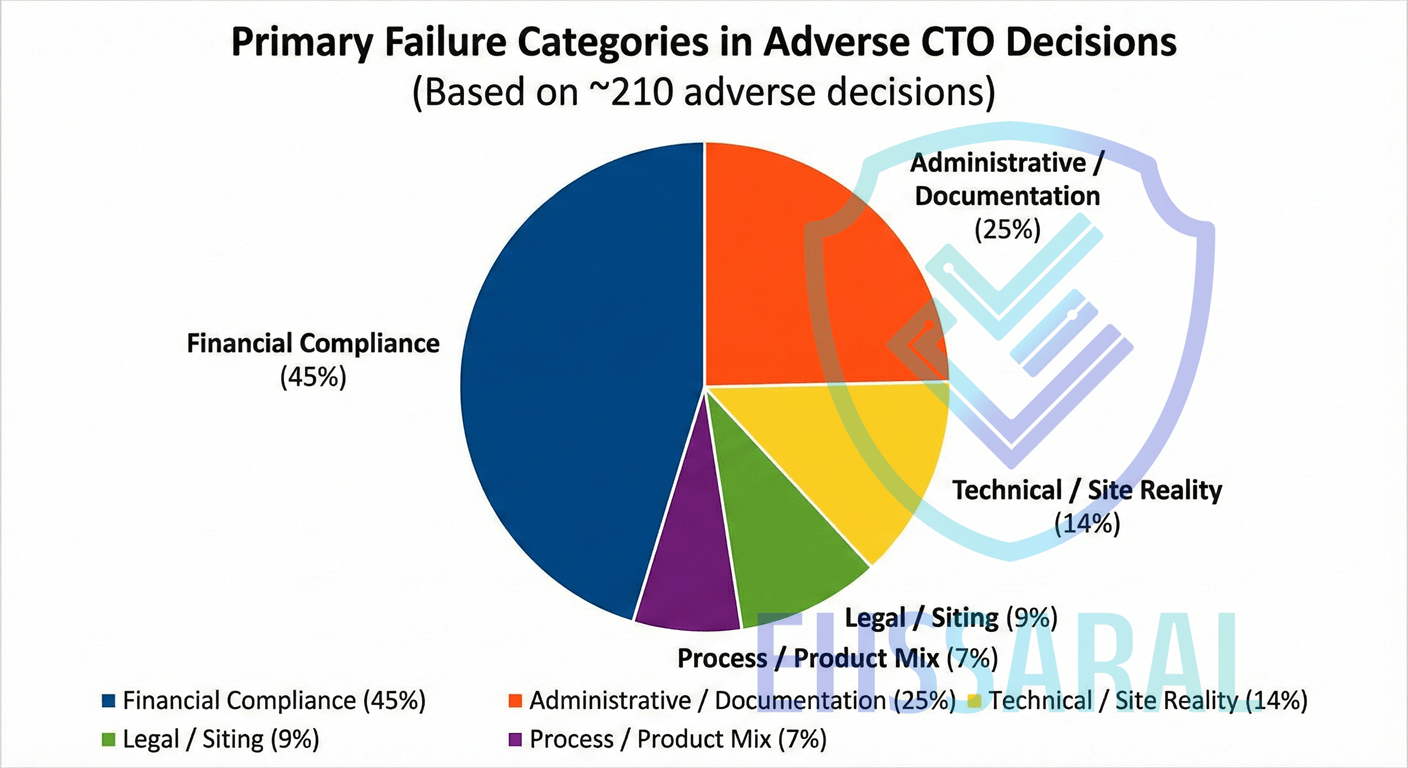
MPCB CTO Refusal Patterns in Maharashtra (2023–2025) Analysis | EHSSaral Research
EHSSaral is an Environmental Compliance Intelligence Platform for Industries. Consent Intelligence • Alerts & Tasks • Incident Reporting • Form IV & V • Audit-Ready Records
See how EHSSaral works
4 Mar 2026
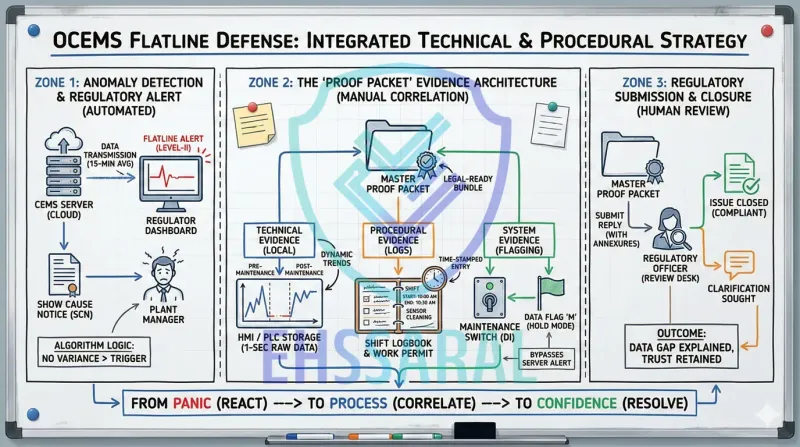
This notice is a request for technical context - not an assumption of wrongdoing.
In many Indian factories, the moment a CPCB or SPCB notice arrives mentioning “flatline”, the reaction is immediate panic.
Phones start ringing.
Management asks uncomfortable questions.
Vendors are called before the notice is even read fully.
This reaction is understandable - but it is also unnecessary.
From a practical and regulatory standpoint, it is important to understand one thing clearly, upfront:
A flatline notice is a request for technical context - not an assumption of wrongdoing.
Most officers issuing these observations are not alleging pollution, manipulation, or intent. They are responding to automated system alerts that require explanation and documentation.
When industries treat such notices as accusations instead of process checks, they often damage their own case - not because of non-compliance, but because of how they respond.
CPCB Guidelines for Online Continuous Emissions Monitoring
In day-to-day regulatory operations, CPCB and SPCBs rely heavily on automated triggers generated by the OCEMS backend.
These notices are typically issued when:
In simple terms, the system is saying:
“We need you to explain why the data behaved this way.”
It is not saying:
Those conclusions come only later, and only if the explanation fails or contradicts evidence.
Industries are often familiar with data gap notices - missing values, blank timestamps, or upload failures.
Flatline notices feel different. They escalate faster. They create more anxiety.
That is because, from a system perspective:
And abnormal behavior triggers higher-priority alerts.
This distinction is important - and often misunderstood.
Read more about what are OCEMS Data Gaps and why CPCB Rejects Data & Troubleshooting
Before responding to any notice, it is critical to understand how the alert was generated - not emotionally, but logically.
OCEMS systems do not “think” like humans.
They evaluate patterns, not intent.
| Data Behavior | What the System Sees | Typical Alert Severity |
|---|---|---|
| No timestamp received | Communication failure | Yellow / Purple |
| Repeating identical values | Sensor reporting but static | Orange (Level-II) / Red (Level-III) |
This difference is fundamental.
If you have received an Orange or Red-level alert, it almost always means:
The system detected “Consistent and Stable Values” over a defined window.
This is commonly referred to as a flatline.
That single phrase - “Consistent and Stable Value Alert” - is important.
Using it correctly in your reply signals system literacy, not guesswork.
From a regulatory monitoring standpoint, a flatline could indicate several possibilities:
The system cannot differentiate between these on its own.
So it escalates.
Not because it assumes wrongdoing -
but because it requires human correlation.
This is where most replies go wrong.
Many replies to flatline notices begin with statements like:
While these may be true, they are explanations, not defenses.
Regulatory systems do not validate explanations.
They validate time-matched evidence.
This is the pivot point that separates:
And this leads us to the core principle of flatline defense.
When an officer reviews a flatline notice reply, they are silently checking three things:
If these three align, the issue typically closes quietly.
If they don’t, the issue escalates - even if the plant was compliant.
Over the years, one pattern becomes clear across Indian industries:
Most flatline notices are not caused by technical failures - they are caused by procedural gaps.
None of these imply intent.
But they do weaken the reply.
A Practical Guide for Indian Factories for EADA Portal & Environment Audit Rules 2025
When industries receive a flatline notice, the instinctive response is to explain what happened.
All of these may be factually correct - yet many such replies still fail.
The reason is simple and uncomfortable:
Regulators do not close notices based on explanations.
They close them based on correlated evidence.
This distinction is subtle, but decisive.
From a regulator’s point of view, an explanation without evidence is indistinguishable from an excuse.
Consider this sentence:
“The flatline occurred due to routine maintenance activity.”
Now ask three silent questions an officer will automatically ask:
If even one answer is unclear, the explanation collapses.
This is why some plants with genuine maintenance activities still face:
Not because the activity was wrong -
but because the reply was not defensible.
Successful flatline replies have one thing in common:
They line up multiple independent records to the same time window.
This is what regulators trust - not because it is clever, but because it is verifiable.
This leads us to a practical concept that every EHS professional should internalize.
A Proof Packet is not a document format.
It is a way of thinking.
It is a structured bundle of time-correlated evidence that explains why the flatline occurred - without debate, emotion, or speculation.
Think of it as answering the notice before the officer asks the next question.
Before defining it, it’s important to clear misconceptions.
A Proof Packet is not:
Length does not equal strength.
Clarity does.
At its core, a Proof Packet answers three questions simultaneously:
If these three answers converge, the flatline becomes explainable - and defensible.
Although notices rarely state this explicitly, officers expect to see:
Any break in this narrative weakens the reply.
This is why statements like:
carry little weight unless they are shown, not stated.
In Indian regulatory practice, courts and tribunals consistently favor:
Over retrospective explanations.
This is why:
often carries more credibility than a technically perfect paragraph.
The Proof Packet leverages this reality.
Before diving into individual components, it is important to understand the sequence.
A Proof Packet should always move from:
Reversing this order confuses reviewers.
One of the most powerful - and underused - elements of a flatline defence is local analyser data.
Why?
Because:
This creates a critical opportunity.
When responding to a flatline notice, the first question should be:
“What does the local analyzer trend show for that window?”
Not the CPCB graph.
Not the SPCB dashboard.
The local HMI or analyzer trend.
Officers reviewing notices handle dozens of replies.
They do not have time to decode dense tables.
A single clean trend screenshot can communicate more than pages of explanation.
What works consistently on the ground:
This visual sequence quietly answers all three regulator questions:
Without saying a word.
A defensible trend should show:
If the flatline extends far beyond the stated activity window, the reply weakens.
If the recovery is delayed with no explanation, suspicion increases.
This is why time accuracy matters more than narrative skill.
Many plants rely only on portal screenshots.
This is a mistake.
Portal views are:
Local analyzer trends reflect actual instrument behavior - which is what the alert originated from.
In flatline cases, this distinction is crucial.
At this stage, many replies collapse because:
These are not technical failures.
They are presentation failures.
Once the analyzer trend establishes technical behavior, the next question a regulator subconsciously asks is:
“Who was responsible on the ground during that time?”
This is where maintenance logbooks quietly carry enormous weight in India.
Despite digitization, physical and shift-wise registers remain one of the most legally respected records across SPCBs, appellate authorities, and even courts.
From a regulatory perspective, a maintenance logbook proves three things at once:
A signed logbook entry often holds more credibility than:
Because it was written before the notice existed.
A strong entry typically includes:
When this time window matches the flatline exactly, the explanation becomes difficult to dispute.
When it doesn’t, doubts arise - even if the activity was genuine.
Many plants maintain logbooks, but:
This does not invalidate the activity - but it weakens the reply.
Precision matters more than perfection.
One of the least discussed - yet most consequential - gaps in OCEMS implementation is Maintenance Mode flagging.
Most industries assume:
“If maintenance happens, the system will understand.”
It doesn’t.
In a properly configured OCEMS setup:
This prevents:
In theory.
In practice:
The result?
Perfectly legitimate maintenance activity still appears as a flatline anomaly on the server.
This is not misconduct.
It is a system configuration gap.
Tip: Advise Vendors to send an official email to their vendor today asking for maintenance mode training. They can attach that email as proof of "Corrective Action" in their reply. It shows they are fixing the system gap.
This point must be handled carefully.
Never write:
Instead, use neutral, responsibility-owning language such as:
“During the said maintenance window, the analyzer operated in hold mode. The maintenance flag was not reflected in the server transmission. We have initiated corrective coordination with the system provider to ensure proper flagging in future.”
This achieves three things:
Regulators respond better to ownership than accuracy alone.
Supporting documents strengthen a reply - but only when used selectively.
More documents do not automatically mean a stronger case.
Include supporting documents if:
Typical supporting evidence includes:
Each document should reinforce the same time narrative.
If it doesn’t, omit it.
Avoid attaching:
These create noise, not clarity.
Some flatline notices fall outside routine maintenance.
These require logic-driven responses, not apologies.
One of the most misunderstood flatline cases arises when:
From a scientific standpoint, the logic is straightforward:
No inflow logically results in no outflow variation.
A strong defense includes:
The explanation should remain factual and unemotional:
“During the referenced period, there was no influent flow to the ETP, as evidenced by inlet flow meter data. Consequently, outlet parameters remained static. This is consistent with mass balance principles and does not indicate sensor malfunction or suppression.”
This framing aligns with engineering fundamentals - which regulators respect.
Not all flatlines are caused by maintenance.
In certain systems - especially biological or equalization-based processes - values can remain stable for extended periods.
This is often misread as manipulation.
The key is to show that:
Supporting logic may include:
A calm statement such as:
“Although averaged values appear stable, second-level data shows continuous micro-variation within normal operating limits, indicating healthy sensor behavior.”
helps reframe the flatline as process stability, not data suppression.
By the time a flatline notice reaches you, the technical issue is already secondary.
What now matters most is:
In Indian regulatory practice, many escalations happen not because of the event, but because of self-damaging language used in replies.
Below are the most common traps - and why they are dangerous.
Why this backfires:
A flatline means:
Claiming internet failure contradicts the alert logic itself.
It signals:
If connectivity was the issue, the alert would have been a data gap, not a flatline.
This is the fastest way to convert a technical observation into a procedural violation.
It implies:
Even if this is factually true, it should never appear in writing.
Blame shifting is viewed very poorly.
From a regulator’s standpoint:
Mentioning vendors as the cause suggests:
(The Ignorance Trap)
This is the most dangerous sentence of all.
Why?
Because OCEMS guidelines assume:
Writing this sentence is equivalent to admitting:
“We are not complying with self-monitoring obligations.”
Many officers will escalate immediately after reading this - even if the original issue was minor.
A regulator-safe reply typically follows this structure:
Example framing:
“During the referenced window, the analyzer operated in hold mode due to scheduled maintenance. The activity has been completed, system behavior has normalized, and additional procedural controls have been implemented to prevent recurrence.”
Notice what is not present:
Just clarity.
These templates are designed to be:
Use only the template that matches your scenario.
Subject: Clarification regarding OCEMS Flatline Observation
Reference: Notice No. ______ dated ______
Respected Sir / Madam,
With reference to the observation regarding static OCEMS values on [date] between [start time] and [end time], we wish to submit the following clarification.
The referenced period coincides with a scheduled preventive maintenance activity involving sensor cleaning and calibration. During this window, the analyzer temporarily operated in value-hold mode to avoid transient spikes.
The activity was completed within the stated time, after which normal dynamic data behavior resumed. Supporting records, including maintenance log entries and post-maintenance verification, are enclosed for reference.
We confirm that the system is currently operating normally and additional procedural controls have been reinforced to ensure clearer flagging during future maintenance activities.
Yours faithfully,
[Name / Designation]
Subject: Reply to OCEMS Flatline Observation
Reference: Notice No. ______ dated ______
Respected Sir / Madam,
This is in response to the observation of static OCEMS values during the period [date and time].
Upon internal review, it was identified that the analyzer sensor experienced functional degradation during the referenced window, resulting in stabilized readings. Immediate corrective action was taken, including sensor replacement and recalibration.
Supporting service documentation and verification records are enclosed. The system has since returned to normal dynamic operation. Preventive monitoring protocols have been strengthened to enable earlier detection in the future.
We submit the above for your kind consideration.
Yours faithfully,
[Name / Designation]
Subject: Technical Explanation for OCEMS Flatline Values
Reference: Notice No. ______ dated ______
Respected Sir / Madam,
With reference to the observation of static OCEMS values, we wish to clarify that during the indicated period there was no influent flow to the treatment system, as evidenced by inlet flow records.
In the absence of influent, outlet parameters remained stable, resulting in a flatline pattern on the portal. This behavior is consistent with mass balance principles and does not indicate sensor malfunction or suppression.
Supporting flow records and operational logs are enclosed for verification.
Yours faithfully,
[Name / Designation]
Once a flatline notice is resolved, the real learning should begin.
Across Indian plants, repeat notices almost always trace back to procedural gaps, not equipment limitations.
Before touching any OCEMS-linked sensor:
Flatline notices are rarely technical failures.
They are:
When systems, people, and records move together, notices reduce naturally.
OCEMS was never designed as a punishment mechanism.
It is a data integrity system - one that relies on context as much as numbers.
Most conflicts arise not from pollution, but from:
EHSSaral exists to convert:
panic → clarity → disciplined compliance
By documenting what actually works on the ground, we aim to strengthen both:
A flatline notice does not judge intent.
It tests preparedness.
Industries that respond with:
Rarely face escalation.
Those that respond emotionally - even when compliant - often do.
This article is not advice to evade scrutiny.
It is guidance to meet scrutiny correctly.
That difference matters.
A flatline notice indicates static OCEMS values over a period. It is a request for technical context, not an allegation of pollution.
No. A data gap means no data was received. A flatline means data was received but appeared static, triggering higher alert severity.
No. Most flatline notices close after a satisfactory technical explanation supported by time-matched evidence.
Local analyzer trend data, maintenance logbook entries, and clear correlation of activity with the flatline window.
Statements like “internet was unstable,” “operator forgot,” or “we did not notice the flatline” should be avoided as they imply procedural failure.

Founder, EHSSaral
Founder - EHSSaral | Partner - Perfect Pollucon | ISO 14001 Lead Auditor | GHG Protocol Scope 2 | Chemist | Data Scientist | Second-generation environmental professional simplifying EHS compliance for Indian industries through practical, automated, tech-enabled, data driven compliance workflows.
MPCB CTO Refusal Patterns in Maharashtra (2023–2025) Analysis | EHSSaral Research
Other Waste Streams in Indian Factories | Battery, E-Waste, Plastic & More | EHSShala
Environmental Monitoring Calendar for Industries - Expert Guide by EHSSaral

Form 4 vs Form 5: Why Hazardous Waste Numbers Don't Match
MSME Supply Chains & BRSR 2026: Where Compliance Breaks | EHSSaral

The Digital Compliance Cliff: EPR Traceability Challenges for Indian MSMEs | EHSSaral Research
Hazardous Waste Stored Beyond 90 Days: What to Do

Is There Truly Free Environmental Compliance Software in India? (An Honest Answer) | EHSSaral

Environmental Compliance Calendar Software – Simplify MPCB Renewals & Due Dates | EHSSaral
TSDF Hazardous Waste Process: Manifest, Disposal & Records