Factory Act & Compliance Thresholds: What Applies to Your Headcount? | EHSSaral
EHSSaral is an Environmental Compliance Intelligence Platform for Industries. Consent Intelligence • Alerts & Tasks • Incident Reporting • Form IV & V • Audit-Ready Records
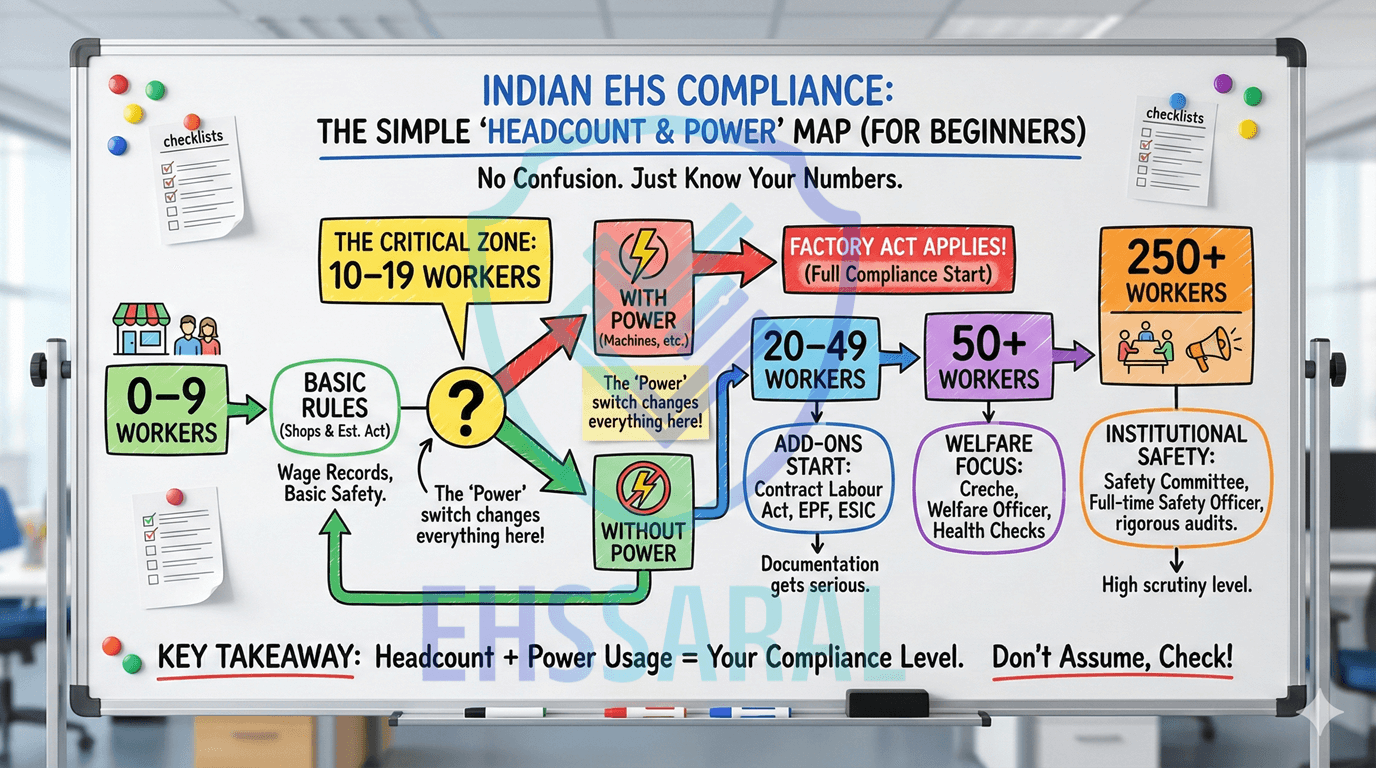
This is a transition zone where problems start quietly.
What changes here
Inspectors start taking you more seriously
Basic registers and documents are expected
Appointment letters and attendance records come into focus
Where SMEs get confused
The Power Trap: If you have 10 or more workers and use electricity for manufacturing (Power), the Factory Act applies to you immediately.
The "Without Power" Loophole: If you do not use power for manufacturing, you generally remain under the Shops & Establishment Act until you hit 20 workers.
The Mistake: Thinking, "We only have 12 people, so we are small." If you have a power connection for machines, the law treats you as a factory.
Common mistakes seen on the ground
No written appointment letters
No clarity on working hours
Health and safety treated as informal verbal instructions
Practical tip: If you are crossing 10 employees, start behaving like compliance will increase - even if it hasn’t yet.
What You Should Do Right Now (If You Are Below 20)
At this stage, don’t panic. Just be systematic.
Minimum actions:
Keep employee count clearly documented
Maintain basic appointment records
Read your Consent to Operate conditions carefully
Don’t rely only on “last year nothing happened”
Most future problems start because early signals were ignored.
If You Have 20+ Employees
(This Is Where Compliance Becomes Real)
For most Indian SMEs, 20 employees is the first serious compliance turning point.
This is the stage where:
Verbal practices stop working
Inspectors stop giving benefit of doubt
“Small unit” logic starts breaking
Many EHS professionals later say:
“Sir, issue toh 20 cross karne ke baad hi start hua…”
At or around this stage, authorities expect you to be formally organised.
Common expectations:
Factory Act registration (depending on power & activity)
Appointment letters for employees
Working hours and leave records
Health check records (especially for hazardous processes)
Safety instructions displayed and followed
Contract Labour Act (CLRA): If you employ 20 or more contract workers (threshold varies by state, e.g., 50 in some), you need a specific Registration Certificate (RC).
Provident Fund (EPF): Mandatory coverage usually triggers strictly at 20 employees.
Even if every clause is not enforced immediately, the mindset changes.
The Most Dangerous Assumption at 20+
“Factory Act toh 50 ya 100 ke baad lagta hai na?”
This assumption causes maximum damage.
In reality:
Factory Act applicability is not only about headcount
Power usage (HP / kW) matters
Nature of manufacturing matters
State interpretation matters
Many factories legally fall under the Factory Act before they realise it.
Common Mistakes Seen at 20-49 Employee Level
These are patterns seen repeatedly during inspections:
No appointment letters or incomplete ones
No medical fitness records
Registers created after notice is received
Relying on contractor records without verification
Assuming “inspection = once in 5 years”
Important truth: Once you cross 20, documentation gaps become visible very fast.
Practical Advice for EHS Professionals at This Stage
If your factory has crossed 20 employees:
Confirm your Factory Act status
Check power load
Check nature of activity
Check state factory department rules
Standardise basics
Appointment letters
Attendance & wage records
Medical check plan (even annual is better than none)
Align consent conditions with labour compliance
Many consent conditions indirectly require labour discipline
This is not about perfection. It’s about being directionally correct.
Common mistake: “Hum log kam hain, toh Factory Act nahi lagega.”
Power load can silently override this assumption.
2. Nature of Activity (Hazardous vs Non-Hazardous)
Chemical handling
Heat processes
Dust-generating operations
Pressure systems
These increase compliance expectations irrespective of headcount.
3. Contract Labour Count
One of the most misunderstood areas.
Contractor workers do count for certain compliances
Authorities often look at total manpower on site
Principal employer responsibility still applies
Common mistake: “They are contractor employees, not ours.”
This logic fails during inspections.
4. Consent Conditions Override Assumptions
Your Consent to Operate may impose requirements:
Safety measures
Monitoring frequency
Record keeping
Even if the law threshold is unclear, consent conditions are binding.
Many SMEs don’t read consent conditions carefully - this creates risk.
Exemptions & Grey Areas (Handle with Care)
This section causes more confusion than clarity if misunderstood.
The MSME / SSI Myth
Many factories believe:
“We are MSME, so labour laws don’t apply.”
Reality:
MSME status gives procedural relaxations
It does not mean exemption from safety or labour responsibility
State-Level Variations
Some thresholds differ by state
Notifications may override older provisions
Old exemptions may no longer apply
Practical advice: Never rely only on:
Old consultant advice
What applied 10 years ago
Neighbouring factory practice
Example: The Contract Labour Act applies at 20 workers centrally, but states like Maharashtra, Rajasthan, and Andhra Pradesh have raised this threshold to 50 workers in many cases. Always check your specific state notification.
Common Mistakes Seen Across All Headcounts
These patterns repeat everywhere:
Assuming compliance starts only after inspection
Creating documents only after notice
Copy-pasting registers without understanding
Treating EHS as “extra work” instead of core function
These mistakes don’t fail immediately - they fail suddenly.
What an EHS Professional Should Do Now
(Simple, Practical, Actionable)
Regardless of your headcount, do this:
Write down your actual manpower
Direct + contract
Note your power load
Read your Consent to Operate conditions
List what you already comply with
Identify gaps calmly
You don’t need to fix everything today. You need to know where you stand.
That alone reduces stress by 50%.
A 2-Minute Reality Check: Who Is Actually Accountable?
In many Indian factories, paperwork and reality don’t match.
Titles can be misleading — but accountability usually follows control:
Who signs statutory documents
Who controls budgets and decisions
Who is recorded in licence / registration records
This self-check helps you clarify Occupier vs Manager responsibility in a practical way, so roles are aligned before an inspection or incident forces the question.
This is for internal clarity, not legal determination.
Occupier vs Manager Responsibility Check
Occupier vs Manager – Know the Difference
Why This Check Exists
In many Indian factories, compliance problems don’t start with unsafe machines.
They start with unclear accountability.
The Factories Act does not ask:
Who is the safety officer
Who handles daily paperwork
It asks one deeper question:
Who has ultimate control over the factory?
This short check looks at control, not designation — based on how licences are signed, budgets are approved, and authority is exercised in real life.
Use this to align paperwork with reality, before an accident or inspection forces the question.
This is a clarity tool, not a judgement. Final determination always rests with the licensing authority.
A practical self-check to understand who is likely treated as the “Occupier” (ultimate control) vs “Manager” (day-to-day in charge) in common Indian factory setups. (For awareness & internal clarity.)
Occupier signals
—
Manager signals
—
Confidence (practical)
—
Practical note: Most confusion starts when one name is on the licence, but decisions are taken by someone else.
A Simple Self-Check: Do These Apply to You?
(Yes / No Clarity)
Use this quick checklist honestly. No legal language. Just reality.
Answer YES or NO:
Do you have 20 or more people working on site (including contract labour)?
Is your power load significant for manufacturing activity?
Do you have a valid Consent to Operate with safety-related conditions?
Are hazardous processes, dust, heat, chemicals, or pressure systems involved?
Has your manpower increased in the last 12-24 months?
If you answered YES to 2 or more, you should assume formal EHS compliance applies - even if no notice has come yet.
This is not fear. This is preparation.
What You Should Focus on First (Not Everything at Once)
Most EHS professionals get overwhelmed by long compliance lists.
Instead, prioritise in this order:
People records
Appointment letters
Attendance & wages
Health & safety basics
Medical fitness where relevant
PPE usage
Safety instructions
Consent alignment
Ensure you are actually following what is written in your consent
Consistency
Small actions done regularly matter more than perfect files made once
Frequently Asked Questions (Real Questions from the Field)
“We have 18 employees. Does the Factory Act apply?”
Not automatically in all cases. But if your power load or process type crosses limits, it may apply earlier than expected.
“Do contract labour workers count in headcount?”
For many compliances, yes. Authorities usually look at total manpower present on site, not only payroll employees.
“We are MSME registered. Are we exempt from labour laws?”
No. MSME status may give procedural relief, but safety and labour responsibilities still apply.
“Inspector is asking for something not written in consent. What to do?”
First, re-check consent conditions carefully. If still unclear, seek clarification calmly - don’t argue, and don’t assume exemption.
“We crossed 20 employees last year but nothing happened. Are we safe?”
Silence does not mean exemption. Most non-compliances surface after an incident or surprise inspection.
Common Sense Closing Note
Indian EHS compliance is not about:
Knowing every section
Memorising every rule
Panicking after notices
It is about:
Understanding where you stand
Knowing what usually applies at your size
Acting before problems arise
If you understand your thresholds, half the confusion disappears automatically.