
Blog
Environmental Non-Compliance Investigation: Process, RCA and Corrective Action
EHSSaral is an Environmental Compliance Intelligence Platform for Industries. Consent Intelligence • Alerts & Tasks • Incident Reporting • Form IV & V • Audit-Ready Records
See how EHSSaral works
4 Jan 2026
EHSSaral Research Series - SME Compliance in India
Part 1 - Why Good People Still Struggle With Compliance in Indian SMEs
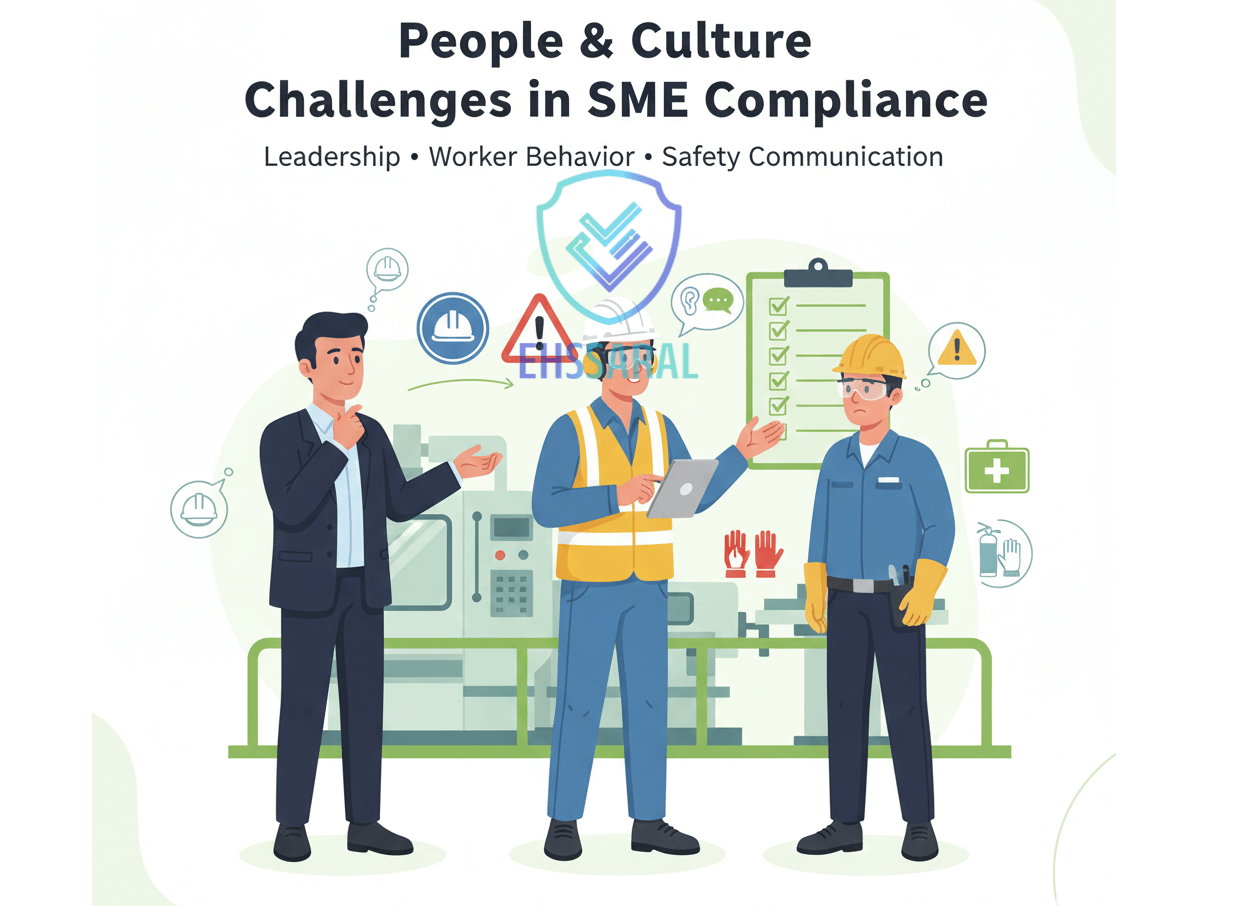
Part 2 - Why Safety Culture Fails in Indian SMEs: People & Compliance Challenges (You're reading this)
Part 3 - Systems & Technology Barriers in Indian SME Compliance
Part 4 - Transforming SME Compliance: Zero Surprise Failures in India
Series Objective: Simplifying compliance challenges faced by SMEs and supporting EHS professionals with practical solutions.
Everyone talks about documents, deadlines and inspectors.
But inside an SME, there is one more silent compliance factor:
👉 How the boss thinks about safety
In Indian SMEs, most decisions are taken by the owner or top manager.
So their attitude becomes the company culture - without any training session.
If the owner says:
“Safety is important - first check compliance status”
→ Everyone follows.
If the owner says:
“Production chalu rakho! Delivery should not stop!”
→ Everyone follows that too.
Leadership doesn’t need a mic.
Their priority automatically becomes everyone’s priority.
Most SME owners care about their people and business.
But their daily actions unintentionally create compliance gaps:
| Leader’s Action | Hidden Message Workers Receive |
|---|---|
| Not wearing helmet while walking in plant | “Rules are optional” |
| Approving new machines without safety checks | “Speed > Safety” |
| Skipping monthly EHS review | “We will manage later” |
| Shouting only after an incident | “Don’t report small issues” |
This creates culture by accident, not culture by design.
Typical questions owners ask:
This mindset comes from high operational pressure:
So safety decisions are made like this:
Immediate Cost vs Invisible Risk
But the risk is only invisible…
until it becomes a very visible problem.
(Real field insights)
| Mindset Type | What they say | Risk to compliance |
|---|---|---|
| Firefighting Owner | “Issue aata hai toh dekh lenge” | Always late, emergency reactions only |
| Box-Ticking Owner | “Audit ke time file clean hona chahiye” | Documents okay, ground condition poor |
| Growth-Focused Owner | “Safety important hai, but delivery first” | Risk gets ignored quietly |
Even motivated owners face this tension:
Daily survival vs Future protection
That struggle defines SMEs.
Small decisions → big ripple effects:
🔸 Delayed approvals for fire maintenance
🔸 “We’ll fix it later” attitude
🔸 Not attending safety meetings
🔸 No budget for training or PPE
🔸 Blaming EHS officer when audits fail
🔸 Hiring untrained contractors to save money
The message becomes:
“If nobody is shouting, nothing is wrong.”
But compliance doesn’t shout -
it suddenly explodes.
We observed successful SMEs doing simple things:
| Simple Action | Impact |
|---|---|
| Owner walks the shop floor with helmet & shoes | Workers copy automatically |
| Monthly 15-minute EHS review | No deadline surprise |
| Approving safety purchases first | Prioritization becomes visible |
| Asking 2 safety questions in every meeting | Culture shifts |
| Praising workers for safe behavior | Motivation without cost |
| Keeping commitment: “No safety, no work” | Production respects EHS |
Leadership doesn’t cost money.
It just costs attention.
A small engineering SME in Navi Mumbai:
Then the owner did one thing:
Every morning, he personally checked 5 workers and thanked them
for wearing gloves properly.
Within 10 days:
Positive culture spread faster than orders.
In ESG audits, auditors observe:
We saw this pattern:
Good Culture → Better Score → More Orders → Growth
Poor Culture → Non-conformance → Order Loss → Stress
EHS is no longer a cost.
It’s a growth requirement.
Ask yourself the toughest question:
“If I suddenly walk into my own factory…
will I feel safe working here?”
If the answer is even a small “no” -
the culture needs a reset.
In short:
The first safety system in SMEs
is not fire hydrant or PPE.
It is leadership behavior.
Everyone knows PPE is important.
Everyone knows unsafe acts can hurt.
Still… rules break every day on the shop floor.
Why?
Not because workers don’t care.
But because behavior follows comfort, habits and pressure.
EHS officers often ask:
“Why are workers not listening? Why shortcuts?”
To understand the real reasons, let’s go inside the shop floor reality.
| Ground Reality | How Workers Think | Result |
|---|---|---|
| PPE is uncomfortable in heat | “Yeh pehenke kaam nahi hota” | Gloves removed, helmets hanging |
| High production pressure | “Kaam bandh karke safety kaun dekhe?” | Shortcuts taken |
| Poor-quality PPE | “Bar-bar phat jaata hai” | Safety rules seen as a joke |
| Zero involvement in rules | “Yeh sab office mein decide hota hai” | No ownership |
| No supervisor enforcement | “Sahab ko fark nahi, mujhe kyun?” | Culture collapses |
Workers are logical -
They remove what slows them down
when no one is watching.
Many SMEs depend on contract workers:
Typical contractor worker onboarding:
“Yeh lo helmet. Chalu ho jao.”
No orientation → No awareness → No safety
And when incident happens?
Blame goes to the SME, not the contractor.
If a worker has done a job the same risky way for 5 years…
One 20-minute training cannot erase that habit.
Behavior change = Repetition + Reinforcement
That’s why best SMEs use:
Safety is a muscle.
It grows with daily practice.
In SMEs, supervisors influence safety more than any policy.
| If Supervisor Wears PPE | If Supervisor Doesn’t |
|---|---|
| Workers follow automatically | Workers ignore rules |
| Safety spreads naturally | Exceptions become culture |
| Incident rate drops | “Shortcut is okay” mindset |
Supervisors = safety role models
Good or bad - workers copy them.
A near miss happens. Worker is scared.
But instead of reporting… silence.
Why?
Result:
Small warning signs stay hidden.
Bigger incidents arrive without warning.
We need a shift:
“Reporting = responsible behavior”
A welding unit in Bhiwandi spent money on:
✔ Posters
✔ PPE banners
✔ Training material
Still:
Workers did welding without face shield.
EHS officer changed strategy:
He asked each welder:
“Bhai, agar aankhon ko kuch ho gaya
toh ghar ka kya hoga?”
This personal question →
Workers started using shields voluntarily.
Motivation through empathy
works better than motivation through fear.
| Low-Cost Action | Why it Works |
|---|---|
| PPE selected with worker feedback | Comfort = compliance |
| Rotate high-hazard tasks | Less fatigue → fewer mistakes |
| Safety champions among workers | Peer pressure used positively |
| Reward safe behavior weekly | Recognized actions repeat |
| Workers asked for solutions | Ownership builds culture |
Workers become partners, not problems.
At the top → Visible Culture
↓ Supervisor Discipline
↓ Worker Involvement
↓ Comfortable Equipment
↓ Clear Instructions
Base → Daily Training Rituals
If any one layer is weak →
Pyramid shakes → unsafe behavior returns.
| Question | If “No” → Red Flag |
|---|---|
| Do workers know “why”, not just “what”? | Blind obedience = unsafe shortcuts |
| Do supervisors enforce PPE always? | Mixed messages = broken culture |
| Are new workers trained on Day 1? | Contractor risk high |
| Are unsafe acts reported without fear? | Hidden issues growing |
| Do workers suggest safety improvements? | Zero ownership |
Score:
• 4–5 Yes → Culture improving 👏
• 2–3 Yes → Behavior risk rising ⚠️
• 0–1 Yes → People emergency 🚨
Workers break rules…
not because they want to
but because systems don’t support them.
Compliance succeeds when:
In short:
Behavior does not change by shouting.
Behavior changes when the system makes the right choice the easy choice.
In many SMEs, the EHS officer prepares:
✔ SOPs
✔ Risk assessments
✔ Training files
✔ Safety notices
✔ Checklists and logs
Everything looks perfect…
but behavior on the floor is still unsafe.
Why?
Because communication is not reaching the people who need it.
Documents live in files.
Risks live on the shop floor.
And there is a gap between the two worlds.
| Root Cause | What Ends Up Happening |
|---|---|
| Safety rules discussed only in office | Workers never hear the “why” |
| One-time training mindset | Skills forgotten in days |
| Language barriers | Half knowledge → full risk |
| Overloaded supervisors | Safety supervision becomes last priority |
| No safety feedback system | Mistakes repeat silently |
| Blame game culture | Workers hide small incidents |
In simple words:
Knowing the rule ≠ Following the rule
EHS officer:
“Training ho gaya. Sign yahaan karo.”
Workers:
“Samajh mein nahi aaya… par chalo sign kar diya.”
Two major training failures:
1️⃣ Training is treated like a signature activity
🡆 Knowledge doesn’t reach the mind
2️⃣ Training is not repeated
🡆 Knowledge doesn’t stay in memory
Safety is not a classroom concept -
it’s a daily behavior.
| Quick Habit | Big Benefit |
|---|---|
| 3-minute toolbox talk before work | Mindset ready for safety |
| Visual SOPs near every risk area | Zero ambiguity |
| Explain root cause after every incident | Future prevention |
| Celebrate someone who reports hazards | Fear-free reporting |
| Use local language with visuals | Inclusivity and clarity |
Communication is not what you say.
It is what they understand.
Typical reaction after an incident:
❌ “Kisne galti ki?”
❌ “Kya kar rahe the tum?”
❌ “Next time careful!”
This creates:
But best SMEs respond differently:
✔ Understand “why accident was possible”
✔ Remove the trigger
✔ Train everyone again
This builds a culture where workers say:
“Sir, here is a risk -
let’s fix it before something happens.”
That is when compliance becomes proactive.
In SMEs, accountability often means:
“Who is at fault?”
But true accountability means:
“Who will ensure this doesn’t happen again?”
Big difference.
A simple accountability system:
| What | Who | When |
|---|---|---|
| Fix broken guard on cutting machine | Maintenance team | 2 days |
| Retrain new welders | Supervisor safety rep | This week |
| Update JSA with trip hazards | EHS officer | Before next shift |
Small tracking → big improvement.
A packaging SME in Ambernath had:
Auditor asked 1 worker:
“Why do you wear gloves?”
Worker:
“Company ne bola hai.”
Auditor:
“But what happens if you don’t?”
Worker:
“Uh… pata nahi.”
Documentation ✔
Understanding ❌
Compliance ❌
Result:
Message:
If workers don’t understand the reason,
they don’t respect the rule.
One message → Three layers of clarity:
1️⃣ What to do
2️⃣ How to do
3️⃣ Why to do
Most SMEs cover only the first point -
and that’s why rules collapse under pressure.
| Leadership | ||
| ▼ | ||
| Supervisors | - | Workers |
If any one is weak →
safety falls.
Supervisors push behavior.
Workers execute tasks.
Leadership sets direction.
Everyone plays a role.
This triangle shows that safety accountability must begin with leadership, supported by supervisors, and executed by workers on the shop floor.
Answer Yes / No:
| Question | Risk if “No” |
|---|---|
| Do we have daily/weekly toolbox talks? | Workers forget rules |
| Do workers understand WHY of every rule? | Unsafe shortcuts |
| Are trainings documented + understood? | Fake compliance |
| Do workers feel safe reporting hazards? | Silent risks |
| Do supervisors enforce 100%? | Culture collapse |
| Do incidents lead to system change? | Same accidents repeat |
0–2 Yes → Culture danger zone 🚨
3–4 Yes → Needs improvement ⚠️
5–6 Yes → Behavior maturity 👍
Compliance does not live in documents -
it lives in people.
Safety culture grows when:
✔ Communication is regular
✔ Training is practical
✔ Accountability is shared
✔ Workers are respected
✔ Supervisors lead from the front
In summary:
Rules work only when people believe in them.
| Challenge Type | What happens in SMEs | Impact |
|---|---|---|
| Leadership mindset | Safety seen as cost | Compliance deprioritized |
| Worker behavior | Habits + heat + shortcuts | Rules break quietly |
| Communication gaps | Training stays in files | Repeat mistakes |
Hardworking people fail…
because the environment around them is not supporting success.
Because workers often learn tasks informally and feel rushing helps productivity. They follow supervisors, not posters. If the shop-floor leadership shows safety discipline, workers naturally adopt safe habits.
Small rituals like weekly safety walks, recognizing good behavior, and clear role responsibilities help build trust and discipline. Safety culture changes through consistent actions, not expensive systems.
Because all knowledge is stored in the person, not in systems. Without proper handover sheets and shared document control, compliance continuity breaks, leading to repeat mistakes.
Supervisors are the immediate leaders workers follow. If supervisors use PPE and enforce safe practices daily, workers copy them. Supervisor behavior shapes factory culture more than any rulebook.
By showing interest, providing basic resources on time, and reviewing EHS performance regularly. Visible top management support motivates everyone to take safety and compliance seriously.

Founder, EHSSaral
Founder - EHSSaral | Partner - Perfect Pollucon | ISO 14001 Lead Auditor | GHG Protocol Scope 2 | Chemist | Data Scientist | Second-generation environmental professional simplifying EHS compliance for Indian industries through practical, automated, tech-enabled, data driven compliance workflows.
Environmental Non-Compliance Investigation: Process, RCA and Corrective Action
Factory Act & Compliance Thresholds: What Applies to Your Headcount? | EHSSaral
 Guide for Indian Factories EHSShala by EHSSaral.webp)
Ambient Air Quality Monitoring (AAQM) Guide for Indian Factories | EHSShala
Battery Waste Registration for Equipment Importers (BWM Rules 2022 Explained) | EHSSaral
Calibration & QA/QC in Environmental Monitoring Guide | EHSShala
CSR Trends 2026: Environmental Compliance Automation in India | EHSSaral

How to Read Your Consent Copy (CTE & CTO Explained Simply) | EHSShala
How EHS Managers Can Verify EPR Credits Before Audit (DIY Guide) | EHSSaral
Isokinetic Sampling Basics: Simple Guide for Stack Monitoring | EHSShala
Hazardous Waste All Forms Form 1 to Form 12 Guide