
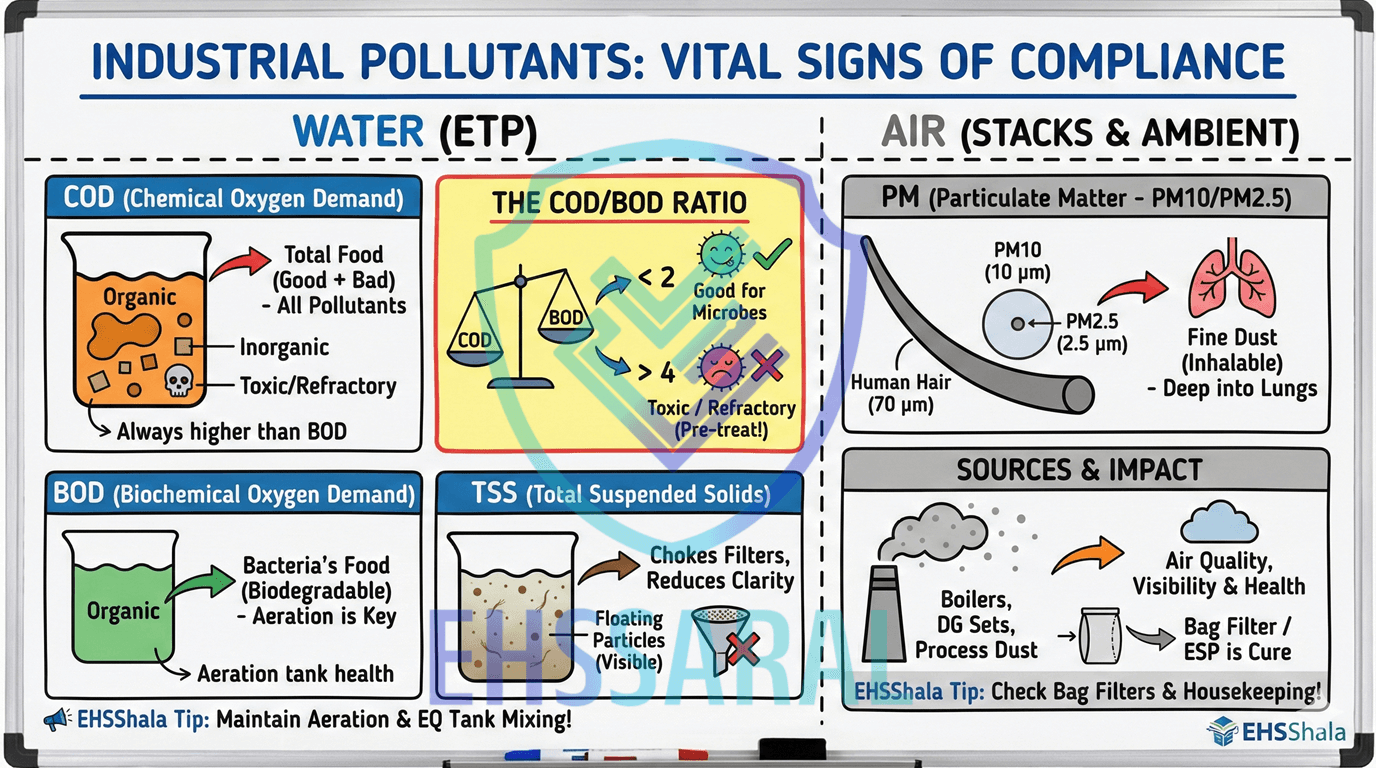
EHSShala
Industrial Pollutants Explained: COD, BOD, TSS & PM (A Practical Guide)
EHSSaral is an Environmental Compliance Intelligence Platform for Industries. Consent Intelligence • Alerts & Tasks • Incident Reporting • Form IV & V • Audit-Ready Records
See how EHSSaral works
10 Jan 2026
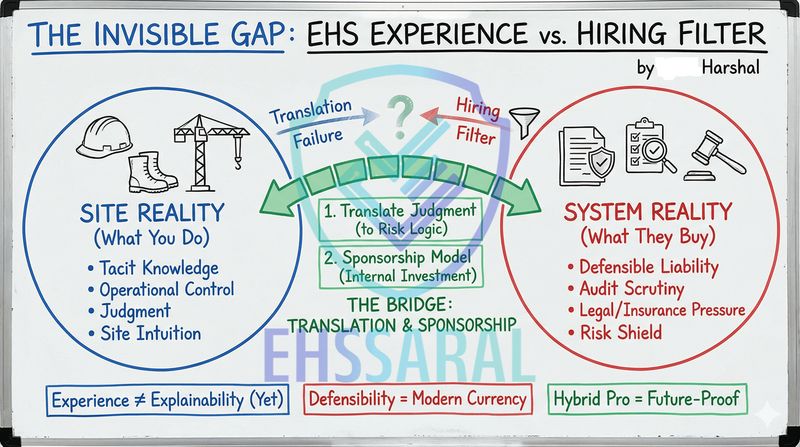
In the last few years, a particular frustration has been surfacing repeatedly among experienced Safety and EHS professionals - but rarely in formal meetings or official forums.
It appears instead in private conversations.
In LinkedIn comments written carefully.
In WhatsApp groups after working hours.
In one-on-one discussions after interviews that “didn’t go anywhere”.
The sentiment is consistent:
“I have handled large sites. I have controlled manpower. I have managed inspections. Yet I am being rejected in favour of people with degrees and certifications but far less site exposure.”
This article is not written to dismiss that frustration.
It is also not written to validate it emotionally.
It is written to explain what has actually changed in the safety hiring ecosystem - and why many capable professionals are being filtered out without their competence ever being questioned directly.
Because what is happening today is not a simple case of experience being undervalued.
It is a structural shift in how safety capability is evaluated, defended, and insured.
Until that shift is understood clearly, professionals will continue to misdiagnose the problem - and respond to it in ways that don’t help them.
Most discussions frame the issue as a binary conflict:
That framing is misleading.
What is actually happening is this:
The criteria used to judge safety competence have changed - but many professionals are still presenting themselves using the old language.
This mismatch creates the illusion that experience is being ignored.
In reality, experience is often never fully evaluated, because it fails to pass through the first set of filters.
That distinction matters.
From the professional’s perspective, the rejection feels deeply unfair.
They know - often correctly - that they can:
These are not small skills.
They are earned over years, sometimes decades.
So when such professionals are filtered out early in the hiring process, the conclusion feels obvious:
“Companies only want paper, not real safety.”
But this conclusion misses an important layer of reality.
If this were only about arrogance or credential inflation, the frustration would have existed forever.
It hasn’t.
The intensity of this problem has increased sharply over the last 5–7 years due to external pressure on organizations, not internal dislike of experience.
Several forces have converged:
Safety roles are no longer evaluated only on what happens on site today.
They are evaluated on how decisions will look months or years later, under scrutiny from people who were never present on that site.
This is a fundamental shift - and it changes hiring behaviour in ways that feel harsh but are not arbitrary.
It is tempting to attribute the situation to:
While such issues exist in pockets, they do not explain the scale or consistency of what is happening.
The more accurate explanation is this:
Safety hiring has moved from being operationally driven to being defensibility driven.
That single shift explains most of the filtering behaviour seen today.
And until professionals understand this shift, they will keep arguing against the wrong opponent.
Historically, safety professionals were hired primarily to:
Today, they are also hired to:
These expectations are rarely stated openly in job descriptions - but they dominate selection logic behind the scenes.
This is why many experienced professionals are never told:
“You lack capability.”
Instead, they hear:
“We’re looking for a different profile.”
That phrase is not about attitude or age.
It is about how risk is being managed at the organizational level.
One of the most misunderstood aspects of modern hiring is who actually filters safety CVs first.
In many organizations, experienced safety professionals never reach:
They are filtered earlier by:
At that stage, experience that is not easily explainable on paper becomes invisible - regardless of how valuable it is in practice.
This is not a judgment on the quality of experience.
It is a limitation of the system used to assess it.
Many professionals respond to this reality with understandable frustration:
While emotionally satisfying, this response is strategically ineffective.
Because the system is not making a moral judgment.
It is making a risk calculation.
And systems do not respond to anger.
They respond to signals.
This article is not trying to:
It is trying to:
Before solutions can work, the problem must be diagnosed correctly.
That diagnosis begins with understanding how employers are actually making safety hiring decisions today - and why those decisions look irrational from the outside, but logical from within.

To understand why experienced safety professionals are being filtered out, it is necessary to look beyond the interview room and into the pressures shaping hiring decisions upstream.
Most safety professionals assume that hiring decisions are made by other safety professionals - people who understand site realities, operational trade-offs, and the value of judgment earned through years of exposure.
In many cases, that assumption is no longer correct.
Modern safety hiring is increasingly shaped by people who may never step onto the site, but whose influence is decisive: HR, legal, compliance, client representatives, and insurance assessors.
Each of these stakeholders views safety through a different lens - and none of them are optimizing purely for operational control.
They are optimizing for organizational defensibility.
Traditionally, safety roles were evaluated based on one primary outcome:
Did the site remain incident-free?
While that outcome still matters, it is no longer sufficient on its own.
Today, organizations are forced to ask a different set of questions - often after something has already gone wrong:
These questions are not theoretical.
They arise during regulatory investigations, client escalations, insurance reviews, and in some cases, court proceedings.
As a result, safety hiring is no longer driven only by prevention capability.
It is driven by how well safety decisions can be explained, justified, and defended later.
Why Good People Still Struggle With Compliance in Indian SMEs
This is where degrees and certifications enter the picture.
Contrary to popular belief, organizations do not rely on certifications because they believe certified professionals are automatically better on site.
They rely on certifications because credentials are:
In other words, certifications function as risk shields.
When an incident occurs, an organization can say:
“We appointed a qualified professional with recognized credentials and defined competence.”
That statement alone reduces perceived negligence - regardless of how effective the individual was in daily operations.
This is uncomfortable for experienced professionals to hear, but it explains a great deal of modern hiring behaviour.
Another invisible shift has occurred in where experience is evaluated.
In many organizations today, safety CVs are filtered long before they reach:
They are first screened by:
At this stage, experience that is not clearly aligned with:
…becomes difficult to assess and easy to reject.
This does not mean HR or legal teams dislike experienced professionals.
It means they are operating under constraints where subjective judgment is discouraged, and defensible criteria are preferred.
Experience, unless translated properly, is subjective.
Certifications are not.
Many job descriptions today emphasize “technical background” as a requirement.
This often frustrates professionals whose strength lies in people management, site intuition, and operational control.
But in hiring language, “technical background” has quietly become shorthand for something else:
It is not always about engineering depth.
It is about explainability.
Organizations assume - sometimes incorrectly - that technical qualifications increase the likelihood that decisions can be defended coherently.
This assumption may be flawed in individual cases, but it is widespread and deeply embedded.
One of the least discussed drivers of this shift is insurance.
In many sectors, insurance providers now:
In some cases, the qualifications of safety leadership affect:
This creates a direct financial incentive for organizations to:
For management teams, this is not philosophical.
It is a cost-control decision.
One of the hardest truths for experienced professionals to accept is this:
A good decision made on site, if undocumented or poorly explained, effectively does not exist during audits or legal review.
Under scrutiny, what matters is not:
What matters is:
This is why professionals who were excellent on site sometimes struggle to survive cross-examination - not because they acted wrongly, but because their actions were never translated into defensible language.
From the outside, the preference for certifications can look irrational.
From inside organizations, it is a response to:
Hiring managers are not choosing between “good” and “bad” safety professionals.
They are choosing between:
In such an environment, certifications become a shortcut - not because they guarantee quality, but because they reduce exposure.
This shift has produced an unintended outcome:
This is not the result of malicious intent.
It is the result of misaligned evaluation mechanisms.
To fix it, the industry must first acknowledge that the problem is not a lack of talent - but a failure to translate and recognize it correctly.
That failure becomes most visible when we examine where experience disappears in the hiring process - and why communication and judgment, though critical, often remain invisible.
That is where the real gap lies.
At this point, the problem becomes clearer.
Experienced safety professionals are not being rejected because they lack capability.
They are being rejected because their capability is not translating into a form the system can evaluate.
This is not a small issue.
It is the core of the talent gap.
Most experienced professionals describe their work using operational language:
These statements are not incorrect.
They are simply incomplete.
They describe activity, not decision logic.
They show presence, not risk reasoning.
Hiring systems, however, are designed to look for:
When experience is presented as a list of tasks, it blends into the background.
It becomes indistinguishable from hundreds of similar CVs.
Many professionals believe their strongest asset is communication - and in practice, they are often right.
They can:
But communication, when described generically, sounds soft.
Consider the difference:
Versus:
The second framing does not describe better communication.
It describes commercial risk avoidance.
That distinction is why communication skills are often undervalued - not because they are unimportant, but because they are rarely linked explicitly to business outcomes.
One of the most powerful skills experienced professionals develop is judgment.
They know:
This judgment keeps sites safe and projects moving.
But judgment is invisible unless it is articulated.
On paper, the system does not see:
“I knew this was unsafe.”
It sees:
Unless judgment is translated into this structure, it disappears.
Consider a common experience statement:
“Managed lifting operations for heavy equipment.”
This tells the reader almost nothing about competence.
Now compare it with:
“Reviewed lifting plans for critical lifts, identified load-path and exclusion-zone risks, and modified controls to reduce personnel exposure during high-risk lifting activities.”
Both describe the same work.
Only one survives audit scrutiny.
The difference is not the experience.
It is the translation.

Take this statement:
“Coordinated safety during shutdown activities.”
Versus:
“Planned safety controls during shutdowns to manage simultaneous operations, preventing high-risk overlaps and avoiding unplanned work stoppages.”
Again, the experience is identical.
The second version shows:
This is what hiring systems are looking for - even if they never articulate it clearly.
When organizations say, “We can’t find good safety professionals,” what they often mean is:
“We can’t find professionals whose competence is easy to verify and defend.”
Meanwhile, experienced professionals say:
“Companies don’t value experience.”
Both statements can be true - simultaneously.
The industry does not lack experience.
It lacks translated experience.
That is why this is not a talent shortage problem.
It is a supply–demand alignment failure.
From the supply side, professionals offer:
From the demand side, organizations ask for:
Neither side is wrong.
They are simply operating at different layers of risk.
Until these layers are connected, filtering will continue - and both sides will feel dissatisfied.
The consequences of this translation failure are significant:
Ironically, the very system designed to reduce risk can end up increasing it - by sidelining the people who understand risk best.
Fixing this requires effort from both sides.
But the first move must come from professionals - because they control how their experience is presented.
Understanding this does not mean accepting unfairness.
It means adapting intelligently to the system that exists.
That adaptation becomes clearer when we stop framing this as a shortage - and start treating it as a correctable mismatch.
The first shift is internal.
Experienced professionals must stop assuming that experience will automatically be recognized.
It no longer is.
This does not mean experience has lost value.
It means the burden of translation now sits with the professional, not the employer.
That translation involves several deliberate changes.
Experience must be described not as tasks performed, but as:
For example, “conducted toolbox talks” means little unless it is linked to:
This is not exaggeration.
It is precision.
Another uncomfortable truth is that hiring systems now look for signals of career intent, not just past service.
A professional with 12–15 years of experience but no recognized upskilling sends an unintended signal:
“I have plateaued.”
This may not be true - but systems interpret silence as stagnation.
Certifications, when chosen thoughtfully, function as:
They do not replace experience.
They amplify it.
For professionals who genuinely intend to remain in safety as a long-term career, resisting all certification eventually becomes self-limiting.
long-term career progression in EHS
The correction cannot be one-sided.
Organizations must also recognize that filtering purely on paper creates blind spots.
Certifications are useful signals - but they are not guarantees of site competence.
Over-reliance on them creates fragile safety leadership.
Recruiters and hiring managers can improve outcomes by:
Framed correctly, this is not about being lenient.
It is about spotting undervalued assets - something good recruiters pride themselves on.
One of the most effective ways to close the experience–certification gap is internal sponsorship.
Many organizations already do this quietly:
When structured maturely, this model benefits everyone.
Organizations gain:
Professionals gain:
The key is how sponsorship is framed.
Poorly designed “bonds” create resentment.
Well-designed retention agreements create alignment.
Effective sponsorship models typically include:
This is not exploitation.
It is a professional investment agreement.
At senior levels, commitment is not a burden - it is a signal of seriousness.
At some point, every experienced professional must confront this reality:
Your experience is valuable.
It is also no longer sufficient on its own.
Both statements can be true.
Resisting this truth leads to stagnation.
Accepting it leads to longevity.
This is not about becoming academic or losing site identity.
It is about moving from operator trust to system trust.
The former keeps sites running.
The latter keeps organizations standing.
Modern safety professionals are expected to carry both.
Safety roles are not becoming less practical.
They are becoming more hybrid.
The future belongs to professionals who can:
Experience will never become obsolete.
But it must become explainable.
Those who adapt to this reality will not only remain relevant - they will quietly outlast trend-driven hiring cycles.

This article is not an argument for lowering standards.
It is an argument for aligning them.
The industry does not need to choose between experience and certification.
It needs professionals - and organizations - willing to bridge the gap between them.
When that happens, safety improves not just on paper, but where it matters most: on the ground, in real time, under real pressure.
And that is a future worth adapting for.
Q1. Why are experienced EHS professionals getting rejected despite strong site exposure?
Because modern hiring prioritizes audit defensibility and explainability, not just operational experience.
Q2. Do companies value certifications more than experience in safety roles?
Certifications are used as risk and liability shields. They do not replace experience but are easier to defend externally.
Q3. Is this an EHS talent shortage or a hiring mismatch?
It is primarily a translation and alignment failure, not a lack of experienced professionals.
Q4. Is NEBOSH necessary if I already have 10–15 years of experience?
It depends on career intent. For long-term growth, certifications act as amplifiers and access keys.
Q5. Can companies sponsor certifications for experienced professionals?
Yes. Structured sponsorship with retention clauses is a proven way to retain talent and improve audit outcomes.
Q6. What skills matter most for future EHS roles?
Hybrid capability: site control + risk reasoning + documentation + audit communication.

Founder, EHSSaral
Founder - EHSSaral | Partner - Perfect Pollucon | ISO 14001 Lead Auditor | GHG Protocol Scope 2 | Chemist | Data Scientist | Second-generation environmental professional simplifying EHS compliance for Indian industries through practical, automated, tech-enabled, data driven compliance workflows.
Industrial Pollutants Explained: COD, BOD, TSS & PM (A Practical Guide)
Form V Environmental Statement: Due Date, Format, Example & Guide
Environmental Non-Compliance Investigation: Process, RCA and Corrective Action
MSME Supply Chains & BRSR 2026: Where Compliance Breaks | EHSSaral
Hazardous Waste All Forms Form 1 to Form 12 Guide
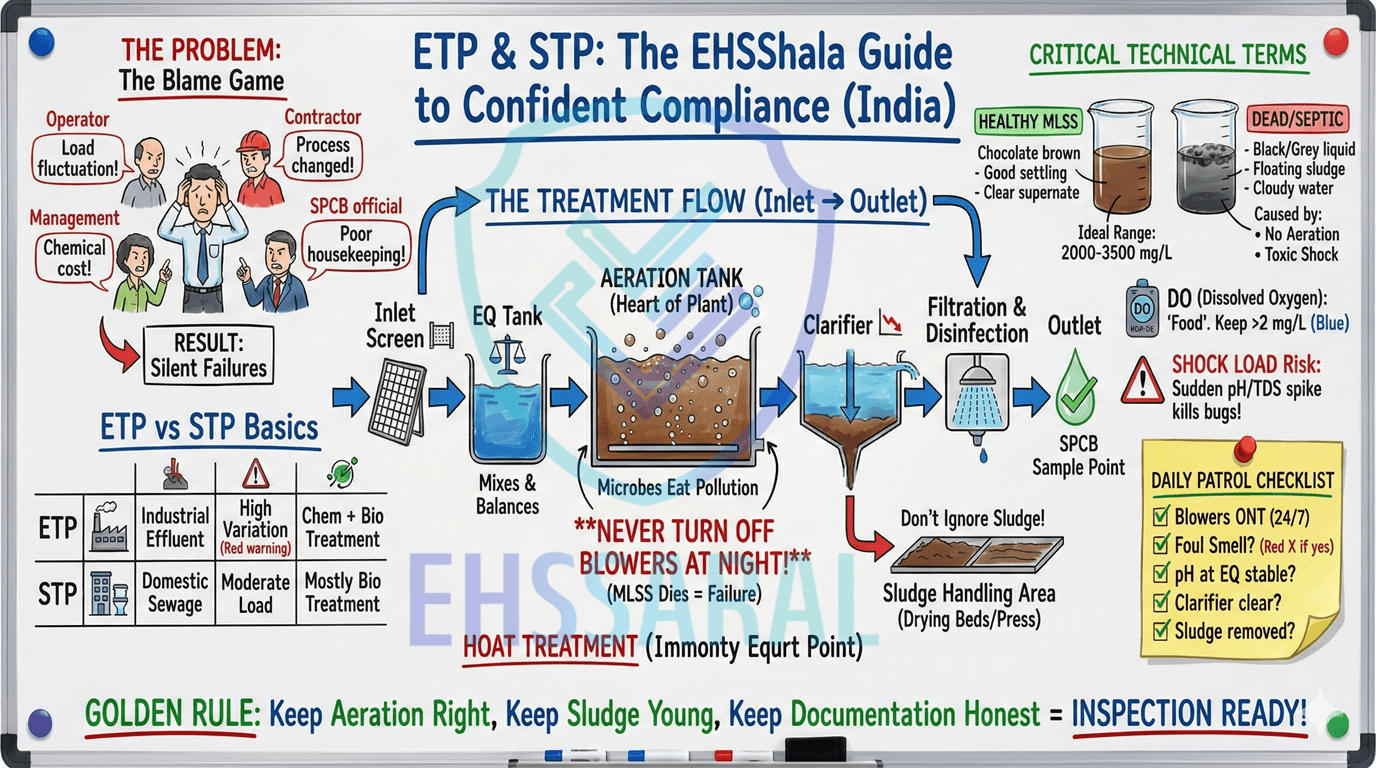
ETP & STP Troubleshooting: The Complete Indian Guide | EHSShala
Battery Waste Registration for Equipment Importers (BWM Rules 2022 Explained) | EHSSaral
The Hidden Costs of Manual Environmental Compliance in India
Hazardous Waste Storage Rules in Indian Factories | EHSShala
 EHSSaral v1.png)
Blue Category MPCB 3-Year Consent Validity for Recyclers (2026) | EHSSaral