Why Running Factories Are Getting Closure Notices in 2026 | EHSSaral
EHSSaral is an Environmental Compliance Intelligence Platform for Industries. Consent Intelligence • Alerts & Tasks • Incident Reporting • Form IV & V • Audit-Ready Records
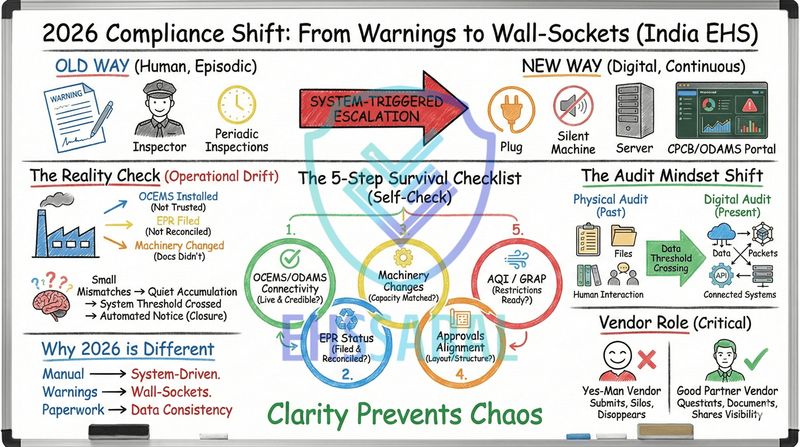
From Warnings to Wall-Sockets: Why Compliance Feels Different in 2026
In the old days, non-compliance usually meant a warning letter. A reminder. Maybe a visit.
In 2026, it increasingly means something far more immediate - a directive to the electricity board. Power off. Machines silent. Production halted.
That is what “from warnings to wall-sockets” really means.
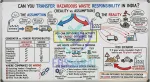
In many Indian plants, compliance still feels human. An inspector, a discussion, a chance to explain. But the reality has shifted quietly. Today, continuity is often decided before anyone visits your gate.
What changed is not intent. What changed is the system.
The Reality Check: “Running Factory” Is No Longer a Shield
For years, a common assumption protected factories:
“If we are running, paying taxes, employing people - things can be managed.”
That assumption no longer holds.
Recent closures have surprised owners not because they were careless, but because the triggers were invisible. Data gaps. Portal mismatches. System thresholds crossed quietly.
No confrontation. No argument. Just automated escalation.
This is not about stricter officers. It is about connected systems.
The 2026 Audit Mindset
Compliance audits have moved from episodic to continuous.
Instead of waiting for inspections, authorities now see how a plant behaves every day. They see whether reported data matches actual patterns. They see whether obligations across different portals align.
At the centre of this shift are continuous monitoring systems - commonly referred to as OCEMS, now increasingly routed through ODAMS dashboards. ODAMS (Online Data Acquisition and Monitoring System) centralizes real-time environmental data across SPCBs-turning local monitoring into networked visibility.
From a practical standpoint, this changes the meaning of “inspection”.
Inspection is no longer a visit. It is a data threshold crossing.
A dashboard showing green only means the system is connected. It does not automatically mean the data is credible.
Why This Shift Feels Sudden - But Isn’t?
To many EHS teams, recent actions feel abrupt. In reality, this transition has been building slowly.
Online consent systems, centralised EPR portals, QR-based material tracking, and continuous monitoring were all introduced over time. For years, they operated independently.
Now they are being read together.
When data across systems aligns, nothing happens. When it does not, escalation becomes automatic.
No phone calls. No reminders. Only outcomes.
What This Article Is (And Is Not)?
This is not a rulebook. It is not a legal interpretation. It is not written to assign blame.
It exists to explain how compliance is now interpreted in practice - not how regulations are written on paper.
Most shutdowns today are not caused by a single dramatic violation. They are caused by small mismatches that build quietly, until a system decides they matter.
Where Good Factories Quietly Start Slipping
Most compliance failures in Indian factories do not begin with bad intent. They begin with small, reasonable changes made over time.
A machine is added to improve productivity. A vendor is changed to reduce cost. A filing is delegated to save time.
Individually, none of these feel risky. Collectively, they create what can be called operational drift - the slow widening gap between what is happening on the shop floor and what the system believes is happening.
In many plants, OCEMS or ODAMS is treated as an installation milestone rather than an ongoing responsibility.
Once the system shows “connected”, attention moves elsewhere.
Over time, common habits creep in:
short downtimes are ignored
flatline data is assumed to be a sensor issue
alerts are considered temporary glitches
From a system perspective, however, consistency matters more than explanations.
A dashboard going green only confirms connectivity. It does not confirm that the data reflects actual operations. Extended flatlines, repeated gaps, or values that never change raise flags quietly - without needing an inspection.
This is one of the most common starting points of escalation.
Production volumes, purchase records, waste generation, and declared obligations often live in different files - sometimes with different vendors. When these numbers do not align, the system does not see intent or effort. It only sees inconsistency.
Filed does not mean reconciled. Submitted does not mean aligned.
Over time, these gaps accumulate silently.
Machinery Changed - Documents Didn’t
This is one of the most common and least discussed risk areas.
A new CNC machine is installed. A compressor is relocated. A DG set is upgraded. A mezzanine floor is added.
In one typical case, a factory added a small second-floor storage area for finished goods. Structurally it felt minor. But it changed the footprint and load assumptions referenced in the older factory licence papers-something that surfaced only when consent renewal required updated supporting approvals. The environmental file was fine. The linked approval trail was two years behind.
From an operational viewpoint, these are improvements. From a documentation standpoint, they are dependencies.
Layouts, capacities, load assumptions, and approval references often remain unchanged. No one flags it because nothing breaks immediately.
Digital audits, however, do not look at machines in isolation. They look at capacity, emissions, structure, and approvals as one connected picture.
This is where otherwise well-run factories begin to look inconsistent.
The Structural Stability Trap
Structural stability is often assumed to be outside environmental compliance. In practice, it becomes a dependency.
When a factory applies for consent renewal or capacity enhancement, supporting approvals come into play. If a factory licence update is required and the structural stability certificate does not cover the revised load or layout, the chain stalls.
The environmental approval does not fail because of emissions. It fails because a linked approval cannot move forward.
This is not regulatory overreach. It is administrative linkage.
Factories are rarely sealed for adding machines. They are sealed for not aligning the approval trail that those machines depend on.
Why These Issues Don’t Feel Dangerous - Until They Are?
None of these gaps trigger immediate alarms internally. Production continues. Orders are met. The plant runs.
Digital systems, however, accumulate signals quietly. They do not warn in advance. They escalate only when thresholds are crossed.
By the time a notice arrives, the issue feels sudden. In reality, it has usually been building for months.
This is how good factories end up surprised - not because they ignored compliance, but because they underestimated how systems now read continuity.
A Practical Self-Check Before Systems Do It for You
In a digital-first compliance environment, survival does not depend on knowing every rule. It depends on periodically checking whether what is happening on the ground still matches what the system expects.
A simple weekly self-check is often enough to catch problems early.
Consider this as a Monday-morning sanity check, not an audit.
Is the OCEMS / ODAMS dashboard consistently live, or has it gone offline repeatedly?
Do the numbers reported show normal variation, or have they flatlined for long periods?
Are EPR returns only filed, or are they internally reconciled with production and purchase data?
Has any machinery been added, relocated, or upgraded in the last two years?
Has output increased without a corresponding consent or capacity update?
Are there any active AQI or GRAP-related restrictions that could trigger sudden stoppages?
None of these questions require legal interpretation. They only require awareness.
Checkpoint
The “2-Minute” Check
The Hidden Risk
Connectivity
Is the OCEMS/ODAMS dashboard green?
Green means connected, not compliant. Check for flatline values or repeated gaps.
EPR Status
Are returns filed?
Filed vs reconciled. Do purchases, production, and obligations align?
Capacity
Has output increased recently?
Consent capacity mismatch is a common trigger during renewal or review.
Machinery
Any new machines installed or relocated?
Machinery changes often create approval dependencies you may not see immediately.
Approvals
Any layout/load change (DG/CNC/mezzanine)?
Structural stability and factory licence linkages can stall environmental approvals.
When to Actually Worry?
Not every factory is at immediate risk. But certain signals should trigger a deeper internal review.
If two or more of the following apply, this isn’t optional. If four or more apply, you’re likely already flagged in a system somewhere.
OCEMS or ODAMS has been offline or inconsistent for extended periods
Production capacity has increased significantly without consent revision
EPR compliance is fully vendor-handled with no internal visibility
New machinery or layout changes were made without revisiting approvals
Consent renewals are approaching within the next few months
Any system-generated communication or restriction notice has been received
These are not red flags because they are illegal. They are red flags because they indicate misalignment.
The Vendor Question Most Factories Avoid
Vendors play a critical role in modern compliance. The risk is not outsourcing work. The risk is outsourcing understanding.
Many factories choose vendors based on speed, availability, or cost. This works until something goes wrong.
A dangerous pattern is the “yes-man” vendor - someone who never pushes back, never questions data, and never flags inconsistencies.
Such vendors optimise for submission, not continuity.
A good compliance partner behaves differently. They ask uncomfortable questions. They slow things down when numbers do not make sense. They refuse to file when data looks inconsistent. They document assumptions and share visibility.
If your vendor never says “no”, they are not protecting you. They are only processing paper.
Why Vendor Quality Matters More in 2026?
In earlier years, filings existed in silos. A mistake in one area could often be corrected in isolation.
Today, systems cross-check each other. A mismatch in one portal can surface through another. Vendors who operate without visibility into the full picture unintentionally create risk.
Work can be outsourced. Responsibility cannot.
This is why factories that rely entirely on external handling without internal ownership are often the most surprised when notices arrive.
If a Notice Has Already Arrived
By the time a notice reaches a factory, anxiety usually takes over. The instinct is to respond immediately, call a consultant, and “close it fast”.
That instinct often makes things worse.
Most notices today are not personal accusations. They are system-triggered alerts indicating that a threshold was crossed somewhere in the data. Treating them as legal attacks instead of diagnostic signals leads to poor responses.
The first step is not drafting a reply. The first step is understanding what triggered it.
Decoding the Trigger Before You Respond
Notices may use broad language, but the underlying causes are usually limited.
OCEMS or ODAMS non-compliance often points to extended downtime, flatline data, or repeated connectivity gaps.
EPR discrepancies usually indicate a mismatch between declared obligations and production or purchase data.
Consent condition violations often trace back to capacity increases or layout changes that were never updated.
Structural concerns usually surface after machinery additions that affect load assumptions or factory licence dependencies.
In most cases, the notice is not questioning intent. It is highlighting inconsistency.
The Correct Response Sequence
What separates closures from clean resolutions is not paperwork quality. It is sequence.
A common mistake is to prepare explanations first and corrections later. Digital systems do not accept explanations without alignment.
A safer sequence looks like this:
Reconstruct a factual timeline of what changed, and when.
Correct the ground reality where possible.
Align documentation to the corrected state.
Respond with evidence of action, not just justification.
This approach reduces escalation because it speaks the language systems understand - consistency.
Notices handled this way often close quietly. Notices handled emotionally tend to multiply.
Where Most Factories Go Wrong After a Notice?
The problem is rarely intent. It is reaction.
Over-dependence on a single external consultant
Blind affidavits without internal verification
Treating compliance as paperwork instead of operations
Fixing documents before fixing reality
These patterns signal risk to a digital system, even when explanations sound reasonable to humans.
Why 2026 Is a Real Turning Point?
What has changed is not regulation volume. It is expectation.
Earlier, compliance depended on:
timely submissions
physical inspections
reactive corrections
Now it depends on:
data consistency across systems
pre-emptive reconciliation
ownership of operational changes
The currency of compliance has shifted from paperwork to alignment.
A Final Thought
Most shutdowns do not begin with inspections. They begin with small mismatches that no one owned.
Factories that adapt to this reality do not work harder. They work clearer.
Most shutdowns don’t start with inspections. They start with small mismatches that no one owned.
Clarity at the process level prevents chaos later.



 EHSSaral.webp)