

Blog
Battery Waste Registration for Equipment Importers (BWM Rules 2022 Explained) | EHSSaral
EHSSaral is an Environmental Compliance Intelligence Platform for Industries. Consent Intelligence • Alerts & Tasks • Incident Reporting • Form IV & V • Audit-Ready Records
See how EHSSaral works
2 Feb 2026
Author: Harshal T Gajare
Affiliation: Founder, EHSSaral
Date: December 2025
India’s environmental compliance framework has entered a decisive new phase. Between 2023 and 2025, regulatory enforcement has shifted from predominantly physical inspection-based models to portal-mediated, rule-based digital traceability systems. This transition is most visible in the implementation of Extended Producer Responsibility (EPR) regimes for plastic and e-waste, where compliance is no longer validated through periodic site inspections alone, but through continuous, invoice-level digital proof submitted via centralized national portals.
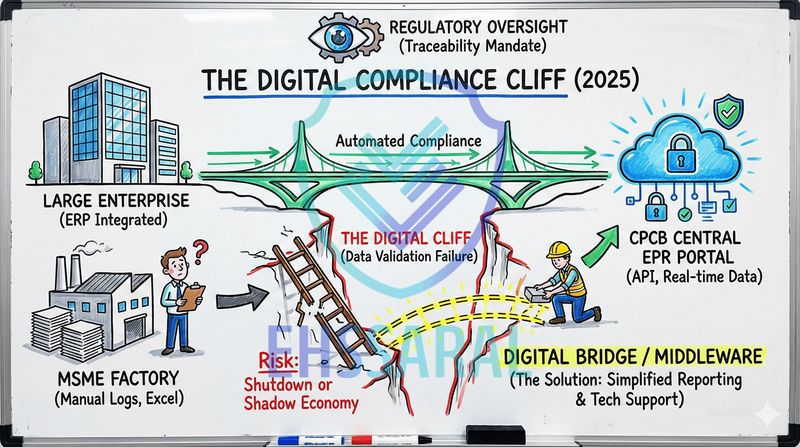
While the policy intent of this shift is robust and environmentally necessary, this paper identifies a critical structural risk: the emergence of a “Digital Compliance Cliff” for Micro, Small, and Medium Enterprises (MSMEs. This cliff does not arise from regulatory resistance or environmental negligence, but from a widening digital capability mismatch between large enterprises and smaller manufacturers.
Large corporations typically operate integrated Enterprise Resource Planning (ERP) systems that allow automated data flows from procurement and production records directly into government portals. MSMEs, by contrast, operate in largely manual environments-relying on Excel-based records, fragmented vendor documentation, and informal supply chains. When subjected to the same portal-level validation requirements, these firms face disproportionately high compliance friction.
Analysis of parliamentary disclosures, Central Pollution Control Board (CPCB) portal data, and oversight observations from the Comptroller and Auditor General (CAG) reveals a recurring pattern: registration intent among smaller entities is high, but successful completion of annual digital reporting cycles lags significantly. This “filing gap” suggests that the primary barrier is not awareness or willingness, but technical execution.
The 2025 traceability mandates-particularly requirements for end-to-end invoice linkage and proof of recycled content-intensify this challenge. Tier-2 and Tier-3 suppliers, many of whom operate outside formal digital accounting systems, are often unable to generate the standardized data required by centralized portals. As a result, compliance bottlenecks propagate upstream, affecting even larger Brand Owners (PIBOs) that depend on these suppliers.
This paper argues that without tiered digital reporting pathways, analogous to the GST Composition Scheme, the current enforcement architecture risks creating perverse outcomes. These include increased consultant dependency, exclusion of smaller vendors from formal supply chains, and incentives for marginal manufacturers to exit formal branding altogether-outcomes that ultimately undermine the objective of traceability.
The paper concludes that environmental compliance in its current form is increasingly a data systems problem rather than a purely legal or engineering challenge. Bridging this gap requires policy recognition of simplified reporting tiers and the development of compliant digital intermediary infrastructure capable of translating MSME operational data into portal-ready formats.
Plastic Waste Management Rules (2022) - A Practical Guide for Indian Factories by EHSShala
For much of the last decade, environmental enforcement in India was defined by physical interventions. Regulatory focus between 2016 and 2022 centered on material restrictions-such as plastic thickness bans-and on-site inspections that evaluated installed pollution control equipment, waste storage practices, and physical documentation.
This paradigm began to shift decisively after 2023. Rather than asking whether waste was treated or recycled, regulators increasingly began asking whether these activities could be proven digitally. The introduction and expansion of centralized EPR portals marked a move toward continuous, transaction-level verification. Compliance became less about the presence of infrastructure and more about the integrity of data trails.
A persistent misconception remains within much of Indian industry that environmental compliance is primarily a matter of installing control devices-filters, effluent treatment plants, or waste storage systems. While these remain essential, they are no longer sufficient. Under current regimes, compliance is validated only when physical actions are digitally mirrored, authenticated, and reconciled within government systems.
This shift represents a fundamental change in enforcement logic. Environmental compliance has transitioned from a periodic, inspector-driven process to an always-on, algorithmically validated one. Understanding the implications of this transition-particularly for MSMEs operating at the margins of digital readiness-is essential to ensuring that regulatory objectives are achieved without unintended economic exclusion.
The Centralized Extended Producer Responsibility (EPR) Portal administered by the Central Pollution Control Board (CPCB) represents a structural redesign of environmental enforcement. Rather than functioning as a passive filing repository, the portal operates as a transaction-validation system.
At a simplified level, the system requires the following sequence:
Each step is digitally interlinked. A downstream failure-such as a recycler’s invoice mismatch or delayed upload-invalidates the upstream entity’s compliance record. In effect, compliance is no longer evaluated entity-by-entity, but network-by-network.
This design reflects a deliberate policy choice: shifting enforcement away from episodic inspections toward continuous digital traceability.
The 2025 phase of EPR implementation introduces a critical escalation: end-to-end traceability.
Under current mandates, it is no longer sufficient for a PIBO to declare that waste has been recycled. The entity must digitally demonstrate:
This requirement fundamentally alters the nature of compliance. Environmental responsibility is now enforced through data lineage, not just outcomes.
For large enterprises with integrated procurement, inventory, and accounting systems, these requirements can be operationalized through automated workflows. For smaller entities, particularly those embedded in informal or semi-formal supply chains, the same requirements represent a structural hurdle.
MSMEs typically operate with three characteristics that clash with portal-based enforcement:
When subjected to invoice-level traceability mandates, these characteristics create compounding friction. A single missing or non-standard invoice from a Tier-2 supplier can cascade into non-compliance for the brand owner.
This exposure is not a result of regulatory avoidance. Rather, it reflects a misalignment between operational reality and digital validation logic.
Parliamentary disclosures and CPCB reporting indicate a recurring pattern across states: the number of registered PIBOs consistently exceeds the number of entities that successfully complete annual return filings.
For example, responses to Lok Sabha Unstarred Question No. 2136 (December 9, 2024) highlighted state-level discrepancies between registered entities and completed filings under EPR regimes. While registrations increased steadily, a significant subset of entities failed to conclude the reporting cycle for the relevant financial year.
This divergence-referred to in this paper as the “filing gap”-is a critical indicator. It suggests that awareness and intent are not the primary constraints. Instead, the bottleneck appears during the technical execution phase of compliance.

In parallel, regulatory scrutiny has intensified. Lok Sabha Unstarred Question No. 2193 (December 9, 2024) confirmed that CPCB audits uncovered irregularities, including the issuance of fraudulent EPR certificates. In response, regulators appropriately tightened portal security and verification protocols.
These measures-such as enhanced authentication requirements, stricter validations, and audit trails-were necessary to preserve system integrity. However, they also increased the digital hardness of the compliance process.
For MSMEs without dedicated compliance or IT personnel, managing frequent password resets, multi-factor authentication, document re-uploads, and validation errors has become a non-trivial operational burden. The same controls that improve enforcement reliability can inadvertently widen capability gaps.
Observations from the Comptroller and Auditor General (CAG), including findings from the Performance Audit on Waste Management (Report No. 2 of 2024), consistently highlight deficiencies in systematic data collection at the local level. Urban Local Bodies (ULBs), recyclers, and small operators often lack standardized procedures for recording, aggregating, and reporting waste flows.
This lack of structured data at the point of generation makes downstream digital mirroring difficult. Portal-level traceability assumes the existence of clean, standardized inputs-an assumption that does not uniformly hold across MSME ecosystems.
Taken together, these indicators reveal the contours of the Digital Compliance Cliff: a point at which regulatory intent, technological enforcement, and enterprise capability diverge sharply.
At the core of the Digital Compliance Cliff lies a fundamental asymmetry in how enterprises interact with compliance systems.
Large enterprises typically operate integrated digital stacks. Procurement orders, material inward records, production data, and sales invoices are captured within ERP systems. When environmental reporting obligations arise, data can be programmatically extracted, validated, and transmitted to government portals with minimal manual intervention.
MSMEs operate in a materially different environment. Compliance data is usually maintained through:
Under portal-based enforcement, these manual systems are required to interface with algorithmic validation engines designed for structured, standardized inputs. The result is a high frequency of mismatches-quantity deviations, date inconsistencies, format errors-that trigger portal rejections.
This mismatch is not a question of diligence, but of system design compatibility.

The economic impact of this mismatch becomes evident when compliance costs are viewed relative to enterprise scale.
For large corporations, digital compliance costs-ERP configuration, consultant support, audit processes-represent a negligible fraction of turnover. These costs are amortized across large volumes and embedded within existing systems.
For micro and small enterprises, the same compliance obligations translate into:
When expressed as a percentage of revenue, the compliance cost curve becomes regressive: smaller entities incur disproportionately higher costs for each unit of material placed in the market, despite having a significantly smaller environmental footprint.
This asymmetry is central to understanding why uniform digital enforcement can produce unequal economic outcomes.
A notable consequence of portal complexity has been the emergence of consultant-led compliance execution.
In theory, consultants are meant to advise, interpret regulations, and build internal capability. In practice, many MSMEs now rely on third parties for:
Compliance becomes a transactional service rather than an institutional function. Over time, this dependency erodes internal understanding and resilience. When consultants disengage or errors occur, enterprises find themselves unable to diagnose or correct compliance failures independently.
This dynamic creates a fragile compliance ecosystem-one that is operationally compliant on paper but structurally vulnerable.
While long-term outcomes of digital enforcement will emerge over time, early behavioral patterns are already observable across MSME ecosystems.
One emerging response to digital friction is a reduction in formal branding. By selling products in unbranded or loosely labeled forms, marginal manufacturers can avoid classification as Brand Owners, thereby exiting EPR obligations altogether.
This response does not eliminate environmental impact. It merely shifts activity outside the traceable perimeter-counter to the objectives of the EPR framework.
Large Brand Owners, facing strict validation requirements, are increasingly screening vendors based on data readiness rather than operational competence alone. MSMEs unable to provide standardized digital documentation risk exclusion from formal supply chains.
This creates a feedback loop: enterprises most in need of digital transition support are the first to be excluded, accelerating market consolidation rather than inclusive compliance.
A third pattern is the outsourcing of compliance as a black-box function. While this may achieve short-term filing success, it prevents learning and adaptation. Over time, enterprises remain dependent on external actors without developing internal data discipline.
These behavioral shifts are not speculative. They are rational responses to friction within the system. However, if left unaddressed, they risk undermining both environmental traceability and MSME sustainability.
Given the sensitivity of environmental regulation and the legitimate urgency of waste management reform, it is necessary to clearly define the boundaries of this analysis.
This paper does not argue that:
Nor does it suggest a return to inspection-only enforcement models.
Instead, this paper argues that uniform digital enforcement without tiered execution pathways risks producing exclusionary outcomes. When compliance systems assume a level of digital maturity that does not exist uniformly across enterprise classes, enforcement effectiveness may increase on paper while real-world traceability weakens.
The intent of this clarification is not defensive, but constructive: to ensure that environmental objectives are achieved through usable, scalable systems, rather than through compliance structures that inadvertently privilege scale over substance.
A practical policy response to the Digital Compliance Cliff is the introduction of simplified digital reporting tiers for MSMEs, calibrated to turnover and material volume.
India already operates such a model successfully through the GST Composition Scheme, which recognizes that uniform procedural requirements impose unequal burdens on small enterprises. A similar logic can be applied to EPR reporting, where:
Such an approach would preserve regulatory intent while reducing unintended exclusion.
The current enforcement architecture implicitly assumes that every regulated entity can directly interface with government portals. This assumption does not reflect ground realities.
A more resilient model would formally recognize digital compliance intermediaries-platforms that can:
These intermediaries should be viewed as compliance infrastructure, not as circumvention mechanisms. Their role would be analogous to GST Suvidha Providers (GSPs) in the taxation ecosystem.
At its core, the Digital Compliance Cliff is not a legal failure or an enforcement failure. It is a data systems mismatch.
Environmental enforcement has become algorithmic. Without corresponding investment in data capture, standardization, and translation at the MSME level, regulatory ambition risks outpacing execution capacity. Aligning enforcement design with enterprise reality is therefore a prerequisite for sustainable compliance outcomes.
India’s transition toward digital, traceability-driven environmental enforcement is both necessary and inevitable. The scale and complexity of modern waste streams demand systems that are transparent, auditable, and resistant to manipulation.
However, enforcement strength must be matched with infrastructure inclusivity. When compliance systems become inaccessible to smaller enterprises-not by intent, but by design-the result is not improved environmental outcomes, but behavioral adaptation that circumvents traceability altogether.
This paper concludes that environmental compliance in its current phase must be treated primarily as a data engineering and systems design challenge, not merely as a regulatory obligation. Bridging the Digital Compliance Cliff is essential to ensuring that India’s environmental goals are met without eroding the economic base of its MSME sector.
Methodology:
This paper employs a data triangulation approach combining:
Limitations:
The analysis focuses on plastic and e-waste EPR regimes as representative digital compliance systems. Findings may not generalize uniformly across all environmental regulations.
Disclosure:
The author is the founder of EHSSaral, a platform working on environmental compliance digitization. References to digital intermediary systems are presented in a category-level context, not as product endorsement.
Harshal T Gajare is an environmental systems analyst and founder of EHSSaral, an environmental compliance infrastructure initiative focused on simplifying regulatory execution for Indian MSMEs. With field exposure to environmental monitoring and compliance workflows, his work focuses on the intersection of regulation, data systems, and enterprise capability.
All sources cited are publicly available government disclosures, statutory reports, or official regulatory portals.

Founder, EHSSaral
Founder - EHSSaral | Partner - Perfect Pollucon | ISO 14001 Lead Auditor | GHG Protocol Scope 2 | Chemist | Data Scientist | Second-generation environmental professional simplifying EHS compliance for Indian industries through practical, automated, tech-enabled, data driven compliance workflows.
Battery Waste Registration for Equipment Importers (BWM Rules 2022 Explained) | EHSSaral
 EHSSaral v1.png)
Blue Category MPCB 3-Year Consent Validity for Recyclers (2026) | EHSSaral
Isokinetic Sampling Basics: Simple Guide for Stack Monitoring | EHSShala
Why Environmental Non-Compliance Happens in Indian Industries: 6 System Failures
Environmental Compliance in India: Beginner Roadmap | EHSShala

Environmental Compliance Management in India: Systems vs Consultants Explained

Why Form IV Readiness Cannot Begin at the End of the Year
Manual Stack Monitoring vs OCEMS: Why Results Differ in Environmental Compliance

EHSShala Start – Begin Your EHS Learning Journey in India

Industrial Siting Criteria in India: Factory Location Guide