
Blog
The ZLD Mass Balance Trap: How Auditors Calculate Effluent Using Your Water Bills | EHSSaral
EHSSaral is an Environmental Compliance Intelligence Platform for Industries. Consent Intelligence • Alerts & Tasks • Incident Reporting • Form IV & V • Audit-Ready Records
See how EHSSaral works
12 Feb 2026
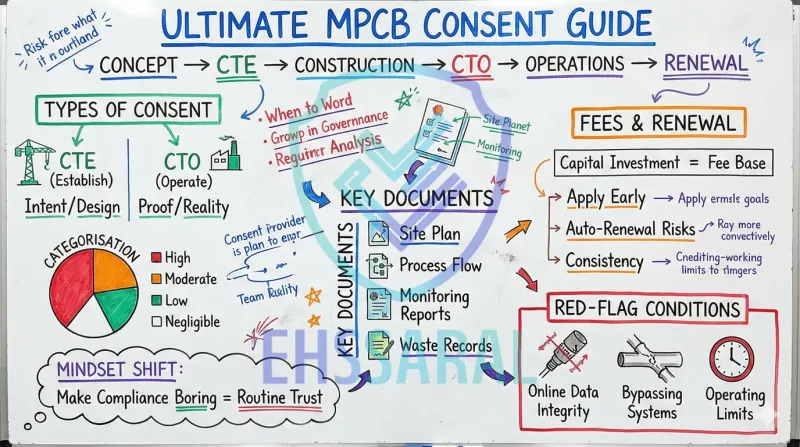
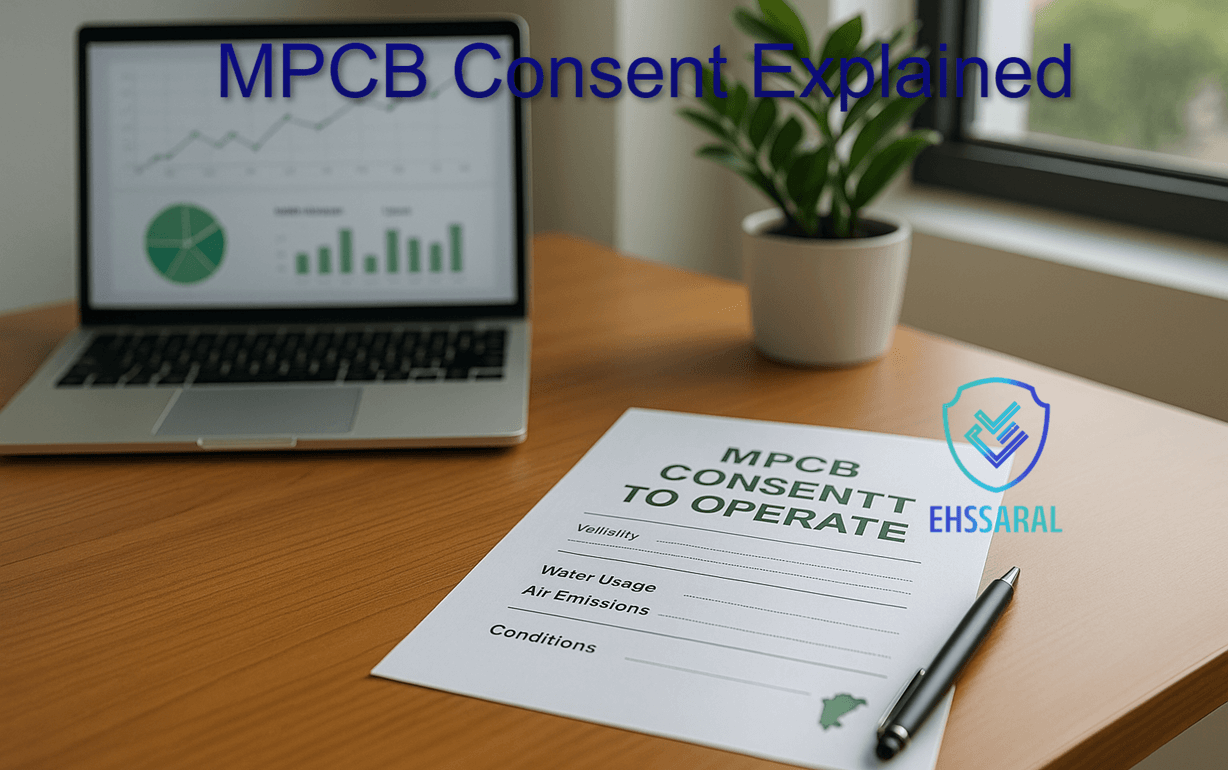
MPCB Consent is a legal approval issued by the Maharashtra Pollution Control Board under the Water Act and Air Act.
It allows an industry to establish and operate only if environmental risks (air, water, waste) are identified, controlled, and recorded.
Think of it this way:
It is not a one-time certificate.
It is a living permission tied to how your factory actually runs - day after day.
If your operations change but your consent doesn’t, trouble usually follows.
This guide is written for:
| Get Free Compliance Visibility in 15 Minutes Upload your Consent to Operate and instantly see extracted obligations, deadlines, reminders, and an audit-ready compliance trail. Free forever for core compliance visibility. No execution lock-in. No forced upgrades. 👉 Register free on EHSSaral |
CTE is permission to build.
You must obtain CTE before:
Construction
Installation of machinery
Capacity expansion
Process change that affects pollution load
CTE checks intent:
What you plan to manufacture
How much you plan to produce
What pollution control systems you propose
Important: Starting construction without CTE is one of the most common and most avoidable violations.
CTO is permission to run.
You apply for CTO after:
Equipment is installed
Pollution control systems are in place
You can prove compliance with CTE conditions
CTO checks reality:
What is actually installed vs what was promised
Whether emissions/effluent meet limits
Whether records and systems exist on ground
Relationship between CTE & CTO:
CTE conditions become a checklist for CTO approval.
If you ignore CTE conditions during construction, CTO gets delayed or rejected.
| Point | CTE (Consent to Establish) | CTO (Consent to Operate) |
|---|---|---|
| Purpose | Permission to build / set up | Permission to run operations |
| Stage | Before construction / installation | After systems are installed |
| What MPCB checks | Your plan and commitment | Your actual ground reality |
| What usually causes delay | Missing design clarity, wrong plans | Mismatch with CTE, missing records |
| Simple way to remember | Promise | Proof |
Industries are classified based on pollution potential:
Red – High pollution potential
Orange – Moderate pollution potential
Green – Low pollution potential
White – Negligible pollution potential (often no consent required)
This category decides:
Consent validity period
Renewal frequency
Fee slabs
Inspection intensity
| Category | What it generally means | What changes for EHS teams |
|---|---|---|
| Red | High pollution potential | Higher scrutiny, stronger control expectations |
| Orange | Moderate pollution potential | Regular scrutiny, conditions still matter a lot |
| Green | Low pollution potential | Easier approvals, but conditions still apply |
| White | Negligible pollution potential | Often no consent, but other rules may still apply |
Common junior mistake: Assuming “small factory = Green category.”
Category depends on process, not size.
Industry Categorization in India: Red, Orange, Green, White & Blue by EHSShala Team
This is the big picture every new EHS professional should memorize - not the forms.
Lifecycle at a glance:
Concept → CTE Application → CTE Grant →
Construction / Installation → CTO Application → CTO Grant →
Operations → Monitoring & Records → Renewal Cycle
Two key insights:
Compliance doesn’t start at CTO-it starts at design stage.
Renewal is not a repeat application; it’s a continuation of trust.
MPCB does not expect perfection.
It expects consistency.
Across thousands of cases, approvals move smoothly when:
Data submitted matches ground reality
Conditions are read and acted upon
Records exist even if numbers fluctuate
Problems begin when:
Documents look “too perfect”
Systems exist only on paper
Different departments submit conflicting data
Officers are trained to spot patterns not hunt for honest mistakes.
If you remember only one thing from this part, remember this:
Consent is not a hurdle to cross.
It is a boundary within which you must operate.
Good EHS professionals don’t memorize rules.
They understand why each rule exists and build systems around it.
(This is where most applications succeed or fail)
For a new EHS professional, document collection often feels like blind paperwork.
In reality, each document answers one specific regulatory question.
If you understand why a document is asked, you’ll never panic during scrutiny.
CTE is about intention and design, not operation.
MPCB wants to understand:
What you plan to do
How much pollution you may generate
Whether control systems are planned before pollution begins
Core CTE documents typically include:
Junior insight:
CTE documents are theory + commitment.
MPCB is approving what you promise to install.
CTO is about proof and performance.
Here, MPCB checks whether:
What you promised in CTE actually exists
Systems are functional
Records are being maintained
Core CTO documents typically include:
Previous CTE copy
Compliance report against CTE conditions
Photographs of installed pollution control systems
Air, water, and noise monitoring reports from approved laboratories
Hazardous waste authorisation & disposal records
Updated machinery list
Environmental statement (where applicable)
Key difference to remember:
CTE = design intent
CTO = ground reality
If there is a mismatch, queries are guaranteed.
MPCB applications today are primarily handled through online systems such as MAITRI / e-MPCB platforms.
While portal layouts may change, the approval logic does not.
Application submission
Document scrutiny by MPCB officer
Query raised (if clarification needed)
Site visit (in selected cases)
Approval / rejection / additional conditions
Important:
Queries are not accusations.
They are requests for clarification.
How you respond often matters more than the query itself.
From field experience, delays usually happen due to:
Missing annexures
Poorly labelled documents
Mismatch between forms and uploaded reports
Copy-paste descriptions not matching the unit
Overly generic pollution control descriptions
Senior tip for juniors:
If an officer has to “assume” something from your application, expect a query.
This section is not criticism - it’s preparation.
Server slowdowns near deadlines
Session timeouts during uploads
File size and format rejections
Temporary portal outages
Ground rule:
Never plan submissions on the last day.
Technical issues are not accepted as justification for late filing.
Fast uploads with incorrect data cause:
Repeated scrutiny
Long clarification cycles
Officer distrust in future applications
Slow, accurate submissions build:
Predictability
Faster renewals later
Fewer site visits
MPCB officers are trained to look for patterns, not perfection.
They mentally check:
Is data internally consistent?
Do numbers match typical industry ranges?
Do proposed systems make sense for the process?
Red flag behavior:
Applications that look “too clean” or copy-pasted across units.
Honest data with explanation performs far better than polished fiction.
Before clicking Submit, ask yourself one question:
“If an officer visits tomorrow, can I show everything I uploaded?”
If the answer is yes - you’re ready.
If the answer is no-pause, correct, then submit.
Before you click Submit, quickly confirm:
Consent fees are one of the most misunderstood parts of environmental compliance.
Many juniors assume fees are linked to:
Production quantity, or
Pollution level alone
That’s not correct.
MPCB consent fees are primarily based on capital investment.
Capital investment typically includes:
Land
Building
Plant & machinery
Utilities directly related to production
It does not mean:
Annual turnover
Profit
Monthly production
Key understanding:
MPCB is pricing the scale of potential environmental impact, not business success.
Example:
A manufacturing unit declares a capital investment of ₹45 crore and falls under the Orange Category.MPCB applies the fee slab corresponding to this investment range and category to calculate the consent fee.
Why this matters:
Under-declaring investment may reduce fees temporarily
But it increases audit and revision risk later
Over-declaring means paying more than necessary
Accuracy protects both compliance and cost.
Using outdated capital investment figures
Ignoring expansion or machinery additions
Declaring different investment values across departments
Treating fee payment as a “formality” without validation
Senior advice:
Always align capital investment figures with finance and project teams before submission.
Renewal is where most EHS professionals experience stress-not because it’s complex, but because it’s delayed.
Best practice:
Apply well before consent expiry
Keep buffer time for queries or clarifications
Reality check:
Renewal is not a fresh application.
It is MPCB asking, “Have you operated responsibly since we last trusted you?”
During renewal, MPCB typically reviews:
Compliance with previous consent conditions
Monitoring data trends (not just one report)
Hazardous waste handling continuity
Whether operations stayed within approved limits
If your records are consistent, renewal is usually smooth.
If records are scattered, renewal becomes scrutiny.
This question causes more panic than any other.
General principle:
If renewal is applied before expiry and acknowledgment exists, operations are usually allowed while the application is under process.
However:
Operating after expiry without application is a violation
Verbal assurances mean nothing without acknowledgment
Junior rule:
Never assume. Always keep documentary proof.
MPCB has introduced simplified renewal mechanisms for certain cases, including auto-renewal with self-declaration.
This is intended to:
Reduce paperwork
Reward consistent compliance
Save time for both industry and regulators
But it is not risk-free.
If your renewal is based on self-declaration, read this carefully before choosing the “easy” route.
Read more about SPCB Auto Renewal consent basis capital investment
Auto-renewal assumes:
No major change in capital investment
No change in production capacity or process
No unresolved non-compliances
Honest self-declaration
Important:
Auto-renewal does not eliminate accountability.
It shifts responsibility directly to the industry.
Avoid auto-renewal if:
Capital investment has increased significantly
New pollution sources were added
Actual operations differ from consent conditions
Records are incomplete or inconsistent
In such cases, manual renewal with explanation is safer.
The biggest long-term risk in renewal is data mismatch.
Examples:
Flow meters installed but not calibrated
ETP capacity approved but partially bypassed
Production within limits on paper, not on ground
Hard truth:
Most serious notices are triggered not by pollution-but by contradiction.
Consistency matters more than perfection.
Before submitting any renewal, quietly verify:
Consent validity date confirmed
All conditions reviewed
Monitoring reports complete and recent
Hazardous waste records signed and traceable
Capital investment re-validated
If all five are checked, renewal anxiety drops sharply.
(This is where compliance actually lives)
Most EHS professionals focus heavily on:
Application
Fees
Approval dates
But 90% of regulatory trouble starts after approval, inside the conditions section of the consent issued by the Maharashtra Pollution Control Board.
Core truth:
Your consent certificate is not an approval letter.
It is a contract of responsibilities.
If you treat it like a certificate, you panic during inspections.
If you treat it like a contract, inspections become routine.
Not all conditions carry the same risk.
Understanding their nature helps you prioritize effort.
These apply to almost all industries.
Typical examples:
Maintain records and logbooks
Allow inspection by MPCB officials
Submit periodic reports
Inform MPCB about changes
Reality:
General conditions rarely trigger notices on their own.
They become issues only when combined with other lapses.
These depend on:
Your process
Pollution potential
Category (Red / Orange / Green)
Examples:
Specific emission limits
Mandatory pollution control equipment
Continuous or periodic monitoring requirements
Junior mistake:
Assuming conditions from another unit apply to yours.
Each consent is custom-built, even within the same industry.
These are imposed due to:
Proximity to residential areas
CETP / STP connectivity
Local environmental sensitivity
Examples:
Restricted operating hours
Mandatory noise control
Discharge restrictions
Important:
Location-based conditions often surprise new EHS officers because they are not process-related-but they are strictly enforced.
Most people skim conditions.
Good EHS professionals translate them.
Never read a condition as a sentence.
Read it as an instruction.
Example:
“The industry shall install and maintain a calibrated flow meter at the inlet and outlet of the ETP.”
This is not one task. It is five:
Install flow meter
Ensure correct location
Calibrate periodically
Maintain calibration certificates
Record readings daily
EHSShala principle:
Every condition must map to an action, a record, and a responsible person.
Many juniors proudly say:
“Sir, system is installed.”
MPCB checks:
Is it functional?
Is it calibrated?
Is it operated daily?
Is there proof?
Hard lesson:
Installed-but-unused systems create more trouble than not-installed systems.
Some conditions are non-negotiable.
Ignoring them does not lead to reminders.
It leads to show-cause notices or directions.
High-risk violations include:
Tampering with online monitoring systems
Bypassing sensors
Power disconnection without intimation
Data gaps without explanation
Reality check:
Data inconsistency is treated more seriously than high values.
Examples:
Bypassing ETP during high load
Venting emissions without APC systems
Temporary diversions without approval
Critical point:
“Temporary” bypasses are not temporary in regulatory eyes.
This includes:
Exceeding production capacity
Increasing operating hours
Adding processes not covered in consent
Junior warning:
Operational pressure is not a legal justification.
Contrary to fear, most notices are not issued because:
MPCB wants to shut industries
Officers are unreasonable
They are issued because of:
Contradictions between consent and reality
Incomplete or missing records
Silence instead of communication
Key insight:
Regulators respond better to explanation than to avoidance.
Experience does not always prevent mistakes.
Some patterns repeat across decades.
When conditions are outsourced:
Ownership disappears
Knowledge gaps increase
Panic becomes routine
Common risks:
Data on ex-employee laptops
Reports lost in email chains
No continuity during handovers
System rule:
Compliance must survive people changes.
This creates:
Temporary compliance
Permanent anxiety
Repeated non-compliance patterns
You don’t need expensive software to stay compliant.
You need clarity and discipline.
Every unit should ensure:
One person owns consent conditions
Each condition has an action & record
Monitoring is periodic, not seasonal
Records are accessible within minutes
Deviations are documented, not hidden
EHSShala belief:
Compliance fails silently before it fails legally.
Good EHS professionals don’t ask:
“How do I avoid notices?”
They ask:
“How do I make compliance boring?”
When compliance becomes boring:
Inspections stop being scary
Renewals become routine
Trust builds silently
Across all four parts, one message remains constant:
Environmental compliance is not about paperwork.
It is about consistency, honesty, and preparedness.
Forms can be filled by anyone.
Responsibility must be carried daily.
If you are a junior EHS professional reading this:
You don’t need to know everything today
You need to build habits that prevent panic tomorrow
That is real compliance.
That is real professionalism.
Q1. What is MPCB Consent?
MPCB Consent is approval issued by the Maharashtra Pollution Control Board allowing an industry to establish and operate under environmental conditions.
Q2. What is the difference between CTE and CTO?
CTE is permission to establish a unit. CTO is permission to operate it after installing pollution control systems.
Q3. How long is MPCB Consent valid?
Validity depends on industry category and consent type. Always check the validity mentioned in the consent copy.
Q4. Can a factory operate if MPCB consent renewal is under process?
If renewal is applied before expiry and acknowledgment is available, operations are usually allowed while the application is under process.
Q5. What are common mistakes during MPCB consent renewal?
Late applications, data mismatch, ignoring consent conditions, and incomplete records are common mistakes.
Q6. What documents are usually required for MPCB CTE?
Commonly: site documents, layout plan, process description, flow diagram, proposed ETP/STP and air control plan, and water balance. Exact needs can vary by unit.
Q7. What documents are usually required for MPCB CTO?
Commonly: CTE copy, compliance report, photos of installed systems, monitoring reports, hazardous waste records, updated machinery list, and supporting registers.
Q8. What happens if MPCB consent expires?
If consent expires and no renewal application is filed with acknowledgment, the unit is generally treated as operating without valid consent. That situation creates avoidable risk. Always track validity dates.
Q9. Is MPCB consent required for Green and White category units?
Often Green requires consent, and White may be exempt from consent in many cases. But other environmental rules may still apply. Always confirm based on your exact activity and category.
Q10. Why do MPCB applications get queries even when everything looks correct?
Usually due to mismatch between forms and documents, missing annexures, unclear descriptions, or numbers that don’t align across departments. Queries are often clarification requests, not accusations.
Q11. What are the most ignored consent conditions in factories?
Commonly: calibration proof, logbook discipline, flow meter continuity, hazardous waste traceability, and documented deviations (instead of hiding them).
Q12. What is the best way to manage consent conditions daily?
Convert each condition into: Action + Record + Owner + Frequency. When this is in place, inspections and renewals become routine.

Founder, EHSSaral
Founder - EHSSaral | Partner - Perfect Pollucon | ISO 14001 Lead Auditor | GHG Protocol Scope 2 | Chemist | Data Scientist | Second-generation environmental professional simplifying EHS compliance for Indian industries through practical, automated, tech-enabled, data driven compliance workflows.
The ZLD Mass Balance Trap: How Auditors Calculate Effluent Using Your Water Bills | EHSSaral
Environmental Monitoring Guide for Indian Factories | EHSShala
ESG Data Management for Indian Factories | EHSSaral
MPCB Consent Explained - Lessons from 25 Years of Environmental Compliance | EHSSaral

Evolution of EHS in India - (Part 1) Pre-Bhopal Era | EHSShala
Noise Monitoring in Factories Workplace vs Boundary (India Guide) | EHSShala
Best Environmental Compliance Software in India (2026): A Practical SME Comparison | EHSSaral
 EHSSaral.webp)
Environmental Monitoring Mistakes in Indian Factories (Real Issues Explained)
Transforming SME Compliance: Zero Surprise Failures in India | EHSSaral Research
 based on Pollution Index (PI) scores for 2025 environmental compliance V1.webp)
Industry Categorization in India: Red, Orange, Green, White & Blue | EHSShala