

Blog
ESG Data Management for Indian Factories | EHSSaral
EHSSaral is an Environmental Compliance Intelligence Platform for Industries. Consent Intelligence • Alerts & Tasks • Incident Reporting • Form IV & V • Audit-Ready Records
See how EHSSaral works
22 Sep 2026
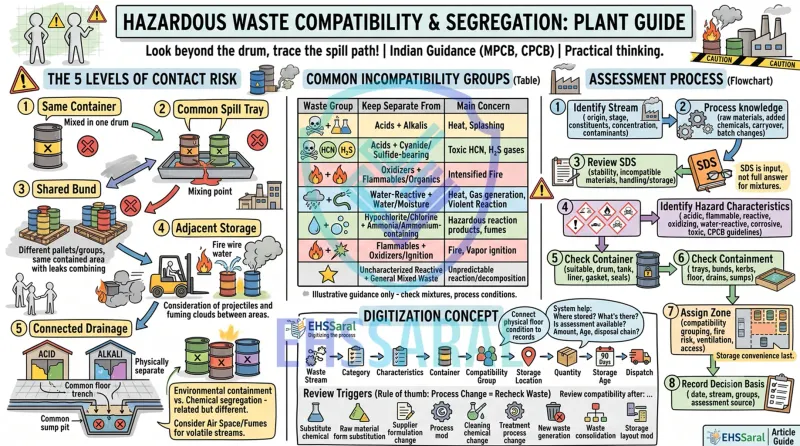
Two hazardous wastes may be perfectly manageable when stored separately.
But if they accidentally come into contact, the situation can change very quickly.
A leaking acid drum may reach an alkaline waste container. An oxidizing waste may enter the same containment area as spent solvent. A water-reactive waste may be protected inside its container but exposed when rainwater enters the storage shed.
The important question is therefore not only:
“Are these wastes stored in different drums?”
It is:
“If something leaks, spills, overflows or enters a common drain, can these wastes physically meet?”
This distinction is important in day-to-day hazardous waste management.
We recently raised a similar question in an EHSSaral LinkedIn post:
Can two hazardous wastes become more dangerous just because they are stored together?
The response from EHS professionals showed how relevant this issue remains on the plant floor. The post discussed risks such as fire, toxic gas release, heat generation, pressure build-up and uncontrolled reactions when incompatible wastes are stored without adequate segregation.
This article goes one step further.
Rather than providing another generic chemical compatibility chart, we will look at how an EHS team can think about hazardous waste compatibility across the container, storage zone, bund, drain and actual waste chemistry.
Hazardous waste segregation should not be based only on:
Compatibility also needs to be considered.
Two wastes may need separation if accidental contact could produce:
An MPCB-hosted hazardous waste guidance document describes incompatible wastes in similar terms and states that incompatible wastes should be segregated and kept apart.
From a practical standpoint, good segregation means looking beyond the drum itself and asking:
Where could the waste travel if containment fails?
Hazardous wastes are incompatible when bringing them together—or sometimes bringing a waste into contact with a particular container material—can create an undesirable reaction or additional hazard.
There are therefore several forms of compatibility to consider.
What happens if Waste A comes into contact with Waste B?
Will the waste corrode, weaken, penetrate or otherwise react with the drum, tank, liner or seal holding it?
What happens if rainwater, wash water or firefighting water reaches the waste?
Could heat, moisture or another storage condition alter the risk?
This is why hazardous waste compatibility is more complicated than simply arranging drums neatly inside a shed.
The MPCB-hosted technical guidance describes an incompatible waste as one unsuitable for a particular containment system because it may affect the containment material, or unsuitable for uncontrolled co-mingling because that may generate effects such as heat, pressure, fire, explosion, violent reaction or toxic or flammable fumes.
That is a useful way to think about compatibility on the plant floor.
This point is often missed.
Many chemical compatibility charts are developed around known chemicals.
Industrial hazardous waste may instead contain:
Two drums carrying the same internal waste name may even have somewhat different composition depending on the process conditions under which they were generated.
For example, a drum labelled simply as:
“Acid Waste”
does not tell you everything you need to know.
Questions may still include:
Therefore:
A generic compatibility chart is useful for screening. It should not replace understanding the actual waste stream.
This is where confusion usually starts.
A plant may keep two incompatible waste streams in completely separate drums.
At first glance, that appears to be segregation.
But segregation needs to be considered through the entire possible spill path.
Different drums do not automatically mean segregated waste. The real question is whether the wastes can meet during a leak or containment failure.
Two incompatible waste streams are directly mixed in the same drum, tank or container.
This is the most obvious form of contact and should be avoided unless the interaction is specifically understood, controlled and part of an approved treatment process.
Two wastes are stored in separate containers, but both containers stand inside the same secondary spill tray.
Under normal conditions there may be no contact.
But if both containers leak, the spill tray itself can become the mixing point.
Separate containers do not necessarily mean separate waste streams during a failure.
Different hazardous waste groups may be kept on separate pallets or in different parts of a shed but still share one connected bunded floor.
The bund may successfully prevent a spill from leaving the storage area.
However, if incompatible wastes leak into the same contained space, the containment system may allow them to come into contact.
This is why environmental containment and chemical segregation are related, but they are not the same thing.
Two groups may be physically separated under normal conditions but still interact during an abnormal event.
Consider:
A spill may travel further than expected.
Compatibility should therefore be considered beyond the immediate footprint of the drum.
Most segregation discussions focus on liquids travelling across the floor.
But some storage risks can also occur through the air space.
Poorly closed, damaged or inadequately sealed containers may release:
These may create exposure, fire or material-corrosion concerns even when two liquids never enter the same bund.
For volatile or fuming waste streams, storage assessment should also consider closure integrity, ventilation and neighbouring hazards, not only floor drainage.
Two storage areas may appear completely segregated above floor level but still drain towards the same:
During a larger spill or firefighting event, those areas can become chemically connected.
CPCB guidance dealing with hazardous-waste storage discusses suitable flooring, controlled collection arrangements and drainage toward collection pits or sumps for accidental spills and firefighting flows.
From a compatibility standpoint, one additional question becomes important:
What other material could enter that same collection system at the same time?
The Practical Test
If one container completely failed, where would its contents travel — and what could they meet on the way?
That question is often more useful than simply checking whether two drums are standing apart.
A simple plant-floor method can make compatibility easier to understand.
Stand in front of a hazardous waste drum and ask:
If the entire contents of this container leaked right now, where would the liquid go?
Trace the possible path.
Would it reach:
Now ask a second question:
What other material could enter the same path?
This simple exercise often reveals storage relationships that are not obvious from looking at drum labels alone.
A storage layout can look well segregated while the spill pathways remain connected.
There is rarely one document that can answer every compatibility question for every industrial waste stream.
A practical assessment therefore combines several pieces of information.
Start with more than the hazardous waste code or internal name.
Understand:
A name like “process waste” or “ETP waste” is usually not enough for a compatibility decision.
Before compatibility can be assessed properly, the waste itself needs to be understood. If classification is unclear, start with our guide to hazardous waste classification in India.
Process knowledge is often just as important as the waste record.
Ask:
An experienced production operator may sometimes explain the waste better than its internal label.
Safety Data Sheets can help identify:
Particular attention is usually given to sections dealing with handling and storage and stability and reactivity.
However, there is an important limitation.
The SDS normally describes the chemical supplied to the plant.
Your waste may contain that chemical plus several other materials.
Therefore:
SDS information is an input to the assessment, not automatically the full answer for the waste mixture.
At a practical level, determine whether the waste has characteristics such as:
CPCB guidance has historically emphasized communicating hazardous characteristics such as corrosive, reactive, ignitable and toxic properties when hazardous wastes are packaged and handled.
Ask whether the:
is suitable for the waste.
Do not select containers only because they are available.
Compatibility between waste and container is itself part of safe storage.
Look beyond the drum.
Consider:
Ask whether a leaking waste could meet an incompatible material before it is contained or recovered.
Once the waste characteristics are understood, assign an appropriate storage location.
The zone may consider:
Storage convenience should come after these considerations, not before them.
Good compatibility management should not depend entirely on one experienced EHS officer remembering everything.
Record:
This becomes especially important when personnel or processes change.
The following combinations illustrate some of the more common compatibility concerns EHS teams encounter.
| Waste Group | Keep Separate From / Review Against | Main Concern |
|---|---|---|
| Acidic wastes | Alkaline wastes | Heat generation, vigorous reaction or splashing |
| Acidic wastes | Certain cyanide-bearing wastes | Potential release of highly hazardous gases |
| Acidic wastes | Certain sulfide-bearing wastes | Potential hazardous gas release |
| Oxidizing wastes | Solvents, oils and combustible organic wastes | Fire or intensified combustion |
| Water-reactive wastes | Water, moisture and aqueous wastes | Heat, gas generation or violent reaction |
| Hypochlorite/chlorine-containing wastes | Ammonia/ammonium-containing materials | Potentially hazardous reaction products and fumes |
| Flammable solvent wastes | Oxidizers and ignition hazards | Fire and vapour ignition risk |
| Uncharacterized reactive wastes | General mixed hazardous waste | Unpredictable reaction or decomposition |
Illustrative compatibility guidance only: This table is not a universal compatibility chart. Actual waste compatibility depends on chemical composition, concentration, contaminants, physical form and process conditions. A site-specific assessment should be used before making storage decisions.
Let's look at some of these groups more practically.
Acidic and alkaline waste streams can arise from many Indian industrial processes, including:
The concern is not simply that one drum is labelled “acid” and another “alkali.”
The important question is whether a leak from both could enter the same containment area.
Separate containers inside a common tray may therefore provide less segregation than the layout initially suggests.
Spent solvent, thinner, oil-containing waste and organic residues may be encountered in many plants.
Oxidizing wastes require particular care around combustible organic materials.
A useful way to understand the relationship is:
Flammable or combustible material can provide fuel.
An oxidizing material may intensify combustion.
This is why grouping materials simply because they are all “liquid hazardous waste” is not a sufficient storage philosophy.
Certain cyanide- and sulphide-containing wastes can create serious hazards if exposed to acidic conditions.
From an EHS standpoint, the practical lesson is straightforward:
These types of waste streams require deliberate compatibility assessment and segregation rather than relying only on separate container labels.
Detailed chemical response should be left to competent personnel and the plant's approved emergency procedures.
“Keep away from water” sounds simple until we look at an actual storage area.
Potential water sources include:
For these waste streams, the building and containment arrangement become part of the compatibility assessment.
Chlorine/hypochlorite chemistry and ammonia/ammonium-containing materials require careful separation because their interaction can create hazardous reaction products.
Again, the exact composition matters.
Avoid assuming that every waste carrying a broad internal name behaves identically.
A hazardous waste drum has one fundamental job:
Keep the waste contained.
That sounds obvious, but container selection sometimes becomes driven by what is available rather than what is chemically suitable.
The material used to store hazardous waste should be compatible with its contents.
CPCB guidance has specifically emphasized that hazardous-waste containers should be made from or lined with suitable material so that the waste does not react significantly with the container or impair its ability to contain the waste safely.
During inspection, look for:
A drum can look acceptable from a distance while its material is gradually being attacked by the contents.
Container compatibility is only one part of container control. The drum or package also needs correct identification, condition and labelling; see our practical guide to hazardous waste packaging and labelling in India.
Bunds, spill trays and containment kerbs are important because they limit the spread of leaked hazardous waste.
But compatibility introduces another layer.
Imagine:
Acid waste drums
↓
Leak
and
Alkaline waste drums
↓
Leak
Both liquids enter:
One common containment area
The bund may successfully prevent the waste from leaving the storage shed.
But it has also allowed two incompatible streams to meet.
This leads to a useful distinction:
Environmental containment and chemical segregation are related, but they are not identical.
A storage design should consider both.
The required size, configuration and design of secondary containment can depend on the waste inventory, container size, site conditions, applicable technical guidance and specific regulatory or authorization requirements.
For that reason, it is better not to apply a single generic containment-capacity formula to every hazardous-waste storage area.
The more important compatibility question remains:
If a release occurs inside the containment system, could incompatible wastes be brought together?
One of the easiest ways to overlook compatibility is to inspect only what is above floor level.
Look down.
Where does the floor slope?
Where do spills travel?
Where does firefighting water travel?
Where does the trench terminate?
CPCB hazardous-waste storage guidance discusses impermeable or suitable floors, collection pits and systems to direct accidental spills toward controlled collection points.
This is good containment practice.
But during compatibility assessment, ask one more question:
Could incompatible wastes enter the same collection point simultaneously?
A common sump can chemically connect two otherwise separate storage zones.
Compatibility is only one part of storage control. EHS teams should also review the broader hazardous waste storage rules in Indian factories, including storage period, shed conditions, labelling, containment and physical stock management.
In many plants, hazardous waste storage evolves gradually.
One department receives one side of the shed.
Another department receives the next section.
Drums may then be arranged according to:
These systems can all be useful operationally.
But none of them automatically answers the compatibility question.
For example:
Two completely different hazardous waste codes may be compatible.
Two wastes coming from the same department may be incompatible.
Two drums of the same colour may have very different chemistry.
Therefore:
Waste identification and compatibility classification should work together.
Rather than downloading a generic chart and applying it directly, a plant can develop a simple internal matrix around its actual waste streams.
For example:
| Waste Stream | Main Characteristic | Container | Storage Zone | Keep Separate From / Review Against | Assessment Basis |
|---|---|---|---|---|---|
| Waste A | Acidic | Compatible container | Acid Zone | Alkalis and identified reactive streams | Process chemistry + relevant SDS |
| Waste B | Alkaline | Compatible container | Alkali Zone | Acids and identified reactive streams | Process chemistry + relevant SDS |
| Waste C | Flammable organic | Suitable approved container | Flammable Waste Zone | Oxidizers and ignition hazards | Waste characterization + relevant SDS |
| Waste D | Oxidizing | Compatible container | Oxidizer Zone | Combustible and organic wastes | Process chemistry + relevant SDS |
Illustrative structure only: The entries above show how a plant-specific compatibility matrix can be organized. They are not container specifications or universal compatibility decisions. Actual waste composition, concentration, contaminants and applicable site requirements should determine the final arrangement.
The exact entries will differ from plant to plant.
The value is not the spreadsheet itself.
The value is that somebody has deliberately asked:
What is this waste, where should it go, and what should not be able to reach it?
A compatibility assessment should not be treated as permanent.
Over the years, we've seen many industrial processes change gradually while the waste name remains unchanged.
For example:
“Process Waste A”
may still be called “Process Waste A” five years later.
But during that time the plant may have changed:
The waste label remains the same.
The chemistry may not.
This gives EHS teams an important trigger:
A useful rule of thumb is:
When process chemistry changes, recheck waste chemistry.
A hazardous waste storage inspection should go beyond counting drums.
Ask:
And then ask the most useful question of all:
If this drum failed completely, what would its contents reach?
That often tells you more than looking at the label alone.
Compatibility and storage age should be checked separately. If older stock is accumulating, see what to review when hazardous waste is stored beyond the permitted storage period.
Some hazardous waste areas appear well organized but still deserve a closer compatibility review.
The drums are separate.
Leakage is not.
The signs on the wall say:
ACID
and
ALKALI
But both floor drains lead to one sump.
The zones are physically separated but potentially connected during a spill.
Physical state is not a chemical compatibility group.
“Liquid waste” may include:
Their liquid form does not mean they should automatically share containment.
Temporary storage often becomes permanent by habit.
A newly generated drum may be placed in the nearest empty corner without anyone reviewing what is stored beside it.
Colour coding can improve identification.
It should support the system.
It should not replace chemical identification.
This is particularly common during:
Temporary or low-volume waste still needs to be understood before being placed in an existing storage zone.
Compatibility gaps are often part of a wider pattern of small storage and record-control issues. We have covered several of these separately in our guide to common hazardous waste mistakes in Indian factories.
An unexpected chemical mixture should be treated cautiously.
Avoid improvising a chemical response without understanding what has happened.
From a practical standpoint:
One particularly important point:
Do not randomly add water, neutralizing chemicals or another material to an unknown reactive mixture.
An incorrect response may create a second reaction.
This was also one of the key messages in the original EHSSaral LinkedIn discussion.
Hazardous waste management in India sits under the Hazardous and Other Wastes (Management and Transboundary Movement) Rules, 2016, together with subsequent amendments. MoEFCC continues to maintain the applicable rules and amendment notifications on its official regulatory pages.
The broader framework covers environmentally sound management of hazardous and other wastes, while individual plants also operate subject to their:
Technical guidance provides additional insight into compatibility.
An MPCB-hosted hazardous-waste facility guideline states that incompatible wastes should be segregated and kept apart, and describes incompatibility in terms of containment failure or uncontrolled co-mingling capable of generating heat, pressure, fire, explosion, violent reaction or hazardous fumes.
CPCB guidance for storage of incinerable hazardous wastes goes further for the facilities within its scope, stating that flammable, ignitable, reactive and non-compatible wastes should be stored separately.
That particular CPCB document has a defined scope, so its engineering provisions should not automatically be treated as universal design dimensions for every generator's hazardous-waste shed.
The broader practical principle, however, is clear:
Hazardous waste storage should consider what can safely coexist in the same storage environment.
Good hazardous waste compliance needs records.
Form 3, manifests, disposal evidence and authorization details provide important traceability.
But paperwork cannot tell you whether an acid drum is currently standing beside an incompatible waste stream inside one common spill tray.
This is where environmental compliance increasingly needs a stronger connection between the record and the physical plant condition.
A useful data chain looks like:
Waste stream
↓
Authorized waste category
↓
Waste characteristics
↓
Container
↓
Compatibility group
↓
Storage location
↓
Quantity
↓
Storage age
↓
Dispatch
That is also how EHSSaral approaches hazardous-waste digitization: not simply as preparation of Form 3 or Form 10 records, but as a connected waste-management process.
If a new waste stream is added, the system should eventually help the EHS team answer questions such as:
This is where digital records become more useful than a standalone spreadsheet register.
Form 3 hazardous waste records help establish what was generated and stored, but the register alone cannot show whether incompatible drums are sharing the same bund or spill path.
This is the type of connected visibility a hazardous waste management software for Indian industries should ultimately provide across generation, storage, movement and evidence.
Hazardous waste segregation is sometimes interpreted as:
Put different wastes in different drums.
That is only the first layer.
A stronger approach asks:
Different drum?
↓
Different containment where necessary?
↓
Safe neighbouring materials?
↓
Controlled spill path?
↓
Compatible drainage arrangement?
↓
Correct container?
↓
Compatibility reviewed after process changes?
The most useful question during a storage-area walkthrough remains very simple:
If this container leaks, where will the waste go—and what could it meet on the way?
Once EHS teams start thinking in those terms, hazardous waste segregation becomes much easier to see on the plant floor.
Good compliance starts with understanding what the waste can actually do, not only what the label says.
Incompatible hazardous wastes are waste streams that may react adversely with one another, with another material, or with the containment system. Possible outcomes include heat generation, pressure, fire, violent reaction, hazardous fumes or deterioration of the container.
Actual compatibility should be assessed using the waste composition, process knowledge and relevant safety information.
Do not decide this based only on the fact that they are in separate drums.
The storage arrangement should ensure that incompatible wastes cannot mix through leakage, shared containment, drainage or other foreseeable failure routes.
The appropriate physical separation will depend on the actual waste chemistry and site design.
Not necessarily.
Two drums may be separate but still discharge into the same spill tray, bund, trench or sump.
Compatibility should therefore be evaluated across the complete potential spill path.
This requires careful technical assessment.
A common bund may contain a release effectively while also allowing leaking incompatible wastes to mix.
For incompatible waste groups, containment design should consider both environmental containment and chemical interaction.
Start with:
For complex or uncertain waste streams, involve personnel competent in the relevant chemistry and hazardous-waste management.
Not always.
The SDS normally describes the original chemical or product.
Industrial waste may contain multiple chemicals, contaminants and reaction products.
Use SDS information together with process knowledge and understanding of the actual waste stream.
Review it whenever there is a significant change in:
The waste name can remain unchanged even when its composition changes.
Avoid unnecessary handling, isolate the affected area, activate the site's EHS/emergency-response arrangements and identify the materials involved where safe to do so.
Do not improvise by adding water or neutralizing chemicals unless the response has been specifically evaluated and is being carried out under an appropriate procedure.
Related EHSSaral discussion: The idea behind this guide began with our LinkedIn post asking whether two hazardous wastes can become more dangerous simply because they are stored together. View the original EHSSaral LinkedIn post

Founder, EHSSaral
Founder - EHSSaral | Partner - Perfect Pollucon | ISO 14001 Lead Auditor | GHG Protocol Scope 2 | Chemist | Data Scientist | Second-generation environmental professional simplifying EHS compliance for Indian industries through practical, automated, tech-enabled, data driven compliance workflows.
ESG Data Management for Indian Factories | EHSSaral
Beyond the Helmet: Why Safety Compliance Alone Fails in Indian Factories | EHSSaral Research
Ozone-Depleting Substances Rules, 2000 - A Practical Guide for Indian Industries

Chemical Accident Emergency Response Guide for Indian Factories | EHSShala
 Practical Guide for Indian Factories EHSShala.webp)
Hazardous Waste Management Rules in India: Forms, Storage & Compliance

Battery Waste Management Rules India - Factory Guide (2026) | EHSShala
How MoEFCC, CPCB & SPCB Work in India: Expert Guide | EHSShala
Isokinetic Sampling Basics: Simple Guide for Stack Monitoring | EHSShala
Types of Pollution in Industries Expert Guide | EHSShala
Factory Act & Compliance Thresholds: What Applies to Your Headcount? | EHSSaral