
Blog
Environmental Compliance KPIs for Manufacturing in India
EHSSaral is an Environmental Compliance Intelligence Platform for Industries. Consent Intelligence • Alerts & Tasks • Incident Reporting • Form IV & V • Audit-Ready Records
See how EHSSaral works
20 Aug 2026
Let’s be honest.
Form 3 creates more confusion than paperwork deserves.
Across factories, the reaction is the same:
This guide exists to stop that panic.
Form 3 is not a trap.
It is not a punishment document.
It is a daily record, meant to show control.
Most compliance problems don’t start with pollution.
They start with unclear records.
Form 3 is a day-to-day register of hazardous waste.
Nothing more.
Nothing less.
Every time hazardous waste is:
…it should leave a trace in Form 3.
That’s all.
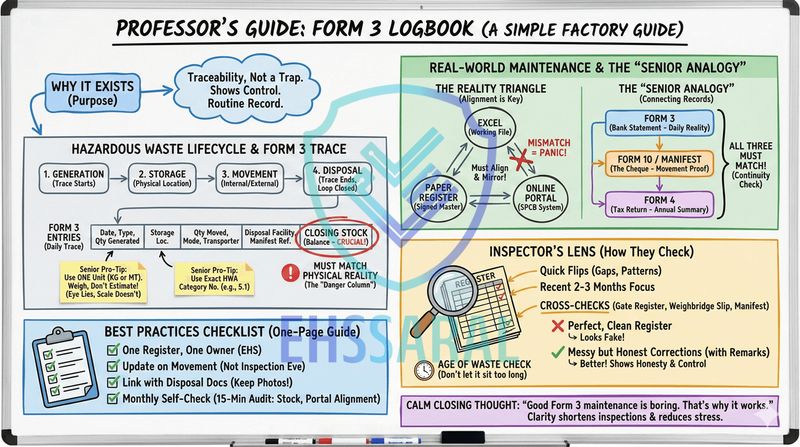
“Form 3 exists so hazardous waste movement is traceable, not to trap factories.”
If someone asks:
“What happened to this waste?”
Form 3 should be able to answer calmly.
Hazardous Waste Management in Indian Factories
Looking for a Form 3 hazardous waste format in PDF or Word?
You can download practical Form 3 formats below for factory record maintenance and inspection preparation.
These formats are commonly used for:
Before using the format, make sure:
The format is only the container. Good record discipline is what actually matters.
Let’s make it real.
“200 kg of used oil-soaked cotton waste was generated on 15 March, stored in HW shed, and sent to authorised disposal facility via ABC Transporter on 20 March.”
That single sentence
= one Form 3 entry.
Once this clicks, Form 3 stops feeling complicated.
Not to scare you.
Not to fine you.
They want to confirm three simple things:
That’s it.
“Most inspectors are checking awareness and control, not perfection.”
Central Pollution Control Board (CPCB)
If your factory:
You need Form 3.
Common misunderstanding:
“We generate very little waste, so Form 3 is not needed.”
This is a common misunderstanding.
Even small quantity = record required.
Typical industries where Form 3 is expected:
If hazardous waste exists, Form 3 exists.
Now let’s open the register.
Not legally.
Practically.
Consistency matters more than frequency.
Avoid vague terms like “chemical waste”.
Senior Pro-Tip (Category Number):
Don’t guess the category number. Open your Hazardous Waste Authorisation (HWA) or your CTO conditions. Copy the exact category number from there (example: 5.1, 35.3). When your Form 3 matches your HWA/CTO, discussions become simpler.
Hazardous Waste Categorisation in India - An Inspector’s Guide by EHSShala
Never write “1 ton” one day and “1000 kg” another day.
Inspectors hate mental math.
Senior Pro-Tip (Unit Alignment):
Check what unit your state portal asks for in Annual Return (often KG or MT). Maintain Form 3 in the same unit. It saves last-minute conversions and mistakes at year end.
This shows physical control.
Form 3 can show what hazardous waste was generated and stored, but it does not show whether incompatible wastes are sharing the same spill tray, bund or drainage path. For the physical storage side, see our hazardous waste compatibility and segregation guide.
No estimates by eye.
“The eye lies. The weighing scale does not.”
This is the most dangerous column in Form 3.
Why?
Because:
This column must match physical reality.
Inspectors trust this column the most.
Simple words are enough.
If transporter changes, record it.
This closes the loop.
Think of it as proof.
Explore Digital hazardous waste management system EHSSaral
“Form 3 is your bank statement.
Manifest is the cheque.
Annual return is the tax return.
All three must match.”
We’ll explain this clearly later.
For now, just remember the logic.
Let’s drop the ideal world.
In real factories, Form 3 usually exists in three places:
This is normal.
This is not wrong.
What matters is alignment, not the format.
“Your physical Form 3 is still the master record.
Online entries should reflect it - not the other way around.”
Most inspections still end here.
Almost every factory uses Excel first, then writes.
This is practical.
Portal data must mirror Form 3, not contradict it.
The biggest trouble starts when:
That is when questions begin.
State Pollution Control Board online portals
There is no “perfect” frequency.
In practice:
“Long gaps invite questions.”
A simple rule:
Not when inspection is announced.
Hazardous Waste Management Rules (2016) Practical Guide for Indian Factories by EHSShala
Common situation:
This is fine.
But one rule matters:
“One register. One owner.”
If everyone updates Form 3, no one controls it.
Best practice:
Very common scenario:
This is allowed.
But Form 3 must:
Vague entries create confusion.
This is important.
Most inspectors do not read Form 3 line by line.
They do this instead:
Recent data matters more.
Common cross-checks:
“They triangulate. They don’t blindly trust.”
Senior Pro-Tip (Age of Waste):
Many officers look at dates to understand the “age” of waste in storage. Form 3 becomes a clock. So don’t let old waste sit on paper for months without a clear reason and plan.
Situation:
What to do?
Best practice:
Small variance is normal. Unexplained variance invites questions.
Never estimate waste quantity by eye.
The eye lies. The weighing scale does not.
These are patterns, not accusations.
Mismatch invites questions.
This is the fastest way to lose trust.
This looks like uncontrolled storage.
“A perfect register sometimes looks fake.”
They may not say it out loud, but they notice:
These don’t mean violation.
They mean questions.
“The inspector doesn’t want to fine you.
They want to finish the audit and go home.
Don’t give them a reason to stay.”
Clarity shortens inspections.
Good Form 3 maintenance is boring.
That is a good sign.
Here are habits seen in well-run factories.
Multiple versions create confusion.
“One register. One truth.”
Form 3 should move with waste.
Whenever waste:
The register should reflect it within a reasonable time.
Backfilling just before inspection looks risky.
Always keep these nearby:
Form 3 without supporting papers feels weak.
Simple habit:
This:
Not mandatory.
But very useful.
This happens.
More often than people admit.
First rule:
Don’t panic.
Second rule:
Don’t try to make it look brand new.
On day one, do a simple start:
This prevents the first question in inspection:
“Okay, but what was your starting balance?”
That looks like hiding.
Use the remarks column.
Or add a clear note.
Example:
“Quantity corrected based on weighbridge slip dated 18 Feb.”
Or:
“Entry updated after reconciliation with disposal records.”
This shows honesty.
“A messy logbook with honest corrections is better than a pristine logbook that looks fake.”
Remember this line.
Inspectors understand:
What they don’t tolerate:
Once a month, check:
That’s it.
No audit.
No stress.
Just alignment.
Legally, many states expect minimum 5 years.
Practically, seniors do this:
“Keep Form 3 until your next Consent to Operate renewal is done safely.”
Old records help during:
Space is cheaper than explanations.
Very common today.
Important clarity:
You can outsource:
You cannot outsource:
Even if:
Form 3 still belongs to you.
Your factory.
Your register.
Example:
Your vendor arranges pickup and gives you a manifest copy. That is good.
But if your Form 3 has no entry for that pickup, it will look like the waste never moved.
So even when vendor does the work, you must record it.
“Most compliance problems start small.
They grow when ignored.”
Form 3 gives early signals.
If it stays clean, many other things stay clean.
This confusion wastes more EHS time than it should.
Let’s simplify it permanently.
This is the mother document.
It comes from Form 3, not the other way around.
Form 10 Manifest System Explained: 7 Copies, Flow & SPCB Checklist by EHSShala
If Form 3 is correct, Form 4 is easy.
“Form 3 is your bank statement.
Form 10 is the cheque.
Form 4 is the tax return.
They must all match.”
If this logic is clear, nothing feels complicated.
They usually check:
They are not looking for mathematics.
They are looking for continuity.
You can keep this near your desk.
That’s enough.
No heroics.
Quiet checks often include:
If numbers look unrealistically perfect, questions come.
If numbers look reasonable, audits move faster.
Form 3 is not about showing that:
It is about showing that:
That is what control looks like.
Most factories are not criminals.
They are just unclear.
Form 3 brings clarity.
“Good Form 3 maintenance is boring.
That’s why it works.”
Once Form 3 becomes routine:
That is the real purpose.
Yes.
Quantity does not remove the requirement.
If hazardous waste is generated, stored, or sent out-even in small quantity-Form 3 must be maintained. Inspectors look for record discipline, not volume.
In practice, many factories use Excel as a working file.
However, inspectors usually expect a printed or bound Form 3 register with signatures.
Excel is acceptable for internal control, but the physical register should match it.
Mismatch is one of the most common reasons inspections take longer.
Physical Form 3 should be treated as the master record.
Portal entries should reflect Form 3-not contradict it.
When mismatch is found, correct the register first, then update the portal.
Yes. Corrections are allowed.
What matters is how you correct:
Honest correction is acceptable.
Fabrication is not.
Inspectors often look at age of waste using Form 3 dates.
If waste appears to be stored for long periods without movement or explanation, questions are raised.
Form 3 acts as a clock, so old waste should always have a clear plan.
The factory.
Even if a vendor manages pickup and disposal, Form 3 must be maintained by the waste generator.
Transporters and vendors do not maintain Form 3 on your behalf.
Use one unit consistently.
Best practice is to use the same unit that your state portal requires for the annual return.
This avoids conversion errors and last-minute confusion.
They usually check:
They are checking continuity, not perfection.
Form 3 should not go silent without explanation.
If no waste is generated:
Silence without explanation creates doubt.
Not always.
Registers with:
sometimes raise suspicion.
A register that shows control with honest corrections is usually trusted more.

Founder, EHSSaral
Founder - EHSSaral | Partner - Perfect Pollucon | ISO 14001 Lead Auditor | GHG Protocol Scope 2 | Chemist | Data Scientist | Second-generation environmental professional simplifying EHS compliance for Indian industries through practical, automated, tech-enabled, data driven compliance workflows.
Environmental Compliance KPIs for Manufacturing in India

Hazardous Waste Classification in India: Schedule I, Class A, B, C & Inspector’s Guide
MPCB CTO Refusal Patterns in Maharashtra (2023–2025) Analysis | EHSSaral Research
 EHSSaral v1.png)
Blue Category MPCB 3-Year Consent Validity for Recyclers (2026) | EHSSaral

ESG Data Management for Indian Factories | EHSSaral
Noise Monitoring in Factories Workplace vs Boundary (India Guide) | EHSShala
Common Hazardous Waste Mistakes in Indian Factories | EHSShala
How to Fill ESG & Sustainability Vendor Forms for SMEs in India
Plastic Waste Management Rules in India: A Practical Guide for Factories, Warehouses and Offices
Late Filing Penalty for Form 4 SPCB: What Happens If You Miss the 30 June Deadline?