

Blog
Transforming SME Compliance: Zero Surprise Failures in India | EHSSaral Research
EHSSaral is an Environmental Compliance Intelligence Platform for Industries. Consent Intelligence • Alerts & Tasks • Incident Reporting • Form IV & V • Audit-Ready Records
See how EHSSaral works
20 Aug 2026
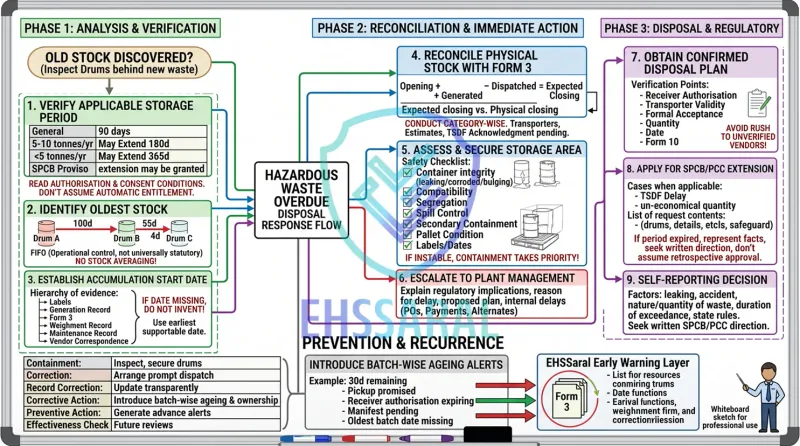
Hazardous waste found beyond its permitted storage period requires careful verification-not rushed record correction. This practical guide explains how Indian EHS teams can establish the oldest stock date, reconcile Form 3, verify the disposal route, approach the SPCB/PCC where necessary and prevent recurrence through ageing alerts.
When hazardous waste is stored beyond 90 days-or appears to have crossed the storage period applicable to the facility-the EHS officer needs to establish the facts before deciding the next action.
During a storage-area inspection, an EHS officer may find old drums behind recently generated waste. Form 3 shows a closing balance, but nobody can confidently establish when those particular drums entered storage.
The disposal vendor says the pickup was delayed. The hazardous-waste shed is becoming full, and the plant may also be expecting an inspection.
The immediate question is usually:
“Has the 90-day hazardous-waste storage period already been exceeded?”
That is an important question-but it is not the first one.
The first task is to determine the storage period applicable to the facility, identify the oldest unresolved stock and establish what the available records can genuinely support.
Do not conceal the age, change the generation date or rush the waste to an unverified receiver. Establish the facts, secure the storage area, arrange prompt disposal through an authorised route and document the corrective plan.
Read more about Hazardous Waste Packaging & Labelling in India (Inspector Guide) by EHSShala
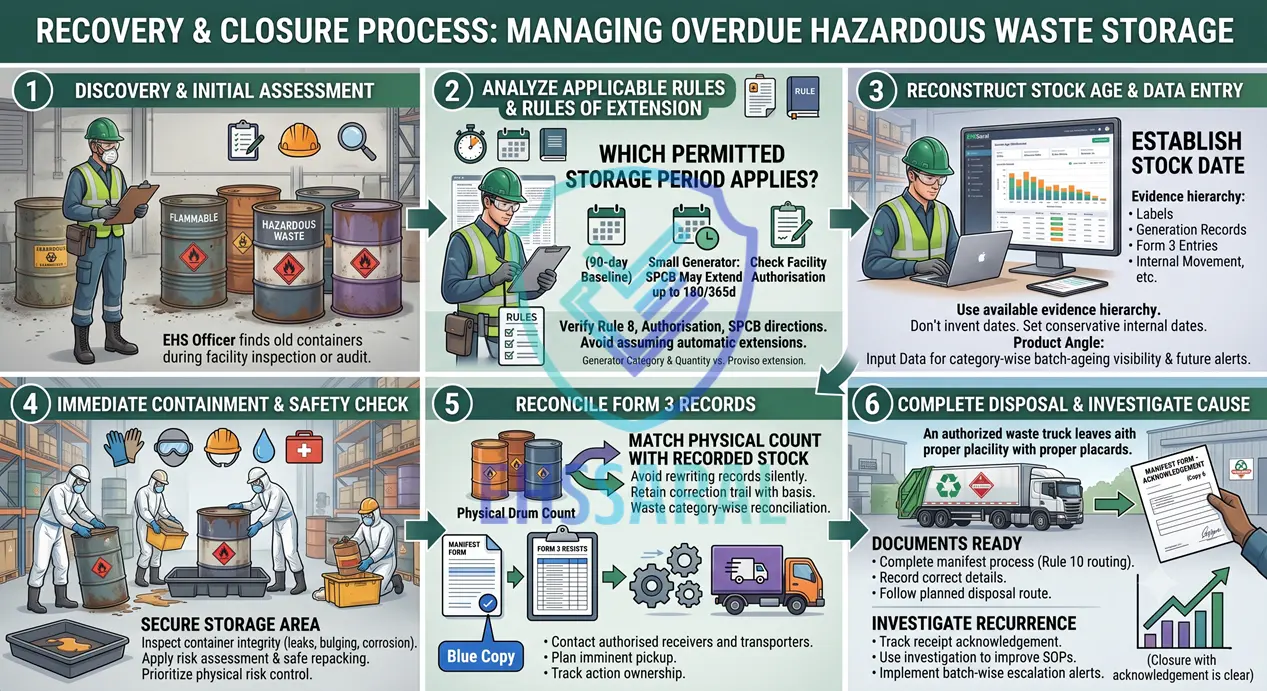
If hazardous waste may have crossed its permitted storage period:
Finding old stock does not mean the records should be rewritten to make the dates appear compliant. It means the facts need to be reconstructed transparently and the unresolved waste brought under control.
Read more about Common Hazardous Waste Mistakes in Indian Factories by EHSShala
In India, the hazardous-waste storage framework is provided under Rule 8 of the Hazardous and Other Wastes (Management and Transboundary Movement) Rules, 2016.
The general position is that an occupier may store hazardous and other waste for a period not exceeding 90 days.
However, 90 days is not the final answer in every situation.
Rule 8 also permits the concerned State Pollution Control Board or Pollution Control Committee to extend the storage period in specified cases. The Hazardous and Other Wastes Amendment Rules, 2024 revised the small-generator categories covered by this extension provision.
| Situation | Practical interpretation |
|---|---|
| General storage framework | Hazardous and other waste should ordinarily not be stored beyond 90 days |
| Generator between 5 and 10 tonnes per annum | The SPCB/PCC may grant an extension up to 180 days |
| Generator below 5 tonnes per annum | The SPCB/PCC may grant an extension up to 365 days |
| Other situations specified under Rule 8 | The SPCB/PCC may consider an extension depending on the circumstances and justification |
| Facility-specific condition or written approval | The hazardous-waste authorisation, consent conditions and written SPCB/PCC directions should also be examined |
Important regulatory point: The Rules say that the SPCB or PCC “may extend” the storage period. A plant should not assume that generating below 5 tonnes automatically permits storage for 365 days, or that generating between 5 and 10 tonnes automatically provides 180 days.
The applicable position should be established by reading Rule 8 together with:
Where these documents appear inconsistent, written clarification should be obtained instead of selecting the most convenient interpretation.
For a more detailed explanation, read our guide on hazardous-waste storage rules in India.
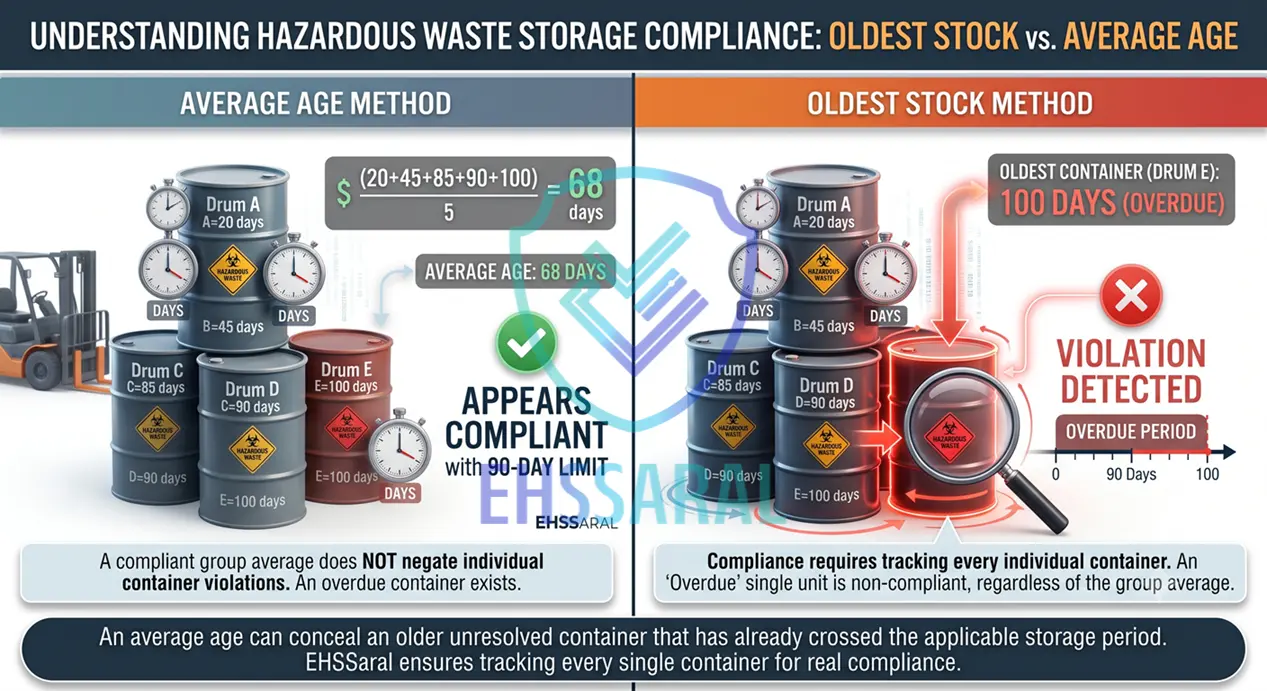
This is where confusion commonly starts.
Suppose the hazardous-waste shed contains three drums:
| Drum | Accumulation date | Age on review date |
|---|---|---|
| Drum A | 5 April | 100 days |
| Drum B | 20 May | 55 days |
| Drum C | 10 July | 4 days |
The plant should not average these ages and conclude that the stock is approximately 53 days old.
That calculation hides the oldest unresolved drum.
Average-age method-unreliable for compliance control
Drum A: 100 days old
Drum B: 55 days old
Drum C: 4 days old
Average age: 53 daysThe average conceals the age of Drum A.
Oldest-stock review-practical control method
Oldest identifiable drum: 100 days
Compare this age with the storage period applicable to the facility and waste category.
Where the waste type and packaging allow it, an oldest-stock-first or FIFO disposal method can help prevent older containers from remaining behind newer stock.
However, FIFO should be treated as an operational control-not as a universal statutory calculation method. Tanks, mixed streams and continuously accumulated wastes may require a different quantity-and-age tracking approach.
The underlying principle remains the same: newer waste should not make older unresolved waste appear compliant.
Ageing cannot be managed unless the plant can establish when the waste entered accumulation or storage.
Depending on the process, useful evidence may include:
The evidence will not be identical in every plant. A batch packed into individual drums can be tracked differently from sludge accumulating continuously in a storage tank.
Do not create a convenient date simply to complete the register.
Instead:
An honestly documented limitation is more defensible than a precise-looking date with no supporting evidence.
Once the likely age has been established, verify whether the quantity recorded in Form 3 agrees with the quantity physically present.
A basic reconciliation is:
Opening stock + waste generated − waste dispatched = expected closing stock
The expected closing stock should then be compared with the physical stock.
This reconciliation should be conducted waste-category-wise. A combined plant total can hide a shortage in one category and excess stock in another.
Differences may arise because:
The objective is not merely to make the arithmetic balance. The reconciled quantity should represent the physical reality of the storage area.
If an error is found, correct the record transparently with a documented basis. Avoid replacing earlier entries without retaining a traceable correction trail.
Disposal should not be treated as operationally closed merely because the vehicle has left the factory.
Follow up for the receiver-signed Form 10 Copy 6, the blue copy, and link it with the weighment record and applicable recycling, utilisation or disposal evidence.
Under the Form 10 routing arrangement, Copy 6 is returned by the receiver to the sender. It confirms receipt by the authorised receiver, but additional evidence may be required to establish final treatment, recycling, utilisation or disposal.
Storage ageing should not be reviewed separately from the facility’s hazardous-waste authorisation.
Verify:
Being within the authorised annual generation quantity is not sufficient on its own to show that the storage-period requirement has been met.
If old stock belongs to a category not listed in the authorisation, the matter may require a separate assessment and communication with the concerned SPCB/PCC.
Read Form IV Quantity Mismatch: Hazardous Waste Reconciliation
A delayed pickup can arise from an external problem, an internal control gap or a combination of both.
The reason should be recorded with supporting evidence.
| Reason for delay | Evidence to retain |
|---|---|
| TSDF or recycler pickup delayed | Pickup requests, emails, revised schedule and follow-up records |
| Transporter unavailable | Transporter communication and enquiries made with alternatives |
| Quantity too small for economical pickup | Generation history and receiver correspondence |
| Waste analysis pending | Laboratory request, sample record and report status |
| Packaging rejected by receiver | Repacking instructions and corrective-action record |
| Purchase order or payment delayed | Internal approval and escalation trail |
| Manifest or documentation incomplete | Pending-document list and action ownership |
| Responsibility unclear | Revised responsibility matrix and task assignment |
| Waste age not tracked | Internal non-conformance or investigation record |
| Storage date uncertain | Date-reconstruction note and supporting records reviewed |
Recording the reason does not regularise overdue storage. It establishes the facts and makes it possible to address the actual cause.
When pickup commitments remain scattered across emails and telephone conversations, it becomes difficult to see which promise is still open and who is responsible for following it up. This is often how a short vendor delay quietly turns into several additional weeks of storage.
Read about TSDF Process for Hazardous Waste: Form 10, Documents & Disposal Proof by EHSShala
Once the stock has been verified, obtain a practical disposal plan rather than another general assurance that pickup will happen “soon.”
Confirm:
Where the existing receiver cannot provide a reasonable schedule, the plant may examine another authorised route permitted under its authorisation and applicable requirements.
Do not rush the waste to an unverified receiver merely because an inspection is expected. Moving the stock does not resolve the issue if the receiver, transporter or disposal route is not compliant.
The compliance review and physical-safety assessment should happen together.
Old containers may be more vulnerable to corrosion, leakage, bulging, deterioration or loss of labels. If a container is unstable, containment takes priority while the disposal arrangement is completed.
Check:
Leaking or damaged containers should be handled through an appropriate risk assessment and safe repacking or overpacking procedure.
Document the condition found, immediate containment measures, photographs where appropriate, responsible persons and target completion dates.
When old stock accumulates, compatibility becomes increasingly important because more waste streams and containers may occupy the same storage area. Check whether the layout also follows hazardous waste compatibility and segregation principles.
Yes. A suspected or confirmed storage-period exceedance should be escalated to plant management promptly.
The escalation should explain:
The purpose is not merely to report “regulatory exposure.” Management involvement may be necessary to remove internal delays relating to purchase orders, payments, transporter approval, alternate vendors or resource allocation.
Rule 8 permits the concerned SPCB/PCC to extend the storage period in specified cases.
However, an extension should not be assumed merely because:
Where the applicable period is unclear, or disposal cannot be completed within it, the occupier should approach the concerned SPCB/PCC with complete facts and seek written clarification or approval.
Depending on the state process and circumstances, the communication may include:
State-specific procedures can differ. The relevant SPCB/PCC requirements should therefore be checked before submitting the representation.
If the applicable period has already been exceeded, submitting an application or representation does not regularise the elapsed period.
The communication should accurately present:
The occupier should seek written direction from the concerned SPCB/PCC on the appropriate next action.
Where the issue has significant regulatory implications, management may also obtain advice from an experienced environmental compliance or legal professional before submitting the communication.
Avoid describing a post-expiry application as retrospective approval unless the regulator has expressly treated it that way in writing.
It is not safe to make a universal statement that every suspected storage-period exceedance must be voluntarily self-reported in the same manner.
The appropriate communication may depend on:
Where the permitted period appears to have been exceeded, the occupier should escalate the matter internally, document the facts and seek appropriate written direction from the concerned SPCB/PCC.
If leakage, fire, chemical release or another reportable event has occurred, separate accident or emergency-reporting requirements may also apply.
Finding old stock during an internal or external audit can be uncomfortable, particularly when earlier records are incomplete.
A calm response is more useful than attempting an immediate record correction without establishing the facts.
“Found during an audit” does not mean the earlier register should be silently rewritten.
If a record requires correction, the basis, date and approval for that correction should remain traceable.
Disposal of the old stock is necessary, but disposal alone may not address why the situation developed.
| Action type | Practical example |
|---|---|
| Containment | Identify, inspect and secure the old containers |
| Correction | Arrange prompt dispatch through an authorised receiver and transporter |
| Record correction | Update the record transparently using a documented basis |
| Corrective action | Introduce batch-wise ageing and clear disposal ownership |
| Preventive action | Generate advance alerts and escalation reminders |
| Effectiveness check | Verify during future reviews that no identifiable stock crosses the applicable period |
The investigation should result in a practical control that can be checked later.
Every action discussed above depends on one basic capability: knowing the oldest unresolved quantity of each hazardous-waste category and its accumulation date with reasonable confidence.
Form 3 provides the statutory record of hazardous-waste generation, storage, treatment and disposal. However, day-to-day ageing control may still weaken when multiple batches are combined, only the total closing balance is reviewed, pickup commitments remain in emails or acknowledgements are not followed through to closure.
EHSSaral adds an operational early-warning layer around these statutory records. It connects each identifiable waste batch with its accumulation date, category, quantity, applicable storage period and planned dispatch date. It can also track action ownership, vendor follow-ups, manifest status, acknowledgements and differences between physical and recorded stock.
Instead of relying on an EHS officer to repeatedly inspect multiple registers, spreadsheets and email threads, the responsible stakeholders can be alerted when stock approaches its applicable period or when a planned disposal action remains unresolved.
The platform does not replace professional judgement, authorisation conditions or regulatory approval. It helps the responsible team see what requires action before the next movement becomes overdue.
Read hazardous-waste management software for Indian industries
A useful ageing tracker should provide more than one reminder on the final day.
Depending on the applicable period and the plant’s internal escalation process, alerts may include:
The alert should reach the person who can take the next action. Depending on the issue, that may be the EHS officer, stores team, purchase team, finance team, transporter coordinator, plant head or disposal vendor.
An alert without ownership is only a notification. An alert linked to a responsible person, target date and escalation path becomes an operational control.
Every month, the EHS team should:
For higher-generation facilities, a weekly review may be more appropriate for categories approaching their applicable storage period.
Rule 8 establishes 90 days as the general storage period. The concerned SPCB/PCC may extend it in specified circumstances. The Rules, hazardous-waste authorisation, written approvals and relevant state directions should be examined before relying on a longer period.
It should not be treated as automatic. Following the 2024 amendment, Rule 8 refers to extensions for generators between 5 and 10 tonnes per annum and generators below 5 tonnes per annum. These categories remain within the SPCB/PCC extension provision.
The practical starting point is generally connected to when the identifiable waste was generated or placed into accumulation or storage. The correct tracking method may differ for separate containers, tanks, mixed streams or continuously accumulated waste.
Review labels, Form 3, generation records, internal movement records, weighment slips, maintenance records, photographs and vendor correspondence. Record the earliest supportable date and the basis used. Do not invent a date merely to complete the register.
The delay should be documented, but a vendor delay does not automatically extend the applicable period. The plant should obtain a confirmed disposal plan and approach the SPCB/PCC where clarification or approval is required.
A representation may still be required to present the facts and seek direction. Its submission does not regularise the elapsed period. The facility should provide accurate information and follow the written direction of the concerned authority.
Form 4, commonly searched for as Form IV, should be prepared from accurate records of generation, storage, treatment and disposal. Old or unresolved closing stock should not be hidden merely because its age raises a compliance concern.
Identify the drums, verify their contents and quantity, reconstruct the earliest supportable date, inspect their condition, reconcile Form 3, confirm the authorised disposal route and escalate the issue. Any record correction should remain transparent and traceable.
Copy 6 is returned by the receiver to the sender and confirms receipt of the hazardous waste. Depending on the disposal route, further evidence may be required to demonstrate final treatment, recycling, utilisation or disposal.
Retain the relevant Form 3 entries, Form 10 copies, weighment records, gate records, transporter details, receiver acknowledgement, applicable recycling or disposal evidence, correspondence and corrective-action records.
Form 3 is the statutory record, but a facility may maintain supporting batch-wise or container-wise controls to make the oldest unresolved stock visible. The appropriate level of detail depends on the waste stream and storage process.
Ageing can be automated by recording the accumulation date, category, quantity, applicable storage period and planned dispatch date for each identifiable batch.
EHSSaral uses these details to highlight the oldest unresolved stock, generate advance alerts, track vendor commitments and escalate delayed disposal actions to the responsible stakeholders.
Hazardous-waste storage problems rarely begin on the day the permitted period is crossed.
They begin when accumulation dates, physical quantities, planned pickups and unresolved vendor actions are not visible together.
EHSSaral helps Indian EHS teams track category-wise stock age, identify the oldest unresolved batch, follow planned disposals and retain the manifest and acknowledgement trail in one place.
The objective is simple: give the responsible team enough time to act before an ageing issue becomes a compliance finding.
Good hazardous-waste control is not only about knowing the permitted storage period. It is about knowing which stock needs attention today, who is responsible for the next action and what evidence will confirm closure.

Founder, EHSSaral
Founder - EHSSaral | Partner - Perfect Pollucon | ISO 14001 Lead Auditor | GHG Protocol Scope 2 | Chemist | Data Scientist | Second-generation environmental professional simplifying EHS compliance for Indian industries through practical, automated, tech-enabled, data driven compliance workflows.
Transforming SME Compliance: Zero Surprise Failures in India | EHSSaral Research
OCEMS Data Gaps Explained: Why CPCB Rejects Data & How to Fix | EHSSaral

Why Form IV Readiness Cannot Begin at the End of the Year

Used Oil & Waste Oil Management in India - Factory & EHS Guide | EHSShala
Groundwater NOC for Factories in India: CGWA Guidelines, State Rules and Borewell Compliance

Hazardous Waste Classification in India: Schedule I, Class A, B, C & Inspector’s Guide
Systems & Technology Barriers in Indian SME Compliance | EHSSaral Research

How to Read Your Consent Copy (CTE & CTO Explained Simply) | EHSShala
Isokinetic Sampling Basics: Simple Guide for Stack Monitoring | EHSShala

EHSShala Start – Begin Your EHS Learning Journey in India