
EHSShala
Common Hazardous Waste Mistakes in Indian Factories | EHSShala
EHSSaral is an Environmental Compliance Intelligence Platform for Industries. Consent Intelligence • Alerts & Tasks • Incident Reporting • Form IV & V • Audit-Ready Records
See how EHSSaral works
10 Aug 2026
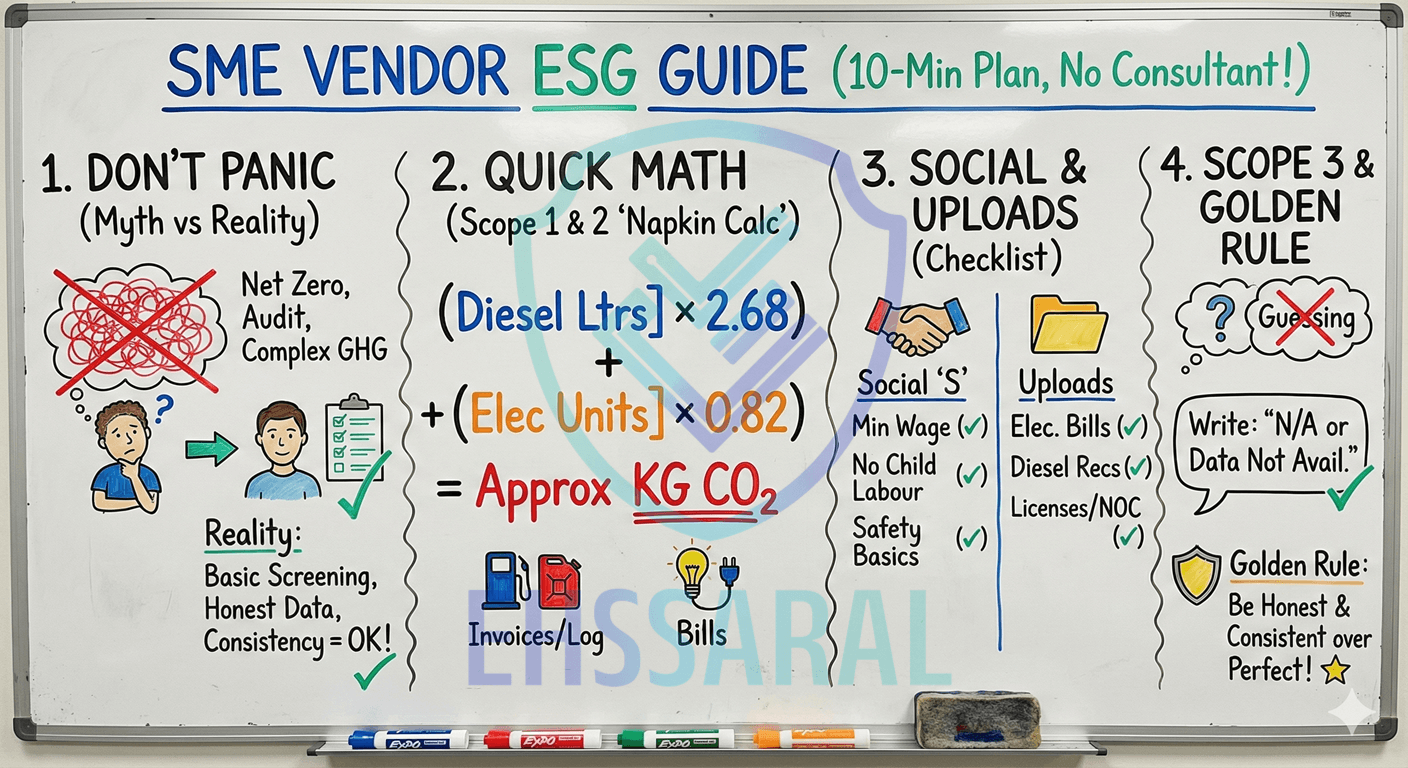
This is a very common situation for EHS professionals today.
You are working in a factory or SME.
Your client sends an email with an attachment or a portal link.
The subject line looks like:
Your internal team starts asking:
“Form kab submit hoga?”
“Order release ho jayega na?”
You open the form and suddenly see questions like:
And the natural reaction is:
“Yeh sab toh large companies ke liye hota hai.
Hum factory level pe yeh kaise calculate karein?”
If you are confused at this stage, you are not alone - and you are not wrong.
Scope 1, Scope 2 and Scope 3 definitions
Most EHS professionals panic because they assume:
For most Indian SMEs, this is not the reality.
In practice, vendor sustainability / ESG forms are mainly:
They are not expecting SME-level factories to produce perfect ESG reports.
What they usually expect is:
Once this is clear, the pressure reduces immediately.
Sometimes the client portal times out or rejects uploads-keep your files under 2–5 MB and rename them clearly (ElectricityBills_FY25.pdf).
On the ground, EHS professionals hear different terms:
Important point to remember:
Whether the client sends an Excel sheet,
or asks you to upload data on Ecovadis, Sedex (SMETA), CDP,
or their internal vendor portal -
the core information expected from SMEs is largely the same.
The platform changes.
The format changes.
But the logic does not change.
That is why this guide focuses on what to fill and how, not on any one portal.
If you break these forms down, most of them focus on just four things:
Mainly:
Even if the answer is:
Such as:
Uploads like:
You usually do not need:
You mostly need:
Water consumption is based on annual utility bills/meter totals. Waste quantities are based on annual dispatch/records including hazardous waste manifests.
From practical factory experience, the difficulty is not compliance - it is communication.
Common reasons SMEs struggle:
This guide is written to remove exactly this confusion.
This is not a theory article.
In the next sections, you will learn:
All explanations are:
This guide:
This guide does not:
And for most Indian SMEs, that is completely acceptable.
When you open a vendor ESG or sustainability form, this is the section that creates maximum confusion.
But for most Indian SMEs, Scope 1 and Scope 2 are much simpler than they sound.
Let’s remove the jargon and look at this the way a factory actually operates.
Scope 1 = Fuel you burn inside your factory boundary
If fuel is purchased by your company and burned by your equipment, it usually comes under Scope 1.
For most SMEs, this means:
If you already track diesel for:
No new system is required.
Note: The formula below covers the most common energy sources (Diesel & Electricity). If you use Coal, PNG, or Briquettes for your boiler, the multiplication factor changes slightly, but the logic remains the same.
Scope 2 = Electricity you buy from the grid
If you receive an electricity bill from:
Then that electricity consumption is your Scope 2 emission source.
It does not matter whether:
If you consume electricity, Scope 2 applies.
The following usually do not come under Scope 1 or 2 for SMEs:
These usually fall under Scope 3, which we will handle separately.
For now, focus only on:
Before calculating anything, collect these two things:
If DG logbook is missing, use diesel invoices as primary evidence.
You can take:
Be consistent. Consistency matters more than perfection.
Just add up the total units for the selected period.
Most EHS professionals already do this for:
Now comes the most important part.
Most vendor forms do not require complex carbon accounting.
They accept reasonable estimation based on standard emission factors.
(Diesel consumed in litres × 2.68) + (Electricity consumed in units × 0.82) = Approximate CO₂ emissions (in kg)
For most vendor forms, this simple estimation is enough.
Let’s say your factory data for one year is:
4,000 × 2.68 = 10,720 kg CO₂
1,20,000 × 0.82 = 98,400 kg CO₂
10,720 + 98,400 = 1,09,120 kg CO₂
This is the number you usually mention in:
Many EHS professionals worry:
“Client reject toh nahi karega?”
Here is the reality:
Using standard factors with clear explanation is better than guessing or hiding data.
You may read online that:
That is correct.
However:
Using 0.82:
If a client specifically asks for a different factor, you can always clarify later.
0.82 kg CO₂/unit is a conservative, commonly accepted average used for quick vendor disclosures.
If a client demands precision (rare for SMEs), you can refer to the latest CEA CO₂ Baseline Database for the Indian power sector and use the updated grid emission factor for that year.
But for most vendor questionnaires: 0.82 with clear explanation is accepted.
For vendor ESG forms:
Do not:
Use one method consistently so your year-on-year numbers don’t look random.
When the form asks:
“Please explain the methodology used”
If your client asks for ‘methodology’, one line explanation is enough-don’t paste definitions.
You can safely write something like:
“Scope 1 and Scope 2 emissions have been estimated based on annual diesel consumption and electricity usage using standard emission factors suitable for SME-level disclosure.”
After you calculate the numbers, most ESG / sustainability forms ask one more thing:
“Please upload supporting documents.”
This is where many EHS professionals panic again.
Let’s be very clear:
Clients are not expecting a carbon audit report from SMEs.
They want basic evidence that your numbers are not imaginary.
Before you click “Submit”, keep a small folder ready (digital or physical) with the following:
You do not need:
You do not need:
For Water
For Waste
For Social proofs
Depending on the client, they may also ask for:
These are standard documents most factories already have.
It helps to keep one folder for these documents something like:
“Vendor Sustainability Documents – 2024–25”
Keep:
This will save you time when:
When this is ready, your next vendor form becomes a 10-minute job.
If electricity bill is in landlord’s name (rented unit), mention it in comments and use the same bills.
If diesel invoices are with purchase team (or in WhatsApp photos), that’s fine-just total them month-wise.
After Scope 1 and 2, almost every form has a section called:
And most EHS professionals honestly don’t know what to do here.
Most SMEs don’t track Scope 3 data today - and clients know that.
Scope 3 includes emissions that you do not directly control, such as:
For large companies, this is important.
For SMEs, this data is usually:
Clients know this.
In most vendor ESG forms, yes - if written correctly.
SMEs are generally:
What matters is how you explain it.
Many SMEs mark Scope 3 as “Not Applicable” and it works.
But some mature clients may ask a follow-up if your company handles logistics.
Use this simple rule:
What to write (SME-safe, future-proof):
“Scope 3 is currently not fully quantified. Outbound logistics is managed via third-party transporters; emissions data is not available at present.”
If your form forces a checkbox, choose:
If the form allows free text, you can write something like:
Scope 3 emissions are not fully quantified due to limited data availability at SME level. The organization currently reports Scope 1 (onsite fuel) and Scope 2 (purchased electricity). Where logistics is outsourced to third-party transporters, emissions data is not available at present; Scope 3 applicability will be reviewed as data systems mature.
This shows:
Choose:
If required, add a short justification in comments.
Do not:
These mistakes can:
Remember:
It is safer to say “not available”
than to say something incorrect.
Large companies understand that:
What they look for is:
Many vendor forms are copied from corporate templates.
That means:
As an EHS professional, your job is not to overperform -
it is to respond responsibly.
After Environment (E), most vendor forms move to Social (S) questions.
This section usually looks scary, but in reality, it is much simpler than it appears.
Most SMEs already comply with these requirements - they just don’t know how to write it properly.
Common questions include:
These are basic compliance confirmations, not audits.
If the form allows text responses, simple and honest wording is best.
You can write:
“The organization complies with applicable minimum wage requirements as per local labour laws.”
You can write:
“The organization strictly prohibits child labour and follows applicable labour laws.”
You can write:
“Basic occupational health and safety practices are implemented at the workplace in line with statutory requirements.”
This level of response is:
Avoid:
Some forms ask you to:
In such cases:
Clients are looking for intent and compliance, not legal perfection.
Declarations help you tick “Yes”, but many portals (Sedex/SMETA style) often ask for proof uploads.
Here are practical proofs you can keep ready (even as PDFs/screenshots):
Minimum wages / salary payment
No child labour
Working hours / overtime
Health & Safety
Governance / ethics (if asked)
Pro tip: Rename files clearly for portal uploads:
“PFChallan_Oct2025.pdf”, “SalarySheet_Nov2025.pdf”, “FireNOC_ValidTill2027.pdf”
From real vendor interactions, these are mistakes EHS professionals should avoid:
If you consume electricity or diesel, emissions are never zero.
This creates confusion and raises unnecessary questions.
Avoid statements like:
Unless management has approved and planned this, do not promise it.
Clients track:
Changing formulas creates red flags.
Many EHS professionals focus only on getting approval today.
But remember:
So:
Honest numbers today give you flexibility tomorrow.
This guide helps you:
This guide does not:
And that is perfectly fine for most Indian SMEs.
If you remember just three things, remember these:
You do not need to fear these forms.
You just need to understand what is being asked.
Once you do that, filling them becomes routine - not stressful.
No.
For most Indian SMEs, ESG reporting is not legally mandatory.
However, customers and large corporates may require ESG or sustainability information as part of vendor onboarding or renewal.
In most cases, no.
Clients understand that SMEs:
What they expect is:
Approximate numbers are acceptable if they are consistent and explained clearly.
Yes.
Most vendor forms accept:
Important:
Consistency matters more than the exact year.
Then your Scope 1 emissions may be zero or very low.
In that case:
Zero Scope 1 is acceptable only if it is true.
In most vendor sustainability forms, no.
SMEs are generally allowed to:
What is important:
If the form does not allow “Not Applicable”:
Never enter guessed values just to complete the form.
For basic SME-level submissions, usually no.
Most SMEs can complete:
without a consultant, as long as they understand:
Consultants are usually needed only for advanced ratings or large enterprises.
At minimum:
Keeping these ready saves time and avoids last-minute panic.
Usually, no.
Clients look for:
Claiming unrealistically low numbers can create future credibility issues.
Honest data is safer in the long run.
Increasingly:
This is becoming a routine compliance activity, not a one-time event.

Founder, EHSSaral
Founder - EHSSaral | Partner - Perfect Pollucon | ISO 14001 Lead Auditor | GHG Protocol Scope 2 | Chemist | Data Scientist | Second-generation environmental professional simplifying EHS compliance for Indian industries through practical, automated, tech-enabled, data driven compliance workflows.
Common Hazardous Waste Mistakes in Indian Factories | EHSShala
EHSShala Foundations - Core Environmental Basics for EHS Officers

Free Environmental Compliance Software in India: A Clear, Honest Answer | EHSSaral

Managing Safety Without Authority: Handling Protected Contractors in Indian Plants | EHSSaral

What Is EHS & Why India Needs It | EHSShala
 Guide for Indian Factories EHSShala by EHSSaral.webp)
Ambient Air Quality Monitoring (AAQM) Guide for Indian Factories | EHSShala
Rule 9 Hazardous Waste Utilization: Why Applications Fail (2023–2025) | EHSSaral Research
Sampling Basics for Air, Water & Noise EHS Officer Guide | EHSShala
Environmental Compliance Calendar Software – Simplify MPCB Renewals & Due Dates | EHSSaral
Noise Monitoring in Factories Workplace vs Boundary (India Guide) | EHSShala