Industry Categorization in India: Red, Orange, Green, White & Blue | EHSShala

Industry Categorization in India: Red, Orange, Green, White & Blue | EHSShala

Industry Categorization Pollution Index (PI) Red Category Industries Orange Category Industries Green Category Industries White Category Industries Blue Category (State-Level)
Last updated:

24 Mar 2026

|
Read time: 18 min read

Red, Orange, Green, White, Blue & Special Categories Explained for EHS Professionals

Breadcrumb:
Home > EHSShala > Foundations > Industry Categorization in India (2025 Edition)


Introduction: “Sir, Hum Red Mein Aate Hain Ya Orange?”

If you are an EHS professional in India, this is the one question that pops up in almost every compliance meeting:

“Sir, hum Red category mein aate hain ya Orange?”

And this one line decides:

  • How many samples you need
  • Whether OCEMS becomes mandatory
  • How much consent fees you’ll pay
  • How often inspectors will visit
  • How complex your documentation will be
  • And how likely you are to receive notices or penalties

Yet, most EHS teams still fall into common traps:

  • Using old 2016 categorization lists
  • Assuming category based on a neighboring plant
  • Misreading state-level modifications
  • Thinking “White means free of rules”
  • Relying on consultants without personal understanding

That’s why this guide exists.

👉 By the time you finish reading, you will never be confused about your industry category again - not even for expansion, fuel change, or new machinery.

This is not a textbook explanation.
This is the kind of clarity a senior mentor gives a junior officer after years of factory visits, consent filings, and actual SPCB interactions.


Get Free Compliance Visibility in 15 Minutes

Upload your Consent to Operate and instantly see extracted obligations, deadlines, reminders, and an audit-ready compliance trail.

Free forever for core compliance visibility.
No execution lock-in. No forced upgrades.

👉 Register free on EHSSaral

If you already have a Consent (CTE/CTO)

You don’t need to guess your category.

In EHSSaral, we are building a feature where you can upload your Consent to Establish/Operate, and the system will automatically identify:

  • Your category
  • Whether it matches CPCB + SPCB rules
  • Whether your category is outdated
  • Whether your activities indicate a higher category

This prevents misclassification - the biggest hidden cause of notices.

Read more about SPCB Consent and how to interpret it


TL;DR (Too Long; Didn’t Read)

Here is the entire guide in 6 crisp points:

  1. Industry categorization in India is based on the Pollution Index (PI) - a measure of pollution potential, not performance.
  2. CPCB’s harmonised categorisation (2025 list) includes Red, Orange, Green, White and Blue (Blue is mainly used for essential environmental services like MSW/C&D/STP).
  3. “Blue” is used in two ways in India:
    (1) CPCB Blue for essential environmental services (MSW, C&D processing, STPs etc.) 
    (2) Some SPCBs also use “Blue” as an administrative fast-track bucket for low-impact service/warehouse type units (state-specific).
  4. Some industries fall under special lists such as GPI (Grossly Polluting Industries) or the Old 17 Highly Polluting Categories, which still influence inspections and OCEMS requirements.
  5. White Category is not “free” - it requires mandatory intimation to SPCB.
  6. State lists override CPCB lists, so one industry may be Orange in Maharashtra but Green in Gujarat.

Table of Contents

  1. Pollution Index (PI): The Scientific Logic
  2. The Four Official CPCB Categories
  3. Blue Category (State-Level)
  4. Grossly Polluting Industries (GPI)
  5. Old 17 Highly Polluting Categories
  6. Temporary & Seasonal Industries
  7. ZLD Myths
  8. Expansion & PI Change
  9. State-Specific Variations
  10. How to Confirm YOUR Category
  11. How Category Impacts Daily EHS Work
  12. Common Mistakes EHS Officers Make
  13. Tools, Links & Resources
  14. FAQs

Pollution Index (PI): The Scientific Logic Behind Categorization

1. PI Is the Real Engine Behind Categorization

Most EHS officers see Red/Orange/Green/White as “ready-made lists.”
But those lists are only the final result.

The real system beneath them is Pollution Index (PI) - a score from 0 to 100 that measures the potential environmental impact of an industrial activity.

👉 The category flows from the PI - not the other way around.


2. What Exactly Is Pollution Index (PI)?

PI is calculated based on four major environmental risk areas:

  • Air emissions (stack + fugitive)
  • Water pollution (effluent quantity + strength)
  • Hazardous waste generation
  • Resource consumption (energy, raw materials, chemicals)

In simple terms:

PI measures “how risky your process CAN be,” not what your current pollution level is.

In simple words, “pollution index of an industry” means the PI score that represents your process’s pollution potential (0-100), and that score decides your CPCB category.

Even a plant with upgraded ETP/STP or excellent pollution control may still fall in a high category because the process has high potential risk.
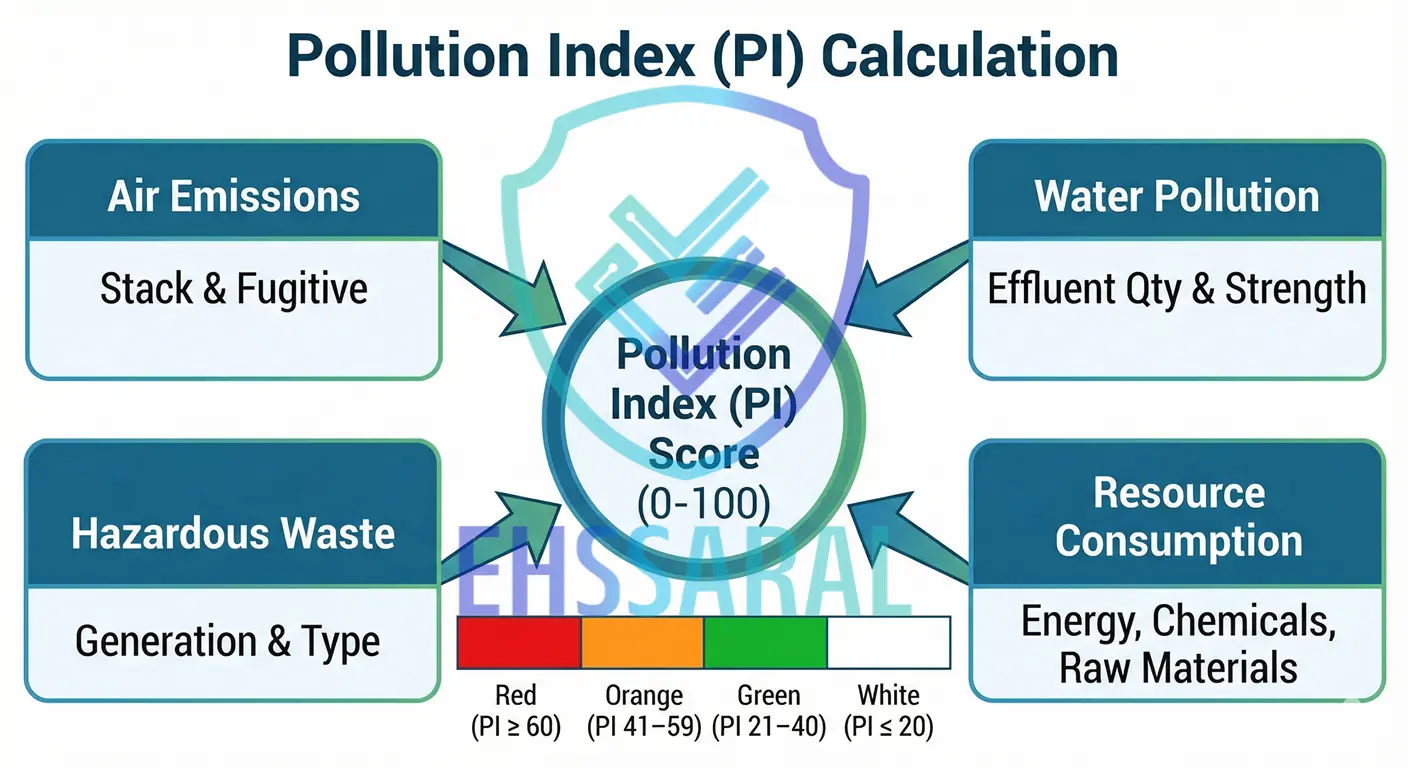
Diagram showing the CPCB Pollution Index (PI) calculation criteria, which combines Air Emissions, Water Pollution, Hazardous Waste, and Resource Consumption scores to classify industries into Red, Orange, Green, and White categories by EHSSaral

3. Why PI Was Introduced (Short, Real Explanation)

Before PI came, India used to follow a small “17 Highly Polluting Industries” list.
That system had three big problems:

  1. Too simplistic - many industries didn’t fit
  2. Inconsistent - one state treated an industry differently from another
  3. Not based on scientific quantification

PI solved these by offering:

  • A numerical scale
  • Uniform classification
  • Comparable risk assessment

4. Official PI Ranges (CPCB)

CategoryPI RangeMeaning
RedPI ≥ 60Very high pollution potential
Orange41-59Medium pollution potential
Green21-40Low pollution potential
White≤ 20Practically non-polluting

5. PI Is About Potential - Not How Clean You Are Today

Junior officers often ask:

“Sir, humne ZLD lagaya… fir bhi Orange Category? Why not Green?”

Because:

  • ZLD reduces discharge,
  • But category depends on process risk, including air emissions, hazardous waste, chemicals, etc.

A dye plant, electroplating shop, chemical reactor, or solvent-based process remains high-risk by nature, no matter how advanced your treatment system is.


6. Mentor Note

📌 Note:
Never assume category by looking at your neighbor’s plant.
Two units may produce the same product but fall into different categories depending on:

  • Raw materials
  • Chemical processes
  • Fuel type
  • Capacity
  • Utilities

7. Practical PI Examples (EHSShala Style)

Example 1: Powder Coating Unit

  • Effluent: None
  • Emissions: Limited
  • Hazardous waste: Filters, spent powder
    → PI ≈ 35 → Green

Example 2: Electroplating Unit

  • Heavy metals
  • Chemical reactions
  • Hazardous sludge
    → PI ≈ 70 → Red

Example 3: IT Office

  • No emissions
  • No effluent
    → PI < 20 → White (or Blue in some states)

8. Why PI Matters in Your Daily Work

Your PI (and therefore your category) decides:

  • Consent validity
  • Monitoring frequency
  • Inspections
  • OCEMS applicability
  • Bank Guarantees
  • Documentation load
  • Fees

👉 As you go higher in category, compliance becomes more complex, expensive, and inspection-heavy.


9. Quick Summary Table (Memory Shortcut)

If PI is…Your Category is…Compliance Load
≥ 60RedVery High
41-59OrangeHigh
21-40GreenModerate
≤ 20WhiteMinimal

The Four Official CPCB Categories (Red / Orange / Green / White)

Industry categorization in India is built on PI, but in real life, EHS officers rarely learn it from a PI table-they learn it through inspections, document corrections, and the occasional painful show-cause notice.

Here, the categories are explained not as definitions but as how they actually behave in the field.


1. Red Category - “High Pollution Potential”

PI ≥ 60

Red Category industries are those whose processes inherently have high environmental risk - chemical reactions, toxic substances, high-energy operations, or large-scale wastewater generation.

Even with strong controls, the potential remains high, which is why regulators keep these units under close watch.

Common Red Category Examples

  • Electroplating
  • Fertilizer plants
  • Pharmaceuticals (API manufacturing)
  • Textile dyeing & bleaching
  • Distilleries
  • Iron/steel processing
  • Hazardous chemical manufacturing

What Red Category Means for You (Ground Reality)

  • OCEMS likely mandatory (especially for continuous processes)
  • High sampling frequency (monthly or quarterly for air/water)
  • Detailed CTO conditions
  • Frequent inspections - scheduled + surprise
  • Shorter consent validity
  • Higher consent fees
  • Mandatory hazardous waste protocols

These units are also expected to maintain:

  • Excellent logbooks
  • ETP/STP daily records
  • Calibration reports
  • HW manifests
  • Stack monitoring history

📌 Mentor Note

Most Red Category units don’t get notices because of actual pollution -
they get notices because documentation isn’t consistent.

A perfectly running ETP without proper logbooks still means non-compliance.

2. Orange Category - “Medium Pollution Potential”

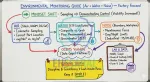
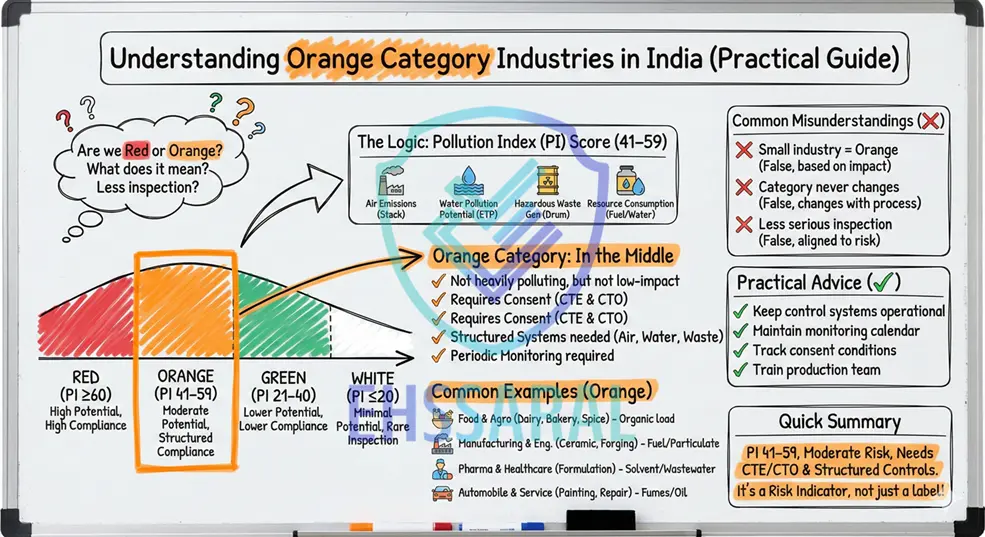
Whiteboard diagram explaining 'Orange Category Industries in India' with a focus on the Pollution Index (PI) score of 41-59. The board includes a spectrum chart of industrial categories (Red, Orange, Green, White), lists common examples like food and pharma, clarifies misunderstandings about compliance, offers practical advice for factory owners, and provides a quick summary of the regulations. ehsshala by EHSSaral

PI 41-59

This is the largest category for SMEs in India.
Orange industries generate manageable pollution loads that can be controlled with standard pollution control systems.

They are not as risky as Red Category, but not simple enough to be Green.

Common Orange Category Examples

  • Food processing units
  • Printing & packaging
  • Auto service centers
  • RMC (Ready-Mix Concrete) plants
  • Engineering workshops
  • Mixing/blending of chemicals
  • Pharmaceutical formulation units

What Orange Category Means for You

  • Moderate sampling (quarterly or half-yearly)
  • ETP/STP is usually required if effluent exists
  • OCEMS rarely required
  • Consent validity longer than Red
  • Documentation must be consistent, especially water consumption and waste records
  • More scrutiny during expansion

Orange Category is where most misclassifications happen.

Read more about Orange Category Industries in India (2025): List, Rules & Compliance Guide


💡 Tip

If your unit handles solvents, chemical reactions, or heavy metals,
your instinct may say “Orange”…
but your PI may place you in Red.

Always verify.


3. Green Category - “Low Pollution Potential”

PI 21-40

Green Category industries have minimal pollution potential and require simpler compliance systems.

These units often involve:

  • Assembly
  • Storage
  • Packaging
  • Minor mechanical operations

Common Green Category Examples

  • Assembly units (non-chemical)
  • Small packaging units
  • Wooden furniture manufacturing
  • Cold storages
  • Mineral water bottling (small scale)
  • Warehousing with minor processes

What Green Category Means for You

  • Longer consent durations (often 10 years)
  • Lower fees
  • Minimal sampling
  • Simple environmental safeguards
  • ETP/STP may not be required, depending on effluent generation

Green Category is “low compliance,” not “no compliance.”


⚠️ WARNING

Many SMEs assume they are Green because their plant “looks clean.”

But category is about pollution potential, not cleanliness.

Raw materials, fuel type, and processes still matter.


4. White Category - “Practically Non-Polluting”

PI ≤ 20

White Category was introduced to simplify operations for units with negligible pollution potential.

It is the most misunderstood category in Indian EHS.

Examples of White Category Units

  • IT offices
  • Educational institutions
  • Research labs without chemical processes
  • Solar module assembly
  • Handicrafts
  • Business offices
  • Retail spaces

What White Category Actually Means

White Category industries:

  • Do NOT require CTE
  • Do NOT require CTO
  • Do NOT pay consent fees
  • Do NOT face routine inspections

But…

⚠️ The Hidden Rule Most People Ignore

White Category units must file a mandatory intimation with the SPCB.

Failure to file this intimation can result in:


📌 Mentor Note

White Category ≠ “No rules.”
White Category = “Very low pollution, but inform the SPCB officially.”

This is the point almost every startup, IT office, and educational institution misses.


Quick Comparison Table - Red vs Orange vs Green vs White

CategoryPI RangePollution PotentialCTE/CTO Needed?OCEMS?Inspection Frequency
Red≥ 60Very HighYesOften YesHigh
Orange41-59MediumYesRareModerate
Green21-40LowYesNoLow
White≤ 20NegligibleNo (Intimation Only)NoVery Low
What Inspectors Commonly Ask (Real Life)

1) “Why have you selected Green when solvent / ink / adhesive is used?”
2) “Show your category justification (process, raw materials, fuel, capacity).”
3) “Has your fuel changed since the last consent?” (LPG → diesel → coal is a common trigger.)
4) “Any new activity added?” (lamination, plating, painting, heat treatment, chemical washing, etc.)
5) “Which activity is your highest pollution potential step?”

Mentor note: Most disputes don’t happen because the plant is dirty. They happen because the category selection does not match the process description.

New & Special Categories in India’s Categorization System

(Blue Category, GPI, 17-Category, ZLD Myths, PI Change Logic, State Variations)

Industry categorization is not limited to Red-Orange-Green-White.
In practice, EHS officers face parallel classification systems used by SPCBs for river protection, OCEMS decisions, consent fees, and hazardous waste regulation.

This section removes all confusion and shows how these systems interact with CPCB’s PI-based categories.

Read more about Environmental Rules and Regulations in India


1. The “Blue Category” - State-Level Administrative Category (NOT CPCB)

This is the #1 area where confusion happens.

Truth:

Blue Category is not an environmental risk category.
It does not come from Pollution Index.
It exists only in certain states for administrative purposes.

States Using Blue Category

  • Maharashtra (MPCB)
  • Gujarat (GPCB)
  • Tamil Nadu (TNPCB)
  • A few others in modified forms

Why Did States Create Blue Category?

Because they needed:

  • A category between Green and White
  • Better sorting for service-sector industries
  • Simpler consent fee structures
  • Quick processing for low-risk, low-pollution units

Blue Category Is NOT:

⚠️ Not a PI-based category
⚠️ Not equal to Green
⚠️ Not equal to White
⚠️ Not a pollution-potential indicator

It is purely administrative.

Typical Blue Category Examples

(Varies by state, but often includes):

  • IT offices
  • Warehouses and storage units
  • Small assembling units
  • Basic service industries
  • Non-chemical workshops
  • Units with no effluent

Consent Requirement for Blue Category

Blue Category usually requires:

CTO (once)
✔ Often no CTE
✔ Lower fees

BUT still comes under consent rules, unlike White.

Read more Blue Category MPCB: 3-Year Consent Validity for Recyclers


📌 Mentor Note

A unit may be Blue for fees,
but Orange or Green for environmental risk.

This dual classification confuses 90% of factories.

Read Factories Act 1948


List of Blue Category Industries (2025) - Official CPCB Blue Sectors

Many people search “List of Blue Category Industries” and expect IT offices or warehouses. That confusion happens because some states use “Blue” as an administrative bucket.

But in the CPCB harmonised list (2025), “Blue Category” is mainly used for Essential Environmental Services like municipal waste processing, sewage treatment plants, and C&D waste processing.

Sr. No.Blue Category Sector (CPCB 2025 list)Plain-English meaning for EHS teams
1Municipal Solid Waste Management Facility (sanitary landfill / integrated landfill with recycling / RDF etc.)City waste processing / landfill operations
2Waste-to-Energy power plantsPower generation using waste as fuel
3Bio-mining of legacy waste projectsOld dump cleanup and recovery work
4MSW Bio-methanation plant (MSW ≥ 5 TPD)Biogas/CBG type plant from wet waste
5MSW Composting Facility (MSW ≥ 5 TPD)Composting of wet waste at scale
6MSW Material Recovery Facility (MRF) (MSW ≥ 5 TPD)Dry waste segregation + recovery centre
7Construction & Demolition (C&D) Waste Processing PlantsConcrete/bricks debris processing unit
8Sewage Treatment Plant (STP) - 5 MLD and aboveLarge municipal STP
9Sewage Treatment Plant (STP) - less than 5 MLDSmall municipal/community STP

Important clarity: This CPCB Blue list is not saying these activities are “low pollution”. In fact, many have high pollution potential, but they are classified as Blue because they are essential environmental services and are handled differently in approvals.

If your site is a factory/warehouse/office and someone told you “you are Blue category”, then it is likely the state-level administrative Blue (different logic, different list). Always confirm which “Blue” your SPCB is referring to.


2. Grossly Polluting Industries (GPI)

(Used for River Protection, not Categorization)

The GPI list is one of the most important-but misunderstood-lists in environmental compliance.

GPI Full Form (In Pollution Context)

GPI = Grossly Polluting Industries. In CPCB/SPCB language, “GPI industry” means an industry type that can generate high-strength wastewater / toxic effluent / large pollution load, especially relevant for river protection and basin-level monitoring.

GPI in Simple Terms (For EHS Officers)

If your unit’s effluent can harm rivers quickly (because of high COD/BOD, toxic chemicals, heavy load, or large volume), you may fall under GPI, even if your PI-based category is not the highest.

Does GPI Affect Category? (Important Clarification)

No. GPI is not a Red/Orange/Green/White category.

  • Category is decided by Pollution Index (PI).
  • GPI is a separate priority list used for stricter monitoring and enforcement, especially near rivers.

What Happens If Your Industry Is GPI? (Practical Impact)

In real SPCB handling, GPI status often leads to:

  • More inspections (especially during operational peaks)
  • Higher chance of OCEMS / online monitoring expectations
  • Stronger push toward ZLD/ETP reliability
  • Faster action if complaints occur
  • Tougher scrutiny on disposal records, manifests, sludge handling, flow meters

What “CPCB GPI Inspection” Usually Means

Many times, CPCB’s focus is not “one unit’s paperwork.” It’s cluster/river-basin level:

  • whether discharge is controlled
  • whether online/periodic monitoring is reliable
  • whether data looks genuine and consistent
  • whether high-risk units have working treatment systems (not just on paper)

Why GPI Exists

Created by CPCB to regulate industries that discharge:

  • High-strength effluent
  • Toxic wastewater
  • Large volumes of organic pollutants

Especially in river basins like:

  • Ganga
  • Yamuna
  • Godavari
  • Krishna

Common GPI Industries

  • Distilleries
  • Slaughterhouses
  • Tanneries
  • Dyeing & bleaching units
  • Pulp & paper mills
  • Large-scale food processing

Important Clarification

GPI has nothing to do with Red/Orange/Green category.

A plant can be:

  • Orange Category but still GPI, or
  • Red Category but not GPI

What GPI Status Changes

If your unit is under GPI:

✔ ZLD expectations increase
✔ More inspections
✔ OCEMS often mandatory
✔ Strict discharge norms
✔ River basin monitoring begins


3. The “17 Highly Polluting Industries” List (Old but Still Used)

Before PI-based categorization existed, CPCB classified industries under the “17 Highly Polluting” list.

This list is technically outdated but still used by SPCBs for enforcement.

Industries in the 17-Category List

  • Pesticides
  • Petrochemicals
  • Pharmaceuticals (API)
  • Dyes
  • Tanneries
  • Pulp & paper
  • Cement
  • Sugar
  • Fertilizers
  • Refining
  • Others

Why It Still Matters

If your industry appears in this legacy list, SPCBs may impose:

✔ Stricter OCEMS requirements
✔ Tougher hazardous waste conditions
✔ Additional monitoring
✔ Frequent show-cause notices

Even if you are technically Orange Category under PI.


4. Temporary & Seasonal Industries

(Short Validity, High Scrutiny During Operation)

Some industries work only a few months per year.
SPCBs handle these differently.

Examples

  • Brick kilns
  • Stone crushers
  • Sugar factories (crushing season)
  • Firecracker units
  • Seasonal processing units

Impact on Categorization

✔ PI stays the same
✔ Consent validity is shorter (6-12 months)
✔ Monitoring increases during operational months
✔ Closure compliance required post-season

Seasonal industries often receive more surprise inspections due to short operating windows.


5. ZLD & Category Myths - The Most Common Misunderstanding

EHS officers everywhere say the same line:

“Sir, humne ZLD laga diya…
ab toh Orange ho jaana chahiye.”

Incorrect.

ZLD reduces discharge, not potential pollution.

✔ Correct Understanding

A Red Category process remains Red Category because:

  • Chemical reactions still exist
  • Hazardous waste still forms
  • Energy/resource consumption is still high
  • Toxic intermediates may still be handled

What ZLD Actually Impacts

  • Consent conditions become softer
  • Sampling requirements may reduce
  • Credibility improves
  • Chance of penalties decreases

What ZLD Does NOT Impact

⚠️ Your CPCB category does not change.

This is one of the biggest myths in Indian industry.

Read more how Auditors Calculate Effluent Using Your Water Bills while doing ZLD Mass Balance


6. Expansion & PI Change Logic

(When does category actually change?)

Expansion can change your PI score.

Category May Increase If You Add:

  • New chemicals
  • Larger ETP/STP loads
  • High-temperature processes
  • High-emission fuel systems
  • Increased hazardous waste generation
  • New chemical reactions
  • Higher production capacity with pollution increase

Category Does NOT Change When You Add:

  • More manpower
  • More storage racks
  • Utility upgrades (unless process-related)
  • Extra machines without effluent/emissions
  • DG set upgrades without load change

📌 Practical Example

A bakery using LPG boiler → Green
Switching to coal boiler → often becomes Orange

Because fuel type changes air pollution potential.


7. State-Specific Variations - The Practical Reality That Matters Most

EHS officers often assume CPCB list is the final word.
In actual compliance:

State categorization overrides CPCB for consent processing.

Each SPCB modifies the list based on:

  • Industrial density
  • Local rivers
  • Pollution hotspots
  • Cluster-specific risks
  • Historical violations

Examples of Variations

MPCB (Maharashtra)
  • Uses Blue Category
  • Some packaging & printing units classified differently from CPCB
GPCB (Gujarat)
  • Very detailed chemical-subcategory system
  • Effluent-based classification is stricter
TNPCB (Tamil Nadu)
  • Special grouping for textile clusters
  • Service industries treated differently

📌 What This Means for You

Your category may be:

  • Red in Maharashtra
  • Orange in Gujarat
  • Green in Tamil Nadu

Even with the same exact process.

✔ Legal Position

For categorization:

SPCB classification prevails.

For environmental standards:

CPCB norms apply nationally.

This is why cross-checking both lists is mandatory.


How to Confirm YOUR Industry Category (Step-by-Step Guide)

A practical method every EHS officer should follow before filing consent

Most non-compliances start with one mistake:

“We assumed our category.”

Either someone copied a competitor, used an outdated PDF, or selected the category with the lowest fee.
This guide gives you a zero-confusion approach that works for every industry and every state.


Step 1 - Start With the CPCB Master Categorization List

This list defines the official national classification based on PI.

Look for:

  • Your main industrial activity
  • The description that matches your process
  • Your PI-based category (Red/Orange/Green/White)

📌 Note:
CPCB list is the foundation - but NOT the final authority for your state.


Step 2 - Cross-Check Your State Pollution Control Board (SPCB) List

Every SPCB modifies the CPCB list to reflect:

  • Local ecological sensitivity
  • River basin protections
  • Industrial density
  • Regional pollution patterns

Examples:

  • MPCB = includes Blue Category
  • GPCB = detailed chemical sub-categorization
  • TNPCB = special textile cluster rules

⚠️ Rule:
If CPCB says Orange but SPCB says RedSPCB prevails.


Step 3 - Identify All Activities Inside Your Plant

Your category is determined by the highest-risk activity, not your main product.

Example

A packaging factory that also has:

  • Solvent-based lamination
  • Ink-based printing
  • Small adhesive mixing

→ Often becomes Orange, not Green, because solvents increase PI.

📌 Note:
Even one small hazardous step can shift the entire unit upward.


Step 4 - Check Whether You Fall Under GPI (Grossly Polluting Industries)

If your unit discharges high-strength wastewater, especially near rivers (Ganga/Yamuna/Godavari/Krishna), check the GPI list.

GPI status affects:

  • OCEMS
  • Inspections
  • ZLD expectations

💡 Tip:
Even a medium PI unit may fall under GPI.


Step 5 - Verify Against the “17 Highly Polluting Industries” List

Though old, this list is still used by SPCBs to impose:

  • OCEMS
  • Hazardous waste conditions
  • Additional monitoring

⚠️ Warning:
Your PI may say Orange, but being in the 17-category list may trigger Red-like conditions.


Step 6 - Check Whether Your State Uses the Blue Category

States like Maharashtra, Gujarat, Tamil Nadu use Blue Category for:

  • Consent fee slabs
  • Simplified processing
  • Service industries

📌 Important:
Blue = administrative category, not PI category.
You still need to track your CPCB category for compliance.


Step 7 - Review Raw Materials, Capacity & Fuel Usage

Category may change if you:

  • Increase production capacity
  • Introduce new chemicals
  • Add emission-heavy machines
  • Switch fuels (e.g., LPG → Coal)

Example:

A bakery using LPG = Green
Same bakery using coal = Orange or higher

Fuel choice directly impacts PI.


Step 8 - Validate Your Category Using Existing Consent Documents

Check:

  • CTE/CTO category line
  • Process description
  • Raw material list
  • Fuel details
  • Production capacity

⚠️ Warning:
Many older consents (2014-2016) use outdated categories.


Step 9 - Use EHSSaral Categorization Analysis (When Available)

Upload your consent and the system will:

  • Detect all activities inside the plant
  • Cross-check CPCB & SPCB lists
  • Detect mismatches
  • Identify outdated categorization
  • Suggest probable corrections

Perfect for eliminating human errors.


Step 10 - When in Doubt, Ask SPCB Helpdesk

Most SPCBs respond within 7-15 days.

Email:

  • Process flow diagram
  • Raw material list
  • Land documents
  • Activity description

📌 Note:
A written reply from SPCB protects you during inspections.

We analysed 450+ MPCB Consents from (2023-2025) to understand CTO Rejection reasons so that you won't have to face CTO rejection.


Category Verification Checklist

StepWhat to CheckWhy It Matters
1CPCB ListBase classification
2SPCB ListOverrides CPCB
3All ActivitiesHighest-risk activity decides category
4GPI ListRiver protection rules apply
517-Category ListOCEMS & HW conditions
6Blue CategoryFee slabs & admin grouping
7Capacity/Fuel ChangeMay shift category
8Consent DocumentAvoid outdated classification
9EHSSaral AnalysisRemoves guesswork
10SPCB ConfirmationFinal authority

What Your Category Means for Daily EHS Work

Your category controls your daily workload, documentation pressure, inspection frequency, and relationship with the SPCB.

Think of it as your EHS “difficulty mode”:

  • Red = Hard mode
  • Orange = Medium
  • Green = Easy
  • White = Minimal

Let’s break it down clearly.


1. Consent Validity Period

CategoryTypical ValidityReason
Red1-5 yearsHigh risk → frequent review
Orange5-10 yearsMedium risk
Green10 yearsLow risk
WhiteNo consentOnly intimation

📌 States may vary.
Maharashtra often gives 5-year CTO for Orange and 10-year CTO for Green.


2. Sampling Frequency

CategorySampling Requirement
RedMonthly/Quarterly
OrangeQuarterly / Half-yearly
GreenAnnual or minimal
WhiteNone

⚠️ If your documentation is weak, inspectors may increase sampling frequency even if your category is low.


3. OCEMS Applicability

Required for:

  • Many Red Category units
  • GPI industries
  • 17-Category industries
  • River basin discharge units

Not required for:

  • Green
  • White

Sometimes required for Orange depending on state circulars.


4. Hazardous Waste Documentation

CategoryHW Requirement
RedStrict controls
OrangeModerate
GreenLow but applicable if any HW generated
WhiteExempt unless e-waste or batteries

5. Inspection Frequency

CategoryFrequency
Red2-4 per year + surprise visits
Orange1-2 per year
GreenRare, paperwork-based
WhiteNone unless complaint

6. Bank Guarantee (BG)

CategoryBG Requirement
RedCommon (₹5-10 lakh typical)
OrangeOnly for specific violations
GreenRare
WhiteNone

7. Reporting & Documentation Load

CategoryDocumentation
RedHigh - daily logs, monthly reports
OrangeMedium - quarterly reports
GreenLow - annual reporting
WhiteMinimal

8. Consent Fee Structure

Highest to lowest:

Red → Orange → Green → (Blue for some states) → White (no fee)


9. Compliance Risk Rating

Most non-compliances occur in this order:

  1. Red - due to complexity
  2. Orange - due to documentation gaps
  3. Green - occasional
  4. White - only if intimation missing

Common Mistakes EHS Officers Make (And How to Avoid Them)

This is where most penalties originate.
If you avoid these, your compliance burden drops drastically.


1. Confusing Blue Category with Environmental Category

Blue is administrative, not environmental.
But many industries think Blue = Green or Blue = White.


2. Copying Neighboring Factories

Two similar factories may have:

  • Different raw materials
  • Different fuels
  • Different hazardous processes
  • Different PI values

Never rely on “what others wrote.”


3. Assuming ZLD Downgrades Category

ZLD reduces discharge, not pollution potential.


4. Using Outdated PDFs from 2014-2016

One of the most common causes of consent rejection.


5. Selecting a Lower Category to Reduce Fees

This often triggers:

  • Rejection
  • Show-cause notices
  • BG imposition
  • Future scrutiny

6. Ignoring Small Hazardous Activities

A tiny electroplating tank can shift the entire plant to Red.


7. Forgetting White Category Intimation

White still requires mandatory intimation to SPCB.


8. Ignoring State-Specific Categorization

Your category may change across states.


9. Not Reassessing After Expansion

Capacity changes = category changes.


10. Relying Entirely on Consultants

Consultants help, but you face the penalty for misclassification.


Tools & Official Resources (Clean, User-Friendly List)

Add this directly to EHSShala or convert into a downloadable PDF later.


CPCB Means What (And Why It Matters Here)

CPCB stands for Central Pollution Control Board. In simple terms, CPCB sets the national standards and categorization logic (like Pollution Index ranges and official Red/Orange/Green/White lists). Your SPCB applies these on ground and may add state-level categories like Blue.
So: CPCB = national rulebook & standards, SPCB = state implementation & consent decisions.


1. CPCB Master Industry Categorization List

Search:
“CPCB Industry Categorization 2025 PDF”

Contains:

  • Activity-wise categories
  • PI values
  • White Category list

Use only the latest version.


2. SPCB Categorization Lists

Search formats:

  • “MPCB categorization Blue Category”
  • “GPCB industry categorization list 2025”
  • “TNPCB categorization pdf”
  • “KSPCB category list”

State lists override CPCB for classification.


3. GPI (Grossly Polluting Industries) List

Search:
“CPCB GPI list 2025”

Important for river basin industries.


4. 17 Highly Polluting Industries List

Search:
“CPCB 17 category industries”

Still used for HW & OCEMS decisions.


5. SPCB Helpdesk Email IDs

Search:

  • “MPCB helpdesk email”
  • “TNPCB consent support”
  • “GPCB XGN contact”

A written reply protects you during inspections.


6. Process Flow Diagram Templates

Simple PFDs help SPCB classify your industry correctly.


7. EHSShala Category Cheat Sheet (Text)

  • Red: PI ≥ 60
  • Orange: 41-59
  • Green: 21-40
  • White: ≤ 20
  • Blue: State admin category
  • GPI: High-effluent sectors
  • 17-Category: Legacy high-pollution list

Closing Summary

Industry categorization shapes:

  • Your consent requirements
  • Fees
  • Monitoring frequency
  • OCEMS rules
  • HW obligations
  • Inspection pressure

The biggest learning:

Your category depends on pollution potential, not on how clean your plant “looks.”

Understanding categorization helps EHS officers:

  • Avoid penalties
  • File accurate consents
  • Maintain trust with SPCBs
  • Reduce documentation burden
  • Improve internal compliance culture

Use this guide whenever you apply for:

  • New consent
  • Renewal
  • Expansion
  • Process change
  • Fuel change
  • Capacity increase

  • Frequently Asked Questions (FAQs)

  • Industry Categorization in India - Practical Answers for EHS Professionals


  • 1. What is industry categorization in India?

  • Industry categorization is the system used by CPCB and SPCBs to classify industries based on their Pollution Index (PI). This classification determines an industry’s compliance requirements, monitoring frequency, documentation burden, and consent validity.

  • 2. What is Pollution Index (PI)?

  • PI is a score between 0 to 100 that indicates the pollution potential of an industrial activity.
    It considers:
  • Air emissions
  • Effluent quantity and characteristics
  • Hazardous waste generation
  • Resource consumption
  • Higher PI → stricter category → higher compliance load.

  • 3. What are the four official CPCB categories?

  • The official national categories (based on PI) are:
  • Red - PI ≥ 60
  • Orange - PI 41-59
  • Green - PI 21-40
  • White - PI ≤ 20
  • These categories decide how much environmental regulation applies to your industry.

  • 4. Is there a Blue Category in India?

  • Yes, but only at the state level.
    Blue Category is used by some SPCBs (MPCB, GPCB, TNPCB) for:
  • Administrative grouping
  • Consent fee slabs
  • Ease-of-doing-business processing
  • It is not based on PI and is not an environmental risk category.

  • 5. What is the difference between Blue and Green Category?

  • Green = Official CPCB category based on pollution potential.
  • Blue = State-created administrative category for convenience.
  • Blue does not indicate pollution level or PI score.

  • 6. How can I check whether my industry is Red, Orange, Green, or White?

  • You should verify using:
  • CPCB categorization list
  • Your SPCB’s modified categorization list
  • Your process flow and raw materials
  • 17-category and GPI lists (if applicable)
  • Your existing consent documents
  • Your SPCB list always prevails during consent filing.

  • 7. Does ZLD (Zero Liquid Discharge) change the industry category?

  • No.
    ZLD reduces discharge, not pollution potential.
    Category is decided by the inherent pollution risk of the process, not by treatment systems.

  • 8. Can two industries making the same product fall under different categories?

  • Yes.
    Classification depends on:
  • Raw materials
  • Fuel used
  • Type of chemical processes
  • Capacity
  • Unit operations
  • Not just the final product.

  • 9. Can my category be different in Maharashtra vs Gujarat?

  • Yes.
    SPCBs modify CPCB categorization based on state-specific environmental sensitivity.
    For consent filing, state categorization overrides CPCB.

  • 10. What is White Category?

  • Industries with PI ≤ 20 and negligible pollution.
    They:
  • Don’t require CTE or CTO
  • Must submit White Category Intimation
  • Must follow basic waste handling rules
  • Operating without intimation may trigger non-compliance.

  • 11. Do White Category industries need environmental records?

  • Only minimal records such as:
  • Basic waste disposal records
  • E-waste/battery-waste documentation (if applicable)
  • But no consent is required.

  • 12. What is the “17 Highly Polluting Industries” list?

  • An older CPCB list used before PI-based categorization.
    Still used by SPCBs for:
  • OCEMS requirements
  • Hazardous waste scrutiny
  • Show-cause notices
  • Stricter monitoring
  • Industries in this list face tighter norms even if their PI is moderate.

  • 13. What is GPI in pollution (CPCB/SPCB meaning)?

  • In environmental compliance, GPI means Grossly Polluting Industries - industry types that can generate high-strength or high-impact wastewater and are therefore monitored more strictly, especially near river basins.
    GPI is not the same as Red/Orange/Green category. Your category comes from Pollution Index (PI), while GPI is a separate priority list affecting inspection frequency, monitoring expectations, and enforcement focus.

  • 14. Can my category change if production capacity increases?

  • Yes.
    Category may shift upward if expansion increases:
  • Effluent quantity
  • Emissions
  • Hazardous waste
  • Chemical processes
  • Minor capacity increases without pollution changes may not affect the category.

  • 15. Does changing fuel (e.g., LPG to coal) affect categorization?

  • Yes.
    Fuel choice directly affects air pollution potential.
    For example:
  • LPG bakery → Green
  • Coal-fired bakery → often Orange

  • 16. How often do SPCBs conduct inspections for each category?

  • Red: Frequent (2-4/year) + surprise visits
  • Orange: 1-2/year
  • Green: Rare; mostly paperwork-based
  • White: None unless complaint-driven

  • 17. What happens if I select the wrong category in my consent application?

  • SPCB may issue:
  • Consent rejection
  • Show-cause notice
  • Higher fees
  • Bank Guarantee requirement
  • Category correction order
  • This also affects future compliance obligations.

  • 18. Is OCEMS mandatory for all Red Category industries?

  • Not all, but many.
    OCEMS is mandatory for:
  • Many Red Category units
  • All GPI industries
  • Most 17-category industries
  • River-discharge units
  • Always check state-specific OCEMS circulars.

  • 19. What documents help SPCB verify categorization?

  • The most important documents are:
  • Process Flow Diagram (PFD)
  • Raw material list
  • Fuel details
  • Plant layout
  • Effluent/emission points
  • Production capacity details
  • Correct documents reduce the chance of misclassification.

  • 20. Can an industry operate without consent if it is White Category?

  • Yes - but only after filing White Category Intimation.
    Without intimation, the unit may still be treated as operating without consent.

  • 21. Is Blue Category exempt from consent?

  • No.
    Blue Category units generally require CTO (and sometimes CTE, depending on state rules).
    Blue ≠ Exempt category.

  • 22. Should EHS officers re-check their category regularly?

  • Yes, especially when:
  • Adding new machinery
  • Introducing new chemicals
  • Changing fuel
  • Increasing capacity
  • Expanding operations
  • PI and category may change without you realizing it.

  • 23. Can one unit fall under more than one category?

  • Yes.
    If multiple processes exist, the category is determined by the highest-risk activity.

  • 24. Is GPI better than GDP?

    In economics, GPI can also mean Genuine Progress Indicator, which is compared with GDP.
    But in environmental compliance in India, GPI means Grossly Polluting Industries. They are unrelated terms.
    So for SPCB/CPCB compliance discussions, GPI = Grossly Polluting Industries only.

Harshal T Gajare

Harshal T Gajare

Founder, EHSSaral

Second-generation environmental professional simplifying EHS compliance for Indian manufacturers through practical, tech-enabled guidance.

Related Blogs

Hazardous Waste Classification in India: Inspector’s Guide (2025) | EHSShala

Hazardous Waste Classification in India: Inspector’s Guide (2025) | EHSShala

Common Hazardous Waste Mistakes in Indian Factories | EHSShala

Common Hazardous Waste Mistakes in Indian Factories | EHSShala

Environmental Inspection India: What Inspectors Check | EHSSaral

Environmental Inspection India: What Inspectors Check | EHSSaral

Why Running Factories Are Getting Closure Notices in 2026 | EHSSaral

Why Running Factories Are Getting Closure Notices in 2026 | EHSSaral

Why BMW Inspections Feel Stricter Today (India) | EHSSaral

Why BMW Inspections Feel Stricter Today (India) | EHSSaral

Blue Category MPCB 3-Year Consent Validity for Recyclers (2026) | EHSSaral

Blue Category MPCB 3-Year Consent Validity for Recyclers (2026) | EHSSaral

How MoEFCC, CPCB & SPCB Work in India: Expert Guide | EHSShala

How MoEFCC, CPCB & SPCB Work in India: Expert Guide | EHSShala

Environmental Compliance for Pharmaceutical Manufacturing in India | EHSSaral

Environmental Compliance for Pharmaceutical Manufacturing in India | EHSSaral

Consent to Operate (CTO) Explained for Indian Factories | EHSShala

Consent to Operate (CTO) Explained for Indian Factories | EHSShala

Environmental Monitoring Mistakes in Indian Factories (Real Issues Explained)
Environmental Monitoring Mistakes in Indian Factories (Real Issues Explained)