
EHSShala
Used Oil & Waste Oil Management in India - Factory & EHS Guide | EHSShala
EHSSaral is an Environmental Compliance Intelligence Platform for Industries. Consent Intelligence • Alerts & Tasks • Incident Reporting • Form IV & V • Audit-Ready Records
See how EHSSaral works
6 Feb 2026
Questions are asked about internal controls, reporting accuracy, or plant-level discipline. For many large Indian companies, these areas have improved steadily over the past decade. Systems exist. Teams are trained. Consultants are engaged.
Yet, compliance risks continue to appear.
Not always within the company’s own operations - but across its supply chain.
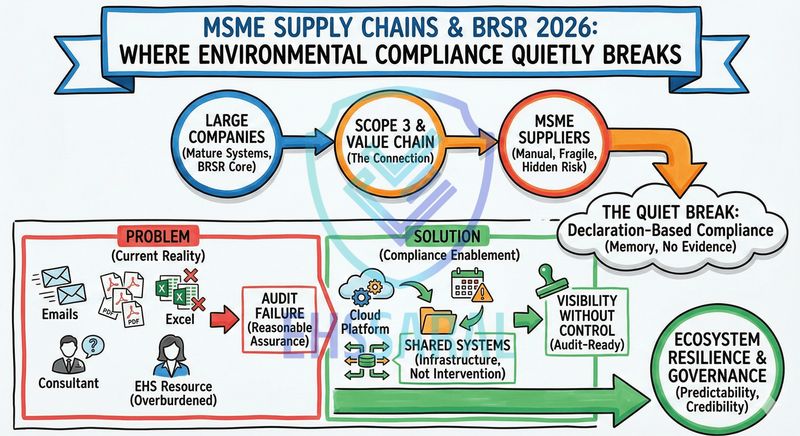
In our earlier analysis, we explored why environmental compliance must be treated as infrastructure, not activity (see Article 1), and why BRSR Core will test that infrastructure through audit-grade assurance in 2026 (see Article 2). This article focuses on where execution quietly breaks in practice: the MSME supply chain.
Under BRSR Core and Scope 3 disclosures, this distinction matters less than it used to. Environmental risk is no longer assessed only at owned facilities. It increasingly includes significant suppliers, contract manufacturers, and service partners - many of whom are MSMEs operating with limited compliance infrastructure.
This is where the system quietly breaks.
Most MSMEs do not fail environmental obligations because they disregard them.
They fail because compliance is managed as a side responsibility rather than a structured function.
In day-to-day operations, an MSME’s environmental compliance typically looks like this:
One EHS or admin resource managing multiple roles
Heavy reliance on external consultants
Consent conditions stored as PDFs, not tracked as tasks
Monitoring schedules remembered through experience, not systems
Records dispersed across email threads and vendor folders
This approach often works - until scrutiny increases.
As long as inspections are infrequent and disclosures are internal, manual compliance remains survivable. Once compliance becomes part of value-chain reporting, the tolerance for ambiguity disappears.
Under BRSR Core framework, companies must disclose information about Significant Value Chain Partners. These are suppliers or partners that meet defined materiality thresholds, often based on contribution to purchases or sales.
In practical terms, this means:
MSMEs supplying critical inputs
Contract manufacturers producing at scale
Waste handlers, recyclers, and logistics partners
Utilities or shared infrastructure operators
These entities may not be listed.
They may not file BRSR themselves.
But their compliance posture now affects someone who does.
This creates a mismatch.
Large companies are asked to provide assured disclosures based on compliance processes that exist outside their direct control - often within MSMEs that operate without audit-grade systems.
The gap is not malicious.
It is structural.
To bridge this gap, many organisations fall back on declarations.
Suppliers are asked to confirm that:
Consents are valid
Monitoring is up to date
No violations exist
On paper, this seems reasonable.
In practice, declaration-based compliance has three weaknesses:
It relies on memory - suppliers confirm based on recollection, not verification
It lacks evidence chains - documents are not linked to obligations or timelines
It breaks under audit - declarations do not substitute for traceable records
It creates false confidence - suppliers believe signing equals compliance, and principal companies believe collecting declarations equals risk control.
Under Reasonable Assurance, these weaknesses become visible.
Auditors do not test intent.
They test control maturity.
If compliance information cannot be reproduced consistently across reporting cycles, it is flagged - regardless of whether environmental performance was acceptable.
The most dangerous aspect of MSME compliance fragility is that it rarely triggers immediate alarms.
There may be no notices.
No shutdowns.
No public incidents.
Instead, the risk accumulates silently - until it appears as:
Scope 3 disclosure qualifications
Audit observations tied to supplier controls
ESG rating downgrades
Board-level questions about supply-chain governance
By the time these signals surface, remediation becomes difficult.
The lag between accumulation and detection is what makes MSME compliance risk so dangerous - it stays invisible until it becomes irreversible.
Systems cannot be built overnight.
Supplier behaviour does not change instantly.
Assurance timelines do not pause.
This is why MSME compliance is emerging as the critical execution bottleneck under BRSR 2026.
When supply-chain compliance risks become visible, the default response is often to increase audits.
Supplier audits are expanded.
Checklists become longer.
Declarations are revalidated.
On the surface, this looks like control.
In reality, audits only capture a moment in time.
Most MSME audits assess whether:
Documents were available on the audit day
Conditions appeared broadly complied with
Major red flags were visible
They do not verify whether compliance is maintained continuously.
An audit may confirm that a consent was valid in March.
It does not ensure that monitoring happened in June, records were preserved in August, or renewals were initiated on time.
This is the structural limitation of audit-led assurance.
Audits observe outcomes at a moment in time.
They do not create the daily disciplines that make outcomes repeatable.
This distinction is often misunderstood.
Large companies hesitate to intervene in supplier compliance because they fear assuming responsibility. That concern is legitimate. No organisation wants to become operationally liable for third-party compliance.
However, visibility is not control.
Compliance visibility means:
Knowing which obligations exist
Knowing whether timelines are being met
Knowing where records are stored
Knowing when deviations occur
Compliance control means:
Directing how work is performed
Managing daily operations
Making regulatory representations
Automation allows organisations to create visibility without control.
It does not replace suppliers’ responsibility.
It reduces uncertainty for reporting entities.
This distinction is essential under BRSR Core, where companies are expected to explain how they know their disclosures are reliable - not how they enforce supplier behaviour.
Another common response is training.
Workshops are conducted.
Guidelines are shared.
Awareness improves.
Training helps, but it does not solve the core issue.
MSME compliance failure is rarely caused by lack of knowledge.
It is caused by lack of structure.
An MSME may fully understand consent conditions yet still miss deadlines because:
No system tracks dates centrally
Responsibilities shift as staff change
Consultants operate reactively
Records are archived inconsistently
Training increases awareness.
It does not create memory.
Systems do.
Ironically, as companies add more manual compliance layers, risk often increases.
More emails.
More spreadsheets.
More follow-ups.
Each layer introduces:
Data duplication
Version conflicts
Delayed responses
Ownership ambiguity
Under audit conditions, this complexity collapses.
Auditors do not evaluate effort.
They evaluate reliability.
If information cannot be produced consistently and confidently, additional documentation becomes a liability rather than a safeguard.
Meanwhile, a second consequence of BRSR Core is reshaping organisational dynamics inside reporting companies.
One unintended consequence of BRSR Core is where compliance pressure actually lands.
It does not remain at the reporting entity alone.
It cascades downwards.
Procurement teams are asked to collect environmental data.
EHS teams are asked to validate supplier responses.
MSMEs are asked to produce evidence they never had systems to store.
This shift was not planned.
But it is now unavoidable.
And without structural support, the weakest link will continue to determine disclosure quality - regardless of how mature the principal company’s internal systems are.
When companies talk about “supporting supplier compliance,” the idea often remains abstract.
In reality, effective compliance enablement is neither heavy-handed nor intrusive. It does not involve taking over operations or issuing instructions. It involves standardising how compliance information exists.
In practice, this means enabling suppliers to:
See their regulatory obligations clearly, not buried in PDFs
Translate consent conditions into time-bound actions
Receive alerts before deadlines are missed
Store records in a consistent, retrievable manner
Respond to information requests with confidence, not urgency
This is not enforcement.
It is infrastructure.
The objective is not to control what suppliers do, but to ensure that what they do can be verified when required.
Many companies attempt to “fix” MSME compliance supplier by supplier.
This approach rarely scales.
Each MSME operates with different consultants, formats, and internal habits. Trying to normalise compliance through one-off interventions creates fragmentation rather than stability.
Shared systems change this dynamic.
When suppliers operate within a common compliance framework:
Information is structured the same way
Evidence is generated in consistent formats
Timelines are visible to both sides
Gaps are detected early, not during audits
Importantly, shared systems do not imply shared liability.
They create a common reference layer - a neutral space where compliance status is visible without operational interference.
This is the difference between coordination and control.
Automation plays a specific role in this ecosystem.
It converts static regulatory documents into living obligations.
For MSMEs, this reduces dependency on memory and individual experience.
For principal companies, it reduces uncertainty and blind spots.
Key stabilising effects include:
Early warnings instead of last-minute escalations
Fewer repeated follow-ups from procurement and EHS teams
Lower audit friction due to organised records
Predictable compliance behaviour over time
Reduced friction during customer audits - suppliers can produce evidence confidently rather than defensively
Most importantly, automation introduces continuity.
Compliance does not reset when staff changes, consultants rotate, or priorities shift. The system retains context.
One mistake organisations make is viewing MSME compliance purely through a vendor lens.
This leads to transactional thinking:
One supplier at a time
One audit at a time
One reporting cycle at a time
BRSR Core changes the unit of analysis.
Disclosure quality depends on the health of the entire supply chain, not isolated nodes. If multiple MSMEs operate within the same cluster, watershed, or industrial area, their compliance outcomes are interconnected.
Pollution does not respect supplier boundaries.
Audit observations do not either.
This is why compliance enablement works best when designed as ecosystem infrastructure, not point solutions.
Companies that move early to stabilise MSME compliance rarely announce it.
There are no press releases.
No CSR showcases.
The benefit appears elsewhere:
Cleaner audit reports
Fewer follow-up questions
Reduced disclosure anxiety
Stronger confidence in Scope 3 statements
Over time, this translates into reputational resilience.
When scrutiny increases - and it will - these companies are not scrambling to assemble evidence. They are explaining processes that already exist.
As BRSR Core expectations harden, disclosure quality will increasingly be judged not by how polished reports appear, but by how resilient underlying systems are.
For many Indian companies, internal controls are no longer the limiting factor.
The real test lies in whether supply-chain compliance can withstand audit scrutiny without constant intervention.
When MSME compliance remains informal, disclosure narratives become fragile. Each reporting cycle introduces uncertainty, and each audit triggers reactive behaviour. Over time, this erodes confidence - not just among auditors, but within boards and management teams.
By contrast, when MSME compliance is stabilised through shared systems and clear visibility, disclosure becomes predictable.
Predictability is governance.
One quiet consequence of BRSR Core is the changing role of procurement.
Procurement teams are no longer assessed only on cost, quality, and delivery. They are increasingly expected to support risk-aware sourcing.
This does not mean turning procurement into an enforcement arm.
It means equipping procurement with:
Clear visibility into supplier compliance readiness
Early warning signals for potential disclosure risks
Structured information that can be escalated appropriately
Without systems, this expectation is unrealistic.
With systems, it becomes manageable.
This is where compliance enablement aligns with governance rather than working against it.
Many organisations hesitate because they fear choosing the wrong approach.
They wait for regulatory clarity.
They wait for industry consensus.
They wait for “better tools.”
Under BRSR timelines, waiting carries its own risk.
MSME behaviour does not change overnight.
Systems take time to stabilise.
Audit expectations do not soften.
Early action does not require perfection.
It requires direction.
Organisations that begin building compliance visibility across their supply chains now will find that each subsequent cycle becomes easier, calmer, and more defensible.
Environmental compliance under BRSR Core is no longer confined to owned operations.
It now lives in networks - suppliers, partners, contractors, and clusters that collectively shape environmental outcomes.
MSMEs sit at the heart of these networks.
Ignoring their compliance reality does not make risk disappear.
Addressing it through structure and shared systems does.
As assurance standards rise, the companies that thrive will not be those with the most impressive sustainability narratives.
They will be the ones whose compliance systems hold together quietly - across factories, suppliers, and reporting cycles - not through heroic intervention, but through structural design.
Under BRSR Core, companies must disclose information about Significant Value Chain Partners. Many of these partners are MSMEs. Even though MSMEs are not listed entities, their environmental compliance posture directly affects the credibility and assurance of the reporting company’s disclosures.
No. MSMEs are not required to file BRSR unless they are listed entities. However, their environmental compliance records, controls, and gaps may be relied upon by larger companies for Scope 3 and value-chain disclosures.
Supplier audits capture compliance at a point in time. They do not ensure that obligations are tracked, monitored, and documented continuously. Under Reasonable Assurance, auditors test repeatability and control maturity, which one-time audits cannot demonstrate on their own.
Declarations may support basic disclosure, but they are not audit-grade evidence. Declarations rely on memory and intent, while Reasonable Assurance requires traceable records linked to obligations, timelines, and processes.
Compliance visibility means knowing what obligations exist, whether they are being met, and where evidence resides.
Compliance control means directing or managing how suppliers operate.
Under BRSR Core, companies are expected to demonstrate visibility - not assume operational control or regulatory liability.
No, if designed correctly. Shared compliance systems can provide visibility without transferring responsibility. Suppliers remain accountable for their compliance, while reporting entities gain confidence in the data used for disclosures.
Training improves awareness, but compliance failures are usually caused by lack of structure, not lack of knowledge. Without systems to track deadlines, store records, and flag deviations, even trained teams miss obligations over time.
Automation converts static regulatory documents into living, trackable obligations using cloud-based SaaS systems that create timelines, reminders, and audit-ready evidence trails. It reduces dependency on individual memory, standardises record-keeping, and creates continuity even when people or consultants change.
No. While BRSR Core applies to listed entities, its effects cascade to MSMEs embedded in supply chains. MSMEs that improve compliance structure early are likely to face fewer disruptions, audits, and last-minute demands from customers.
The biggest risk is not immediate penalties - it is disclosure fragility. This may appear as audit qualifications, Scope 3 inconsistencies, procurement escalations, or loss of confidence from boards, investors, and global partners.
Start with visibility, not enforcement. Identify key suppliers, understand where compliance information breaks down, and introduce shared structures that make obligations, timelines, and records easier to manage - before audit pressure peaks.

Founder, EHSSaral
Founder - EHSSaral | Partner - Perfect Pollucon | ISO 14001 Lead Auditor | GHG Protocol Scope 2 | Chemist | Data Scientist | Second-generation environmental professional simplifying EHS compliance for Indian industries through practical, automated, tech-enabled, data driven compliance workflows.
Used Oil & Waste Oil Management in India - Factory & EHS Guide | EHSShala
Common Hazardous Waste Mistakes in Indian Factories | EHSShala

Why Form IV Readiness Cannot Begin at the End of the Year
Bio-Medical Waste Management Rules, 2016 for Factories
SWM Rules 2026: Is Your Factory a Bulk Waste Generator? | EHSSaral
Environmental Compliance for Pharmaceutical Manufacturing in India | EHSSaral
Factory Act & Compliance Thresholds: What Applies to Your Headcount? | EHSSaral
Environmental Compliance vs Environmental Accounting in India
Manual Stack Monitoring vs OCEMS: Why Results Differ in Environmental Compliance
CSR Trends 2026: Environmental Compliance Automation in India | EHSSaral