
 ehssaral.webp)
Blog
50 mg/Nm³ Emission Limit in India: Is Your Chimney Ready? (SME Guide)
EHSSaral is an Environmental Compliance Intelligence Platform for Industries. Consent Intelligence • Alerts & Tasks • Incident Reporting • Form IV & V • Audit-Ready Records
See how EHSSaral works
27 Apr 2026
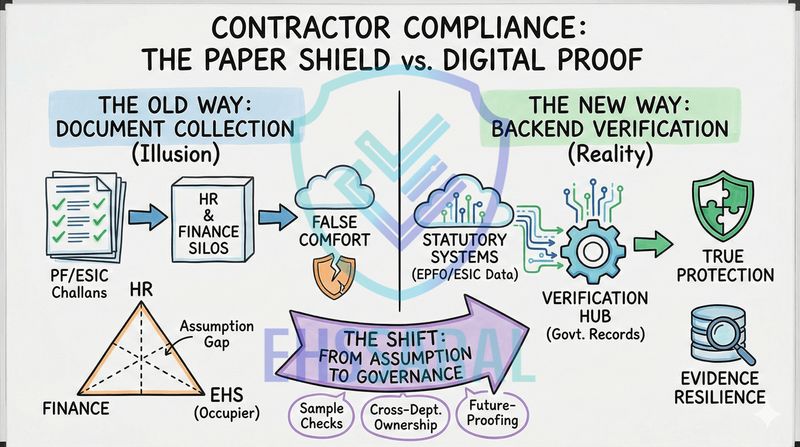
In most Indian factories, contractor bill clearance follows a well-rehearsed routine.
A PF challan is attached.
An ESIC challan is attached.
HR signs off.
Finance releases the payment.
The file looks complete.
Registers are updated.
Everyone moves on.
From the outside, compliance appears “done”.
This belief - that document collection equals compliance - is deeply embedded in how organisations operate. It is not laziness. It is habit, built over years when paperwork was the system of record.
And for long stretches of time, this approach works.
Until one day, it doesn’t.
A large automotive component manufacturer received an EPFO notice in 2024 for contractor dues from 2021–2023. The contractor had wound down operations in 2022. Internal files showed 42 challans, all approved. EPFO records showed 23 actual deposits. The gap? HR had verified formats. Finance had cleared bills. But no one had checked backend credits. The exposure: ₹38 lakhs + penalties
The illusion rarely breaks during normal operations.
It breaks under pressure.
At that moment, organisations realise something unsettling:
The challans were checked.
But the deposits were never verified.
This is not a story about incompetence or bad intent.
It is a story about systems mistaking paperwork for proof.
For a mid-sized contractor with 200 workers, unpaid PF/ESIC dues + penalties can easily exceed ₹15–20 lakhs. If the gap spans three years and includes interest, exposure climbs to ₹40–50 lakhs or more. And by the time the notice arrives, the contractor is often unreachable - but the liability is on your desk.
Under Indian labour laws, responsibility is structured clearly:
This liability does not disappear because:
From an enforcement perspective, authorities are not concerned with intent.
They are concerned with credit.
Did the money reach the statutory system or not?
If the answer is no, recovery powers extend to the Principal Employer - especially when the contractor is no longer traceable.
This is why liability often surfaces years later, when relationships have ended and memories have faded.
Many assume PF and ESIC are purely HR or Finance matters.
In practice, the exposure travels differently.
EHS professionals and Factory Managers often:
When compliance gaps surface, enforcement does not chase internal workflows.
It looks for the responsible person at the factory level.
This is why safety professionals and plant heads often inherit liabilities created far away from the shop floor.
Compliance is not departmental.
It is a single ecosystem.
When PF or ESIC issues emerge, the immediate assumption is fraud.
That assumption is usually incomplete.
What is seen far more often are process gaps, not criminal intent.
Some common patterns include:
From a document perspective, these challans often look perfectly acceptable.
They are stamped.
They are signed.
They match expected formats.
And that is precisely why they pass routine checks.
A challan PDF looks identical whether:
Formats do not change.
Visual cues do not warn you.
The document reflects what was intended.
The statutory system reflects what actually happened.
When organisations rely only on PDFs, they are trusting intention - not outcome.
That distinction rarely matters during day-to-day operations.
It matters enormously during audits.
Most internal contractor compliance systems were designed when:
Over time, statutory systems evolved:
What did not evolve at the same pace were internal clearance processes.
As a result, many organisations still operate with paper-era assumptions inside digital-era enforcement systems.
That mismatch is where exposure quietly builds.
Read Why Most Environmental Non-Compliance Is a System Failure, Not Intent by EHSSaral
Many professionals feel enforcement has suddenly become harsher.
In reality, it has become more visible.
Modern audits rely less on random sampling and more on:
Digital systems do not forget old periods.
They connect dots silently.
Gaps that went unnoticed earlier are now surfaced automatically - often years after the contractor relationship ended.
By this point, most experienced readers reach the same realisation:
“This is not about catching someone wrong.
It’s about whether our systems can prove compliance later.”
That realisation is uncomfortable - but necessary.
Because the biggest risk here is not fraud.
It is false comfort.
And false comfort lasts just long enough to create real liability.
Read more about Decoding the Factories Act 1948 by EHSSaral
Most organisations believe they are protected because they follow a checklist.
The checklist typically asks:
From an internal control perspective, this feels sufficient.
But these checklists answer only one question:
“Did we receive a document?”
They do not answer the more important question:
“Can we independently prove this deposit later?”
That distinction is subtle - and critical.
Checklists are designed to ensure collection discipline.
They are not designed to ensure evidence durability.
As long as enforcement relied on manual inspection and physical files, this distinction did not matter much. In a digital enforcement environment, it matters a great deal.
A checklist gives a sense of closure.
Once boxes are ticked, the file is closed and attention moves elsewhere. That psychological closure is powerful - and misleading.
The problem is not that checklists are wrong.
The problem is that they stop one step too early.
They assume that:
Those assumptions are no longer safe.
Here is the part that surprises many senior professionals:
The system of record already exists - and much of it is public.
PF and ESIC contributions leave backend trails inside statutory systems. These trails are not created by PDFs. They are created by actual credit events.
Verification does not require:
It requires knowing where truth lives.
Internal processes were built assuming documents were the final truth.
Statutory systems now operate assuming backend data is the truth.
Those two assumptions are no longer aligned.
EPFO and ESIC maintain transaction-level data tied to TRRNs, ECR filings, and establishment codes. If you know where to look, deposits can be independently traced - without logging into contractor accounts or needing their cooperation.
A challan PDF is a snapshot of intent.
It tells you:
It does not reliably tell you:
From an audit standpoint, this distinction is decisive.
When auditors compare backend records with internal files, they are not judging effort. They are checking outcomes.
That is why organisations with “perfect files” still face exposure.
A TRRN is generated the moment a transaction is initiated - even if payment fails minutes later. The challan PDF looks identical in both cases. Only backend records distinguish success from failure.
Verification often meets resistance because it is misunderstood.
Teams worry that it implies:
In reality, verification is about future-proofing, not fault-finding.
It is not about questioning people.
It is about strengthening systems.
Instead of asking:
“Did we check the challan?”
Ask:
“Can this challan be validated during an audit - without calling the contractor?”
That single question shifts behaviour.
It moves the organisation from:
Verification, when framed this way, becomes a governance function - not a policing activity.
This is where most silent exposure originates.
In many organisations:
Each function performs its role sincerely.
But no one owns end-to-end verification.
This creates an assumption loop:
The gap between these assumptions is where exposure hides.
This is the structural imbalance most organisations don’t notice.
The Occupier or Factory Manager - the person legally responsible - often:
Yet, when enforcement action arises, accountability travels upward - not sideways.
This is not a people problem.
It is a design problem.
Most professionals involved in contractor management are:
Expecting any one person to “catch everything” is unrealistic.
The issue persists because:
When no one is explicitly responsible for verification, everyone assumes it is happening somewhere else.
That assumption holds - until it doesn’t.
Without assigning blame, ask:
If two or more answers are “no”, you are not non-compliant.
You are exposed.
The good news is that exposure created by systems can be reduced by systems - once acknowledged.
For plant heads, EHS leaders, and occupiers, the implication is strategic.
Compliance is no longer about effort or intent.
It is about provability.
Strong organisations are not those with perfect paperwork.
They are those whose systems can answer calmly when questions arise years later.
That calm comes from structure - not memory.
Organisations that handle this risk well do not become suspicious of contractors.
They become structured.
The shift is subtle but decisive:
This is not about checking every challan, every month. That approach is neither practical nor necessary.
What mature organisations typically do instead:
This allows organisations to balance trust with diligence - without slowing down operations.
Factory Act & Compliance Thresholds for factory Headcount as per new Labour codes
A common concern raised internally is:
“Won’t this slow down bill clearance?”
In practice, the opposite usually happens.
Clear ownership and defined verification processes:
Instead of scrambling through old emails or chasing contractors who no longer exist, the organisation knows exactly what can be proven and how.
That confidence is not created by paperwork.
It is created by governance.
Some organizations verify 100% of challans for the first three months of a new contractor relationship, then shift to quarterly sampling for established vendors. Others flag contractors with sudden headcount changes or payment delays for targeted checks.
Many professionals assume digitisation will make compliance easier and reduce disputes.
Digitisation does simplify processes - but it also increases visibility.
Key shifts already underway:
Digital systems do not forget.
They quietly connect historical dots - even when organisations have moved on.
What was once invisible due to fragmented systems is now being surfaced automatically.
This is not stricter enforcement.
It is continuous visibility.
With systems like e-Shram and Unified Labour Portals under development, multi-year, cross-employer compliance trails are becoming the norm - not the exception.
Every PF and ESIC transaction leaves a footprint.
That footprint persists even when:
In earlier years, time diluted exposure.
In the digital era, time amplifies it.
This is why organisations relying solely on document collection often feel blindsided when issues surface years later.
The system remembers what people don’t.
Without assigning blame, ask honestly:
If two or more answers are “No”, you are not alone.
Most organisations operate this way.
The difference lies in whether this gap is acknowledged early - or discovered through a notice.
For EHS professionals and Factory Managers, this issue is not abstract.
They are often the ones who:
When systems fail elsewhere, liability lands at the factory gate.
Understanding this risk does not mean stepping into Finance’s role.
It means ensuring that compliance systems across HR, Finance, and EHS speak the same language - proof, not paper.
Most compliance failures are process failures, not intent failures.
The real question is not:
“Did we want to comply?”
The real question is:
“Can our systems prove that we did - years later?”
Paperwork creates comfort.
Proof creates protection.
Organisations that understand this early rarely panic later.
No. Collecting challans only confirms that a document exists.
Compliance is established only when the actual contribution is credited in the EPFO/ESIC system. Audits focus on deposits, not paperwork.
Under PF and ESIC laws, the Principal Employer has joint liability if contributions were not deposited - regardless of whether contractor invoices were cleared or challans were submitted.
Payment to the contractor does not transfer statutory responsibility.
Most cases arise during:
Because digital systems retain historical transaction data, gaps from earlier years become visible later.
In many cases, the issue is not deliberate fraud.
More often, challans are:
They look genuine on paper but do not reflect actual deposits.
Most checklists are designed for document collection, not backend verification.
They confirm that challans were received - not that money was credited. This creates false comfort until an audit occurs.
Yes.
EPFO and ESIC maintain transaction-level records that can be independently cross-checked using references such as TRRNs, ECR filings, and establishment details.
Verification does not require access to contractor accounts.
EHS and Factory Managers often act as the Occupier and represent the site during inspections.
When compliance gaps surface, liability typically lands at the factory level, even if the process failure originated elsewhere.
For a mid-sized contractor (150–200 workers), unpaid dues plus penalties and interest can easily exceed ₹15–20 lakhs for a single year.
If gaps span multiple years, exposure can rise to ₹40–50 lakhs or more.
No.
Many mature organisations follow:
The goal is evidence durability, not distrust.
Because compliance enforcement is becoming data-driven.
With interconnected labour databases, long-term transaction storage, and retrospective analytics, gaps that were invisible earlier are now automatically flagged - even years later.

Founder, EHSSaral
Founder - EHSSaral | Partner - Perfect Pollucon | ISO 14001 Lead Auditor | GHG Protocol Scope 2 | Chemist | Data Scientist | Second-generation environmental professional simplifying EHS compliance for Indian industries through practical, automated, tech-enabled, data driven compliance workflows.
50 mg/Nm³ Emission Limit in India: Is Your Chimney Ready? (SME Guide)
SPCB Consent Conditions: Common Compliance Mistakes Explained | EHSSaral
Environmental Compliance Data for BRSR & GRI Reporting in India | EHSSaral Research

Noise Monitoring in Factories Workplace vs Boundary (India Guide) | EHSShala

Hazardous Waste Management Software India | EHSSaral
Form V Late Filing Penalty: Steps After 30 September
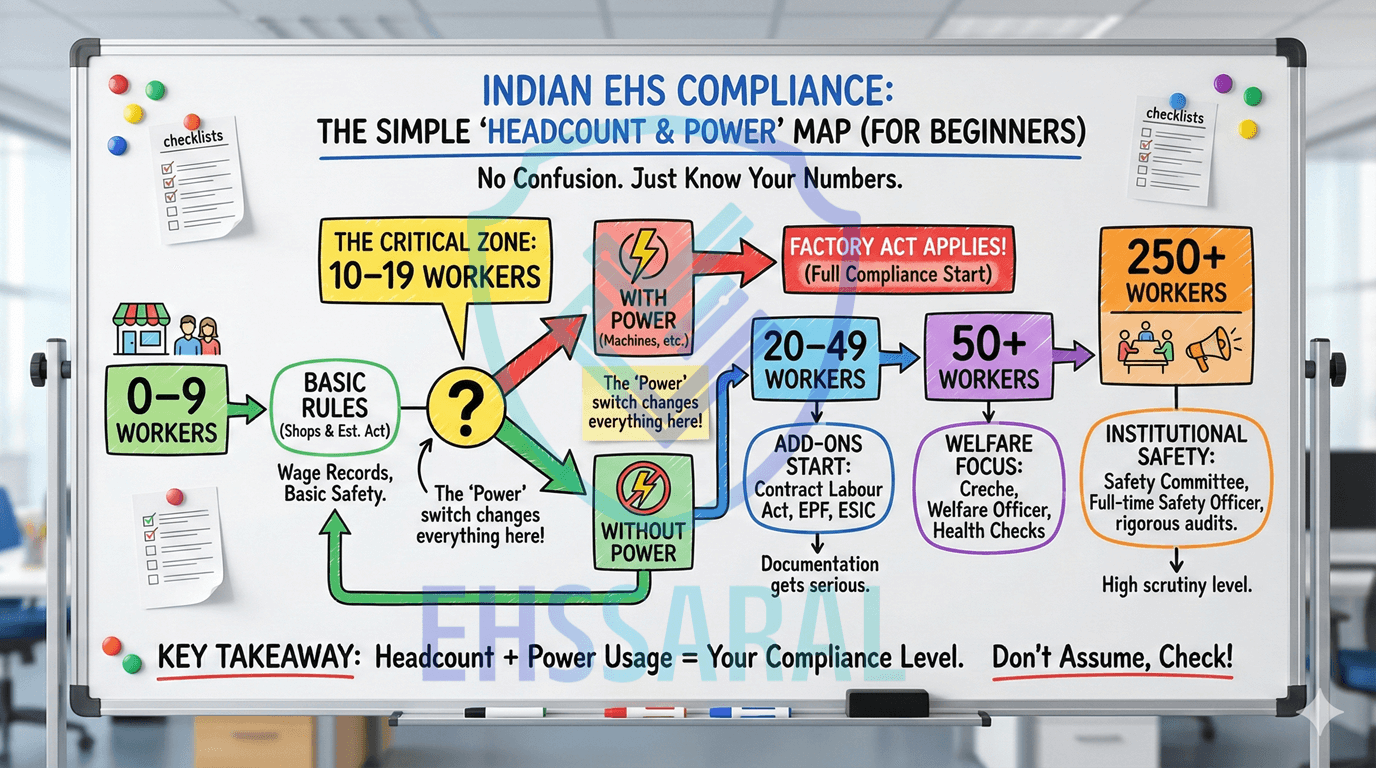
Factory Act & Compliance Thresholds: What Applies to Your Headcount? | EHSSaral
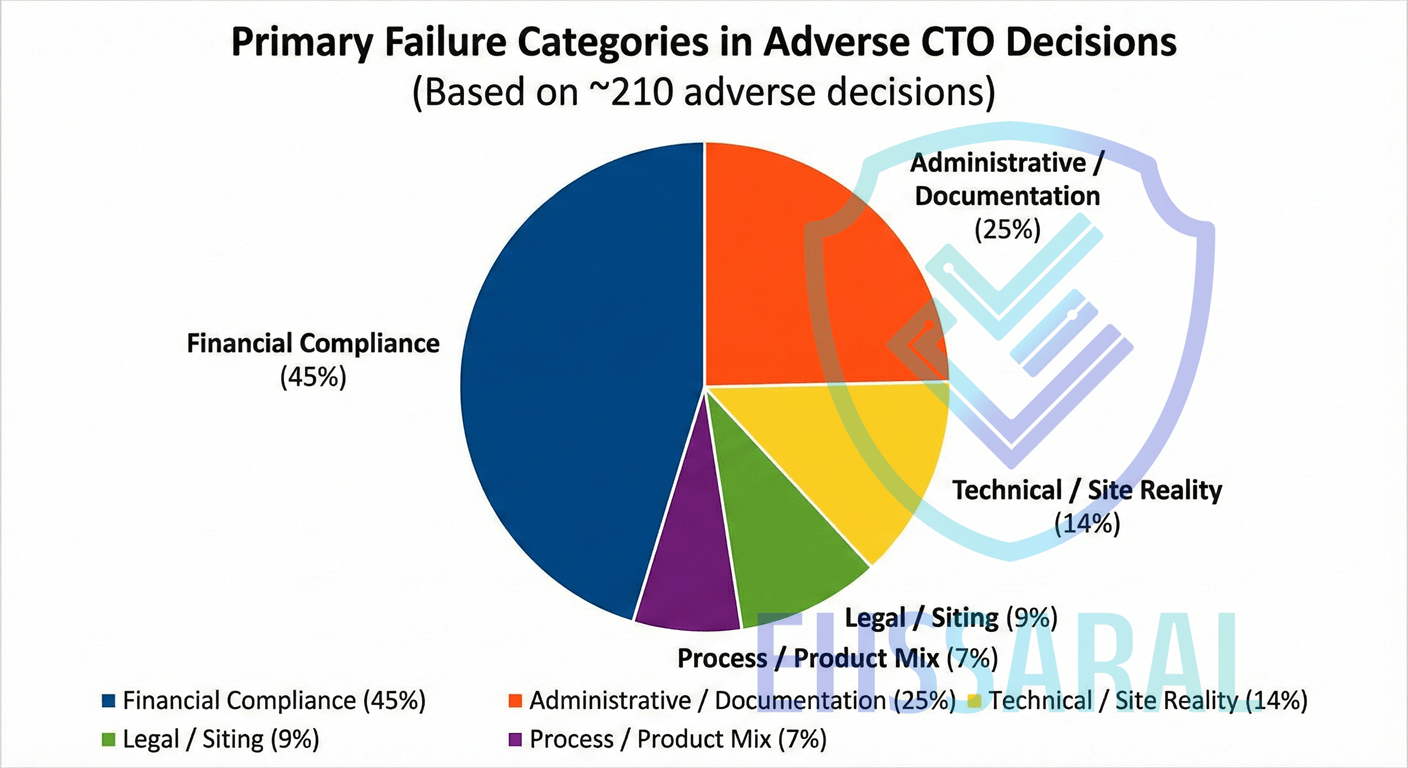
MPCB CTO Refusal Patterns in Maharashtra (2023–2025) Analysis | EHSSaral Research

MSME Supply Chains & BRSR 2026: Where Compliance Breaks | EHSSaral
 EHSSaral.webp)
Environmental Monitoring Mistakes in Indian Factories (Real Issues Explained)