
EHSShala
Calibration & QA/QC in Environmental Monitoring Guide | EHSShala
EHSSaral is an Environmental Compliance Intelligence Platform for Industries. Consent Intelligence • Alerts & Tasks • Incident Reporting • Form IV & V • Audit-Ready Records
See how EHSSaral works
8 Sep 2026
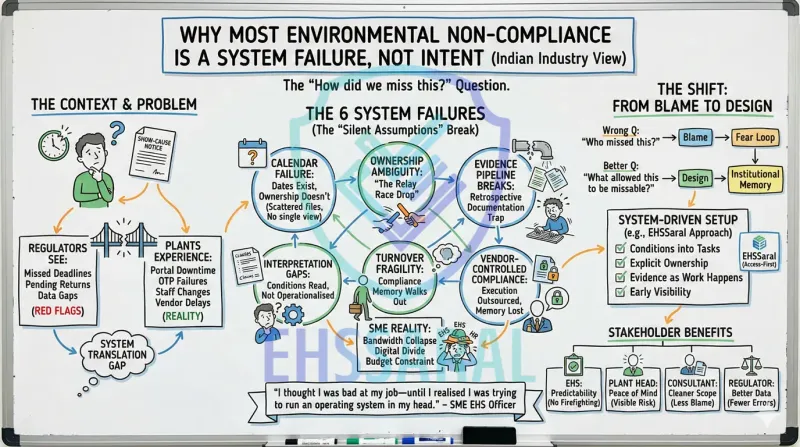
A practical look at recurring and unintentional compliance gaps in Indian plants
Environmental non-compliance occurs when an industry does not meet an applicable environmental law, consent or authorisation condition, prescribed standard, reporting requirement or waste-management obligation.
In day-to-day industrial operations, non-compliance can take several forms:
| Type of non-compliance | Practical example |
|---|---|
| Permission-related | Operating without a valid Consent to Operate or required authorisation |
| Operational | Effluent, stack emissions or other parameters exceeding prescribed limits |
| Infrastructure-related | Pollution-control equipment not being installed, maintained or operated as required |
| Waste-related | Improper storage, transportation, recordkeeping or disposal of hazardous waste |
| Reporting-related | Missing a return, monitoring submission, renewal or regulatory clarification |
| Evidence-related | Being unable to substantiate reported figures or completed compliance activities |
The consequences depend on the applicable law, consent condition, seriousness, duration and environmental impact. They may include clarification or show-cause proceedings, corrective directions, environmental compensation, consent-related action or operational restrictions in more serious cases.
This article focuses mainly on recurring and unintentional non-compliance caused by gaps in dates, ownership, evidence, handovers and visibility. It does not suggest that every environmental violation is administrative or accidental.
In many Indian plants, a compliance gap is not discovered at the moment it begins.
It surfaces later:
Only then does someone ask:
“How did we miss this?”
Sometimes the answer is technical or operational. A treatment system may not have performed as expected, a monitoring result may have exceeded the limit, or waste may not have been handled according to the applicable condition.
But many recurring and unintentional failures begin elsewhere. The obligation was known, yet it was not converted into a task. The report was prepared, but nobody confirmed submission. The activity was completed, but the supporting evidence remained in an employee’s inbox.
These are not minor concerns. A procedural or documentary gap can lead to regulatory clarification, inspection scrutiny, delayed approvals or difficulty demonstrating that the plant acted correctly.
Over the years, we have seen that such failures are rarely caused by one isolated mistake. They usually emerge from a combination of weak ownership, fragmented records, missed follow-ups and dependence on individual memory.
The purpose of this article is to examine those underlying system failures—not to excuse non-compliance, blame industry or criticise regulators.
Understanding how a gap developed is necessary before the plant can prevent it from recurring.
Most environmental compliance systems in India operate on an unspoken assumption:
“Someone is tracking this.”
Someone knows when the consent expires.
Someone remembers the quarterly submission.
Someone will follow up with the lab.
Someone has uploaded the report.
Someone has the proof ready.
In practice, that “someone” is rarely a system.
It is usually:
As long as that person is present, responsive, and uninterrupted, compliance appears to work.
The problem begins when reality interferes.
People change roles.
Consultants change staff.
Emails are missed.
Portals behave unpredictably.
Priorities shift during production pressure.
At that point, compliance does not fail loudly.
It fails quietly.
This is where confusion usually starts.
Many plants maintain physical files containing consent copies, laboratory reports, manifests, correspondence and old acknowledgements. These records remain useful and, in some situations, may be required during reviews or inspections.
The limitation is that a physical file usually shows what has already happened. It may not clearly show:
Online portals create an additional layer. A letter may exist in the plant’s file, but the corresponding application or clarification may still appear pending in the regulatory system.
From a practical standpoint, plants increasingly need both: properly maintained records and a current digital view of obligations, submissions and unresolved actions.
If compliance depends mainly on one person’s memory, inbox or physical file, the weakness lies in the continuity of the process.
To understand why this gap persists, it is important to acknowledge both sides of the table.
From a regulator’s perspective, the picture is straightforward.
They see:
On paper, these look like clear failures.
Inside plants, the experience is often very different.
EHS officers deal with:
A common situation looks like this:
A plant sends a letter or uploads a reply. Internally, the team considers the matter addressed. However, the portal continues to show “Pending Clarification,” or the team does not retain a clear acknowledgement of successful submission.
From the plant’s perspective, action was taken. From the regulator’s available record, the matter may still appear unresolved.
Regulators ordinarily have to act on the applications, measurements, records and portal status available to them. Internal effort that is not reflected in the official record may be difficult for an authority to recognise.
This creates a gap between three different stages:
Work completed → Submission made → Closure confirmed
Many compliance processes track the first stage but do not confirm the second and third.
The practical lesson is simple: sending a document is not the same as confirming its receipt, acceptance or closure. A dependable process should preserve the submitted document, date, acknowledgement, current status and any subsequent communication.
Read more about Why Safety Compliance Alone Fails in Indian Factories
When environmental non-compliance is examined closely, it rarely traces back to a single mistake. Instead, it emerges from recurring patterns-small, predictable breakdowns that compound over time.
Across Indian plants, these breakdowns tend to fall into six broad system failures.
Most compliance obligations are time-bound.
Consent renewals.
Returns.
Sampling frequencies.
Annual submissions.
And yet, in many plants, these dates live in scattered places:
What is often missing is a single, living compliance calendar that converts conditions into actionable tasks.
A single consent can contain numerous general and specific conditions. Once monitoring frequencies, submissions, renewals, recordkeeping and evidence requirements are separated, the document may translate into many recurring actions during the year.
When this translation never happens, deadlines are not missed-they are simply never seen.
This is why many EHS officers say:
“We knew the consent was valid, but we didn’t realise this submission was due.”
Validity is not readiness.
Dates without ownership are invisible risks.
Read more Transforming SME Compliance: Zero Surprise Failures in India
Environmental compliance in India often works like a relay race.
The consultant prepares the report.
The lab conducts the analysis.
The EHS officer coordinates documents.
Management assumes it is done.
Somewhere between “prepared” and “submitted,” the baton drops.
The consultant assumes the plant uploaded the report.
The plant assumes the consultant did.
Both parties may believe the other person owns the final step. The report is ready, but the portal still shows “Not Submitted.”
The problem is unclear handover design. When responsibility is implied rather than assigned, completion depends on memory, availability and follow-up.
Every recurring obligation should therefore have a named owner, a reviewer where appropriate, a due date and a clear definition of completion.
Environmental compliance is evidence-driven.
Sampling → Report → Upload → Record → Retrieval
When this pipeline works in real time, compliance feels routine.
When it breaks, the damage is rarely immediate.
A lab sends the report late.
The email goes to an old ID.
The EHS officer has changed.
The file sits on someone’s desktop.
Months later, during inspection or review, the question arises:
“Where is the proof?”
At this stage, the plant may have to reconstruct the compliance trail using contemporaneous evidence such as laboratory reports, invoices, manifests, emails, photographs and portal acknowledgements.
That exercise is time-consuming and may still leave unanswered questions. Records should not be created or backdated merely to fill a historical gap.
A stronger system captures evidence as the work happens and links it to the relevant obligation. This makes later verification easier for the plant, consultant, auditor and regulator.
Consent conditions are often read once-when the document is issued or renewed.
After that, they sit quietly in a file.
What is rarely done is operational translation:
Without this translation, conditions remain abstract.
This is why EHS officers often say:
“We didn’t realise this clause required periodic action.”
The condition was there.
The system to act on it was not.
For example:
A consent expires in March. The EHS officer is on medical leave during the preparation period, while the reminder remains in an individual email account. The consultant assumes the plant will initiate the process, and the plant assumes the consultant is tracking it. By the time the team reconnects, the application is late and may require additional explanation, fees or regulatory handling, depending on the applicable process.
The medical leave did not create the compliance weakness. It merely exposed a process that depended on one person being continuously available.
One of the most uncomfortable truths in Indian industry is this:
In many plants, environmental compliance lives in one person’s head.
When that person leaves-through resignation, transfer, or extended absence-the compliance system does not degrade gradually. It collapses suddenly.
Files and archived emails may still exist, but the context behind them often disappears: why a condition mattered, which submission needed follow-up and where the supporting records were maintained.
Why a condition mattered.
Which vendor was reliable.
Which submission needed follow-up.
This is the difference between individual memory and institutional memory.
Systems retain memory.
People carry it.
When compliance depends on people alone, turnover becomes a regulatory risk-not because the new person is incompetent, but because the system never existed.
Consultants and laboratories play a critical role in environmental compliance. They execute specialised tasks that plants cannot easily handle internally.
Problems arise when execution is outsourced, but memory is also outsourced.
When:
Both sides become vulnerable.
The plant loses oversight.
The consultant becomes a single point of failure.
This is not about competence or intent.
It is about ownership of continuity.
Consultants execute tasks.
Systems retain accountability.
When the two are confused, compliance becomes dependent on relationships rather than structure.
These six failures rarely appear alone.
They stack.
A missed calendar leads to rushed ownership.
Rushed ownership leads to missing evidence.
Missing evidence triggers retrospective fixes.
Retrospective fixes attract scrutiny.
By the time a notice arrives, the system has already failed multiple times-quietly, predictably, and without intent.
For units operating across states, the system failures multiply: different state portals, different renewal cycles, different clarification processes-all managed by the same lean team.
Small and mid-sized industries are not necessarily less serious about environmental compliance. Their difficulty is often limited organisational bandwidth.
In many plants, one person coordinates several responsibilities:
Environmental obligations therefore compete with breakdowns, labour issues, urgent purchases, customer visits and daily production demands.
A second difficulty is the transition from paper-based working to portal-based compliance. A reply may have been prepared and sent, but the portal may still show a pending status. A physical acknowledgement may exist, while the supporting digital record is difficult to retrieve.
Budget constraints also influence how compliance is organised. Immediate operational expenses are visible, while the value of a compliance-management system may become apparent only after a deadline, record or handover is missed.
For SMEs, the practical objective is not to create a large compliance department. It is to build a simple structure that continues working when one employee is absent, a consultant changes or an urgent production issue takes priority.
A clear calendar, named ownership, central evidence storage and periodic management review can substantially improve continuity without adding unnecessary complexity.
For a broader implementation approach, see Environmental Compliance Technology for Indian SMEs.
Enforcement plays an essential role in environmental protection and accountability. Notices, inspections, directions and other regulatory measures help identify non-compliance and require corrective action.
However, enforcement alone may not correct the internal process that allowed the failure to occur.
A notice can identify that a return was missed. It cannot automatically create a compliance calendar.
A direction can require submission of missing information. It cannot decide who will own that obligation during the next reporting cycle.
A penalty can demonstrate the seriousness of a lapse. It cannot restore records that were never centrally maintained.
If the plant responds only to the immediate observation, compliance may improve temporarily. The same weakness can return during the next renewal, employee transition or reporting period.
A complete response should therefore address two levels:
Where a specific non-compliance has already been identified, a documented root-cause and corrective-action process can help distinguish the immediate correction from the longer-term system improvement.
Read: Environmental Non-Compliance Investigation: Process, RCA and Corrective Action
After a compliance failure, the first question is often:
What made this obligation easy to miss?
Individual accountability may need to be examined, but that question alone rarely prevents recurrence.
A second question is equally important:
“What made this obligation easy to miss?”
This changes the investigation from a search for one responsible person into a review of the complete process.
A resilient compliance system does not assume uninterrupted availability. It expects that employees may change, vendors may rotate, portals may malfunction and production priorities may shift.
Accountability remains important. The difference is that a well-designed process makes accountability visible, transferable and verifiable.
A system-driven setup does not necessarily require more people or more paperwork. It requires fewer assumptions.
| Common weakness | Practical control |
|---|---|
| Conditions remain buried in documents | Convert each recurring condition into a trackable obligation |
| Deadlines depend on memory | Maintain a live calendar with reminders and escalation |
| Ownership is unclear | Assign an owner and, where required, a reviewer |
| Evidence remains in emails or folders | Link proof directly to the relevant task or record |
| Submission is assumed complete | Preserve acknowledgement and confirm current status |
| Knowledge leaves with an employee | Maintain central history, notes and handover records |
| Management learns about gaps late | Review pending tasks, missing evidence and upcoming deadlines periodically |
The objective is not perfect paperwork. It is early visibility.
When a missing report or delayed action is visible before the due date, the team still has time to respond. When it becomes visible only during an inspection or after a notice, the same gap becomes harder to explain and correct.
EHSSaral is designed around this operating logic:
The platform does not replace the judgement of an EHS professional, consultant or plant manager. It provides the structure needed to preserve continuity when people, documents and priorities change.
A useful starting exercise is to take one consent, map every recurring condition, assign an owner and check whether the related evidence can be retrieved within ten minutes. The gaps revealed by this exercise usually show where the compliance process needs strengthening.
Explore how EHSSaral supports environmental compliance workflows
| Stakeholder | Practical improvement |
|---|---|
| EHS officers | Less dependence on memory, fewer last-minute follow-ups and clearer proof of completed work |
| Plant heads and occupiers | Earlier visibility into pending obligations, missing records and recurring risk areas |
| Environmental consultants | Clearer division of responsibility and easier access to client information |
| Management | A more reliable view of compliance status instead of verbal assurance alone |
| Regulators and auditors | More consistent records, clearer submissions and faster retrieval of supporting evidence |
The benefit is not that compliance problems disappear completely. The benefit is that emerging gaps become visible while there is still time to investigate and respond.
Environmental non-compliance does not have one universal cause.
Some cases arise from technical exceedances, inadequate pollution-control arrangements or incorrect operational decisions. Others begin with administrative gaps: a missed deadline, unclear ownership, incomplete evidence, an unresolved portal status or a poor handover.
The second category is particularly preventable because it usually leaves a visible pattern before the actual failure:
A dependable system connects the obligation, owner, due date, activity, evidence, submission and final status.
Good professionals remain essential. The system ensures that their work does not disappear when someone is absent, changes roles or leaves the organisation.
Clarity at the process level helps prevent confusion later. Good compliance begins when every important obligation can be understood, assigned, completed and demonstrated.

Founder, EHSSaral
Founder - EHSSaral | Partner - Perfect Pollucon | ISO 14001 Lead Auditor | GHG Protocol Scope 2 | Chemist | Data Scientist | Second-generation environmental professional simplifying EHS compliance for Indian industries through practical, automated, tech-enabled, data driven compliance workflows.
Calibration & QA/QC in Environmental Monitoring Guide | EHSShala
Why Form IV Filing Becomes Difficult for Indian EHS Teams: A Field-Level Analysis
Environmental Incident Response Guide for Indian EHS Professionals | EHSShala
BRSR Core 2026: Why Compliance Automation Is Now Mandatory | EHSSaral
SWM Rules 2026: Is Your Factory a Bulk Waste Generator? | EHSSaral
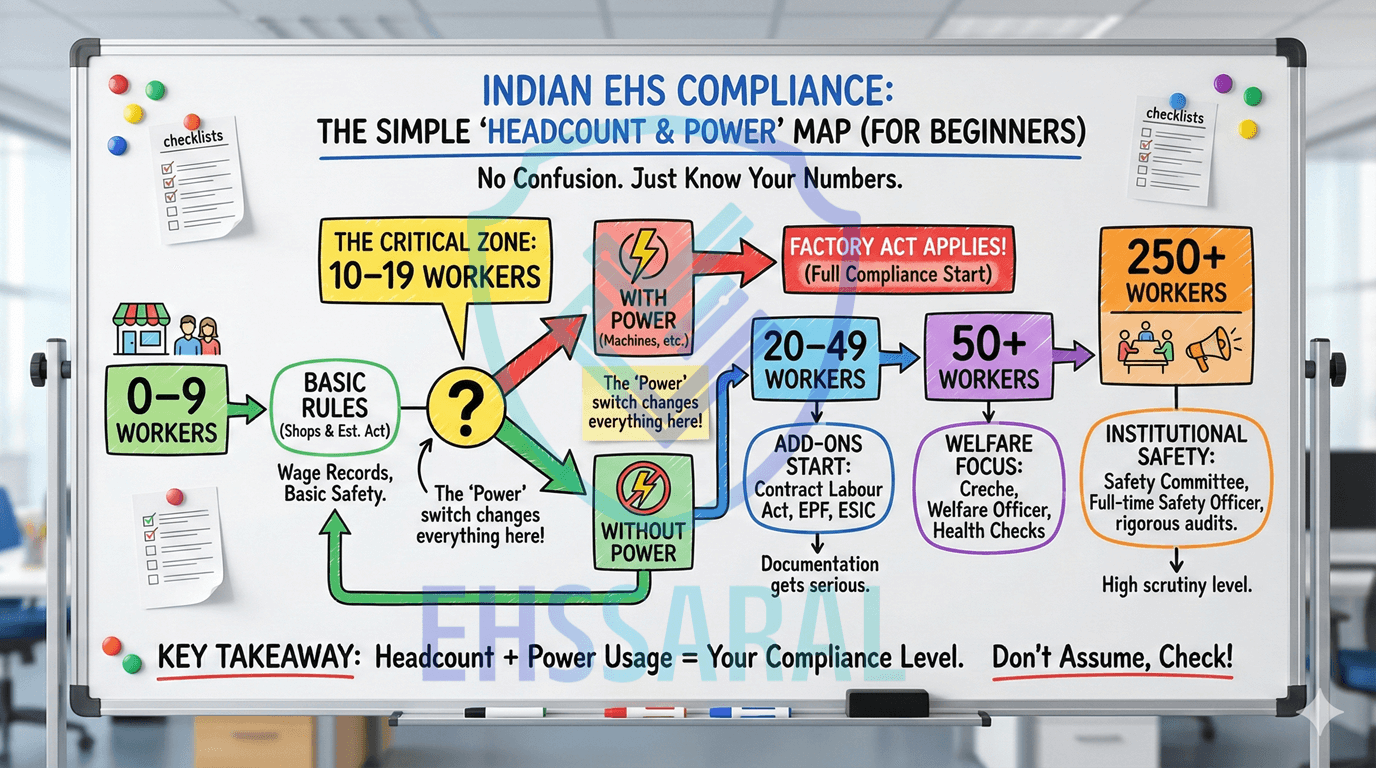
Factory Act & Compliance Thresholds: What Applies to Your Headcount? | EHSSaral
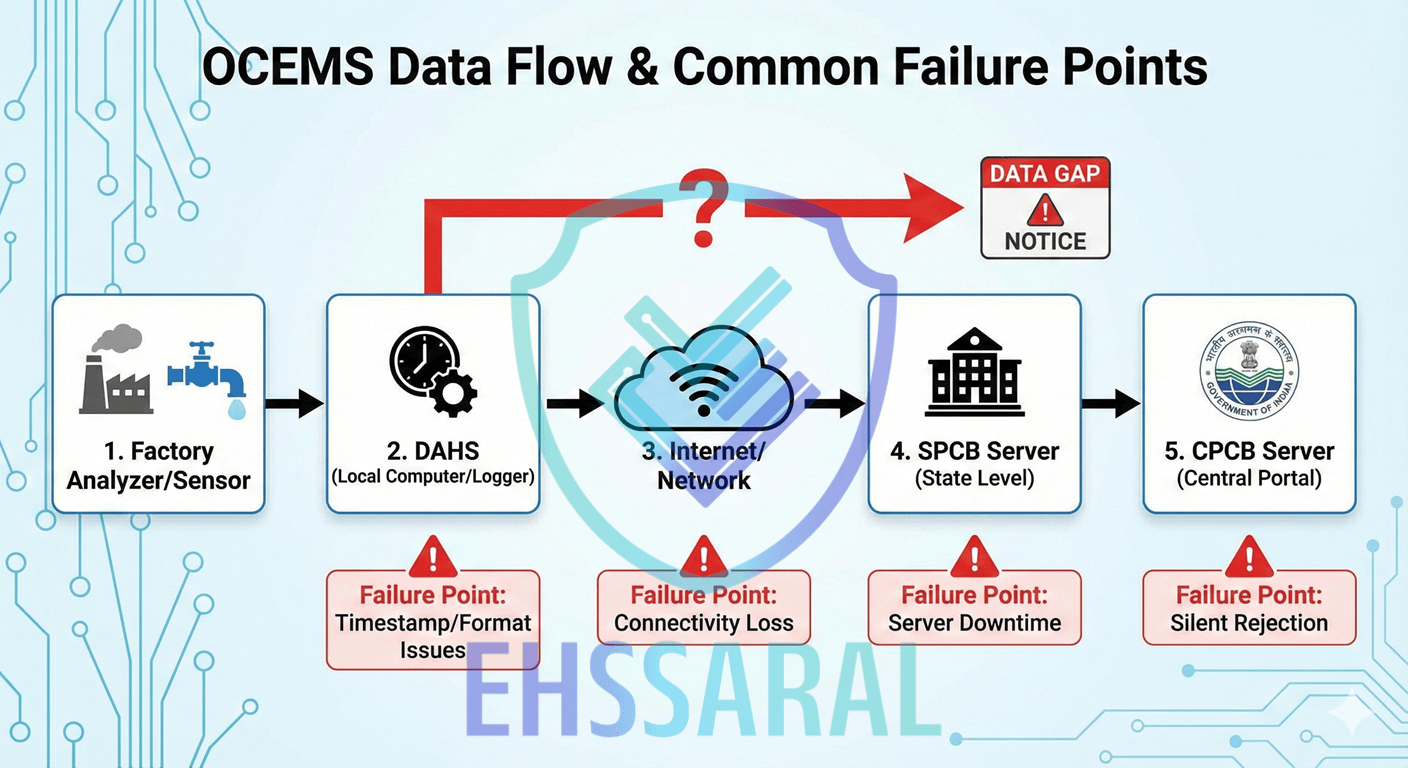
OCEMS Data Gaps Explained: Why CPCB Rejects Data & How to Fix | EHSSaral
 EHSSaral.webp)
Environmental Monitoring Mistakes in Indian Factories (Real Issues Explained)

Industrial Siting Criteria in India: Factory Location Guide
MSIHC Rules, 1989: Practical Guide for Indian Factories