

EHSShala
Consent to Establish (CTE) Explained: Process, Documents, Rules & Common Mistakes | EHSShala
EHSSaral is an Environmental Compliance Intelligence Platform for Industries. Consent Intelligence • Alerts & Tasks • Incident Reporting • Form IV & V • Audit-Ready Records
See how EHSSaral works
8 Jun 2026
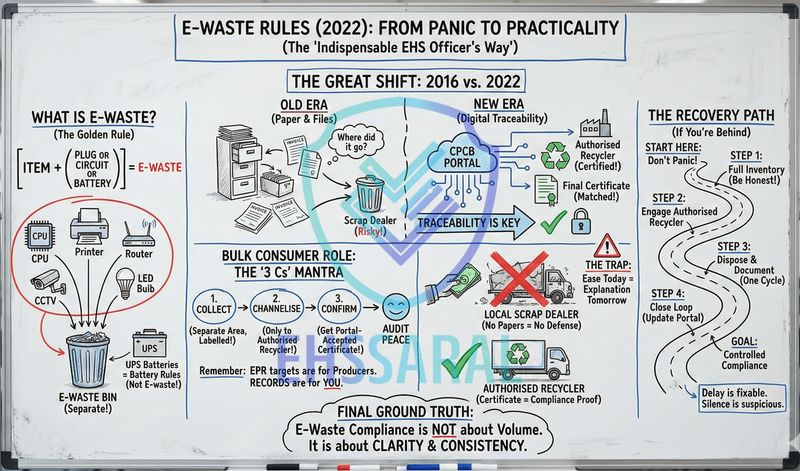
Let’s start with honesty.
Most e-waste non-compliances in Indian factories and offices are not intentional violations.
They are not done to save money or break rules.
They happen quietly.
Across many sites, the pattern is the same:
equipment becomes old
a new system is installed
the old system is kept “temporarily”
staff changes happen
responsibility becomes unclear
Over time, the equipment stops being “temporary”.
It becomes invisible.
Then one day:
an auditor asks
a Consent renewal is filed
an inspection happens
And suddenly, everyone is searching for answers.
This guide exists because:
panic helps nobody
fear leads to wrong decisions
most problems are fixable if handled calmly
This is not a rulebook.
This is how e-waste compliance actually works on ground.
“Most e-waste problems don’t start on inspection day.
They start months or years earlier with small assumptions.”
Before reading further, take 10 minutes and check this honestly at your site.
Ask yourself:
Do we clearly know what items are treated as e-waste here?
When was the last authorised e-waste disposal done?
Do we have recycler certificates, or only invoices?
Is e-waste stored separately, or mixed with general scrap?
Are there old electronic items lying unused in stores or cabins?
If one or two answers feel uncomfortable, that is normal.
Most EHS officers realise gaps only when they ask these questions.
This guide is meant to help you close those gaps before they turn into inspection issues.
Forget complicated definitions.
Use one simple, practical rule.
“If it has a plug, a circuit, or a battery - treat it as e-waste.”
This rule works because it is:
easy to remember
easy to explain to supervisors
safe during inspections
In real factories and offices, e-waste usually includes:
desktop computers, CPUs, laptops
printers, scanners, photocopiers
routers, modems, networking equipment
CCTV cameras, DVRs, access control systems
servers, data storage units
PLC panels and electronic control systems
UPS systems and stabilisers
LED bulbs and tube lights
Sometimes auditors or seniors ask, “Which category is this e-waste?”
Don’t get stressed.
These are the broad buckets people commonly use:
| Category | What it Usually Includes |
|---|---|
| IT & Communication Equipment | Computers, laptops, servers, routers |
| Office Electronics | TVs, audio systems |
| Lighting Equipment | LED bulbs, tube lights |
| Electrical Tools | Drills and small electrical tools |
| Control & Automation | PLCs, sensors, control panels |
| Other Equipment | UPS, stabilisers, CCTV systems |
You don’t need to memorise this.
Use it only when you want to explain clearly in audits.
Many people still associate e-waste only with computers, printers, and office electronics.
In reality, the scope of e-waste has expanded significantly over the years.
Today, a much wider range of electrical and electronic equipment can fall under the e-waste management framework.
This is one reason why old internal procedures sometimes become outdated.
When a new type of equipment reaches the end of its life, avoid making assumptions.
Document the item, verify its classification, and ensure disposal is routed through the correct channel.
"The list of equipment may evolve.
Good record-keeping principles do not."
Many of these items are missed during internal checks because:
they are small
they are not “dirty waste”
they are stored neatly
But inspectors look at function, not appearance.
If an item once handled electricity or data, it raises a question.
Some items always create debate during inspections.
It helps to be clear in advance.
LED bulbs and tube lights
These are treated as e-waste. They should not go into general waste.
UPS batteries
These fall under battery waste rules, not e-waste. They must be handled separately.
Old electrical panels with no electronics inside
These may be treated as scrap, but your decision should be documented clearly.
The goal is not to guess what the inspector thinks.
The goal is to show that:
you have thought about it
you have classified items consciously
you have records to support decisions
“Clarity with documentation protects better than assumptions.”
E-waste is rarely ignored intentionally.
It is ignored because:
it does not smell
it does not leak
it does not look dangerous
it does not create daily operational issues
So it gets lower priority than:
hazardous waste
effluent
air emissions
But during inspections, e-waste becomes visible because:
it is easy to verify
it is easy to count
it shows record discipline
Many inspections don’t go bad because of pollution.
They go bad because of missing records and unmanaged stores.
This is where most confusion begins.
Most factories, offices, warehouses, IT parks, commercial buildings, and corporate offices fall under Bulk Consumer.
In simple terms, being a Bulk Consumer means:
you use electrical and electronic equipment in bulk
you generate e-waste through usage, not manufacturing
As a Bulk Consumer, your responsibility is very specific:
hand over e-waste only to authorised recyclers
maintain proper disposal records
ensure traceability of disposal
You are not responsible for:
recycling targets
recovery percentages
national EPR calculations
Many EHS officers panic when they hear the word EPR.
Remember this line clearly:
“EPR belongs to producers.
Records belong to you.”
Your role is safe storage, authorised handover, and documentation.
Nothing more is expected from you.
The 3C Rule for E-Waste Compliance
To remember your responsibility, use 3 Cs:
• Collect e-waste separately
• Channelise only to authorised recycler
• Confirm disposal certificate
If these three are done, e-waste compliance is under control.
Miss one C, and questions start.
One of the most common questions is:
"Do the E-Waste Management Rules, 2022 apply to us?"
In most cases, the answer is yes if your organisation uses electrical or electronic equipment and generates e-waste.
These rules commonly apply to:
If your site uses items such as computers, printers, servers, CCTV systems, networking equipment, PLCs, UPS systems, or electronic control panels, e-waste will eventually be generated.
For most factories and offices, the important question is not whether the rules apply.
The important question is:
"How will we store, document, and dispose of e-waste when it arises?"
That is where most compliance gaps occur.
During inspections or audits, officers usually want answers to simple questions:
Where is e-waste stored?
When was it last disposed?
Who took it?
Do you have proof?
They are not expecting:
legal interpretations
rule numbers
policy debates
They are checking whether:
the site is in control
waste movement is traceable
records match reality
If you understand your Bulk Consumer role clearly, these questions become easy to answer.
In many factories:
e-waste is present
but nobody “owns” it
IT says it is EHS responsibility.
EHS says it is IT responsibility.
Stores say it is scrap.
This gap creates silence.
Silence creates risk.
This guide is meant to help you own the process calmly, without fear or confusion.
You don’t need to remember rule numbers.
You only need to understand what changed in practice.
Earlier, e-waste compliance was mostly:
file based
paper driven
localised
Many units handled it quietly:
scrap sale once in a few years
basic invoice filed
issue forgotten
After 2022, the system shifted.
Now the focus is on:
traceability
authorised handover
digital records matching physical reality
The rule change did not make compliance impossible.
It made gaps visible.
That is the real shift.
Many people search “e-waste policy 2025”.
In most cases, they are not referring to a new law.
They are referring to the same E-Waste Management Rules, 2022, but with more digital tracking and stricter follow-up.
In simple words:
earlier, gaps stayed hidden in files
now, gaps show up because records are checked digitally
For factories and offices (bulk consumers), the expectation is still the same:
store e-waste separately
handover only to authorised recycler
keep certificates and records clean
“In 2025, the rule may not feel new.
The checking feels tighter.
Many people search for:
In practice, most amendments and notifications focus on:
For factories and offices acting as Bulk Consumers, the core expectations remain largely unchanged:
This is why many organisations do not need to redesign their entire compliance system whenever a new notification is issued.
The fundamentals remain the same.
"Notifications may change processes.
Good record keeping rarely goes out of date."
Recent CPCB updates introduced pricing guidelines for EPR certificates generated through authorised recycling activities.
These mechanisms mainly affect:
The pricing framework was introduced to improve transparency and stability within the EPR ecosystem.
For most factories and offices acting as Bulk Consumers, day-to-day responsibilities remain unchanged.
You are still expected to:
Understanding EPR certificate pricing is useful from an industry perspective, but it does not change how Bulk Consumers manage e-waste on site.
Under the current system:
authorised recyclers upload disposal details
disposal reflects in digital records
annual returns depend on these entries
This means one thing for factories and offices:
“If disposal is not accepted digitally,
physical papers alone may not protect you.”
This is where many EHS officers get stuck.
They have:
an invoice
a gate pass
a pickup record
But during renewal or audit, the question comes:
“Is this reflected in the system?”
That gap creates stress.
This needs to be said clearly.
A scrap or vendor invoice is not compliance proof.
What actually matters:
authorised recycler certificate
quantity mentioned
date of disposal
category of e-waste
Inspectors rarely ask:
how much money you received
They usually ask:
who took the waste
was the recycler authorised
do you have proof
“Money proves a transaction.
Certificate proves compliance.”
Many people ask this question because they have old SOPs from 2016.
Here is the simple difference.
| Aspect | 2016 Rules (Earlier Reality) | 2022 Rules (Current Reality) | Why Factories Feel the Change |
|---|---|---|---|
| Overall approach | Disposal-focused | Traceability-focused | Disposal alone is no longer enough |
| Coverage of items | Limited categories | Much wider list of equipment | More items now fall under e-waste scrutiny |
| Bulk consumer role | Often unclear or loosely enforced | Clearly defined and checked | Factories are now directly questioned |
| Records expected | Physical files sufficient | Physical + digital consistency | Paper-only records raise queries |
| Recycler importance | Secondary | Central to compliance | Recycler actions affect your compliance |
| Proof of compliance | Invoice often accepted | Certificate + digital acceptance required | “Invoice filed” mindset no longer works |
| System of control | Manual, local | Centralised digital systems | Gaps surface automatically |
| Inspection experience | Explanation-based | Verification-based | Answers must match records |
| Penalty exposure | Indirect, case-based | Specific environmental compensation | Poor records now have clearer consequences |
For factories and offices, the biggest shift is not new work.
It is better record discipline.
During Consent to Operate renewal or audit, checking usually happens in this order:
Last disposal date
Quantity disposed
Name of recycler
Certificate availability
Storage condition at site
If one of these is unclear, questions start.
This is not harassment.
This is verification.
If an Inspector Asks Tomorrow (Quick Recall)
Most inspections revolve around three questions:
Where is your e-waste stored?
When was it last disposed?
Who took it, and do you have proof?
If you can answer these calmly with records,
most inspections move on.
On ground, disposal is rarely perfect.
The usual flow looks like this:
Old or damaged equipment identified
Kept aside in store or IT room
Internal approval taken
Recycler contacted
Pickup scheduled
Certificate awaited
Problems usually occur at step 6.
The pickup happens.
The certificate is delayed.
People relax.
Months later, during audit, panic begins.
Many factories and offices store e-waste for:
2 years
3 years
sometimes 5 years
In practice, it is safer to dispose e-waste within about six months and avoid long storage.
Reasons are always practical:
waiting for better price
waiting for approval
low priority
But inspectors see storage differently.
They see:
old CPUs
unused servers
broken electronics
And they ask:
“Why is this still lying here?”
Long storage creates:
suspicion
questions
unnecessary explanations
It is safer to:
dispose periodically
keep storage minimal
keep records clean
“Losing a few rupees is cheaper
than losing control during inspection.”
A common situation seen during renewals:
factory has physical disposal certificate
recycler has not uploaded or accepted it digitally
Result:
physical record says “disposed”
digital record says “pending”
This mismatch becomes a query.
It does not mean wrongdoing.
It means follow-up is required.
That is why EHS officers must:
track certificates
follow up with recyclers
not assume work is complete after pickup
“Portals don’t punish.
They expose unfinished work.”
Most officers are not looking for perfection.
They are looking for:
control
awareness
intent
If you can show:
you know what e-waste exists
you know where it is stored
you know how it is disposed
The conversation stays calm.
Trouble starts when:
nobody knows
records are missing
responsibility is unclear
Think of e-waste like this:
Hazardous waste → visible risk
E-waste → record risk
Hazardous waste fails because of pollution.
E-waste fails because of missing traceability.
Once you understand this difference, compliance becomes easier.
Read more about Everything about Hazardous Waste from EHSShala
This is where most e-waste compliance breaks down.
On ground, the situation usually looks like this:
local scrap dealer is ready
cash payment offered
immediate pickup promised
no questions asked
From a commercial angle, it looks easy.
From a compliance angle, it is a long-term risk.
| Aspect | Scrap Dealer | Authorised Recycler |
|---|---|---|
| Pickup | Immediate | Planned |
| Payment | Cash / quick | Slower |
| Certificate | ❌ No | ✅ Yes |
| Audit defence | ❌ Weak | ✅ Strong |
| Renewal risk | High | Low |
Scrap dealers solve storage problems.
Authorised recyclers solve audit problems.
In many cities, local scrap dealers are often the first point of contact when old electronics are removed from offices or factories.
However, e-waste compliance is based on traceability.
This is why authorised recyclers play a central role in the formal system.
In practice, some collection networks work with authorised recyclers and channel material into the formal recycling chain.
As a factory or office, the important question is not who collected the material first.
The important question is:
"Can the final recycling and disposal be traced and documented?"
When in doubt, always verify who is ultimately responsible for authorised recycling and whether supporting records will be available.
Why scrap dealers are tempting:
they come quickly
they take mixed material
they don’t ask for documents
Why this becomes a problem later:
no legal traceability
no disposal certificate
no digital record
During inspection, this question always comes:
“Who took this e-waste?”
A scrap dealer’s name does not close that question.
“Ease today creates explanation tomorrow.”
Use this simple decision logic on site.
Authorised recycler is required when:
item has a circuit board
item has a battery
item handled data or control
you fall under Bulk Consumer
your Consent mentions e-waste disposal
In these cases, using a scrap dealer creates a defence gap.
It is not about whether the scrap dealer recycled it properly.
It is about whether you can prove it.
Many EHS officers face this situation:
Finance or Admin says:
“Scrap dealer is cheaper. Why complicate?”
The correct response is not emotional.
The correct logic is simple:
scrap dealer = no compliance proof
authorised recycler = audit defence
Explain it calmly like this:
“This is not a revenue decision.
This is a risk-control decision.”
Once framed this way, resistance usually reduces.
These mistakes repeat across industries and states.
They are not crimes.
They are habits.
Because it looks harmless and valuable.
Fix:
Separate e-waste early. Don’t let it enter scrap flow.
Disposal happens only when store is full.
Fix:
Fix one disposal window every year or 18 months.
Everything kept in one corner.
Fix:
Create a clearly marked e-waste area.
“Certificate will come later.”
Fix:
Close the loop. Pickup is not completion.
Nobody knows what is lying where.
Fix:
One simple list is enough.
“Most compliance failures don’t come from bad intent.
They come from missing systems.”
Many EHS officers discover this reality suddenly:
2–5 years of e-waste lying unused
no disposal records
no certificates
First thing to remember:
This is manageable.
Do not panic.
Do not hide it.
Do not rush blindly.
This approach has worked across many sites.
Step 1: Make a Full Inventory
List everything:
item name
approximate quantity
location
Accuracy is more important than perfection.
Step 2: Engage an Authorised Recycler
Share inventory.
Plan disposal in one or phased cycles.
Step 3: Dispose and Document
Ensure:
proper handover
certificate received
records filed
Step 4: Close the Loop
Update internal records.
Follow up for digital acceptance if applicable.
Step 5: Be Honest if Asked
If inspection happens mid-way:
explain that clean-up is ongoing
show plan and progress
This usually reduces tension.
“Delay can be corrected.
Silence makes it suspicious.”
Avoid these mistakes:
backdating documents
mixing new and old records
rushing through scrap dealers
hiding material during inspection
These actions create more trouble than the original delay.
Inspectors understand reality.
What they look for is:
awareness
intent
corrective action
A controlled recovery looks better than:
confusion
denial
missing answers
Once recovery is done, e-waste becomes one of the easiest compliances to manage.
You do not need new software.
You do not need consultants.
You do not need complex SOPs.
What works in Indian factories is visibility + routine.
Create one clearly identified area:
label it as “E-Waste Storage”
keep only electronic items here
do not mix with MS scrap or obsolete machinery
When e-waste is visible, it gets managed.
When it is scattered, it gets forgotten.
“If e-waste is not visible, it does not exist - until inspection day.”
One Excel sheet or register is sufficient.
Maintain these columns:
item description
department / location
condition (working / scrap)
date identified
disposal date
recycler name
certificate reference
This single list answers:
auditor questions
management questions
inspector questions
“Good compliance does not need systems.
It needs discipline.”
Most problems come from irregular disposal.
Pick one rule and stick to it:
once every year, or
once every 18 months
Do not wait for:
store to overflow
price to improve
someone to remind you
Regular disposal creates:
smaller quantities
cleaner records
calmer inspections
Across inspections, the questions are very similar.
Be ready for these:
“Show me your last e-waste disposal certificate.”
“Where is e-waste stored?”
“Why is this old server still lying here?”
“Who is your authorised recycler?”
“How often do you dispose e-waste?”
If your system answers these in two minutes, the inspection moves on.
Once systems are in place:
no daily generation
no pollution measurement
no process control
Only:
storage
disposal
documentation
That is why it is frustrating when e-waste becomes a problem.
It usually fails not because it is difficult,
but because it is quiet.
Many EHS officers carry unnecessary stress about e-waste.
Remember this:
e-waste is low-risk if managed
officers expect control, not perfection
recovery is always possible
What creates trouble is:
silence
confusion
lack of ownership
Once ownership is clear, the rest becomes routine.
If You Remember Only One Page from This Article
• Identify e-waste early
• Store it separately
• Use authorised recycler
• Get disposal certificate
• Dispose regularly
That’s it.
Good compliance is boring.
That’s why it works.
E-waste compliance is manageable.
Most problems come from:
waiting too long
assuming someone else is handling it
not closing the documentation loop
Once you build:
visibility
routine
simple records
E-waste stops being a fear point.
“E-waste compliance is not about quantity.
It is about clarity.”
Good compliance does not need heroics.
It needs consistency.
Many EHS professionals prefer to keep a copy of the official rules for reference during audits, inspections, training sessions, and internal compliance reviews.
You can download the official E-Waste Management Rules, 2022 PDF and keep it in your compliance folder for future reference.
The official document is useful when:
Remember that understanding how the rules apply on site is usually more valuable than memorising clauses.
"Good compliance comes from implementation, not from collecting PDFs."
Looking for the latest compliance updates? Always cross-check the PDF with current notifications and official CPCB systems, as implementation processes can evolve over time.
Download:
While the official rules are useful for reference, most operational compliance today relies on digital systems.
Authorised recyclers, producers, refurbishers, and other stakeholders increasingly use CPCB-managed platforms for registrations, reporting, and compliance tracking.
This is one reason digital records have become more important than ever before.
Before relying on old presentations, PDFs, or guidance documents, it is good practice to check whether the latest requirements are available through official CPCB systems.
"Physical records show what happened.
Digital records increasingly show whether it can be verified."
Do we need a separate authorisation for e-waste as a bulk consumer?
Generally no. Bulk consumers are expected to ensure authorised disposal and proper records.
Can e-waste be disposed once in 2–3 years?
It is safer to dispose regularly. Long storage raises questions during inspections.
What if the authorised recycler delays the disposal certificate?
Follow up actively. Pickup is not completion. Certificates are critical records.
Is auction of e-waste allowed?
Only if the material is handed over to authorised recyclers and proper documentation is maintained.
What about very old electronic items lying for many years?
Inventory them, dispose through authorised recycler, document the correction, and move forward calmly.
Can scrap dealers handle any part of e-waste?
Items without circuits or batteries may be scrap, but decisions must be documented clearly. When in doubt, use authorised recyclers.
What are the 7 Rs in waste management? Do they apply to e-waste compliance?
The 7 Rs (Refuse, Reduce, Reuse, Repair, Refurbish, Recycle, Recover) are general waste-management principles.
For e-waste compliance in factories, the most practical ones are:
Reuse (shift usable equipment internally)
Refurbish (repair and extend equipment life)
Recycle (handover to authorised recycler with proper certificate)
For inspections and renewals, officers do not check whether all “7 Rs” are followed.
They check authorised disposal, traceability, and records.

Founder, EHSSaral
Founder - EHSSaral | Partner - Perfect Pollucon | ISO 14001 Lead Auditor | GHG Protocol Scope 2 | Chemist | Data Scientist | Second-generation environmental professional simplifying EHS compliance for Indian industries through practical, automated, tech-enabled, data driven compliance workflows.
Consent to Establish (CTE) Explained: Process, Documents, Rules & Common Mistakes | EHSShala
Hazardous Waste Management Software India | EHSSaral

Form 4 vs Form 5: Why Hazardous Waste Numbers Don't Match
Form V Late Filing Penalty: Steps After 30 September
Form V Data Variation: Explain Water, Waste & Pollution Changes

Common Hazardous Waste Mistakes in Indian Factories | EHSShala
BRSR Core 2026: Why Compliance Automation Is Now Mandatory | EHSSaral
Beyond the Helmet: Why Safety Compliance Alone Fails in Indian Factories | EHSSaral Research
 EHSSaral v1.png)
Blue Category MPCB 3-Year Consent Validity for Recyclers (2026) | EHSSaral
SPCB Consent Conditions: Common Compliance Mistakes Explained | EHSSaral