

EHSShala
Bio-Medical Waste Management for Non-Hospitals (India) | EHSShala
EHSSaral is an Environmental Compliance Intelligence Platform for Industries. Consent Intelligence • Alerts & Tasks • Incident Reporting • Form IV & V • Audit-Ready Records
See how EHSSaral works
4 Mar 2026
A Practical Guide for Factories & EHS Officers
Let’s say this clearly.
Most battery waste non-compliances in Indian factories are not deliberate violations.
They are not shortcuts.
They are not “management pressure”.
They are slow-built misunderstandings.
They happen because:
rules changed quietly
batteries are hidden inside equipment
vendors said, “We will handle it”
old hazardous waste habits continued
EHS teams are already overloaded
Over time, small assumptions become normal practice.
Then one day, during inspection or renewal, everything surfaces together.
“Most compliance problems don’t start on inspection day.
They start months earlier with unclear understanding.”
This guide exists to:
reduce panic
improve clarity
explain how battery compliance actually works
help you manage reality, not fear the law
This is not a rulebook.
This is a ground-reality guide.
Most environmental non-compliance is a system failure, not intent.
Battery waste means any battery that is no longer fit for use.
In factories, this usually includes:
old or replaced DG batteries
forklift batteries that have lost capacity
UPS or inverter batteries
lithium-ion batteries from tools, laptops, instruments
damaged or swollen batteries
rejected or expired batteries
One simple way to remember:
“If a battery entered your factory and will eventually leave it, it is battery waste.”
The size of the battery does not matter.
The chemistry does not matter.
What matters is:
it entered your system
it reached end of use
it must exit through an authorised channel
This was not done to trouble factories.
Before these rules:
batteries were sold openly to scrap dealers
acid was drained improperly
lithium batteries caused fires
heavy metals leaked into soil and drains
no one knew where batteries finally went
There was no traceability.
So the idea behind the rules is simple:
“Track batteries from market entry to final recycling.”
Not paperwork for the sake of paperwork.
But responsibility till the end.
If you search online, you will see:
Battery Waste Management Rules 2023
Battery Waste Management Rules 2024
Battery Waste Management Rules 2025
This creates a wrong impression that there are many different laws.
That is not true.
There is only one law:
Battery Waste Management Rules, 2022
Everything after that (2023, 2024, 2025) is only an amendment - meant to fix gaps, tighten controls, or reduce practical difficulties.
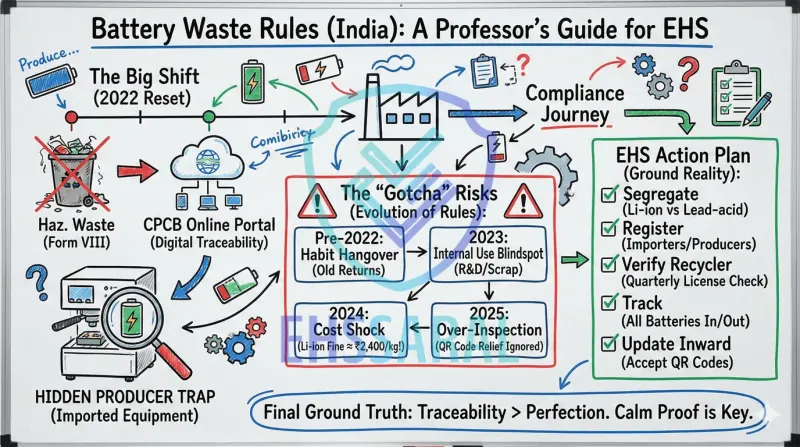
To remove this confusion completely, look at the evolution era by era, not PDF by PDF.
The table below shows:
what changed in each phase
why it changed
what factories should actually do
and where most people get caught unknowingly
(Tip: On mobile, this table is easiest to read if you scroll sideways. It is designed like a soft-board reference.)
Era / Phase | The Big Shift (What Changed?) | Your To-Do List (Action) | The "Gotcha" Risk (Hidden Trap) |
|---|---|---|---|
Pre-2022 (The Old World) | Fragmented Rules. Batteries handled under Haz Waste or old 2001 rules. Physical returns filed to SPCB. | • Forget the old "Form VIII". • Stop filing physical half-yearly returns to State Boards. | The "Habit Hangover" Continuing to file physical returns or use old manifests, thinking "we are compliant." |
2022 (The Reset) | The Digital Shift. All batteries (Li-ion, Lead-acid, EV) unified under one rule. Compliance moved to CPCB Online Portal. | • Segregate Li-ion waste from Lead-acid immediately. • Register on the Portal if you import equipment/batteries. | The "Hidden Producer" Did you import a machine with a battery inside? You are legally a "Producer," not just a user. |
2023 (The Fix) | Closing Loopholes. "Self-use" imports and Pre-consumer waste (rejects) brought under EPR. | • Track batteries used in R&D, labs, or pilot testing. • Report factory rejects/scraps in your annual data. | The "Internal Use" Blindspot Thinking "We don't sell batteries, so this doesn't apply." (Consumption = Responsibility). |
2024 (The Fine) | Financial Teeth. Environmental Compensation (EC) rates finalized. Non-compliance became expensive. | • Calculate financial risk (Quantity x Rate). • Verify recycler license validity Quarterly (not just once). | The Cost Shock Li-ion fines (~₹2,400/kg) are massive compared to Lead-acid. Small quantity ≠ Small risk. |
2025 (The Ease) | Practical Relief. QR codes allowed on packaging. No need to print EPR numbers on every small cell. | • Update inward inspection checklists. • Accept QR code on the box/manual as valid proof. | The "Over-Inspection" Trap Quality teams rejecting compliant material because they are still looking for old-style printed labels. |
2026+ (The Future) | The Tightening. Portal integration with GST and Customs data. Automated mismatch detection. | • Reconcile your waste data with recycler's upload before filing returns. • Audit your data gaps now. | The "Auto-Mismatch" The portal will automatically flag if your "Import Data" (Customs) doesn't match your "Waste Data" (CPCB). |
Also, Other way to look at it:
| Feature | Pre-2022 (Old Approach) | 2022 Rules (Reset) | Amendments (2023–2025 Reality) |
|---|---|---|---|
| Primary Focus | Mostly Lead-acid batteries | All battery types covered (Lead-acid, Lithium-ion, EV, Portable) | Closing gaps, improving traceability, reducing misuse |
| Registration System | State-level (SPCB), mostly offline | Centralised CPCB online portal | Better data linkage, QR codes, system-driven checks |
| Extended Producer Responsibility (EPR) | Weak or unclear | Mandatory for producers and importers | Tighter verification through recycler-linked certificates |
| Recycling Targets | Not clearly defined | Targets introduced (phase-wise) | Increasing focus on material recovery and accountability |
| Disposal Practices | Informal scrap handling common | Landfilling / burning prohibited | Enforcement tightened through digital tracking |
| Labelling & Marking | Basic or inconsistent | Strict marking requirements introduced | Practical relaxation via QR codes and packaging labels |
| Penalties | Limited enforcement | Environmental Compensation framework introduced | Financial impact made significant, especially for Lithium-ion |
(This Is Where Most Confusion Starts)
This section is important.
Read it slowly.
These are companies that make batteries.
Most factories are not in this category.
So we won’t spend time here.
Companies that import batteries directly into India.
Again, many factories are not here.
But confusion starts just after this.
(Most Factories Fall Here)
If your factory uses batteries, you are a bulk consumer.
This includes batteries used in:
DG sets
forklifts
UPS systems
inverters
testing instruments
process equipment
Most manufacturing units fall into this category.
So far, this sounds familiar.
Now comes the part that catches people off-guard.
(Critical for Factories)
Many factories genuinely believe:
“We don’t import batteries.
We only import machines.”
This is where the misunderstanding starts.
If your factory imports equipment that contains a battery, such as:
CNC machines
UPS systems
specialised testing rigs
sensors or controllers with internal batteries
imported forklifts or AGVs
Then for that battery, your company may be treated as a producer.
Why?
Because that battery entered the Indian market through you.
It may be small.
It may be hidden in the machine.
It may not even be mentioned clearly during installation.
But in regulatory terms, responsibility follows market entry, not visibility.
This is why many factories receive queries or notices and say:
“We didn’t even know the machine had a battery inside.”
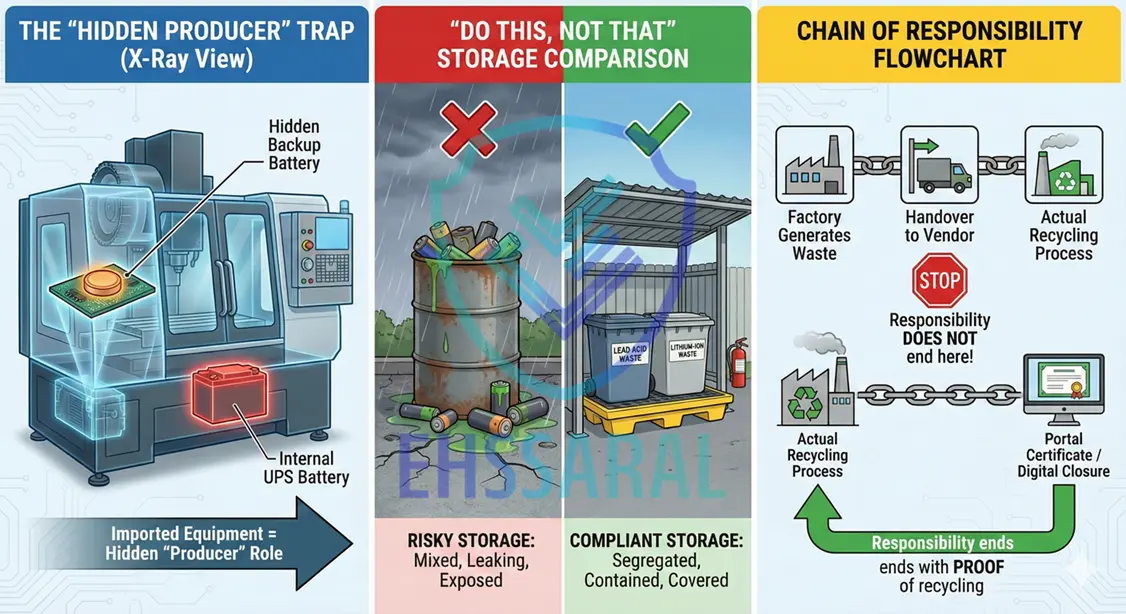
This is not rare anymore.
It is commonly seen.
Practical timing note: In such cases, registration and role clarity is expected at the time of import / market entry of the equipment, not later when the battery becomes waste. That is why this blind spot creates queries.
Battery Waste Registration for Equipment Importers (BWM Rules 2022 Explained)
Yes.
And this is another common gap.
Earlier:
batteries were handled under Hazardous Waste rules
Now:
batteries fall under separate Battery Waste Management Rules
What this means in practice:
hazardous waste authorisation alone may not be enough
records are different
portals are different
responsibility logic is different
Important clarity:
“Following Hazardous Waste rules does not automatically mean battery compliance is covered.”
This is where many factories feel they are compliant - but are not fully aligned.
Hazardous waste compliance works differently
(Ground Reality, Not Blame)
Across many factories, the same patterns appear again and again.
Not because people don’t care.
But because the system changed quietly.
Common situations seen on site:
Old batteries handed over to local scrap dealers
No verification whether the recycler is authorised
No internal record of how many batteries were generated
Vendor saying “our registration covers you”
Battery waste mixed with general scrap
Lithium-ion batteries stored like lead-acid batteries
Most of these practices were acceptable earlier.
They are risky now.
“Compliance problems usually start where old habits meet new rules.”
(Practical, Not Decorative)
You do not need complex software.
At minimum, a factory should be able to show:
type of battery
quantity
date of replacement or discard
where it was stored
when it was handed over
to whom it was handed over
Most importantly:
proof that the recycler is authorised
proof that the battery actually went for recycling
This proof may be:
a recycling certificate
a digital confirmation
a portal-generated document
| Date | Battery Type (LA / Li-ion / Others) | Qty | Equipment/Area | Stored Location | Handover Date | Recycler/Vendor Name | Proof Ref (Certificate/Challan/Portal) |
|---|
This is enough for most factories.
You can maintain it in Excel. Keep one common folder for proofs.
“If an inspector asks ‘show last battery disposal’, the answer should not be a phone call.”
Battery storage is not inspected like a laboratory.
It is inspected like a risk area.
What officers usually notice:
batteries kept in a dry, covered area
no visible acid leakage
no mixing with general scrap
no physical damage
clear segregation between battery types
For lithium-ion batteries, additional attention is given to:
swollen or damaged batteries
fire risk awareness
separation from combustible material
This is not about perfection.
It is about basic control.
On paper, disposal looks simple.
In reality, this is where responsibility often breaks.
What matters in practice:
recycler must be authorised
handover must be documented
recycling must be completed
proof must be available
The most important mindset shift:
“The truck leaving the factory gate is not the end of responsibility.”
Responsibility usually ends only when:
the waste is accepted
and recycling is confirmed
Until then, the waste is still considered linked to the generator.
(Without Panic)
Battery waste compliance has a digital component.
This includes:
registration requirements for certain roles
data entry
recycler confirmation
Most issues do not arise because someone avoided registration.
They arise because:
data was incomplete
roles were misunderstood
recycler did not close the loop digitally
A practical update that helps (QR Code Relief):
Since Feb 2025, producers may show EPR registration details through a QR code on the packaging / equipment box / manual, instead of printing numbers on every small battery cell.
So during inward checks:
Don’t reject stock just because the number is not printed on the cell
Check the box/manual: QR code is now an accepted compliance link
This change reduced unnecessary inward-inspection confusion for EHS teams.
One more 2025 relief (label marking):
For batteries where cadmium (Cd) and lead (Pb) content is below specified limits, marking requirements were relaxed.
This is why some compliant products may not show the old-style heavy metal symbols.
Data mismatch is what usually triggers queries
The pattern is familiar.
Officer asks about waste disposal
Hazardous waste records are shown
Battery waste is mentioned
Records are incomplete or unclear
Questions begin
This does not mean something is “wrong”.
It means clarity is missing.
“Most battery waste discussions start as questions, not accusations.”
If basic records are available, these discussions usually settle calmly.
You don’t need heavy systems.
What works consistently on the ground:
one battery register (Excel is enough)
one responsible person
one verified recycler list
one common folder for all battery records
This does two things:
reduces daily confusion
prevents panic during inspections
Consistency is more important than sophistication.
Before any inspection or internal audit, confirm:
☐ Battery types segregated (Lead-acid / Lithium-ion)
☐ Battery register updated (date, qty, area, handover proof)
☐ Recycler authorisation checked (validity + battery type scope)
☐ Last disposal proof available in one folder
☐ Inward inspection checklist updated for QR code acceptance
☐ Equipment imports reviewed for “hidden battery” producer risk
If you can tick these calmly, battery compliance stops being a stress point.
Many factories realise battery compliance gaps after an inspection, audit, or internal review.
If that is your situation, pause first.
Panic usually makes things worse.
What actually helps:
identify all batteries currently on site
list the types and quantities
identify where old batteries were sent
verify whether the recycler was authorised
start proper records from today
Do not blindly back-date entries.
Do not create documents without understanding.
“Late clarity is still better than continued confusion.”
Most issues become manageable once systems start functioning.
(Reality Check, Not Fear)
Battery waste is no longer ignored during audits.
Environmental compensation exists and is quantified, especially for:
lithium-ion batteries
large quantities
repeated gaps
Reality check (indicative EC range): Publicly available CPCB guidance indicates that lithium-ion batteries can attract significantly higher environmental compensation than lead-acid batteries - in some cases ₹2,000+ per kg for certain non-compliance situations. This is why even “small quantities” are taken seriously in audits.
Penalties vary based on:
battery type
quantity
nature of non-compliance
This is why officers now take battery waste questions seriously.
But one important point must be understood:
“Most penalties arise from missing traceability, not from genuine effort.”
Basic records and authorised disposal prevent most problems.
Paper compliance does not always mean real compliance
If a factory replaces even 200 kg of lithium-ion batteries in a year
and traceability is missing,
an indicative EC rate of ₹2,000 per kg can create exposure in lakhs.
This is why lithium-ion waste attracts more scrutiny than lead-acid.
The issue is not quantity alone. It is traceability + chemistry.
Battery compliance is not always black and white.
Some common grey zones seen on site:
DG batteries sent for reconditioning
refurbished batteries vs waste batteries
lithium-ion batteries overlapping with e-waste
small dry cells ignored because of size
vendor agreements that shift responsibility informally
One more quiet grey area: In some cases, higher yearly replacement volumes can shift how your role is viewed (bulk consumer vs producer obligations). Many factories miss this because they count battery changes monthly, not annually. A simple yearly review of total replacements prevents surprises.
In such cases:
clarity matters more than speed
documentation matters more than assumptions
If unsure, pause and clarify before disposal.
Many factories rely on vendors for battery handling.
This is normal.
But reliance should not mean blindness.
Before handing over batteries, check:
recycler authorisation validity
scope of authorisation
whether recycling proof is provided
whether digital closure happens
A simple question that helps:
“Will I get proof that this battery is fully recycled?”
If the answer is unclear, risk remains with the factory.
Not all batteries behave the same.
On the ground:
lead-acid batteries are bulky and visible
lithium-ion batteries are compact but high-risk
small batteries are often forgotten
Each type:
has different risks
is tracked differently
attracts different scrutiny
Understanding this prevents one-size-fits-all handling mistakes.
Lithium-ion overlap note (common confusion):
Lithium-ion batteries sometimes overlap with e-waste routes when they are part of electronic equipment. Double-reporting (or reporting in the wrong place) is a common mistake. This area is still evolving, so when unsure, pause and take specific guidance for your exact battery scenario.
(Link suggestion: E-Waste Management Rules in India Pracical Guide)
Battery use is increasing rapidly.
Factories are adding:
automation
sensors
backup systems
energy storage
With this:
battery volume increases
traceability becomes important
audits become more specific
“What is manageable today becomes critical tomorrow if ignored.”
Starting early always costs less effort.
You do not need external help for every battery replacement.
But you should seek clarity if:
batteries are imported inside equipment
quantities are large
lithium-ion batteries are involved
records are missing for past disposals
Knowing where DIY ends is part of good compliance.
If you want one thing from this article, take the Quick Checklist above and make it your monthly routine. That alone prevents most battery-related inspection surprises.
Battery waste compliance is not about being perfect.
It is not about memorising rules.
It is not about fearing inspections.
“It is about knowing what you generate, where it goes, and proving it calmly.”
Good compliance does not need brilliance.
It needs clarity, consistency, and routine.
Once that is in place, battery waste stops being a stress point
and becomes just another controlled process.
(What People Actually Ask on Site)
Do UPS batteries come under battery waste rules?
Yes.
UPS batteries are covered once they reach end of life and are replaced or discarded.
Can we sell old batteries to scrap dealers?
Only if the scrap dealer is an authorised recycler and provides proper proof of recycling.
Informal scrap sales without traceability create risk.
Is battery waste covered under hazardous waste authorisation?
Not fully.
Battery waste has its own rules, records, and tracking logic.
Hazardous waste compliance alone does not automatically cover batteries.
Vendor said they will handle everything. Is that enough?
Vendor support helps, but it is not a full shield.
Responsibility closes only when:
the vendor/recycler is authorised for that battery type
the handover is documented
and you receive proper proof that the recycling loop is closed (certificate / portal confirmation)
If the vendor takes the battery but does not provide closure proof, the question can still come back to the generator during audits.
Do small batteries also count?
Yes.
Size does not remove responsibility.
Small batteries are often ignored, which is why they attract questions later.
Do I need to register if I import equipment for in-house use (not for sale)?
In many cases, yes. If the imported equipment contains a battery, your company may be treated as the entity that introduced that battery into India. This is the “hidden producer” situation. If you are unsure, clarify your role early rather than waiting until the battery becomes waste.

Founder, EHSSaral
Founder - EHSSaral | Partner - Perfect Pollucon | ISO 14001 Lead Auditor | GHG Protocol Scope 2 | Chemist | Data Scientist | Second-generation environmental professional simplifying EHS compliance for Indian industries through practical, automated, tech-enabled, data driven compliance workflows.
Bio-Medical Waste Management for Non-Hospitals (India) | EHSShala

Why Good People Still Struggle With Compliance in Indian SMEs | EHSSaral Research
Types of Pollution in Industries Expert Guide | EHSShala
Systems & Technology Barriers in Indian SME Compliance | EHSSaral Research
Hazardous Waste Storage Rules in Indian Factories | EHSShala
Best Environmental Compliance Software in India (2026): A Practical SME Comparison | EHSSaral

CSR Trends 2026: Environmental Compliance Automation in India | EHSSaral

What Is EHS & Why India Needs It | EHSShala
 Guide for Indian Factories EHSShala by EHSSaral.webp)
Ambient Air Quality Monitoring (AAQM) Guide for Indian Factories | EHSShala
Sampling Basics for Air, Water & Noise EHS Officer Guide | EHSShala