

EHSShala
150 Essential EHS Terms Explained Simply | EHSShala
EHSSaral is an Environmental Compliance Intelligence Platform for Industries. Consent Intelligence • Alerts & Tasks • Incident Reporting • Form IV & V • Audit-Ready Records
See how EHSSaral works
30 Jan 2026
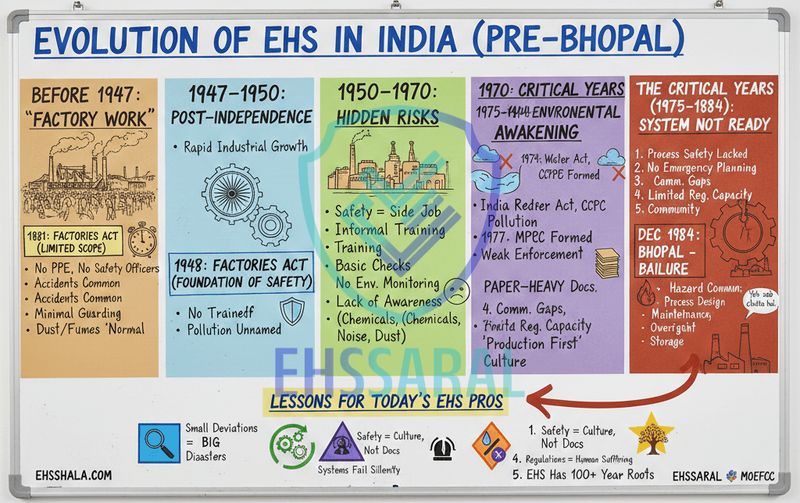
Home > EHSShala > Start > Evolution of EHS in India - Part 1 (Pre-Bhopal)
Tanaji Gajare’s 40-Year Experience, My Learnings, and the Foundation of India’s EHS Culture
When I entered the EHS world seriously, I didn’t begin with Acts, Rules, or compliance lists.
I began with stories - stories my father told me from his early working years.
My father is 69 today.
He started working in 1981 - three years before the Bhopal disaster.
Growing up, I didn’t understand the depth of what he was telling me. But when I became older, entered factory floors, spoke to MPCB officials, worked with industries, and eventually began building EHSSaral… his words started making sense.
This article is not just “history.”
It is what I learned from:
Most young EHS professionals know about “post-Bhopal rules,” but very few understand what existed before Bhopal - and why EHS was forced to evolve.
If you understand this history, you will understand:
Let’s go back in time, much before modern safety existed.
foundation topics for new EHS professionals
My father once said:
“In those days, EHS was not a word. It was just ‘factory work’.”
Before independence, India had:
But there was no structured safety culture.
The first attempt at regulating this chaos was the Factories Act of 1881 - but even that had extremely limited scope.
Most early factories continued operating with:
Environmental concern = 0%
Worker health = survival-based
Safety = reactive (after accidents)
This is important for you as a junior EHS professional to realize:
The safety culture you see today is not natural - it was built slowly, painfully, and through many incidents.
If you are new to EHS, the you can refer to our 150 Essential EHS Terms Explained with real life example so that you can remember them easily by EHSShala
After independence, India needed rapid industrial development.
My father used to describe the early years like this:
“Factories were growing faster than rules could be written.”
But something important happened in 1948.
This was India's first serious step toward:
It didn’t use the word “EHS,” but it became the foundation of Indian safety.
My father always said:
“Factories Act 1948 was the first time India realized that worker safety is not optional.”
Still, even with the Act…
implementation was weak.
Most supervisors didn’t understand it.
Factories followed it “as much as convenient.”
During these decades:
…were expanding rapidly.
India wanted growth.
But growth came faster than safety systems.
A major challenge was lack of awareness.
Most workers didn’t know:
This is why most EHS habits today - like toolbox talks, MSDS training, monitoring schedules - didn’t exist then.
This period was the turning point…
For the first time, India recognized:
My father remembers those early MPCB inspection days:
“Board officers were knowledgeable, but industries didn’t understand the seriousness yet.”
Factories were confused:
Documentation was PAPER-HEAVY.
Compliance understanding was LOW.
Enforcement was SLOW.
Industry culture was still “production first.”
And then came 1984 - the night that changed everything.
By the early 1980s, India had industrial ambition…
…but not the safety maturity to match it.
My father often describes this era with one line:
“Factories were modernizing faster than safety systems.
The gap kept widening - until one night in 1984 exposed everything.”
Let’s understand the buildup in a calm, factual, respectful way.
We’re not here to blame - we’re here to learn.
Between 1975 and 1984, India’s industrial growth accelerated:
But several foundational elements were missing.
Most factories focused on:
…but not on:
These concepts were new globally - even western countries were still formalizing them.
Fire drills existed, but chemical disaster planning was rare.
A major reason many chemical incidents happen is that:
…don’t share risk data openly.
This was very common before 1984.
Regulators were:
…but severely limited by:
Everything was paper-based.
Monitoring was manual.
Data came once a month, not real-time.
People living near industries didn’t know:
This amplified the tragedy when it happened.
Around 1983, my father visited a chemical unit where:
When he spoke to the supervisor, the response was:
“Yeh sab chalta hai. Production rukna nahi chahiye.”
(“These things happen. The production must not stop.”)
This attitude wasn’t because people were careless -
it was because nobody had seen a disaster on that scale yet.
India didn’t know how dangerous “small issues” could become.
This mindset changed overnight in December 1984.
As EHS professionals, we do not need to dramatize Bhopal.
It is already the world’s worst industrial disaster.
But what many juniors don’t realize is this:
Bhopal was not just a chemical accident.
It was a systemic failure.
Here’s what failed:
This is why today’s EHS culture emphasizes:
Because we learned the hard way.
My father said something powerful:
“Before Bhopal, safety was optional.
After Bhopal, it became survival.”
The disaster exposed gaps everywhere:
India had to respond - and it did.
This response marks the entrance into Part 2 of this series, but it’s important to understand why Part 1 matters so deeply.
These are lessons my father repeated often, and I now pass on to you.
Never ignore:
These are early-warning signs.
In old factories, people didn’t fear violations - they feared production stoppages.
Today, you must reverse that mindset.
What failed at Bhopal:
Failures rarely shout.
They whisper.
Every Act, every Rule, every Condition was written after real incidents.
Nothing is arbitrary.
Understanding this makes you a better professional.
Because it teaches:
You cannot understand modern EHS without understanding how and why it evolved.
This article is not about nostalgia - it’s about foundation.
The pre-Bhopal era shows us one simple truth: EHS did not start from regulations; it started from experience.
India learned safety and environmental discipline slowly - through decades of industrial growth, early laws, weak processes, and real incidents that revealed what was missing.
Everything we follow today - audits, training, monitoring, documentation, emergency planning - exists because the systems before 1984 were not ready for modern industrial risks.
For today’s EHS professionals, understanding this history gives perspective.
It helps you appreciate why your role matters and why compliance, culture and discipline are not optional.
This foundation sets the stage for the next chapter - how India transformed after Bhopal and built the EHS framework we know today.
EHS was not a formal discipline before 1984. Early safety practices were informal, environmental laws were weak, and compliance systems were manual and paper-based.
Because industrial growth outpaced safety systems. There was limited process safety knowledge, weak emergency planning, minimal community awareness, and no real-time monitoring tools.
Factories Act 1948, Water Act 1974, CPCB (1974), MPCB (1977), and the Air Act 1981. However, implementation was slow and documentation was manual.
It gives essential context. Understanding what India lacked before 1984 helps professionals appreciate modern rules, audits, digital tools, and the value of proactive safety culture.
Because today’s digital systems exist to prevent the gaps of the past-late detection, poor documentation, communication failure, and absence of real-time monitoring.

Founder, EHSSaral
Founder - EHSSaral | Partner - Perfect Pollucon | ISO 14001 Lead Auditor | GHG Protocol Scope 2 | Chemist | Data Scientist | Second-generation environmental professional simplifying EHS compliance for Indian industries through practical, automated, tech-enabled, data driven compliance workflows.
150 Essential EHS Terms Explained Simply | EHSShala
ESG Data Management for Indian Factories | EHSSaral
Environmental Compliance KPIs for Manufacturing in India
Maharashtra SME Plastic Waste EPR Guide: Are You a Brand Owner | EHSSaral
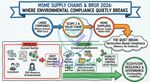
MSME Supply Chains & BRSR 2026: Where Compliance Breaks | EHSSaral

Chemical Accident Emergency Response Guide for Indian Factories | EHSShala
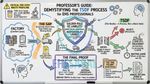
TSDF Hazardous Waste Process: Manifest, Disposal & Records
 EHSSaral v1.png)
Blue Category MPCB 3-Year Consent Validity for Recyclers (2026) | EHSSaral
 ehssaral.webp)
Environmental Monitoring Checklist for Factories (India Guide) | EHSShala

New Labour Codes in India Effective Nov25: Mandatory Appointment Letters & Health Checks | EHSSaral