
EHSShala
Groundwater NOC for Factories in India: CGWA Guidelines, State Rules and Borewell Compliance
EHSSaral is an Environmental Compliance Intelligence Platform for Industries. Consent Intelligence • Alerts & Tasks • Incident Reporting • Form IV & V • Audit-Ready Records
See how EHSSaral works
26 Aug 2026
EHSSaral’s Hazardous Waste Management System connects Form 3 records, Form 10 manifests, storage balances, TSDF/recycler evidence and Form IV preparation in one traceable workflow.
Manage Form 10 manifests and hazardous waste records digitally in EHSSaral
Looking for the actual Form 10 PDF format for hazardous waste transport in India?
You can download the blank hazardous waste manifest form and keep it ready for:
“Understanding the form is important.
But keeping the correct format ready before dispatch avoids last-minute confusion.”
Best Practice
Do not wait until the truck arrives at the gate to prepare Form 10.
Many manifest mistakes happen because the form is filled in a hurry during dispatch.
The diagram below explains how hazardous waste moves from:
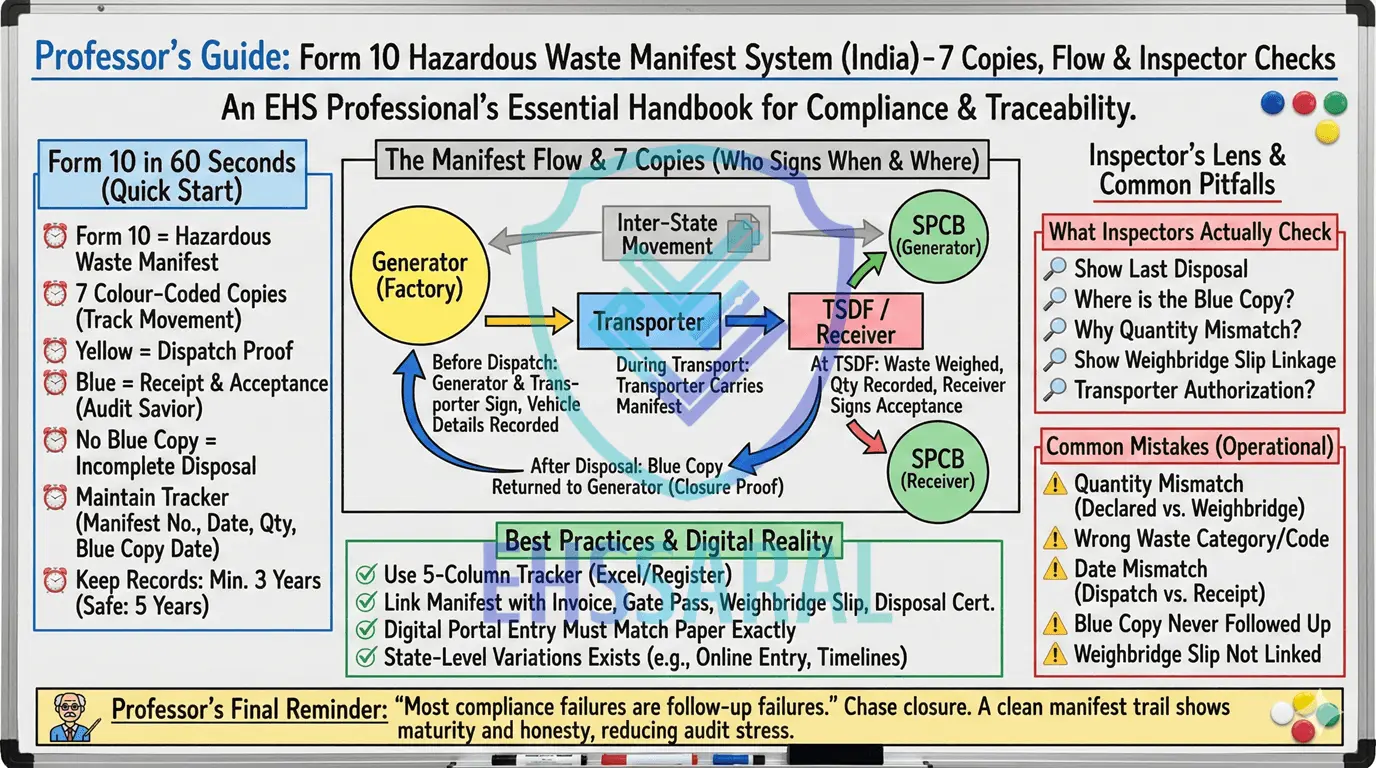
Generator → Transporter → TSDF / Receiver → SPCB
It also highlights:
| Get Free Compliance Visibility in 15 Minutes Upload your Consent to Operate and instantly see extracted obligations, deadlines, reminders, and an audit-ready compliance trail. Free forever for core compliance visibility. No execution lock-in. No forced upgrades. 👉 Register free on EHSSaral |
Most hazardous waste problems do not start because someone wanted to hide something.
They start because people do not fully understand what happens after waste leaves the factory gate.
Inside the plant, things feel under control.
Waste is stored.
Labels are there.
Registers are maintained.
But once the truck moves out, many people mentally relax.
That is exactly where the risk begins.
“If you cannot trace where hazardous waste went, inspectors assume it went wrong.”
This article exists to remove that blind spot.
Not to scare you.
Not to quote rules.
But to help you understand the system once, properly.
Forget forms for a moment.
The manifest system is simply a tracking system.
It answers only three questions:
That’s it.
Everything else - copies, colours, signatures - exists only to make sure these three answers are provable later.
Think of it like a courier tracking slip.
Once the parcel leaves your hand,
the only way to prove delivery is the trail it leaves behind.
Hazardous waste works the same way.
Let us be very clear.
Form 10 legally has 7 colour-coded copies.
Not “usually”.
Not “depending on state”.
Seven.
Each copy exists for a reason.
Each copy protects someone in the chain.
If even one copy is missing, the chain breaks - and responsibility travels back to the generator.
People often ask:
“Why so many papers?”
Because hazardous waste involves multiple stakeholders:
Each one needs proof.
Each one needs protection.
The copies are not duplication.
They are distribution of responsibility.
Inspectors are not standing next to your waste yard 24×7.
They do not see:
So they rely on documents that show continuity.
The manifest is that continuity.
It proves that responsibility did not end at your boundary wall.
Form 10 is the official manifest format for hazardous waste movement.
It is used only when hazardous waste is transported outside the premises for:
Most people do not struggle with the rules.
They struggle with:
Below is a simple practical understanding of the important fields.
Enter:
Make sure the authorization number matches the current hazardous waste authorization.
Mention:
Do not use vague terms like:
Use actual waste description matching your authorization.
Enter:
Vehicle mismatch is one of the most common audit observations.
Mention:
Always verify that the receiving facility is authorised for that waste category.
As far as possible:
Portal quantity and physical manifest quantity should match.
Before dispatch:
After receipt:
Incomplete signatures create audit gaps later.
In many factories, the form is technically filled — but operationally weak.
The most commonly misunderstood fields are:
| Field | Common Mistake |
|---|---|
| Waste Category | Old or incorrect category used |
| Quantity | Estimated quantity instead of actual weight |
| Vehicle Number | Last-minute vehicle change not updated |
| Receiver Details | TSDF authorization not checked |
| Signatures | Missing transporter or receiver signature |
| Dispatch Date | Backdated entries during audit pressure |
“Most manifest problems begin as small shortcuts.”
Form 10 is not required for:
This clarity alone avoids many unnecessary mistakes.
Note: E-waste and battery waste follow separate movement/manifest formats under their respective rules. Form 10 is for hazardous waste movement under HWM Rules.
Read Battery Waste Registration for Equipment Importers (BWM Rules 2022 Explained) by EHSSaral
A frequent question from EHS officers is:
“Do I need Form 10 for oil-soaked cotton waste sent to a scrap dealer?”
The answer depends on classification, not convenience.
The manifest system follows waste category, not vendor type.
Many of these same manifest records are later used during Annual Return Form 4 preparation and hazardous waste reconciliation.
This is an uncomfortable truth, but important.
Many people believe:
“Once waste is handed to the transporter, it is not my problem.”
That is not how the system works.
In hazardous waste management:
This is exactly why the manifest system exists.
It keeps the generator connected to the final outcome.
The moment hazardous waste crosses a state boundary:
That is why Form 10 includes a Grey copy for inter-state movement.
Inter-State Movement Alert
When hazardous waste crosses state boundaries:
Common issue: A transporter is approved for one side, but papers are weak for the other side. This creates queries later.
Even if your factory operates only within one state,
the Form 10 set still carries all seven copies.
None should be ignored.
At the understanding stage itself, common mistakes include:
These issues stay hidden.
They usually surface later - during inspection or consent renewal.
Hazardous Waste Storage Rules in Indian Factories
Most inspectors are not hunting for punishment.
They are checking one basic thing:
“Can this factory prove what it claims?”
If your manifest trail is clear:
Clarity reduces stress - for you and for the inspector.
This is where most mistakes happen.
Not because people don’t work hard.
But because no one explained what each copy actually proves.
Form 10 has 7 colour-coded copies.
Each one has a job.
Sent to SPCB by the Generator
This copy tells the regulator:
“Hazardous waste has been dispatched from this unit.”
In many states, this happens through the online portal now.
But the intent remains the same.
Why it matters
Retained by the Generator
This is the most commonly preserved copy.
It proves only one thing:
“Waste left my factory.”
That’s all.
Important reality
Think of it as a dispatch receipt, not a completion certificate.
Retained by the Receiver / TSDF
This copy confirms:
“We received this waste.”
Two things matter here more than anything else:
Stamp is secondary.
Date and quantity are primary.
Delays in returning acknowledgment from TSDF are common.
But they must be followed up.
Given to the Transporter (After Delivery)
This copy proves the transporter completed the movement.
Common mistake seen everywhere
This becomes a problem during portal uploads and audits.
Always verify vehicle details before dispatch, not after.
Sent to SPCB by the Receiver
This closes the regulator loop on the receiver side.
It tells the Board:
“The authorised facility has accepted this waste.”
If this is missing, the regulator questions the TSDF.
But the generator may still be pulled in for explanation.
Sent back to the Generator by the Receiver
This is the copy that actually saves you during audit.
“Blue copy proves the waste was received and accepted.”
Without this:
Ground reality
Many factories have Yellow copies neatly filed.
But no Blue copies.
During inspection, this becomes the biggest gap.
If you remember only one thing about Form 10, remember this:
“No Blue copy = incomplete hazardous waste disposal proof.”
Used for Inter-State Movement
This copy is sent to the sender’s SPCB when waste moves across states.
Even if your unit operates only within one state:
Inter-state movement attracts more scrutiny.
Documentation discipline must be tighter.
| Copy Colour | Who Keeps It | What It Proves | Common Mistake |
|---|---|---|---|
| White | SPCB (Generator side) | Dispatch informed to regulator | Assuming portal entry is optional |
| Yellow | Generator | Waste left factory | Assuming this proves disposal |
| Pink | Receiver / TSDF | Waste received | Not chasing timely acknowledgment |
| Orange | Transporter | Transport completed | Vehicle/driver details mismatch |
| Green | SPCB (Receiver side) | TSDF accepted waste | Filing without linking to quantity proof |
| Blue | Generator | Disposal closure proof | Never following up with TSDF |
| Grey | SPCB (Inter-state) | Cross-state regulatory trail | Ignoring it even when the movement is inter-state |
Print this table mentally.
It removes 80% confusion.
Understanding copies is useless unless you know the sequence.
This must happen before the truck leaves.
This step decides whether closure will be clean or messy.
Many people relax too early and forget to chase this step.
That is where trouble starts.
These are patterns seen repeatedly:
None of these are intentional.
All of them are preventable.
Manifest problems don’t explode immediately.
They sleep quietly.
Then they wake up during:
That’s why understanding the flow matters more than memorising the form.
Most manifest mistakes are not deliberate.
They are operational.
Here are the ones seen repeatedly across factories:
Even small differences raise questions later.
This often leads to TSDF rejection or portal errors.
Dates matter more than stamps.
During audit, this looks like incomplete disposal.
Inspectors don’t assume.
They ask you to show linkage.
Form 10 paperwork looks complete on file, but the transporter is the weak link.
In practice, transporters should have:
If the transporter side is not proper, the manifest chain becomes difficult to defend during inspection.
This is not theory.
This is what actually gets asked.
These questions are routine.
They are not personal.
A simple Excel or register works.
| Manifest No. | Dispatch Date | Quantity Sent | Blue Copy Date | Disposal Certificate No. |
|---|
If this is ready:
No fancy system required.
Many people confuse Form 10 and Form 4.
But they serve very different purposes.
| Form | Purpose |
|---|---|
| Form 10 | Tracks movement of hazardous waste consignment |
| Form 4 | Annual summary of total hazardous waste generation and disposal |
Simple way to remember:
“Form 10 tracks one truck movement.
Form 4 tracks the entire year.”
This is where many notices originate.
Form 4 asks for total hazardous waste disposed in the year.
That number must equal:
Sum of all Form 10 quantities for that year
If you sent 40 consignments but can produce only 38 manifests:
Manifest discipline protects your annual return.
This is where most juniors panic.
Don’t.
These help explain the situation.
This is why Blue copy follow-up matters.
Silence creates suspicion.
Explanation creates control.
In many states now:
Common issue seen:
This mismatch is flagged automatically.
Paper alone is no longer enough.
One more practical point: once a digital manifest is generated on the portal, it is often locked. Editing later may not be easy. If your online quantity is guessed and the truck actually carries less, the mismatch becomes permanent. As far as possible, finalise quantity after weighing before generating the final online entry.
Simple discipline works best:
“Good compliance is boring.
That’s why it works.”
As a minimum safe baseline, keep Form 10 and related documents for at least 3 years from the date of disposal.
In real factory life, queries can come later during:
Safe practice: keep manifest records for 5 years so you are not forced to “reconstruct history” under pressure.
Manifest is not paperwork.
It is proof that:
“When hazardous waste leaves your gate,
the manifest is your voice.”
Keep it clear.
Keep it complete.
And most problems never start.
While Form 10 is a central format, how it is handled on ground does vary by state.
This does not change your responsibility.
It only changes how closely things are checked.
Safe rule:
Always follow both paper manifest and portal discipline.
Never assume one will cover the other.
Before inspection or renewal, check these points calmly:
If these six points are clear,
most inspections stay smooth.
Hazardous waste compliance is not about intelligence.
It is about follow-through.
“Most compliance failures are not legal failures.
They are follow-up failures.”
If you chase closure properly,
Form 10 becomes a shield - not a stress point.
Many factories search for the manifest format only when the transporter arrives.
That is when mistakes happen.
Best practice:
Inspectors do not expect perfection.
They expect:
A clean manifest trail shows maturity.
And mature factories face fewer problems.
Form 10 is the official manifest format used in India to track the movement of hazardous waste from the generator to the authorised receiver (TSDF, recycler, or co-processor).
It proves where the waste went and who handled it at each stage.
Form 10 has 7 colour-coded copies.
Each copy is meant for a specific stakeholder such as the generator, transporter, receiver, and Pollution Control Board.
If even one required copy is missing, the manifest chain becomes incomplete.
The Blue copy is the most important for the generator.
It proves that the hazardous waste was received and accepted by the authorised facility.
Without the Blue copy, you can prove dispatch, but not disposal.
No.
The Yellow copy only proves that waste left the factory.
It does not prove that the waste was received or disposed of.
Inspectors always look for the Blue copy to confirm closure.
If the Blue copy is missing:
This situation creates stress and delays during inspections or renewals.
Legally, Form 10 records should be kept for minimum 3 years from the date of disposal.
Safe industry practice: keep records for 5 years, as inspections and consent renewals often refer to older data.
Inspectors commonly check:
They check traceability, not perfection.
Yes.
When hazardous waste moves across state boundaries:
Inter-state movement requires extra discipline.
No.
E-waste and battery waste follow separate movement and reporting systems under their respective rules.
Form 10 is used only for hazardous waste covered under the Hazardous and Other Wastes rules.
No.
Each hazardous waste category should be tracked clearly.
Mixing multiple waste categories under one manifest can lead to rejection or audit queries.
Minor variation is common.
Best practice:
Consistency and transparency matter more than exact matching.
No.
The disposal certificate supports the manifest but does not replace it.
Inspectors expect both documents to be linked.
In many states, yes.
Several SPCBs now require:
Paper alone may not be sufficient.
The most common mistake is not following up for the Blue copy.
Many factories keep dispatch records neatly but fail to confirm disposal closure.
This gap usually surfaces during inspection or renewal.
No.
Documentation expectations are the same for all generators.
Only the scale of waste differs, not the compliance requirement.
Maintain a simple tracker with:
This single habit prevents most inspection problems.
Because once hazardous waste leaves the factory gate,
the manifest is the only proof trail showing responsible handling.
If waste cannot be traced, responsibility comes back to the generator.

Founder, EHSSaral
Founder - EHSSaral | Partner - Perfect Pollucon | ISO 14001 Lead Auditor | GHG Protocol Scope 2 | Chemist | Data Scientist | Second-generation environmental professional simplifying EHS compliance for Indian industries through practical, automated, tech-enabled, data driven compliance workflows.
Groundwater NOC for Factories in India: CGWA Guidelines, State Rules and Borewell Compliance

Hazardous Waste Compatibility & Segregation Guide India

EBWGR Certificate: Eligibility, Process, Cost & Records
SWM Rules 2026: Is Your Factory a Bulk Waste Generator? | EHSSaral

EHSShala Foundations - Core Environmental Basics for EHS Officers

Environmental Inspection India: What Inspectors Check | EHSSaral

Form 3 Logbook Explained: Simple Guide for Indian Factories | EHSShala

Managing Safety Without Authority: Handling Protected Contractors in Indian Plants | EHSSaral

The Paper Shield: PF & ESIC Challans vs Real Compliance Risk | EHSSaral
Environmental Compliance Calendar Software – Simplify MPCB Renewals & Due Dates | EHSSaral