
Blog
OCEMS Data Gaps Explained: Why CPCB Rejects Data & How to Fix | EHSSaral
EHSSaral is an Environmental Compliance Intelligence Platform for Industries. Consent Intelligence • Alerts & Tasks • Incident Reporting • Form IV & V • Audit-Ready Records
See how EHSSaral works
8 Sep 2026
Let’s say this clearly.
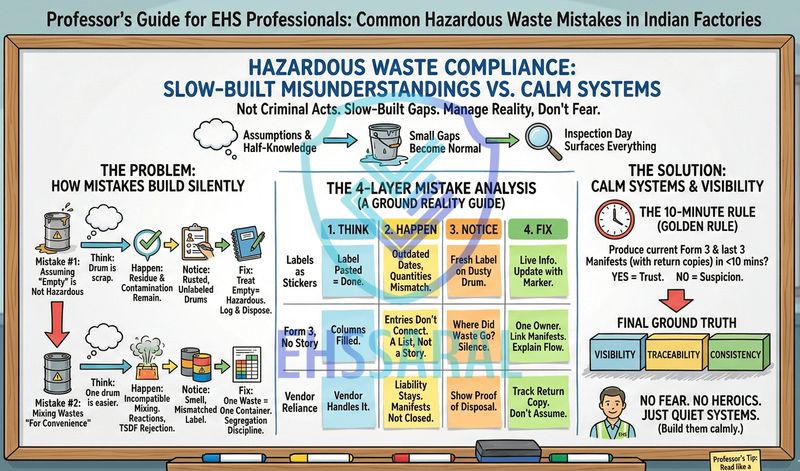
Most hazardous waste non-compliances in Indian factories are not criminal acts.
Hazardous waste management framework in India
They are not deliberate violations.
They are slow-built misunderstandings.
They happen because of:
Over time, small gaps become normal.
Then one day, during inspection or renewal, everything surfaces together.
“Most compliance failures don’t start on inspection day.
They start months earlier with small assumptions.”
This article exists to:
This is not a rulebook.
This is a ground-reality guide.

In real factories, hazardous waste rarely looks like a problem.
Everything feels “under control”.
Then an inspection happens.
Usually, the start is calm.
The officer walks around.
Looks at storage.
Looks at labels.
Asks a few questions.
Then comes one simple question.
“Your Form 3 shows disposal in March.
Show me the manifest.”
You answer confidently.
Files are opened.
Something is missing.
That moment of silence is where trouble begins.
Not because waste was dumped illegally.
But because the system cannot explain itself clearly.
This article is written to prevent that moment.
Read this like a plant walk, not like an exam.
Each mistake is explained in four layers:
You do not need perfection to be compliant.
You need clarity, traceability, and consistency.
“The drum is empty.
The chemical is used.
It’s just scrap now.”
So the drum is:
Residue remains.
Odour remains.
Contamination remains.
An “empty” drum is rarely clean.
From a chemical point of view, even a small residue is enough to:
From a compliance point of view, an empty contaminated container is still hazardous waste until properly cleaned and documented.
This mistake does not happen in one day.
Soon, there is a corner full of old drums that no one “owns”.
Inspectors’ eyes go to:
“A neglected drum attracts attention faster than a full one.”
If those containers are not reflected in records, questions start immediately.
You don’t need fancy systems.
You need ownership.
“All are hazardous.
All are going to TSDF.
One drum is easier.”
This usually happens:
Different hazardous wastes behave differently.
Mixing ignores compatibility.
What looks harmless administratively can become dangerous physically.
Mixing can:
It can also lead to additional characterization, a change in the accepted disposal route or rejection by the receiving facility.
One drum now contains:
These are clear signals of weak segregation.
Depending on the receiving facility and waste stream, acceptance procedures may include review of the declared waste characteristics, documentation and sampling or analysis.
If the declared waste does not match the actual waste:
A rejected vehicle is a major compliance red flag.
Segregation discipline solves many downstream problems quietly.
Another issue that is easy to miss is chemical compatibility. Two correctly labelled drums can still create a risk if their contents can meet through a shared spill tray, bund, sump or drainage path.
For a deeper plant-floor approach, see our guide to hazardous waste compatibility and segregation, including the spill-path test for understanding where incompatible wastes may accidentally meet.
“Label is pasted.
Work is done.”
Usually:
Labels are treated like decoration, not information.
Over time:
The label stops representing reality.
This mismatch builds silently.
Inspectors notice visual contradictions.
Common examples:
“Fresh label on a dusty drum usually means last-minute correction.”
That immediately raises doubt about records.
Labels should match today’s reality, not last month’s.
Registers exist.
Columns are filled.
Signatures are there.
Entries exist, but they don’t connect.
Typical issues:
Form 3 becomes a list, not a story.
Nothing looks “wrong” day-to-day.
But nothing explains movement clearly either.
One calm question:
“Where did this particular waste go?”
If Form 3 cannot answer that in one glance,
inspection time increases.
Messy Form 3 creates panic during:
What feels like a “small register issue” becomes a year-end crisis.
A Form 3 register may be internally neat and still deserve a closer look if the waste-generation trend does not make sense against plant operations.
For example:
This does not automatically mean the data is wrong.
There may be genuine reasons such as:
The important point is that the EHS team should be able to explain the variation from records.
Good hazardous waste accounting should reconcile not only document-to-document, but also operation-to-waste.
This is where a monthly reconciliation system becomes valuable. EHSSaral is being designed to connect hazardous-waste generation, physical stock, manifests, disposal evidence and annual reporting so that unexplained differences can be identified before year-end filing or inspection.
Form 3 should make the basic movement clear:
Generated → Stored → Dispatched
The wider compliance system should then connect that movement with manifests, receiver evidence, physical closing stock and annual reporting.
“We are roughly within time.”
This is the most dangerous assumption.
Storage time drifts quietly.
Common reasons:
Before anyone notices, waste crosses 90 days.
Time violation happens silently.
Inspectors look at:
Simple subtraction.
No debate.
Under Rule 8 of the Hazardous and Other Wastes (Management and Transboundary Movement) Rules, 2016, hazardous waste may generally be stored for up to 90 days, with specified circumstances in which the SPCB may extend the storage period.
From a plant-management perspective, the important issue is to identify the delay early and review the applicable extension route before the stock becomes overdue.
From a practical standpoint, the bigger problem is late visibility.
A disposal delay may begin with:
These practical constraints may explain why disposal is slipping, but they do not replace the need to identify the issue early.
If waste is approaching the permitted storage period, the EHS team should review the applicable provision, authorization conditions and available regulatory route before the situation becomes overdue.
The safest time to manage a storage delay is while it is still an upcoming issue, not after it has become an old stock problem.
“Vendor has taken the waste.
They will handle everything.”
This belief is extremely common.
Once the truck leaves the gate, people relax.
Work can be outsourced.
Responsibility cannot.
If the vendor:
The generator is still accountable.
The label on the drum points back to the factory.
Over time, tracking weakens.
“Show me proof that this waste reached the TSDF.”
Not:
They want disposal proof.
Form 10 – Hazardous Waste Manifest
The manifest system provides traceability across the movement of hazardous waste:
Generator → Transporter → Receiver / TSDF
After the waste is accepted by the receiving facility, the applicable manifest or receiving evidence becomes part of the documentary trail available to the generator.
If that return or receiving evidence is missing, the factory may know that the truck left its gate but may not have complete documentary evidence to close the movement confidently.
Truck dispatched does not automatically mean the documentation trail is closed.
Months later, files are incomplete.
This is particularly important for:
These materials can sometimes drift toward informal scrap channels because they appear to have resale value.
A waste movement is controlled only when the receiving route, documents and final evidence all tell the same story.
“We make the same product.
Waste is same as last year.”
This sounds logical.
But it often fails.
Small process changes cause big waste changes:
Waste composition shifts quietly.
Everything looks fine until disposal day.
At TSDF gate:
If actual waste does not match declared waste:
A rejected truck is a serious compliance signal.
Even if intent was clean, confidence reduces.
Waste analysis is not paperwork.
It is waste identity.
This is a common source of confusion.
A waste stream may continue to be called:
“Process Sludge”
“Spent Solvent”
or
“Acid Waste”
for years.
But during that period, the plant may have changed:
The internal name stays the same.
The chemistry may not.
That creates an important compliance question:
Does the current waste still match the classification, storage method, disposal route and authorization assumptions behind its old name?
When the identity is uncertain, go back to the source process and waste characteristics rather than relying only on the historical label.
For a deeper explanation, see our guide to hazardous waste classification in India.
“SPCB Consent is legal paper.
Operations are practical.”
So both run in parallel.
Paper trail breaks.
Common example:
Nobody notices until:
Mismatch becomes normal.
They mentally connect:
Consent → Form 3 → Manifest → Disposal mode
If one link breaks, questions follow.
Consent is not separate from operations.
It defines them.
For practical interpretation of post-approval obligations, see Consent Conditions Explained: What Factories Must Actually Follow After Approval.
“The waste is being recycled instead of disposed.
That must be better.”
Environmentally, recovery and resource utilization can certainly be preferable in appropriate cases.
But the compliance question is different:
Is this particular waste permitted to move through this particular utilization route?
Plants sometimes verify that a recycler exists and appears authorized, but do not check whether:
This can create a gap between:
Waste category → Authorization → Utilization route → Receiving facility
The change often starts with a reasonable operational discussion:
“Why send this material for disposal if somebody can recover value from it?”
A new vendor is found.
A trial movement works.
The commercial arrangement becomes routine.
But the compliance basis may never be checked with the same attention.
Before changing a hazardous-waste disposal or utilization route:
Circularity is useful when the technical and compliance chain remain aligned.
For a deeper analysis of utilization approvals, see why Rule 9 hazardous waste utilization applications fail.
“The drum is sealed.
Nothing will leak.”
This assumption is very common.
Reality is not perfect.
Even a small leak can:
Once chemical touches soil, the issue becomes serious.
By the time someone notices, the mark is permanent.
Inspectors’ eyes go to:
These signs suggest lack of prevention, not accident.
Soil contamination is:
Even small leaks can create long-term liability.
Prevention is cheaper than explanation.
Secondary containment should also be reviewed from a compatibility perspective.
Two wastes may be stored in separate drums but still meet if both leak into the same spill tray, bund or sump.
For a practical walkthrough of this issue, including shared containment and drainage paths, see our guide to hazardous waste compatibility and segregation.
“Waste is inside designated area.
That is enough.”
Storage area becomes:
Over time, discipline reduces.
Area stops looking controlled.
Inspectors notice:
These are visible system weaknesses.
“We have fire extinguishers.
That’s enough.”
Emergency readiness near hazardous waste is often missing:
During inspection, this becomes visible.
Inspectors check:
This reflects preparedness, not paperwork.
Preparedness is not about having equipment on display. It is about whether people can respond correctly when something actually happens.
“Our registers are perfect.
Files are updated.
So we are safe.”
This assumption belonged to an older time.
Today, many SPCBs operate through online systems, and information submitted through those systems can become part of the compliance record available for review.
That means portal information may be compared with:
So the online record and the physical factory record should not be treated as two separate compliance systems.
Nothing feels wrong day to day.
But data slowly drifts apart.
Inspectors compare:
If:
Questions begin before site visit.
Data mismatch suggests:
Even if waste was handled correctly, trust reduces.
Digital consistency is now part of compliance.
A stronger hazardous-waste review should connect the entire movement:
Generation → Form 3 → Physical stock → Manifest → Receiver evidence → Closing stock → Annual return
Where relevant, it is also useful to ask whether the overall waste trend broadly makes sense against operational indicators such as:
The purpose is not to force every waste stream into a fixed production ratio.
Industrial waste varies for many legitimate reasons.
The objective is to identify changes that cannot presently be explained.
For example:
Production rises by 30%.
Hazardous waste falls by 40%.
That may be completely valid.
But the plant should ideally know why before the figure reaches Form 4 or an inspection discussion.
A mismatch is easier to investigate when your own system finds it than when somebody asks about it months later.
This is an important direction for EHSSaral. Instead of treating Form 3, manifests, disposal certificates and annual returns as independent records, the platform is being developed around reconciliation—so the EHS team can see where quantities stop matching and investigate the exception while the underlying records are still available.
“Form 4 is annual.
We’ll manage in June.”
This thinking creates panic every year.
When Form 4 filing starts:
The scramble begins.
By June, the damage is already done.
Poor annual return quality signals:
This affects renewal and trust.
Annual returns should feel boring - not stressful.
The same principle applies to Form IV readiness: year-end filing becomes much easier when generation, storage, manifests and closing stock have already been reconciled during the year. See why Form IV readiness cannot begin at the end of the year.
“Everyone knows their part.”
In reality:
Small gaps appear between responsibilities.
Nobody sees the full picture.
When questions arise:
Inspectors sense:
This creates doubt, even if data exists.
Ownership builds confidence.
Ownership does not necessarily mean one person has to manually remember everything.
A better system separates accountability from memory.
One person may remain responsible, while reminders, pending manifests, document status, storage ageing and reconciliation checks are maintained in a shared system.
This is one of the practical problems EHSSaral is intended to solve: when an EHS officer, consultant or plant employee changes, the compliance history should remain with the plant rather than leaving with the person.
“I must answer immediately.
Silence looks bad.”
So people:
Inspectors are trained to observe behaviour, not just documents.
When answers are:
It signals weak systems, even if paperwork exists.
When inspection comes, stress takes over.
Panic suggests:
Even honest factories get trapped here.
Confidence comes from systems, not speed.
If an inspector walks in, can you produce within 10 minutes:
- the current Form 3;
- the last three hazardous-waste manifests;
- the corresponding receiving/return evidence;
- the present physical closing stock for that waste stream?
If the answer is yes, the system is probably not dependent on memory.
If yes:
If it takes 30 minutes:
The 10-Minute Rule is not about pressure.
It is about readiness.
Before any inspection or renewal, ask yourself:
If most answers are “yes”, you are largely safe.
Let’s close with a mirror image of the opening scene.
Officer asks:
“Your Form 3 shows disposal in March. Show me the manifest.”
You open the file.
You place it on the table.
Officer nods.
Moves to the next topic.
No drama.
No tension.
That is what good compliance feels like.
Good hazardous waste compliance is not about having more paperwork. It is about being able to explain the complete waste journey clearly.
A strong system should answer:
What was generated?
Where is it stored?
How old is it?
Does the quantity make operational sense?
Where did it go?
Who received it?
Is the final evidence available?
Do Form 3, manifests, physical stock and annual returns tell the same story?
When these answers are visible, inspections become easier and year-end filing becomes routine.
When they depend on memory, WhatsApp messages, separate spreadsheets and individual employees, small gaps can accumulate quietly.
That is the problem EHSSaral is being built to reduce.
The objective is not to replace the judgement of an experienced EHS professional. It is to give that professional a clearer system for connecting:
Authorization → Waste generation → Storage → Ageing → Manifest → Disposal evidence → Reconciliation → Annual reporting
Good compliance starts with understanding.
Strong compliance continues through visibility, traceability and consistent follow-through.
The most common problem is assuming things are “mostly okay” without checking whether records, physical stock, labels, manifests and disposal evidence actually match.
Small gaps often build slowly and become visible only during inspection, renewal or annual return preparation.
An empty drum should not automatically be treated as ordinary scrap simply because the usable chemical has been removed.
If the drum, barrel or liner is contaminated with hazardous chemicals or hazardous waste residues, it should be managed according to the applicable hazardous-waste requirements and authorization conditions.
They should not be mixed simply for convenience.
Different waste streams may react with each other, change waste characteristics, affect the disposal route or lead to additional characterization or rejection at the receiving facility.
Compatibility should be checked before wastes share a container, spill tray, bund or drainage path.
Form 3 may be maintained, but the entries do not always tell a clear movement story.
A good record should help explain:
Generated → Stored → Dispatched
The wider compliance system should then connect this with manifest details, receiver evidence, physical closing stock and annual reporting.
Under Rule 8 of the Hazardous and Other Wastes (Management and Transboundary Movement) Rules, 2016, hazardous waste may generally be stored for up to 90 days, with specified circumstances in which the SPCB may allow an extension.
From a practical standpoint, the EHS team should identify the delay early, review the applicable provision and authorization conditions, and manage the situation before the stock becomes overdue.
Appointing a transporter, recycler or TSDF does not remove the need for the generator to maintain a complete movement and disposal trail.
The factory should verify the receiving route, relevant authorizations and manifest or receipt evidence rather than closing the record only because the vehicle has left the premises.
Waste characterisation should be reviewed when there is a meaningful change in the process that may affect the waste stream.
Examples include changes in:
The internal waste name may remain the same even when the actual waste characteristics have changed.
A mismatch between consent or authorization conditions and actual disposal practice can create questions during inspection, renewal or document review.
The EHS team should periodically compare:
Consent / Authorization → Form 3 → Manifest → Disposal or Utilization Route
Any change in the disposal route should be reviewed before it becomes routine practice.
Secondary containment helps control leaks and reduce the chance of waste reaching soil, drains or surrounding areas.
It should also be reviewed from a compatibility perspective. Two wastes may be stored in separate drums but still come into contact if both leak into the same spill tray, bund, sump or drainage path.
Yes.
Information submitted through SPCB or other regulatory portals can become part of the compliance record available for review.
Physical Form 3 records, manifest quantities, annual returns and online submissions should therefore be periodically reconciled rather than treated as separate systems.
Annual returns become difficult when year-long inconsistencies are discovered only during filing.
Common causes include:
Annual returns should ideally be the summary of a system that has already been maintained and reconciled throughout the year.
The 10-Minute Rule is a simple readiness test.
If an inspector asks, can you produce within 10 minutes:
If yes, the system is probably not dependent on memory or last-minute document hunting.
The objective is not speed for its own sake. It is readiness, traceability and confidence in the record trail.

Founder, EHSSaral
Founder - EHSSaral | Partner - Perfect Pollucon | ISO 14001 Lead Auditor | GHG Protocol Scope 2 | Chemist | Data Scientist | Second-generation environmental professional simplifying EHS compliance for Indian industries through practical, automated, tech-enabled, data driven compliance workflows.
OCEMS Data Gaps Explained: Why CPCB Rejects Data & How to Fix | EHSSaral

EHSShala Foundations - Core Environmental Basics for EHS Officers

What Is EHS & Why India Needs It | EHSShala
CPCB OCEMS Flatline Notice: How Industries Should Respond (Safely) | EHSSaral

Evolution of EHS in India - (Part 2) Post-Bhopal | EHSShala

Form 4 Hazardous Waste Annual Return: Filing Guide & Format

Consent Conditions Explained: What Factories Must Actually Follow After Approval | EHSShala
Why Form IV Filing Becomes Difficult for Indian EHS Teams: A Field-Level Analysis
ESG Data Management for Indian Factories | EHSSaral
Hazardous Waste Management Software India | EHSSaral