Types of Pollution in Industries Expert Guide | EHSShala

Types of Pollution in Industries Expert Guide | EHSShala

industrial pollution EHSShala pollution types in industries environmental compliance india
Last updated:

22 Dec 2025

|
Read time: 13 min read

Home > EHSShala > Foundations > Types of Pollution in Industries in India: Complete Guide for EHS Officers & SMEs

A practical, India-focused guide to air, water, waste, and noise pollution-explained through real factory situations and years of on-ground experience.

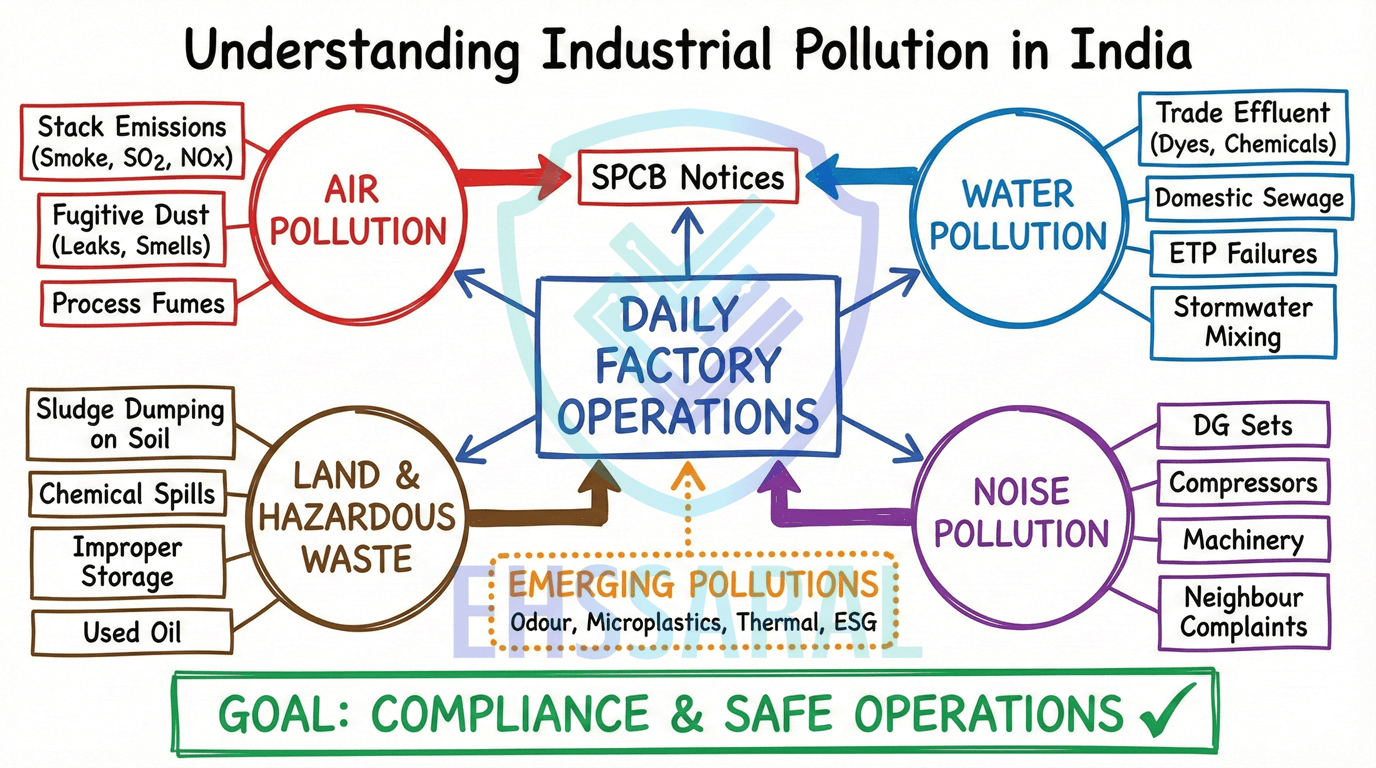
Understanding Industrial Pollution in India

Industrial pollution is not just smoke from a chimney or dirty water coming out of a pipe. In India, pollution from industries is a day-to-day operational reality that every factory-small or big-has to manage carefully. Many EHS officers learn this the hard way, usually after receiving a notice from the SPCB or after a surprise inspection.

Most SMEs think pollution means “just air pollution”. But in reality, industrial pollution has four major dimensions:

  • Air
  • Water
  • Land & hazardous waste
  • Noise

These four combine to decide whether an industry is Red, Orange, Green or White category. They also determine what conditions your Consent to Operate will carry, how strict your monitoring will be, and how often you may face inspections.

As a beginner EHS professional, once you understand how each pollution type actually happens inside Indian factories, 70% of your compliance stress reduces. This guide explains pollution not from a textbook angle, but from real factory floor situations, mistakes commonly seen during inspections, and practical insights gained over years of working with Indian industries.


Why Industries in India Generate Pollution

Every industry-whether textile, food, chemical, pharma, engineering, or automobile-goes through a few basic operations:

  • Combustion (boilers, DG sets, furnaces) → creates air emissions
  • Use of chemicals, dyes, solvents → leads to air emissions + hazardous waste
  • Cleaning, washing, production processes → generates wastewater
  • Machinery & equipment operation → creates noise pollution
  • Material handling, housekeeping gaps → contaminates soil/land

Pollution is simply a by-product of these activities. The goal is not to eliminate it completely-because no industry can-but to control it within standards set by the State Pollution Control Board (SPCB).

If you are a junior EHS officer, owner, or plant head, think of pollution control as your license to operate safely without surprises or notices.


Air Pollution in Industries

Air pollution is the most visible and most misunderstood form of industrial pollution. For many SMEs, “air pollution” means black smoke from a stack. But in reality, air pollution includes:

  • Particulate Matter (PM10, PM2.5)
  • Sulphur Dioxide (SO₂)
  • Nitrogen Oxides (NOx)
  • Carbon Monoxide (CO)
  • Volatile Organic Compounds (VOCs)
  • Dust from material handling
  • Odour emissions

Let’s break this down into simple, real-world terms.


1. Stack Emissions (from Boilers, Furnaces, DG Sets, Thermopacks)

Almost every factory in India uses either:

  • Coal / Petcoke / Briquettes
  • Furnace oil / Diesel
  • PNG / LPG

When fuel burns, it creates:
PM, SO₂, NOx, CO, smoke, and unburnt hydrocarbons.

Common compliance requirements:

  • Stack height as per CPCB formula
  • Sampling port and platform (as per IS-11255)
  • Annual/bi-annual monitoring by NABL lab
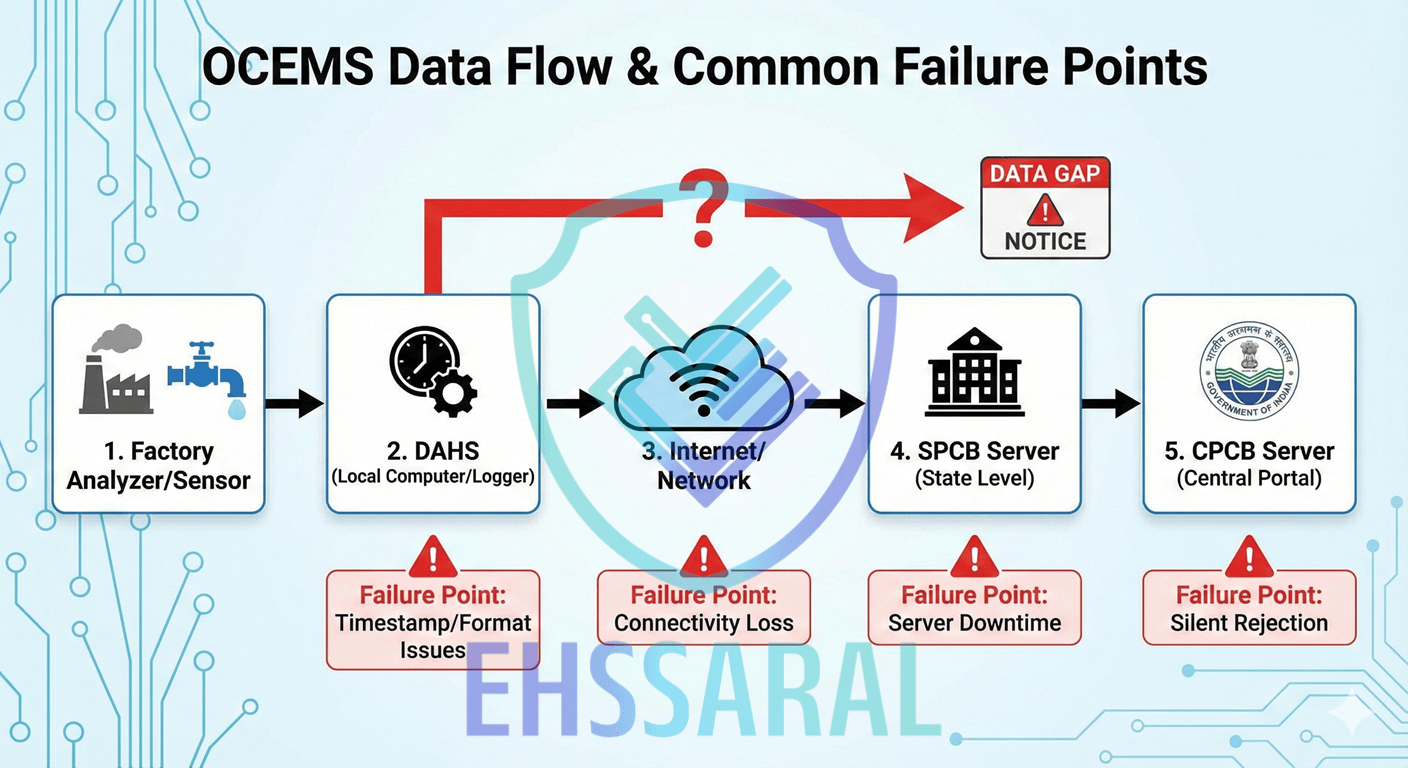
  • OCEMS (Online Monitoring) for large industries
  • Fuel quality reports (for coal/petcoke users)

Typical mistakes seen in SMEs:

  • Wrong sampling point height
  • No proper ladder/railing for sampling
  • Missing 15A power socket at the platform (monitoring teams cannot run equipment without long, unsafe extension cords).
  • Coal quality not checked → SO₂ exceeds limits
  • Using old DG sets without acoustic enclosures
  • No logbook of DG running hours

Reality: 80% of “air pollution notices” in SMEs come because of stack monitoring failures or missing documentation-not because of actual high emissions.


2. Fugitive Emissions (the invisible pollution most factories ignore)

Fugitive emissions are uncontrolled leaks of dust, fumes, vapours or gases that do not go through a stack.

They happen during:

  • Material unloading (lime, cement, coal, fly ash)
  • Grinding, crushing, pulverising
  • Chemical transfers
  • Painting, coating, spraying
  • Storage tank breathing losses
  • Poor housekeeping

Typical issues inspectors notice immediately:

  • Dust on floors, walls, sacks, machinery
  • Coal stored openly
  • Paint smell outside the unit
  • VOC smell near solvent storage
  • No proper ventilation or local exhaust system

Tip for beginners:
If you can smell something in the factory, the inspector can smell it too. And smell = fugitive VOC emission.


3. Process Emissions (specific to industry type)

These emissions depend on what you manufacture.

Examples:

  • Textile: VOCs from printing, smoke from thermopacks
  • Foundry: Melting fumes, metal fumes (Mn, Pb, Zn)
  • Chemical units: HCl, Cl₂, SO₂, NH₃ fumes
  • Pharma: Solvent vapours, VOCs
  • Food industry: Odour emissions

What SPCB expects:

  • Proper scrubber system
  • Mist eliminators
  • Activated carbon filters
  • Enclosed transfer systems

Many SMEs use a scrubber but don’t maintain it. A dry or choked scrubber creates more pollution than no scrubber at all.


4. DG Set Emissions (highly regulated but often neglected)

DG sets produce:

  • NOx
  • PM
  • Noise
  • Unburnt hydrocarbons

Required compliance:

  • Stack height (H = h + 0.2 √KVA)
  • Acoustic enclosure
  • Annual monitoring

Most complaints against DG sets come from neighbours, not SPCB. One prolonged noisy DG can lead to police + SPCB intervention.


5. Odour Pollution (complaint-based but very real)

Odour is a major reason for public complaints in:

  • Food processing
  • Pharma
  • Chemical manufacturing
  • Distilleries
  • Paint/ink units

There is no single “odour limit,” but inspectors judge:

  • Presence of VOC smell outside your boundary
  • Distance from residential areas
  • Effectiveness of scrubbers and activated carbon beds

If your factory smells from outside, it is an air pollution problem-even if your stack results are perfect.


How Inspectors Evaluate Air Pollution During a Visit

Inspectors rarely start with stack data. They look at:

1. Visual signs

  • Smoke colour: black → incomplete combustion
  • Dust on surfaces → fugitive emissions
  • Corrosion near ducts → acid fumes
  • Worker complaints → odour or VOC leakage

2. Housekeeping & storage

  • Coal stored openly
  • Chemical drums leaking
  • No spill trays
  • Solvent barrels kept outside shed

3. Running condition of APCs

(APC = Air Pollution Control)

  • Is the scrubber pump running?
  • Is the water circulation white/dirty/foamy?
  • Is the bag filter torn or clogged?
  • Is the ID fan operational?

4. Documentation

  • Last stack monitoring report
  • Fuel purchase bills
  • DG logbook
  • OCEMS uptime report (for large industries)

Most “show-cause notices” happen because documents were unavailable during the visit-not because emissions exceeded limits.


Quick Checklist for Air Pollution Control (For SMEs & EHS Beginners)

  • Keep stack monitoring reports updated
  • Maintain scrubber water quality (check pH weekly)
  • Use proper ducting, not temporary pipes
  • Install local exhaust ventilation for dusty areas
  • Cover all loose material (coal, sand, fly ash)
  • Maintain DG set acoustic enclosure
  • Conduct regular bag filter inspection
  • Keep all documents ready in one “ECB folder” (Environment Compliance Binder)

If you implement just these 8 points, you eliminate 70% chances of an air-pollution-related notice.


Water Pollution in Industries (The Most Common Reason for SPCB Notices)

When you talk to any EHS officer in India - especially in SMEs - you’ll hear one line again and again:

“Water pollution ke chakkar mein hi sab phas jaate hain.”

And it's true.

Why?

Because water pollution is not just about wastewater going out of the factory. It includes:

  • What water you take in
  • Where and how you use it
  • What quality comes out
  • Whether you treat it properly
  • And whether it mixes with stormwater or groundwater

For most SMEs, the real challenge is not the treatment, but the basics - understanding what wastewater they generate, how much, and what to do with it before an inspector asks.

Let’s break this down practically.

Read more about Environmental Laws in India for EHS Professionals, Plant Head or SME Owner


1. Types of Wastewater Generated in Industries

Almost every industry in India generates three types of water streams:

1) Trade Effluent (Process Wastewater)

This comes directly from production processes:

  • Dyeing, printing, washing (textile)
  • Washing, soaking, curing (food & beverage)
  • Chemical reactions (chem/pharma)
  • Rinsing & surface treatment (electroplating)
  • Boiler blowdown, cooling tower blowdown

Typical pollutants:

  • COD, BOD
  • pH imbalance
  • Colours, dyes
  • Heavy metals (Cr, Cu, Ni, Pb)
  • Oils & grease
  • TDS (salts)
  • Surfactants

This is the water that determines whether your industry is Red, Orange or Green category.


2) Domestic Wastewater (Toilets, Pantry, Washing Area)

Many SMEs assume domestic water “doesn’t matter”, but inspectors check:

  • Septic tank condition
  • STP operation (in large units)
  • Whether domestic water is mixing with trade effluent
  • Whether domestic water is going into stormwater drains

If domestic sewage enters an open drain, it becomes an Environmental Damage Notice instantly.


3) Cooling & Utility Wastewater

Often forgotten, but important:

  • Cooling tower blowdown
  • Boiler blowdown
  • RO reject
  • Softener regeneration waste

These streams usually have high TDS, which affects your ETP performance.


2. Common Water Pollution Problems in Indian Factories

Here are real scenarios observed repeatedly in Indian industrial belts:

Problem 1: Effluent mixed with stormwater

A single wrong pipeline connection…
a cracked chamber…
a careless drain cleaning…

…can make treated water mix with rainwater or groundwater.

Inspectors catch this immediately because:

  • Discharge colour changes
  • There is smell
  • TDS increases in the chamber
  • Sludge marks appear

This alone can result in closure notice or Environmental Compensation.


Problem 2: ETP is installed but not operated

This is the most common issue in SMEs.

Reasons are simple:

  • Skilled operator not available
  • ETP considered “cost centre”
  • No proper dosing
  • ETP runs only on inspection days

An ETP that does not run daily is as good as not having an ETP.


Problem 3: No flow measurement

Inspectors ask only one question:

“How much effluent does your plant generate per day?”

If the answer is “approximately” → red flag.
If the flow meter is not working → red flag.
If no logbook → definite red flag.


Problem 4: Sludge not handled properly

Sludge should be:

  • Dried
  • Stored in HDPE-lined area
  • Sent to TSDF with manifest

But what happens in SMEs?

  • Sludge stored on soil
  • Bags leaking
  • No records of sludge quantity

This becomes both water and land pollution.


Problem 5: Using chemicals without understanding impact

Many ETP operators overdose:

  • Lime
  • Alum
  • Polymer

Result:

  • High TDS
  • Poor settling
  • Colour not removed
  • Increased sludge quantity

An ETP is not magic - it is a controlled chemical process.


3. What Inspectors Check During a Water Pollution Visit

If you understand this section well, you will avoid 80% water-related notices.

A. Physical Infrastructure

Inspectors observe:

  • ETP inlet → outlet flow
  • Condition of tanks (equalization, aeration, settling)
  • pH meter reading
  • Aeration blower sound
  • MLSS colour in aeration tank
  • Sludge dryness
  • Oil & grease traps

B. Documentation

You MUST maintain:

  • ETP logbook
  • Daily pH/COD/BOD records
  • Effluent analysis reports
  • Flow meter reading
  • Sludge disposal receipts
  • Calibration certificates

Missing documents = “non-compliance”, regardless of actual performance.

C. Discharge Point

Inspectors always check:

  • Colour
  • Odour
  • Floating particles
  • Signs of illegal discharge
  • Connection to stormwater drain

If your outlet water looks even slightly coloured, the inspector will ask:
“Why is dye still coming through? Is your ETP running properly?”

Read more about ETP / STP Failures - expert guide


4. Industrial Water Pollution by Sector (Examples)

1) Textile Dyeing

  • Colour
  • High COD
  • TDS from salt
  • Metal contamination from dyes

Real mistake: dumping salt water directly into ETP → ETP fails.


2) Leather & Tannery

  • Chromium
  • Sulphides
  • High BOD
  • Odour

High-risk: Cr(VI) contamination → severe penalties.


3) Pharma

  • Toxic organic compounds
  • Solvent traces
  • API contamination

Inspector’s priority: “Does the ETP remove final COD effectively?”


4) Food & Beverage

  • High BOD
  • Grease
  • Suspended solids

Common issue: blocking of drains → overflow → complaint.


5) Chemical & Engineering

  • Heavy metals
  • Cyanide
  • Acids/alkalis

Common SME mistake: Neutralization tank not maintained.


5. How SMEs Can Reduce Water Pollution Easily

These steps are simple, low-cost, and immediately reduce risk:

1) Fix all water pathways

Create a simple map:

  • Raw water → Process → ETP → Outlet

Once mapped, wrong connections become obvious.

2) Avoid peak-load shock to ETP

Do not dump all wastewater at once.
Equalization tank must function properly.

3) Check pH daily

Most chemical reactions inside ETP fail because pH is not controlled.

4) Maintain proper aeration

If your aeration tank smells bad → bacteria are dying.

5) Train your ETP operator

Even a one-day training can save lakhs in penalties.

6) Keep sludge dry and covered

Wet sludge → leachate → groundwater pollution.


Quick Checklist for Water Pollution Control

  • Flow meter working & readings maintained
  • ETP operated daily
  • Proper sludge handling
  • No mixing of domestic & process wastewater
  • No shortcuts in dosing chemicals
  • ETP area neat & labelled
  • All analysis reports ready
  • Discharge visually clear & colour-free

If you follow this checklist, you reduce almost 90% chances of water-related non-compliance.


Land & Hazardous Waste Pollution in Industries

Land pollution is one of the most underestimated environmental issues in Indian factories.
Why?
Because it is not as visible as smoke or effluent. It happens slowly, quietly - and exactly for this reason, SPCB takes it very seriously.

In India, land and hazardous waste issues usually arise due to:

  • Leaks or spills
  • Wrong storage of chemicals
  • Improper disposal of sludge
  • Hazardous waste stored on soil
  • Rainwater mixing with waste
  • Unauthorised dumping

Let’s break it down in simple terms.


1. What is Hazardous Waste in an Industry?

Hazardous waste is any waste that can:

  • Corrode
  • Catch fire
  • React
  • Release toxic fumes
  • Contaminate soil/groundwater
  • Harm human health

It includes:

  • ETP sludge (from dyes, chemicals, metals)
  • Paint sludge
  • Solvent waste
  • Used oil
  • Spent carbon
  • Contaminated containers
  • Chemical sludge
  • Pharmaceutical residues
  • Acid/alkali neutralization sludge

If your factory generates any of these - you fall under the Hazardous Waste Management Rules, 2016.


2. Typical Issues Seen in SMEs (Real Observations)

1) Sludge placed directly on soil

This is the number one violation in many Indian factories.

What inspectors see:

  • Stains on the ground
  • Wet sludge leaking
  • No HDPE-lined storage area
  • Torn gunny bags

This indicates groundwater contamination risk, which leads to serious penalties.


2) No proper labeling of hazardous waste

Every hazardous waste bag, drum, or container MUST have:

  • Name of waste
  • Category
  • Date of generation
  • Hazard symbol
  • Contact details

Most SMEs skip this - but SPCB insists on it.


3) Unauthorised disposal

Some units give hazardous waste to:

  • Scrap dealers
  • Informal workers
  • Nearby landfills
  • Or dump secretly at night

This is extremely risky and can lead to:

  • Closure notices
  • Environmental Compensation
  • Criminal cases (in serious cases)

4) Improper storage of chemicals

Common red flags:

  • Drums stored outside the shed
  • No spill tray
  • Acid drums rusted
  • Leaking valves
  • Rainwater touching chemical bags
  • No secondary containment

One spill during rains can contaminate the soil for years.


5) Improper handling of used oil

Used oil is a hazardous waste.
It should NOT:

  • Be kept in open containers
  • Be sold to unauthorised vendors
  • Be mixed with regular waste

Used oil must be:

  • Stored in proper drums
  • Labelled clearly
  • Sold only to authorised recyclers

3. What Inspectors Check for Land & Hazardous Waste Pollution

A. Storage Area

They look for:

  • Impermeable flooring
  • Bund walls
  • Roof cover
  • No contact with rainwater
  • Leak-proof containers
  • Proper labeling

B. Records & Documents

You must maintain:

  • Form 3 (Hazardous waste inventory)
  • Form 10 (Manifest)
  • Annual Return (Form 4)
  • TSDF receipts
  • Used oil sale receipts

C. Cleanliness & Housekeeping

They observe:

  • Any spillage marks
  • Oil stains
  • Overflowing bags
  • Rusted barrels

Even old stains tell the inspector the truth.


4. Low-Cost Best Practices (For SMEs)

You do NOT need crores to manage hazardous waste properly.
Even small steps make a big difference:

  • Create a small HDPE-lined platform for waste
  • Use secondary containment trays
  • Label every drum and bag
  • Keep spill kits ready
  • Train workers to handle waste safely
  • Dispose waste every 30–60 days
  • Never store waste outside or near stormwater drains

Just these practices alone can prevent 90% of land pollution problems.


Noise Pollution in Industries

Noise pollution is often ignored - until someone complains.
And in India, complaints from neighbours are the fastest way to get an SPCB visit.

Noise pollution arises mainly from:

  • DG sets
  • Compressors
  • Blowers & ID fans
  • Cutting & grinding machines
  • Boilers
  • Cooling towers
  • Heavy machinery

Let’s understand it practically.


1. Legal Noise Limits (As per CPCB)

Area TypeDay LimitNight Limit
Industrial Area75 dB(A)70 dB(A)
Commercial65 dB(A)55 dB(A)
Residential55 dB(A)45 dB(A)

Your factory’s location decides which limit applies, but for industrial belts, noise violations mostly happen due to DG sets and compressors.


2. DG Set Noise Pollution (Most Common Cause of Complaints)

A DG set should always have:

  • Acoustic enclosure (mandatory)
  • Proper muffler/silencer
  • Vibration pads
  • Foundation bolts

If your DG set is not enclosed, neighbours will likely complain during power cuts.

SPCB inspectors will immediately ask:

  • Is the acoustic enclosure CPCB-approved?
  • Is the silencer original or replaced with a local one?
  • Are vibration pads intact?

If you’re inside a cluster area, complaints increase during night shifts.


3. Common Noise Issues in SMEs

a) Compressors kept outside

Many factories place air compressors outdoors to save space.
This increases noise exposure to neighbours.

b) Blower noise

ID/FD fans of boilers make high-pitched noise, especially if:

  • Bearings are worn
  • Fan alignment is poor

c) Hammering & metal fabrication

Fabrication units generate impact noise, which is extremely disturbing in residential surroundings.

d) Cooling tower noise

Large fans create constant low-frequency noise.


4. Practical Ways to Reduce Noise Pollution

Most solutions are inexpensive:

  • Put compressors inside a room
  • Add acoustic panels around noisy machines
  • Use vibration-damping pads
  • Maintain rotating equipment regularly
  • Close all ventilation gaps near DG sets
  • Install silencers on air exhausts
  • Avoid night-time hammering/cutting

Remember:
Noise issues are solved more through management than technology.


5. What Inspectors Look for in Noise Pollution Cases

  • DG set manufacturing plate (to check CPCB approval)
  • Acoustic enclosure condition
  • Noise measurement report
  • Machine maintenance records
  • Complaints filed by neighbours
  • Material handling area noise level

Even if your machine is compliant, poor documentation can lead to a notice.


Emerging Pollution Types in Indian Industries

Beyond the four major categories (Air, Water, Land/Hazardous Waste, Noise), industries in India are now facing new and evolving forms of pollution. These pollution types are not always measured openly, but they create serious compliance risks - mainly through public complaints, ESG audits, and sector-specific inspections.

Let’s understand them in a simple, practical way.


1. Odour Pollution (Complaint-Based but Very Serious)

Odour is not directly regulated with numeric limits, but it is one of the biggest triggers of public complaints to SPCB.

Industries where odour is common:

  • Food processing plants
  • Spice & masala units
  • Pharma and chemical manufacturing
  • Paint & ink factories
  • Distilleries
  • Fish/meat processing units
  • Waste handling areas

Why odour matters:
Even if your air emissions meet standards, a strong smell outside your boundary means something is escaping into the community.

What SPCB checks:

  • Scrubber efficiency
  • Activated carbon filters
  • Proper ventilation
  • Leakages in ducts
  • Enclosures around odour-generating operations

Odour is the fastest way to get unwanted attention, especially in mixed industrial–residential areas.


2. Light Pollution (Growing Issue in Industrial Belts)

Industries that work at night often use:

  • High mast lights
  • Flood lights
  • Open-yard lighting

These lights cause:

  • Disturbance to nearby residents
  • Glare affecting drivers
  • Migratory bird impact (for certain zones)

While not a major compliance parameter today, light pollution is increasingly being raised in public hearings and environmental clearances.

A simple step like installing downward-facing reflectors or shields can eliminate complaints.


3. Thermal Pollution (Industries Discharging Heated Water)

This is common in:

  • Power plants
  • Dairies
  • Breweries
  • Large-scale food processing
  • Cooling tower blowdown

When hot water is discharged:

  • River temperature rises
  • Aquatic life gets affected
  • Dissolved oxygen decreases

In many Indian states, SPCB has started monitoring the temperature difference between inlet and outlet water.

A rise of more than 5°C is usually considered a risk.


4. Microplastic & Fibre Pollution

Industries contributing to microplastic pollution:

  • Textile mills
  • Packaging units
  • Plastic recycling industries
  • Paint manufacturers
  • Cosmetic & personal care manufacturing

Microplastics enter:

  • ETP sludge
  • Process wastewater
  • Air (during fibre handling)

While India does not yet have strict numeric limits, export buyers, ESG auditors, and international clients are pushing very hard on this parameter.

For EHS officers in textile and FMCG sectors, this will become a major compliance topic in the next 2–3 years.


5. ESG-Driven Pollution Categories (Corporate Audits)

Large companies and MNCs classify pollution risk under ESG (Environmental, Social & Governance) indicators.

Industries must now demonstrate:

  • Carbon footprint reduction
  • Water positivity / water neutrality
  • Zero liquid discharge (ZLD) for certain sectors
  • Circular waste management
  • Energy efficiency
  • Green procurement

Even if SPCB rules are not strict, buyers’ audits can enforce tougher pollution controls.

This especially affects:

  • Tier-2 and Tier-3 suppliers
  • MSMEs supplying to MNCs
  • Export-driven industries

Complying early builds long-term business value.


Final Summary of Industrial Pollution Types

Industrial pollution in India comes from everyday operations:

1. Air Pollution

Smoke, dust, fumes, gases, odour - mainly from:

  • Boilers, DG sets, furnaces
  • Chemical/solvent processes
  • Material handling
  • Poor ventilation

2. Water Pollution

Wastewater carrying:

  • Colour
  • High COD/BOD
  • Heavy metals
  • Oils & grease
  • Salts/TDS

Main reasons for notices:

  • ETP not operating
  • Mixing of stormwater and effluent
  • Improper sludge handling

3. Land & Hazardous Waste Pollution

Caused by:

  • Wrong storage of chemicals
  • Sludge dumped on soil
  • Leaks/spills
  • Unauthorised disposal of waste/used oil

4. Noise Pollution

Mostly from:

  • DG sets
  • Compressors
  • Blowers, fans
  • Cutting & grinding operations

Noise notices come faster when neighbours complain.

5. Emerging Pollutions

  • Odour
  • Microplastics
  • Light pollution
  • Thermal pollution
  • ESG-linked emissions

What Every EHS Officer or Factory Owner Should Do (Simple Action Plan)

Here is a practical, no-excuses pollution control improvement checklist:


A. Air Pollution – Quick Wins

  • Maintain your boiler & DG set
  • Ensure scrubber/bag filter is always ON
  • Monitor stack emissions on time
  • Keep coal, fly ash, lime covered
  • Fix leakage points in ducts

B. Water Pollution – Quick Wins

  • Run the ETP daily
  • Check pH every shift
  • Keep flow meter functional
  • Prevent stormwater mixing
  • Dry & store sludge properly

C. Hazardous Waste – Quick Wins

  • Provide an HDPE-lined platform
  • Label every drum, bag, container
  • Dispose waste only to authorised recyclers
  • Maintain Form 3 & Form 10

D. Noise Pollution – Quick Wins

  • Maintain DG set acoustic enclosure
  • Put compressors inside rooms
  • Add vibration pads below fans/pumps
  • Avoid night-time noisy operations

E. Emerging Pollution – Quick Wins

  • Control odour at source
  • Reduce unnecessary yard lighting
  • Maintain cooling tower temperature
  • Prepare basic ESG data (if you supply to MNCs)

Closing Note

Pollution control is not about buying expensive equipment.
It is about:

  • understanding your processes,
  • maintaining equipment properly,
  • keeping records ready,
  • and preventing small issues from becoming big violations.

If you understand the types of industrial pollution, you can handle any inspection confidently and build a culture of compliance inside your factory.


Frequently Asked Questions (FAQs)

(Types of Pollution in Industries in India)


1. What are the main types of pollution caused by industries in India?

Industries mainly create four types of pollution:

  1. Air Pollution – smoke, dust, fumes, gases
  2. Water Pollution – contaminated wastewater from processes
  3. Land & Hazardous Waste Pollution – sludge, chemicals, used oil
  4. Noise Pollution – DG sets, machines, compressors

Many factories also generate odour, heat, microplastics, which are now emerging pollution concerns.


2. Which industry is the biggest contributor to industrial pollution in India?

There is no single industry, but these sectors contribute the most:

  • Thermal power plants → highest air emissions
  • Textile, chemical, pharma → highest water pollution
  • Leather, electroplating → highest heavy metals
  • Foundries, cement → highest dust and particulate matter
  • Engineering & fabrication → high noise levels

SMEs overall contribute a large share because of outdated technology and poor waste management.


3. What is considered hazardous waste in a factory?

Hazardous waste is any waste that can harm people, soil, or water, such as:

  • ETP sludge
  • Used oil
  • Paint sludge
  • Contaminated rags/containers
  • Chemical sludge
  • Spent carbon
  • Solvent residues

This waste must be stored properly and sent only to authorised recyclers / TSDF.


4. What are common water pollution mistakes SMEs make?

Top mistakes:

  • ETP not operated daily
  • Effluent mixing with stormwater
  • No flow meter or wrong reading
  • Overdosing chemicals
  • Sludge stored on soil
  • Domestic wastewater mixing with process wastewater

These mistakes lead to most notices from SPCB.


5. How often should stack and effluent monitoring be done?

It depends on your industry category, but generally:

  • Stack emissions → once or twice a year
  • Effluent analysis → monthly or quarterly
  • Noise monitoring → annually
  • Hazardous waste returns → annually

For large industries, OCEMS (Online Continuous Monitoring) may be mandatory.


6. Why is odour a serious pollution issue?

Odour quickly leads to public complaints, and SPCB responds fast.
Even if all your readings are within limits, strong smell outside the boundary means:

  • Scrubber not working
  • VOC leakage
  • Poor housekeeping
  • Wrong storage of chemicals
  • Incomplete combustion

Odour is the simplest sign of pollution, so it cannot be ignored.


7. Can improper hazardous waste storage cause groundwater pollution?

Yes.
If sludge or chemicals touch soil, rainwater carries contaminants into the ground.
SPCB considers this a serious violation, and penalties are high.

This is why hazardous waste must always be stored on a covered HDPE-lined platform with proper labels.


8. What are the CPCB noise limits for industries?

In India:

  • Industrial area: 75 dB day / 70 dB night
  • Commercial area: 65 dB day / 55 dB night
  • Residential area: 55 dB day / 45 dB night

DG sets must have an acoustic enclosure as per CPCB norms.


9. Why do SMEs struggle more with pollution control compared to MNCs?

SMEs struggle mainly because of:

  • Limited capital
  • Small space
  • Outdated machines
  • Lack of trained operators
  • Lack of documentation
  • ETP and APC (scrubber/bag filter) running costs

MNCs have stricter internal audits and ESG commitments, so compliance levels are usually higher.


10. How can a factory reduce pollution without major investment?

Simple low-cost improvements can make a huge difference:

  • Maintain boiler/DG set regularly
  • Use proper ducting and housekeeping
  • Run ETP daily and control pH
  • Keep waste on HDPE-lined area
  • Use spill trays for chemicals
  • Cover dusty material
  • Put compressors inside a room
  • Train your operators

Many compliance issues happen not because of equipment, but because of habits.


11. What documents are important for pollution control inspections?

Every EHS officer should maintain:

  • Stack & effluent analysis reports
  • ETP logbook
  • Flow meter records
  • Hazardous waste Form 3 & Form 10
  • Used oil disposal records
  • Calibration certificates
  • DG set and APC maintenance records
  • Safety data sheets (SDS)

Missing documents often lead to notices even if operations are fine.


12. What is the link between industrial pollution and industry category (Red/Orange/Green/White)?

Your pollution potential decides your category:

  • Red – High pollution (chemical, pharma, dyeing, steel, cement)
  • Orange – Medium pollution (food processing, paper, engineering)
  • Green – Low pollution (assembly, packaging, small workshops)
  • White – Practically no pollution

Your category determines:

  • Consent conditions
  • Monitoring frequency
  • Equipment requirements

13. Can a factory get shut down due to pollution issues?

Yes.
SPCB can issue:

  • Show-cause notice
  • Directions under Water/Air Act
  • Closure orders
  • Environmental Compensation penalties

Shutdown usually happens when:

  • ETP/APC is not functional
  • Waste is dumped illegally
  • Public complaints are serious
  • Repeated violations occur

14. What is the first thing an EHS beginner should fix to improve compliance?

Start with three basics:

  1. Run the ETP daily
  2. Keep APC (scrubber, bag filter) running when required
  3. Create a simple “Compliance Folder” with all reports

These three alone prevent 70% of notices.


15. Do SPCB inspectors focus more on documentation or actual pollution?

Both - but documentation is checked first.

If documents are missing, outdated, or inconsistent, the inspector assumes operations are non-compliant.

Good documentation creates immediate trust.


16. Is noise pollution checked during environmental inspections?

Yes, especially when:

  • There are complaints
  • DG sets are running
  • The unit is near a residential area
  • Machinery is old or poorly maintained

Noise is a quick indicator of poor maintenance.


17. What is the role of ETP sludge in pollution?

ETP sludge contains:

  • Heavy metals
  • Toxic dyes
  • Chemicals
  • TDS
  • Suspended solids

If dumped on soil, it directly contaminates groundwater.
Therefore, proper drying, storage, and disposal is mandatory.


18. What is the biggest mistake EHS beginners make?

Relying only on equipment.

Compliance is 70% discipline, 30% machinery.

The biggest mistakes are:

  • Not maintaining records
  • Not training operators
  • Running ETP/APC only during inspection
  • Ignoring small leaks or spills

19. How can a company show improvement in pollution control?

By consistently following:

  • Monthly analysis
  • Regular maintenance
  • Proper waste storage
  • Zero mixing of stormwater and effluent
  • Correct documentation

Even small improvements add up over time.


20. Why should industries care about “emerging pollution types”?

Because the future of compliance is shifting beyond traditional air and water norms.

Odour, microplastics, ESG indicators, thermal discharge - these will become major parameters in:

  • Export audits
  • Buyer requirements
  • Corporate ESG reports
  • Environmental clearances

Preparing early gives a competitive advantage.

Harshal T Gajare

Harshal T Gajare

Founder, EHSSaral

Second-generation environmental professional simplifying EHS compliance for Indian manufacturers through practical, tech-enabled guidance.

Related Blogs

Hazardous Waste Classification in India: Inspector’s Guide (2025) | EHSShala

Hazardous Waste Classification in India: Inspector’s Guide (2025) | EHSShala

The Paper Shield: PF & ESIC Challans vs Real Compliance Risk | EHSSaral

The Paper Shield: PF & ESIC Challans vs Real Compliance Risk | EHSSaral

Plastic Waste Management Rules (2022): Practical Guide for Indian Factories | EHSShala

Plastic Waste Management Rules (2022): Practical Guide for Indian Factories | EHSShala

Managing Safety Without Authority: Handling Protected Contractors in Indian Plants | EHSSaral

Managing Safety Without Authority: Handling Protected Contractors in Indian Plants | EHSSaral

Why BMW Inspections Feel Stricter Today (India) | EHSSaral

Why BMW Inspections Feel Stricter Today (India) | EHSSaral

MPCB CTO Refusal Patterns in Maharashtra (2023–2025) Analysis | EHSSaral Research

MPCB CTO Refusal Patterns in Maharashtra (2023–2025) Analysis | EHSSaral Research

Transforming SME Compliance: Zero Surprise Failures in India | EHSSaral Research

Transforming SME Compliance: Zero Surprise Failures in India | EHSSaral Research

How MoEFCC, CPCB & SPCB Work in India: Expert Guide | EHSShala

How MoEFCC, CPCB & SPCB Work in India: Expert Guide | EHSShala

Sampling Basics for Air, Water & Noise EHS Officer Guide | EHSShala

Sampling Basics for Air, Water & Noise EHS Officer Guide | EHSShala

Environmental Compliance Calendar Software – Simplify MPCB Renewals & Due Dates | EHSSaral

Environmental Compliance Calendar Software – Simplify MPCB Renewals & Due Dates | EHSSaral