

Blog
Managing Safety Without Authority: Handling Protected Contractors in Indian Plants | EHSSaral
EHSSaral is an Environmental Compliance Intelligence Platform for Industries. Consent Intelligence • Alerts & Tasks • Incident Reporting • Form IV & V • Audit-Ready Records
See how EHSSaral works
24 Jan 2026
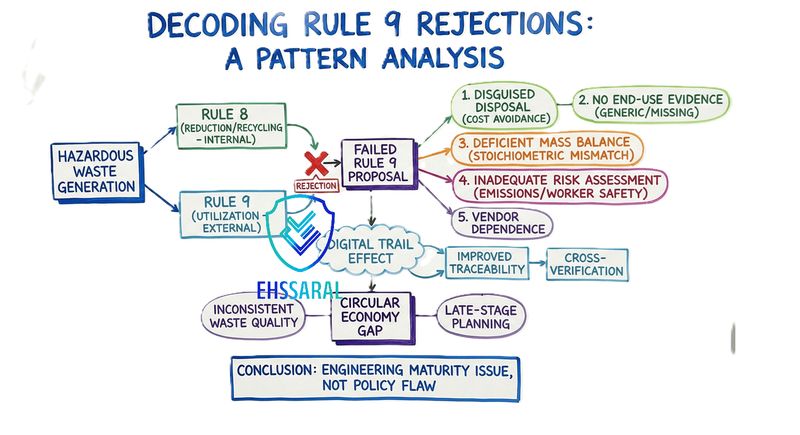
Between 2023 and 2025, Maharashtra has witnessed a noticeable increase in the rejection of hazardous waste utilization proposals submitted under Rule 9 of the Hazardous & Other Wastes (Management and Transboundary Movement) Rules, 2016. These rejections have often been interpreted by industry as a sign of tightening regulations or resistance to circular economy initiatives. However, a closer examination of observable regulatory outcomes suggests a different explanation.
This paper finds that Rule 9 is not failing as a policy mechanism. Rather, utilization proposals are increasingly unable to meet the engineering, evidentiary, and risk-assessment standards now expected by regulators. In many cases, hazardous waste utilization continues to be framed as a cost-reduction or disposal-avoidance exercise, instead of a technically defensible process with demonstrable environmental and occupational safety.
The period after 2023 marks a shift in enforcement behavior - not due to major amendments in the rules, but due to greater scrutiny enabled by digitized workflows, improved traceability of hazardous waste movements, and cross-verification of historical data. Applications that may have passed earlier under form-based evaluation are now subjected to deeper technical examination.
The consequences of these failures are significant. Industries remain locked into rising TSDF disposal costs, EHS professionals increasingly perceive Rule 9 as a “high-risk” regulatory pathway, and the broader objectives of resource recovery and circular economy adoption remain unrealized at the plant level.
This study analyzes recurring rejection patterns in Rule 9 applications across Maharashtra, identifies the systemic technical gaps underlying these failures, and reframes the issue as an industry capability challenge rather than a regulatory bottleneck.
A foundational cause of Rule 9 rejection patterns lies in persistent conceptual confusion between different regulatory provisions governing hazardous waste management.
Rule 8 focuses on minimization at source. It prioritizes:
Rule 8 actions typically remain within the control boundary of the generating unit and do not require external utilization justification.

Rule 9 governs the use of hazardous waste as a resource in another process, product, or application. Approval under Rule 9 requires evidence that:
Critically, Rule 9 is not intended to function as an alternative disposal route. It imposes a higher evidentiary burden because it extends regulatory responsibility beyond waste generation into downstream process outcomes.
Co-processing, particularly in cement kilns, is often mistakenly treated as synonymous with Rule 9 utilization. In practice, co-processing represents a subset of Rule 9, governed by specific CPCB guidelines, established SOPs, and long-standing institutional acceptance.
Its comparatively smoother approval pathway stems from:
In contrast, utilization proposals involving bricks, construction materials, process substitution, or chemical recovery face higher scrutiny due to variability in process control and end-use exposure pathways.
Failure to distinguish between these categories leads to misaligned expectations and poorly framed applications.
Several structural factors sustain this confusion:
These factors contribute directly to rejection outcomes when applications reach technical scrutiny stages.
This study relies exclusively on non-confidential, defensible, and observable data, ensuring analytical integrity and regulatory neutrality.
This ensures that conclusions are grounded in verifiable regulatory behavior, not anecdotal inference.
The study employs qualitative pattern analysis, focusing on recurring failure points rather than individual case outcomes. Emphasis is placed on:
Each pattern is assessed using four primary lenses:
This research is:
It seeks to explain why utilization proposals fail, not how to secure approval.
This distinction is intentional and essential for maintaining regulatory and ethical neutrality.
Across reviewed Rule 9 utilization proposals, rejection outcomes rarely stem from a single missing document or clerical lapse. Instead, failures emerge from structural weaknesses embedded in how utilization itself is conceptualized, justified, and presented.
These weaknesses repeat across industries, waste categories, and end-use claims, indicating systemic patterns rather than isolated mistakes. This section dissects those patterns in sequence, tracing where and why proposals fail under technical scrutiny.
One of the most consistent rejection drivers is the implicit framing of utilization as a cost-avoidance mechanism rather than a technically justified process.
In such proposals:
Regulatory evaluation increasingly distinguishes between:
Applications in the latter category struggle to establish legitimacy, as they fail to answer a fundamental question:
What environmental or process value does this utilization create beyond cost reduction?
Without a clear answer, proposals are perceived as disposal reframed through circular-economy language, triggering skepticism at early scrutiny stages.
Another dominant failure pattern is the lack of credible end-use substantiation.
Common observations include:
In some cases, even where an end user exists, proposals fail to demonstrate:
From a regulatory perspective, utilization without a secured and technically compatible end user introduces unacceptable uncertainty. It raises questions about:
Consequently, applications lacking end-use certainty are frequently rejected, regardless of the waste’s theoretical usability.
Read Hazardous Waste Storage Rules in Indian Factories
Mass balance analysis represents one of the most critical - and most frequently deficient - components of Rule 9 proposals.
Observed issues include:
Many applications describe utilization in narrative terms but fail to reconcile:
Beyond basic mass balance, regulators increasingly identify stoichiometric inconsistencies - situations where the claimed conversion of waste into product is chemically implausible.
Examples include:
Such inconsistencies signal that utilization claims are conceptual rather than engineering-based, undermining the proposal’s technical credibility. Even when not explicitly cited, these mismatches contribute significantly to rejection outcomes.
Rule 9 extends regulatory concern beyond waste generation into utilization-stage impacts. However, many applications fail to address this shift adequately.
Common omissions include:
Instead, risk assessments often focus solely on waste characteristics at generation stage, neglecting changes introduced by:
From an enforcement standpoint, this creates an incomplete risk profile. Utilization that appears benign at the waste generation stage may introduce new environmental or occupational hazards during processing - hazards that must be anticipated and controlled.
Proposals that do not explicitly acknowledge and address these risks struggle to satisfy safety expectations under Rule 9.
A subtle but recurring pattern is the delegation of technical responsibility to third-party vendors or technology providers.
Typical indicators include:
While vendors may provide legitimate technologies, Rule 9 accountability ultimately rests with:
When applications outsource justification entirely to vendors, they signal:
This perception significantly weakens regulatory confidence in the proposal’s long-term compliance viability.
A particularly critical failure pattern emerges when utilization is proposed for waste streams without an existing CPCB Standard Operating Procedure (SOP).
Instead of initiating a Trial Run under Rule 9(2) - which is explicitly intended for such scenarios - applicants often:
Trial runs are designed as risk-containment mechanisms, allowing regulators to evaluate:
Avoiding trial runs signals an attempt to bypass uncertainty, not manage it. From a regulatory perspective, this raises concerns about:
As a result, proposals exhibiting SOP mismatch or trial-run avoidance face elevated rejection risk, often at preliminary technical review stages.
Importantly, these failure modes rarely occur in isolation.
A typical rejected application may simultaneously exhibit:
This compounding effect magnifies regulatory concern. What might be tolerable as a single gap becomes unacceptable when multiple uncertainties converge.
Despite regulatory clarity, these failures continue due to:
Until utilization planning is embedded earlier in process design, these structural weaknesses are likely to persist.
A key question arising from increased Rule 9 rejection rates is whether regulatory expectations themselves have changed. An examination of applicable rules, notifications, and guidelines indicates that no major amendments to Rule 9 occurred during this period that would independently explain the observed pattern.
Instead, the shift is best understood as an enforcement maturity transition.
Between 2023 and 2025, regulatory evaluation in Maharashtra moved decisively from form-centric compliance assessment to technical defensibility review. This transition did not introduce new obligations but made existing ones visible, verifiable, and cross-checkable.
In this context, Rule 9 proposals began to fail not because standards were raised arbitrarily, but because latent inconsistencies could no longer remain hidden.
One of the most consequential - yet often underestimated - drivers of rejection outcomes has been the digitization of hazardous waste records and workflows.
Historically, hazardous waste management relied heavily on:
Under such systems, discrepancies between:
could remain undetected for extended periods.
The gradual digitization of:
has enabled regulators to establish continuous traceability across the waste lifecycle.
This digital integration has had a compounding effect:
In several observed cases, Rule 9 proposals failed not because the utilization itself was fundamentally flawed, but because the proposal conflicted with previously declared waste handling patterns.
What was earlier tolerated as administrative variation is now interpreted as technical inconsistency.
The rise in rejection rates post-2023 can therefore be attributed to three reinforcing factors:
This shift has narrowed the margin for approximation. Utilization claims that rely on narrative justification rather than quantifiable evidence increasingly fail to pass technical scrutiny.
India’s hazardous waste framework explicitly supports the principles of resource recovery and circular economy. However, a persistent gap remains between policy intent and operational feasibility at the plant level.
This gap is not ideological. It is structural.
One of the most under-discussed challenges in hazardous waste utilization is batch-to-batch variability.
Unlike virgin raw materials, hazardous waste streams often exhibit:
From an end user’s perspective, such variability undermines:
As a result, even technically viable utilization pathways may be rejected due to reliability concerns, not environmental opposition.
End users of hazardous waste-derived materials bear:
In the absence of:
end users often withdraw from utilization arrangements, leaving Rule 9 proposals without durable downstream support.
Another systemic limitation is the timing of utilization consideration.
In many cases:
By this stage, waste characteristics are already locked in, leaving limited scope for:
This reactive approach makes utilization structurally fragile and more likely to fail regulatory evaluation.
As rejection experiences accumulate, a feedback loop emerges:
This loop reinforces itself despite policy encouragement, creating a paradox where utilization is promoted in principle but avoided in practice.
The evidence from 2023–2025 suggests that the central challenge is not regulatory resistance, but capability alignment.
Until utilization is approached with the same rigor as process design or product development, this gap is likely to persist.
The rejection patterns observed in Rule 9 utilization proposals have implications that extend beyond individual applications. They influence industry behavior, professional decision-making, and regulatory outcomes at a systemic level.
For industrial units, particularly SMEs, repeated Rule 9 rejections translate into:
Over time, this reinforces a compliance-only mindset, where hazardous waste is managed to satisfy minimum legal obligations rather than optimized as a controllable process output.
For EHS professionals, Rule 9 increasingly becomes perceived as a high-risk regulatory zone.
Observed outcomes include:
This dynamic narrows the professional role of EHS teams from process integrators to document custodians, limiting both professional growth and organizational resilience.
High rejection rates are often interpreted externally as regulatory rigidity. However, the patterns examined in this study suggest a different interpretation.
From a regulatory standpoint:
Seen through this lens, rejection outcomes highlight an industry capability gap rather than resistance to utilization itself.
While the patterns identified are consistent and repeatable, this study has inherent limitations:
These limitations do not invalidate the findings but frame them within an interpretive, pattern-based context.
The evidence from 2023 to 2025 leads to a clear and consistent conclusion:
Rule 9 is not failing as a regulatory mechanism.
Utilization proposals are failing to meet engineering and evidentiary maturity.
The shift in rejection patterns reflects:
Until hazardous waste utilization is approached as a process engineering decision - incorporating mass balance, risk assessment, end-use certainty, and operational accountability - rejection outcomes are likely to persist.
Circular economy adoption in hazardous waste management is therefore not constrained by regulatory intent, but by execution quality and institutional readiness.
Harshal T Gajare (Founder - EHSSaral)
Harshal T Gajare combines a technical foundation in Chemistry and Data Science with over two decades of family-led experience in environmental compliance at Perfect Pollucon Services. As the Founder of EHSSaral, he specializes in data-driven regulatory intelligence-decoding enforcement patterns to help industries bridge the gap between policy intent and plant-level execution. His work focuses on transforming environmental compliance from a checklist exercise into a defensible engineering discipline.
This document is an independent analytical study prepared for educational and informational purposes only.

Founder, EHSSaral
Founder - EHSSaral | Partner - Perfect Pollucon | ISO 14001 Lead Auditor | GHG Protocol Scope 2 | Chemist | Data Scientist | Second-generation environmental professional simplifying EHS compliance for Indian industries through practical, automated, tech-enabled, data driven compliance workflows.
Managing Safety Without Authority: Handling Protected Contractors in Indian Plants | EHSSaral
Common Hazardous Waste Mistakes in Indian Factories | EHSShala
Plastic Waste Management Rules in India: A Practical Guide for Factories, Warehouses and Offices
Noise Monitoring in Factories Workplace vs Boundary (India Guide) | EHSShala
 EHSSaral.webp)
Environmental Monitoring Mistakes in Indian Factories (Real Issues Explained)
Bio-Medical Waste Management Rules, 2016 for Factories
Evolution of EHS in India - (Part 2) Post-Bhopal | EHSShala
Why Safety Culture Fails in Indian SMEs: People & Compliance Challenges | EHSSaral Research

Form 4 vs Form 5: Why Hazardous Waste Numbers Don't Match
Ozone-Depleting Substances Rules, 2000 - A Practical Guide for Indian Industries