
Blog
OCEMS Data Gaps Explained: Why CPCB Rejects Data & How to Fix | EHSSaral
EHSSaral is an Environmental Compliance Intelligence Platform for Industries. Consent Intelligence • Alerts & Tasks • Incident Reporting • Form IV & V • Audit-Ready Records
See how EHSSaral works
20 Aug 2026
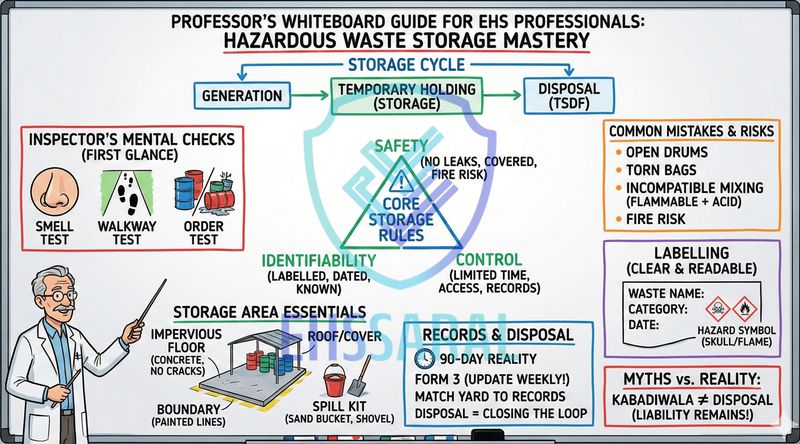
In most factory inspections, hazardous waste storage decides the mood of the visit.
Not the consent file.
Not the portal login.
Not even Form 3.
Storage.
Because storage is physical.
It is visible.
It cannot be explained away easily.
If storage looks organised, inspectors slow down.
If storage looks careless, inspectors start assuming other things are also careless.
This article exists to remove that anxiety.
Not by quoting rules.
But by explaining how storage is seen, judged, and understood in real inspections.
Most factories are not trying to hide anything.
They are just unclear about what “good storage” actually looks like on the ground.
Hazardous waste storage is temporary holding of waste inside your factory.
Nothing more.
Nothing less.
It is not disposal.
It is not dumping.
It is not a long-term solution.
Storage exists for three simple reasons:
To prevent pollution before disposal happens
To prevent fire, leaks, and exposure
To keep waste traceable till it leaves the factory legally
Think of storage as a controlled pause.
The moment storage loses control, it stops being “storage” in the inspector’s mind.
Walk into most Indian factories and you will find hazardous waste in a few predictable places.
Not because someone planned it badly.
But because these spots are convenient.
Common reasons factories choose these areas:
Close to where waste is generated
Already have concrete flooring
Away from production activity
Legacy layouts that “worked earlier”
Typical storage locations you will see:
A designated hazardous waste yard
ETP sludge drying or holding area
Used oil drum room near DG sets
Empty chemical container stacking zone
Inspectors already know these patterns.
They are not surprised by the location.
They are judging how that location is managed.
Track hazardous waste storage and disposal compliance in EHSSaral. See how it works !
This part decides whether the inspection feels calm or tense.
Before anyone asks questions, three silent checks happen.
Officers often smell the storage area before they fully see it.
Strong solvent smell.
Rotting sludge smell.
Chemical fumes from a distance.
Smell creates an immediate assumption:
leakage
stagnation
poor control
Once that assumption forms, every answer you give is questioned harder.
Inspectors hate struggling to reach the storage area.
If they have to:
climb over scrap
step around broken drums
walk through clutter
…the message received is simple:
“There is something you don’t want me to see clearly.”
A clean, open path reduces suspicion more than any explanation.
At one glance, inspectors notice:
Is the area defined or scattered?
Are drums kept inside a boundary?
Is waste mixed with general scrap?
Is it covered or exposed?
They are not counting kilograms yet.
They are judging intent.
Order suggests control.
Chaos suggests neglect.
Forget long checklists.
Storage compliance rests on three ideas only.
No leakage
No soil contact
No rainwater entry
Fire risk under control
If waste can leak, burn, or spread - storage has failed.
At any moment, these questions should be answerable without panic:
What waste is this?
How much is stored?
Since when?
If waste has no identity, it creates fear.
Anonymous waste always looks dangerous.
Control means:
Limited storage time
Limited access
Recorded movement
Once storage becomes “anyone can dump anything anytime,”
control is lost.
“Most storage problems are not about quantity.
They are about loss of control.”
Inspectors do not separate storage from mindset.
Good storage tells them:
This factory notices small things
This factory tracks its waste
This factory plans disposal
Bad storage tells them:
Records may be weak
Disposal may be delayed
Problems may be hidden
That is why storage is inspected first, even when files exist.
This is where most factories panic.
Someone hears “90 days”
Someone checks the calendar
Someone starts worrying about penalties
Let’s slow this down.
Hazardous waste storage is generally limited to 90 days.
This number exists for one reason only:
to prevent waste from sitting forgotten inside factories.
It is not meant to trap industries.
It is meant to stop stagnation.
In real inspections, officers rarely start by counting days.
They start by looking at the waste itself.
Dust on drums.
Rust on containers.
Cobwebs on bags.
Faded or missing labels.
These visual signs tell them one thing:
“This waste has been lying here for a long time.”
Once that thought enters the mind, the exact number of days becomes secondary.
“If waste looks abandoned, the calendar does not save you.”
In practice, smaller generators often seek extended storage time.
This usually works only when:
the request is made openly
quantities are small
records are clean
disposal intent is visible
What creates trouble is silence.
Waste lying for long periods without explanation looks like avoidance, not limitation.
This is where factories overthink drawings and miss basics.
Inspectors are not expecting world-class infrastructure.
They are expecting control-friendly design.

Impervious flooring simply means:
liquid should not seep into the ground.
Concrete flooring is expected.
But officers also look at:
cracks in concrete
oil stains
blackened patches
A black floor tells a story:
“If it reached here, it likely reached the soil.”
That single visual creates environmental doubt.
You do not need fancy fencing.
What works:
painted boundary lines
barricades
low walls
The message should be clear:
“This area is meant only for hazardous waste.”
Undefined areas invite misuse.
Cover is important when:
waste can dissolve or leach
rainwater can cause overflow
sludge can spread
It is not about beauty.
It is about preventing contamination.
Seasonal Reality (Often Missed):
Storage discipline is tested differently in June than in January.
During monsoon, sludge leachate, water ingress, and flooding expose weak storage practices very quickly.
What looks controlled in dry months may fail in heavy rain.
Books say:
“Maintain emergency response equipment.”
On site, inspectors expect something much simpler.
A bucket of sand.
A shovel.
That’s it.
No sand means:
“No immediate response if something leaks.”
“No sand bucket = no spill plan in the officer’s mind.”
This is where problems start slowly.
Not because people don’t care.
But because “temporary” becomes permanent.
Common observations:
Open drums kept “for now”
Torn bags tied with rope
Rusted drums reused repeatedly
Chemical containers reused without cleaning
Each of these sends a signal:
“This waste is not being actively managed.”
More serious than physical damage is wrong mixing.
Examples often seen:
flammable solvent drums kept next to sludge
acidic waste stored near oil
multiple hazardous waste types dumped in one container
Inspectors fear one thing more than paperwork errors:
fire and reaction risk.
Incompatible storage is treated as unsafe, even if quantities are small.
Keeping hazardous wastes in separate containers does not automatically mean they are chemically segregated. Shared spill trays, bunds and drainage can still bring incompatible waste streams together. See our detailed guide to hazardous waste compatibility and segregation.
Once fire risk is perceived:
inspection becomes stricter
explanations matter less
safety questions increase
This is why separation distance matters.
Not because of rules on paper,
but because officers imagine worst-case scenarios.
Labelling is not about format.
It is about clarity.
Minimum information expected:
waste name
category
date of storage start
Handwritten labels are acceptable
if they are readable and stable.

Many labels fail one simple test.
Rain.
If ink runs,
if paper tears,
if dates disappear,
…the label is treated as missing.
Permanent marker or laminated paper costs almost nothing,
but signals seriousness.
Reality Check (Seen Often):
If label ink runs during rain, inspectors treat the label as missing.Using a permanent marker or laminating the paper costs almost nothing,
but it prevents unnecessary questions during inspection.
Skull symbol.
Flammable sticker.
Even cheap stickers create an impression:
“This factory understands danger.”
It is symbolic, but inspectors notice it.
This is where many inspections quietly turn serious.
The officer looks at the storage yard.
Then looks at Form 3.
If both tell the same story, the inspection stays calm.
If they don’t, trust drops immediately.

A very common situation:
Fresh waste visible in the yard
Form 3 last entry done weeks or months ago
This creates only one assumption:
“Records are not being updated regularly.”
Even if disposal is genuine, the delay in updating Form 3 raises doubts.
Simple discipline that works:
Update Form 3 logbook weekly
Even if quantities are small
Even if no disposal happened
“Inspectors trust records only when they look alive.”
If the yard shows:
many drums
large sludge piles
…but Form 3 shows:
very small quantities
The officer stops trusting both.
This mismatch often leads to:
deeper questioning
cross-checking past manifests
review of disposal frequency
Read more about Form 10 Manifest Explained - 7 Copies & What Inspectors Check
This confusion causes more non-compliance than any rule.
Storage is not a solution.
Storage is only a waiting stage.
When waste stays stored for long periods without disposal,
it starts looking like avoidance, not limitation.
From an inspector’s perspective:
storage without disposal = incomplete compliance
This is why officers often ask:
“When was your last disposal?”
Not:
“How nicely is this stored?”
Because disposal closes the loop.
Even if storage is slightly messy,
recent disposal shows intent.
But if disposal is old or unclear:
storage is questioned harder
time limits become critical
records are checked closely
“Recent disposal forgives many small storage flaws.”
Let’s clear some dangerous beliefs calmly.
Reality:
Storage rules apply even when not explicitly written.
Storage must still be safe, limited, and controlled.
Silence in consent is not permission.
Reality:
Small units may get practical leniency,
but not unlimited freedom.
Leniency works only when:
intent is visible
quantities are low
records are clean
Reality:
Cover prevents rain.
It does not remove time limits.
Long-stored waste still looks abandoned,
covered or not.
This is the most dangerous myth.
If that scrap dealer:
dumps it illegally
mixes it with general waste
causes contamination
…and the waste is traced back to your factory,
liability returns to you, not the kabadiwala.
Waste responsibility does not end at the gate.
Myth | Reality |
|---|---|
"Consent doesn't mention storage, so it's allowed." | Storage rules apply to everyone. Silence in consent is not permission. |
"We are a small unit, rules are relaxed." | Leniency is only for those who show intent. Chaos is never excused. |
"Covered area means unlimited storage." | Cover prevents rain, not time limits. Old waste is still old waste. |
"I gave it to the kabadiwala, so it’s gone." | Most Dangerous. If the scrap dealer dumps it illegally, the liability returns to you. |
Why Most Environmental Non-Compliance Is a System Failure
Most factories have a hazardous waste display board
at the main gate.
Inspectors often check two things:
what the board says
what the yard shows
If the board says:
“0.5 tons stored”
But the yard looks like:
“5 tons lying”
The problem is not the board.
The problem is credibility.
“Boards don’t fail inspections.
Mismatch does.”
These are not expensive systems.
They are discipline habits.
One fixed storage location only
One designated key holder for the waste yard
Monthly internal storage review
Clear date marking on every container
Photo record before disposal
Basic color coding for zones or drums
Color coding costs almost nothing,
but makes the factory look organised and intentional.
This reduces panic during questioning.
There is a big difference between:
Valid situation:
“We are waiting for TSDF slot confirmation.”
Gap:
“We forgot.”
Another example of a valid situation:
“Our regular TSDF changed acceptance criteria for this waste category recently.
We are in the process of qualifying an alternate authorised facility.”
This shows awareness, action, and control - not avoidance.
Acknowledging a gap calmly often builds more trust
than defensive explanations.
Inspectors respond better to honesty than avoidance.
Do not try to fix everything at once.
Priority order that works:
Stop leaks and open exposure
Identify and label clearly
Separate incompatible waste
Plan disposal
Align Form 3 and physical storage
Most issues reduce once control returns.
This checklist is designed for real inspections - not for files.
It focuses on what inspectors see first, question first, and doubt first.
Use it before inspections, during internal audits, or whenever storage starts feeling “unclear.”
You don’t need perfection.
You need control.
What to do when hazardous waste exceeds the permitted storage period
Location: ___________________
Checked By: ___________________
Date: ___ / ___ / ___________
☐ Can I walk directly to the storage area without obstacles?
☐ Can I identify every waste container without asking someone?
☐ Does this area look controlled, not forgotten?
👉 If any answer is NO, start fixing that first.
☐ Storage area clearly marked / bounded
☐ Impervious flooring (concrete, no cracks or black stains)
☐ Weather protection (covered where waste is leachable)
☐ Clear access path (no climbing over scrap)
☐ Drainage clear (no water pooling near drums)
☐ Drums / bags intact, closed, not rusted
☐ No surface leakage on containers
☐ Incompatible waste kept separate
(solvents ≠ acids, flammable ≠ oxidizers)
☐ Solvent drums not placed next to sludge
☐ Compatibility chart displayed near storage area
☐ Waste name and category mentioned
☐ Storage start date clearly written
☐ Labels readable even after rain
☐ Hazard symbols visible (skull / flame / corrosive)
☐ Bucket of sand available
☐ Shovel available
☐ Fire extinguisher nearby and valid
☐ Basic PPE available at entry (gloves / mask)
☐ Last disposal done within ____ days
☐ Form 3 updated within last 7 days
☐ Quantity in Form 3 matches storage yard
☐ Main Gate Display Board matches yard quantity
☐ No waste stored beyond 90 days (unless formally extended)
☐ No rainwater entering storage area
☐ Sludge not spreading due to rain
☐ No flooding around storage zone
Does this area look:
☐ Controlled ☐ Abandoned (Fix Immediately)
🟢 18-20 checks: Inspection-ready
🟡 14-17 checks: Fix gaps within 1 week
🔴 <14 checks: Immediate action required
Last disposal: ___________________ / ___________________/ ___________________
Last Form 3 update: ___________________ / ___________________ / ___________________
Last internal storage review: ___________________ / ___________________ / ___________________
Hazardous waste storage is not about perfection.
It is about:
control
clarity
visible intent
“Good compliance does not need brilliance.
It needs consistency.”
Many factories only notice storage issues when someone starts looking closely.
An old stain on the floor.
An abandoned drum behind the shed.
A pile of sludge no one remembers generating.
This is where panic usually starts.
The right response is not to hide it.
Isolation matters because it stops further spread
while you plan the correct corrective action.
It protects soil and prevents the problem from growing quietly.
The right response is to regain control.
First actions that help:
isolate the area
stop further leakage
identify the waste
record what exists today
Trying to erase history creates more questions than answers.
Inspectors have seen everything.
They know:
old factories carry old problems
layouts change over time
records were not always maintained digitally
What they respond to is:
acknowledgement
visible corrective action
seriousness in present control
A factory that says:
“This is old, we identified it, and this is how we are correcting it”
is treated very differently from a factory that pretends nothing exists.
Good storage discipline quietly fixes many other problems.
When storage is under control:
Form 3 becomes easier to maintain
disposal planning becomes routine
internal audits take less time
inspection anxiety reduces
Most compliance stress does not come from laws.
It comes from uncertainty.
Storage clarity removes uncertainty.
Before an inspection, walk to the storage area yourself and ask:
Can I reach it easily?
Can I identify every waste without asking someone?
Do labels clearly show dates?
Does Form 3 reflect what I see?
Does this look controlled or forgotten?
If you can answer calmly, inspections usually follow the same tone.
“Hazardous waste storage is not about how long waste is kept.
It is about how well it is controlled.”
Factories rarely fail because they generated waste.
They struggle when waste is left unmanaged.
When Self-Correction Is Not Enough
Some situations need specialised handling.
Large historical contamination, confirmed soil impact, or formal regulatory notices
should not be handled by improvisation.
In such cases, the priority is to prevent further damage first,
then proceed with technically correct remediation.
Good hazardous waste storage does not require big budgets.
It requires:
attention
routine
ownership
When storage is clear, inspections become conversations.
When storage is messy, inspections become investigations.
“Good compliance does not need heroics.
It needs consistency.”
Hazardous waste is generally stored for up to 90 days. Inspectors focus more on stagnation and control than only counting days.
Yes. Storage rules still apply. Storage must always be safe, limited, and controlled.
Long-term storage without disposal and mismatch between Form 3 records and physical storage.
No. Cover prevents rain entry but does not remove time limits or record requirements.
No. Disposal must be through authorised channels. Liability remains with the generator if waste is dumped illegally.
Smell, accessibility, orderliness, leakage, labelling, and whether records match what is physically stored.

Founder, EHSSaral
Founder - EHSSaral | Partner - Perfect Pollucon | ISO 14001 Lead Auditor | GHG Protocol Scope 2 | Chemist | Data Scientist | Second-generation environmental professional simplifying EHS compliance for Indian industries through practical, automated, tech-enabled, data driven compliance workflows.
OCEMS Data Gaps Explained: Why CPCB Rejects Data & How to Fix | EHSSaral

TSDF Hazardous Waste Process: Manifest, Disposal & Records

Noise Monitoring in Factories Workplace vs Boundary (India Guide) | EHSShala

Environmental Compliance for Pharmaceutical Manufacturing in India | EHSSaral

MSME Supply Chains & BRSR 2026: Where Compliance Breaks | EHSSaral

Hazardous Waste Rules & Management Explained | EHSShala
 EHSSaral v1.png)
Blue Category MPCB 3-Year Consent Validity for Recyclers (2026) | EHSSaral

Transforming SME Compliance: Zero Surprise Failures in India | EHSSaral Research

Form 10 Manifest System Explained: 7 Copies, Flow & SPCB Inspectors Checklist | EHSShala

Manual Stack Monitoring vs OCEMS: Why Results Differ in Environmental Compliance