
EHSShala
Plastic Waste Management Rules in India: A Practical Guide for Factories, Warehouses and Offices
EHSSaral is an Environmental Compliance Intelligence Platform for Industries. Consent Intelligence • Alerts & Tasks • Incident Reporting • Form IV & V • Audit-Ready Records
See how EHSSaral works
28 Dec 2025
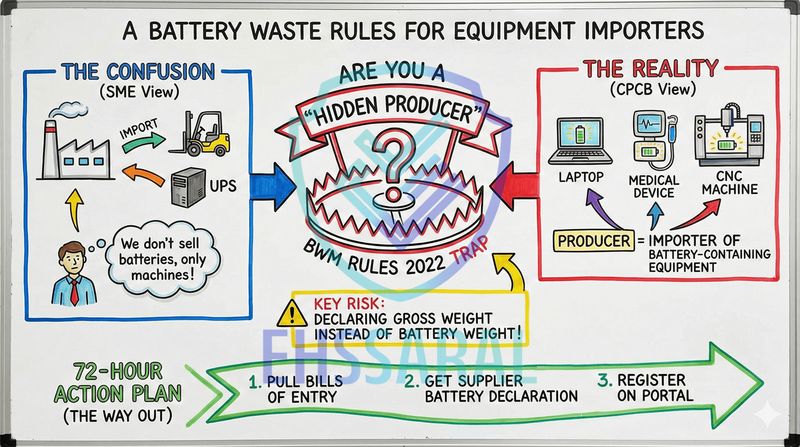
In many Indian SMEs, Battery Waste Management Rules are still mentally filed under:
So when a notice or clarification email arrives mentioning Battery Waste registration, the most common response is:
“We only import machines. We don’t manufacture or sell batteries.”
This reaction is understandable.
For decades, environmental responsibility in factories has been associated with what you produce inside the plant - emissions, effluent, hazardous waste. Imported equipment, especially capital goods, rarely felt like an environmental compliance trigger.
This is exactly where confusion usually starts.
Read our Research on Rule 9 Hazardous Waste Utilization: Why Applications Fail (2023–2025)
A natural question most importers ask is:
“If these rules came in 2022, why are we hearing about this only now?”
From a practical, on-ground standpoint, three things have changed over the last year:
First, the Battery Waste registration system is no longer just a notification on paper. The CPCB portal is now operational, registrations are being scrutinized, and data validation has begun at scale.
Second, import data has always existed - Bills of Entry, IEC details, HS codes. What has changed is how this data is being used. Import records are now being cross-checked during compliance reviews instead of sitting in separate silos.
Third, State Pollution Control Boards are increasingly issuing clarification-based communications. Most of these are not allegations of violation. They are requests to explain whether Battery Waste rules apply to a particular importer and, if yes, how compliance is being planned.
This is not a sudden crackdown.
It is a system alignment phase.
For clarity, this process sits under the oversight of Central Pollution Control Board, but much of the interaction happens at the SPCB level.
The core of this entire issue lies in one word: Producer.
Most people associate “Producer” with someone who manufactures something. Under the Battery Waste Management Rules, 2022, that assumption is incomplete.
In simple operational terms, a Producer includes:
That last category is where most equipment importers get caught off guard.
If a battery enters India inside a machine, the importer of that machine becomes responsible for that battery under Extended Producer Responsibility (EPR).
It does not matter whether:
Responsibility is linked to placing the battery in the Indian market, not to resale intent.
This is not a loophole or an overreach. It is how producer responsibility frameworks work globally - the entity introducing the battery is expected to plan for its environmentally sound end-of-life.
How EHS Teams Can Verify Their EPR Credits Before Audit
Based on what we routinely see in Indian import compliance cases, the following categories are most frequently affected:
| Equipment Type | Typical Battery Type | Approximate Battery Weight Range | When Responsibility Starts |
|---|---|---|---|
| Industrial UPS systems | Lead Acid | 200–500 kg | First import |
| Electric forklifts | Lead Acid / Lithium-ion | 800–1200 kg | Immediate |
| Bulk laptop imports | Lithium-ion | 0.3–0.5 kg per unit | Volume dependent |
| Medical ventilators & devices | Lithium-ion | 5–15 kg | First import |
Many importers are surprised to see laptops or medical equipment on this list. The rule does not distinguish between industrial and office use. It only looks at whether a rechargeable battery has been introduced into the country.
This list is indicative, not exhaustive. Any imported equipment containing rechargeable batteries may fall under the same logic.
One of the most common objections raised during discussions is:
“The battery is just a component of the machine. We don’t trade in batteries.”
From a regulatory standpoint, this distinction does not change responsibility.
Battery Waste rules are designed to ensure that batteries do not become unmanaged waste several years later, when the equipment reaches end of life. To make that possible, responsibility is assigned at the point of introduction, not at the point of resale.
So even if:
…the obligation still applies to the battery portion.
This is where many well-meaning importers realise that the issue is not about wrongdoing, but about how the rule is framed.
Once this definition is understood clearly, most importers reach the same conclusion:
“So the rule applies to us - but only for the battery inside the equipment, not for the full machine.”
That understanding is correct.
However, this is where the next and more practical challenge begins - how to separate battery weight from total equipment weight, especially when all official import documents show only the gross weight.
This is the point where most registrations either get delayed or go wrong, not because of intent, but because of data mismatch.
If you are a Brand Owner then read our Maharashtra SME Plastic Waste EPR Guide
Once importers accept that Battery Waste rules apply to them, the next question almost always is:
“Our Bill of Entry shows only the machine weight. Where do we show battery weight?”
This is not a trivial question
This is the single biggest operational bottleneck in Battery Waste registrations for equipment importers.
A Bill of Entry typically captures:
For example, a forklift’s Bill of Entry weight includes:
From a customs perspective, this makes sense.
The Battery Waste portal, however, is designed for EPR accounting, not customs clearance.
It asks specifically for:
This difference in purpose is why confusion arises.
Customs looks at what entered the country.
EPR looks at what will eventually become battery waste.
Two mistakes are repeatedly seen in practice.
This usually happens when:
The impact of this mistake is not immediate - and that is what makes it dangerous.
It results in:
Once declared, these numbers are difficult to reverse.
The second mistake is more subtle.
When battery specifications are not readily available, some importers:
This creates vulnerability during:
Battery Waste compliance is data-driven.
Approximation is rarely viewed favourably when supporting documents are missing.
Consider a common real-world example.
| Description | Weight |
|---|---|
| Total Bill of Entry weight | 5,000 kg |
| What this includes | Frame, mast, motors, wheels, battery |
| Battery type | Lead Acid |
| Battery weight per forklift | 200 kg |
| Total battery weight (10 units) | 2,000 kg |
From a Battery Waste compliance perspective:
You are responsible for planning EPR only for the battery portion, not the machine housing it.
This one segregation step often brings immediate clarity and relief to importers.
In most cases, battery weight can be obtained from one of the following sources:
Among these, supplier declarations tend to be the most reliable.
Why?
Because they:
In many cases, suppliers already have this data internally - they are simply not aware that Indian regulations require it.
In day-to-day compliance handling, we’ve observed that most delays do not occur because data is unavailable, but because it was never formally requested.
A structured supplier declaration helps:
This is particularly important for:
Without documented segregation, importers often end up carrying a compliance burden far larger than necessary.
Most foreign suppliers don't know what Indian rules require. We recommend using a specific 'Battery Declaration Format' that asks for exactly what the CPCB portal needs (Chemistry + Net Weight). This avoids the back-and-forth of vague emails.
Once battery weight is clearly identified, the next hurdle is portal registration.
This is where many importers feel stuck, not because the rules are unclear, but because multiple datasets are being validated together.
Based on current portal practice, importers are typically asked to submit:
Each of these serves a validation purpose:
Many importers are surprised to see GSTR-9 linked to Battery Waste registration.
From a regulatory logic standpoint, it is used to:
A common scenario:
This does not automatically indicate non-compliance.
However, it often leads to clarification requests that stall registrations if not handled carefully.
This cross-checking is procedural and does not by itself indicate any violation
Most portal-related problems fall into a few recurring patterns.
| Portal Issue | Typical Reason | What Usually Resolves It |
|---|---|---|
| GSTIN not verified | GSTR-9 not filed or processed | File / revise and retry |
| IEC mismatch | Entity name differs across records | Align IEC and GST details |
| Category rejection | Wrong producer category selected | Select “Importer of equipment containing battery” |
| Weight query | No supporting document | Upload supplier declaration |
These are not violations.
They are data alignment issues.
Treating them calmly and systematically usually resolves the problem.
One practical point often overlooked:
If your Bill of Entry description or HS classification clearly indicates:
…the system may automatically flag the entry for battery responsibility.
Ensuring that:
are internally consistent significantly reduces rejection cycles.
By this point, most importers reach three important conclusions:
The remaining anxiety usually relates to:
That’s what we address next - calmly and step by step.
Once importers understand how the rule applies and how battery weight should be calculated, the next concern is almost always about the past:
“We imported this equipment last year… or two years ago. What happens now?”
This concern is valid, and it needs to be addressed calmly.
From a practical compliance standpoint, authorities are generally trying to understand whether the importer recognises applicability and is willing to align, not whether there was any deliberate avoidance.
In most cases, issues arise not because imports happened earlier, but because:
Silence creates risk.
Structured clarification reduces it.
Based on how such cases are usually handled on the ground:
This is why approaching the issue proactively is important.
Not to “confess”, but to explain with data.
If your company imported battery-containing equipment in earlier years, a structured approach helps:
In many cases, this positions the matter as unintentional non-alignment, not non-compliance.
One of the most damaging assumptions importers make is that:
“If a notice has come, it means we are already in violation.”
In reality, most Battery Waste-related communications are:
They typically ask:
They do not usually:
How you respond matters far more than the fact that the notice exists.
A calm, structured response usually includes:
What creates trouble is:
Over the years, we’ve seen that most issues escalate only when responses are vague or absent.
Most effective responses to SPCB clarification notices follow this format:
Subject Line:
“Response to Notice No. [XYZ] dated [Date] - Battery Waste Rule Applicability
for [Company Name]”
Body Structure:
Tone to Maintain:
What to Avoid:
Many importers act based on guidance that was common earlier, but is no longer reliable today.
Some examples:
These beliefs were understandable when systems were new and enforcement was unclear.
However, with portal-based compliance and data cross-verification, such assumptions now lead to avoidable exposure.
The rules have not suddenly changed - their application has become clearer.
At this stage, most readers want a quick internal check before taking next steps.
You likely need Battery Waste registration if:
You are less likely to be impacted if:
Where uncertainty remains, clarification is safer than assumption.
From experience, the biggest risks do not arise from:
They arise from:
Battery Waste compliance is cumulative.
Numbers declared today affect obligations years later.
This is why early correction, even if delayed, is almost always better than continuing in uncertainty.
When non-registration is established after repeated non-response, SPCBs may calculate Environmental Compensation based on:
The exact calculation varies case-to-case and is communicated through official orders.
In practice, early clarification and voluntary alignment significantly reduce the likelihood of retrospective compensation being imposed.
If you’ve just understood that Battery Waste rules apply to your imports,
here’s what to prioritize:
Within 24 Hours:
Within 48 Hours:
Within 72 Hours:
Within 7 Days:
This timeline assumes no notice has been received. If you have a notice,
respond within the stipulated period (usually 15-30 days) with technical
explanation and registration plan.
For most equipment importers, Battery Waste compliance is not about becoming a waste management expert.
It is about:
Once these pieces fall into place, the issue usually becomes manageable.
Most long-term compliance stress comes not from the rule itself, but from un
clear interpretation at the start.
Getting that interpretation right early saves years of effort later.
Q: I imported 5 laptops for my office. Do I need to register?
A: In most cases, very small, non-commercial imports (such as a few laptops for internal office use) are not the immediate focus of enforcement. However, applicability depends on battery specifications and cumulative imports. When in doubt, clarification is safer than assumption.
Q: Can I register retrospectively for imports made in 2022-23?
A: Yes. The portal accepts retrospective declarations with proper documentation. Most SPCBs view this as compliance alignment, not violation, if explained clearly with battery weight data.
Q: Who calculates battery weight-us or the customs authority?
A: You, the importer, must calculate it using supplier specifications. Customs clears based on gross weight; EPR requires battery weight only.
Q: What if my supplier doesn’t respond with battery specifications?
A: Check equipment manuals, OEM websites, or industry standard databases. If unavailable, document your attempts and use manufacturer published specifications for similar models. Avoid guessing.
Q: Do lithium-ion and lead-acid batteries have different compliance requirements?
A: Both require registration, but EPR targets and recycling obligations differ by chemistry. Portal asks for chemistry-specific declarations.
Q: Is there a minimum import value threshold below which registration isn’t required?
A: The rule focuses on battery weight and quantity, not import value. However, enforcement prioritizes commercial-scale imports.
Q: Can I hire a consultant to handle this, or must I register personally?
A: Consultants can assist with documentation and portal filing, but registration must be in the importer’s name with authorized signatory.
Q: What happens if I declare the wrong battery weight initially?
A: You can request correction through the portal with supporting documents. Early correction (within same year) is easier than multi-year revisions.
Q: Do equipment importers need Battery Waste registration?
Yes. Under Battery Waste Management Rules 2022, Rule 3(1)(d), any entity importing equipment containing rechargeable batteries ≥300g is classified as a “Producer” and must register on the CPCB portal within 90 days of first import. (Rechargeable batteries typically above ~300g per unit are generally considered material for registration, subject to CPCB portal applicability and clarification.)

Founder, EHSSaral
Founder - EHSSaral | Partner - Perfect Pollucon | ISO 14001 Lead Auditor | GHG Protocol Scope 2 | Chemist | Data Scientist | Second-generation environmental professional simplifying EHS compliance for Indian industries through practical, automated, tech-enabled, data driven compliance workflows.
Plastic Waste Management Rules in India: A Practical Guide for Factories, Warehouses and Offices
Late Filing Penalty for Form 4 SPCB: What Happens If You Miss the 30 June Deadline?
 EHSSaral v1.png)
Blue Category MPCB 3-Year Consent Validity for Recyclers (2026) | EHSSaral

MPCB Consent Guide: CTE, CTO, Renewal, Fees & Conditions | EHSShala

MSIHC Rules, 1989: Practical Guide for Indian Factories

Evolution of EHS in India - (Part 2) Post-Bhopal | EHSShala
TSDF Hazardous Waste Process: Manifest, Disposal & Records

Why Form IV Readiness Cannot Begin at the End of the Year
Hazardous Waste Stored Beyond 90 Days: What to Do
Hazardous Waste Compatibility & Segregation Guide India