
Blog
SPCB Consent Conditions: Common Compliance Mistakes Explained | EHSSaral
EHSSaral is an Environmental Compliance Intelligence Platform for Industries. Consent Intelligence • Alerts & Tasks • Incident Reporting • Form IV & V • Audit-Ready Records
See how EHSSaral works
27 Apr 2026

You receive an email from your consultant.
“Sir, EPR compliance completed. Certificate attached.”
You download the PDF.
Logo looks official.
Quantity looks correct.
Your company name is spelled right.
You forward it to your manager, maybe upload it during Annual Return filing, and move on to the next fire - audit prep, vendor questionnaire, internal Excel tracker, something else.
Most EHS managers stop here.
And honestly, that feels reasonable.
You hired a consultant for this exact reason.
But this is also where many problems quietly start.
Not because you did something wrong - but because EPR today is not paper compliance anymore.
Read More about EPR (Plastic Waste) Registration challenges for Indian SMEs

If you are working in an Indian factory or SME, EPR usually lands on your table like this:
Meanwhile, you are already dealing with:
So EPR becomes one more outsourced task.
The common assumption is:
“If certificate is there, compliance must be done.”
That assumption used to work in the paper era.
It doesn’t work reliably anymore.
This one line will save you a lot of stress later.
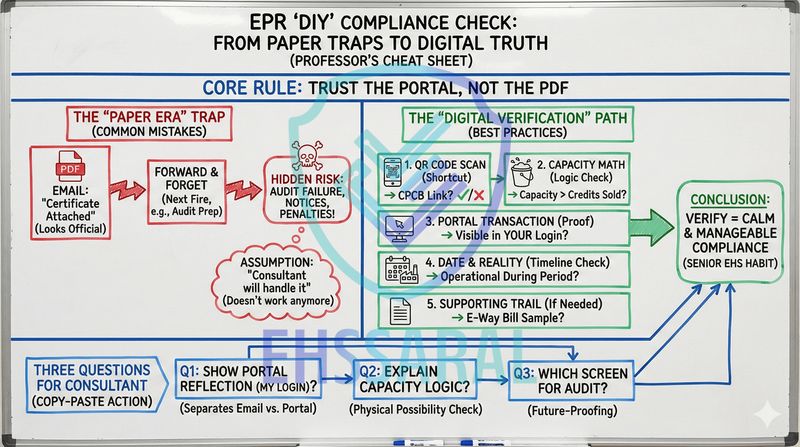
A certificate is only an output.
The portal entry is the proof.
If something:
…then it does not protect you during audits or future scrutiny.
This is similar to many things you already know:
EPR works the same way now.
Form 5 Environmental Statement India: Example & Mistakes
This article applies to both Plastic and Battery EPR.
The verification mindset is the same.
One small difference you should be aware of:
So if you are handling Battery EPR, this checking habit is not optional - it’s basic hygiene.
Read the Research: The new traceability standard most MSMEs are missing.
This guide is not:
This guide is:
Think of it like checking a lab report before forwarding it.
Not mistrust - just professionalism.
You don’t need technical knowledge or portal mastery.
Just keep this ready:
That’s it.
You don’t need recycler login credentials.
You don’t need backend access.
You just need to know where to look.
Before logging into any portal, look at the certificate PDF itself.
Most genuine EPR certificates today carry:
Scan the QR code once.
If It doesn’t lead to a CPCB / official portal page, or The details shown don’t match the PDF
Pause there.
You don’t need to investigate further until this mismatch is clarified.
This single step often saves time and uncomfortable conversations later.
When something goes wrong:
They come to the company.
And questions come to you, because you handled the compliance.
This article is not about becoming an EPR expert.
It’s about knowing how to verify what is being done in your name.
Once you understand this logic, EPR stops feeling scary.
It becomes manageable - like any other compliance task you already handle.
(What to actually check, step by step)
This section is where most EHS managers say:
“Okay, now I know what to do.”
You don’t need to check everything every time.
But you must understand all of these checks, so you know which one matters in your situation.
This is always the first check.
Before quantity, before documents, before arguments.
If the recycler is not “Active” on the portal for the relevant period, nothing else matters.
Don’t argue. Just pause and ask for clarification.
This saves time.
Before you deep-dive into portals:

Pause.
You don’t need to accuse anyone.
Just say:
“I’m not able to trace this on the portal yet. Can you help me with that?”
That’s it.
This is the most important check in this entire article.
You don’t need recycling expertise.
You just need basic logic.
“Is this physically possible?”

If credits being sold appear higher than capacity, something is off.
This does not automatically mean fraud.
It could mean:
But it must be explainable.
“Can you help me understand how this quantity fits within the recycler’s registered capacity?”
A genuine consultant will:
A weak one will:
This is where many EHS managers get confused.
EPR credits are not just certificates.
They are transactions.
There should be:
Accepting:
Instead of:
If something exists only as a screenshot, it doesn’t protect you.
This check is simple but powerful.
Sometimes:
[Recycler Name] + Closure Notice or [Recycler Name] + NGT Order often reveals things the certificate hides.)If recycling is shown during a period when:

You have a timeline mismatch.
This is rarely intentional from the EHS side.
But timelines matter a lot during audits.
This is not about demanding files for everything.
But genuine recycling creates:
Ask only if:
You don’t need GST lectures.
You don't need a full audit trail. But asking for 'One sample E-Way Bill' for the waste entering their plant is a reasonable request that separates genuine recyclers from paper traders.
You need confidence that activity exists.
Before trusting any EPR certificate, check:
If even one of these feels unclear - pause and clarify.
That pause is not weakness.
It’s professional discipline.
By now, you understand one thing clearly:
EPR is not scary.
Unverified EPR is.
This final part is about:
(Copy–Paste. No Drama.)
You don’t need arguments.
You don’t need accusations.
Just ask these three questions calmly.
“Can you show me where this credit is reflected on the CPCB portal against our company name or obligation?”
Why this matters:
This separates portal-backed compliance from email-backed compliance.
“How does this quantity fit within the recycler’s registered capacity?”
Why this matters:
You’re not questioning honesty - you’re checking physical possibility.
A genuine consultant will explain this easily.
“If this comes up in audit next year, which portal screen should I show?”
Why this matters:
This tells you whether the consultant is thinking beyond today’s invoice.
EHSSaral truth:
Good consultants don’t fear verification. Weak ones fear questions.
(Seen in many factories - not a judgment)
Let’s be honest. These happen.
Link final payment to portal reflection.
Many factories now follow this quietly:
This is not pressure.
This is process discipline.
This is important. Don’t panic.
Don’t ignore the discomfort. That instinct exists for a reason.
Simple mail. No accusations.
“We are unable to fully trace this on the portal yet. Please help us understand.”
Portal pages change. Keep a basic record.
Better to flag early than explain later.
Early correction is always safer than silent acceptance.
Audits don’t remember:
They see:
And questions come to you, because you handled the compliance.
Good EHS work is:
This guide is not about control.
It’s about self-protection through clarity.
You don’t need to become an EPR expert.
You don’t need to fight consultants.
You don’t need to fear audits.
You just need one habit:
Verify what is done in your name.
Once you understand portal logic, EPR becomes like any other compliance task - manageable, explainable, and calm.
That’s how senior EHS professionals work.
Q1. If my consultant already filed EPR, should I still check?
Yes. Filing and verification are different responsibilities.
Q2. Will asking these questions upset my consultant?
A professional consultant will not be upset by basic verification.
Q3. Do auditors really check portal data?
Increasingly, yes - especially during EC reviews and brand audits.
Q4. Is a portal mismatch always fraud?
No. Sometimes it’s delay or error. That’s why early checking matters.
Q5. Is this verification needed every year?
Yes. EPR is a recurring obligation, not a one-time task.

Founder, EHSSaral
Founder - EHSSaral | Partner - Perfect Pollucon | ISO 14001 Lead Auditor | GHG Protocol Scope 2 | Chemist | Data Scientist | Second-generation environmental professional simplifying EHS compliance for Indian industries through practical, automated, tech-enabled, data driven compliance workflows.
SPCB Consent Conditions: Common Compliance Mistakes Explained | EHSSaral
Environmental Compliance for Pharmaceutical Manufacturing in India | EHSSaral
 ehssaral.webp)
Hazardous Waste Form 4 Portal Errors (MPCB & GPCB Fix Guide)
Why BMW Inspections Feel Stricter Today (India) | EHSSaral
Environmental Monitoring Guide for Indian Factories: Air, Water & Noise | EHSShala
Beyond the Helmet: Why Safety Compliance Alone Fails in Indian Factories | EHSSaral Research
Best Environmental Compliance Software in India (2026): A Practical SME Comparison | EHSSaral
 Practical Guide for Indian Factories EHSShala.webp)
Hazardous Waste Management Rules in India: Forms, Storage & Compliance

Why Good People Still Struggle With Compliance in Indian SMEs | EHSSaral Research
Hazardous Waste Storage Rules in Indian Factories | EHSShala