
Blog
Why Safety Culture Fails in Indian SMEs: People & Compliance Challenges | EHSSaral Research
EHSSaral is an Environmental Compliance Intelligence Platform for Industries. Consent Intelligence • Alerts & Tasks • Incident Reporting • Form IV & V • Audit-Ready Records
See how EHSSaral works
4 Feb 2026
If you manage EHS at a factory, warehouse, office, mall, corporate park, or any non-hospital site, you may have faced this awkward moment:
A visiting officer asks about your yellow bag.
Or a vendor asks for signatures, photos, barcodes, weight slips, handover time, and storage details.
And inside your head you think:
“Boss, we are not a hospital. Why is bio-medical waste becoming such a big topic?”
This confusion is very common. And it is usually not because people are careless.
Most non-hospital sites are not trying to hide anything.
They are not trying to save money by dumping waste.
They are not trying to “manage” inspections with shortcuts.
The real issue is simpler:
Many sites remember the old expectation.
The system is operating with a new expectation.
So the work feels the same, but the scrutiny feels different.
This article exists to explain that difference calmly.
Not as a rulebook.
Not as a fear story.
Not as legal language.
But as a senior-to-junior explanation of what changed in the Indian BMW compliance ecosystem, and why inspections today feel more “proof-based” than “discussion-based”.
You will find plenty of checklists online that say:
keep colour-coded bins
segregate correctly
hand over to authorised CBWTF
keep records
Those are useful. But they do not solve your main pain.
Your pain is usually this:
“Why are they asking so many questions now?”
“Why is vendor suddenly demanding more documents?”
“Earlier this was smoother. Today it feels like I’m always missing something.”
So this article focuses on the missing piece:
BMW rules did not suddenly become strict.
The system matured.
Once you understand that maturity, inspections stop feeling random.
They start feeling predictable.
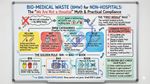
Bio-Medical Waste Management for Non-Hospitals (India)
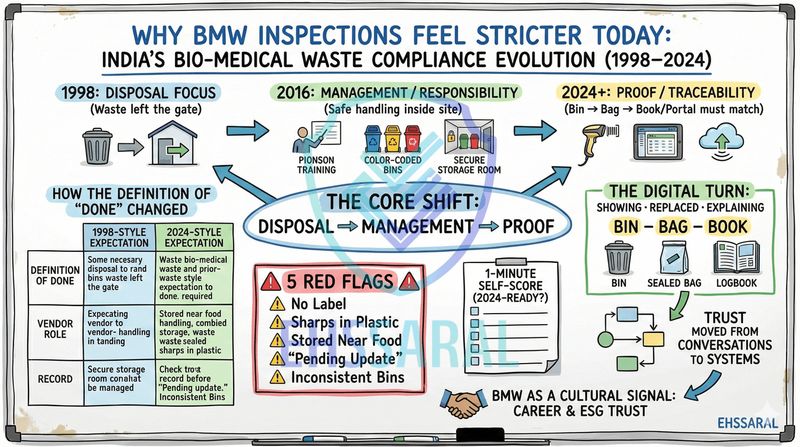
BMW compliance in India broadly moved through three phases:
Disposal
Management / Responsibility
Proof / Traceability
This is the simplest mental model.
Earlier, “done” meant:
“Waste left the gate safely.”
Now, “done” often means:
“I can show control from bin to handover to record trail.”
That shift is the root of today’s friction.
If you remember only one line from this article, remember this:
BMW compliance moved from:
Out of Gate → Under Control → On Record
This one line is why inspections feel stricter today.
This table is not about law changes.
It is about expectation drift.
Most confusion in BMW inspections happens because people are still operating with a 1998 mental model, while the system is evaluating them using a 2024 model.
Read this table as:
“How the system silently changed the definition of ‘good enough’.”
| Topic | 1998-style expectation | 2024-style expectation |
|---|---|---|
| Definition of done | Waste left the gate. | Control + proof exists. |
| Vendor | Vendor = compliance. | Vendor = service provider. |
| Inspection style | Conversation-based | Verification-based |
| Record | Manual comfort | Traceability comfort |
In the early years, the system’s main concern was straightforward:
BMW is hazardous
Don’t dump it in open garbage
Send it to an authorised facility
For many sites, compliance felt complete when:
“The waste is out of my premises.”
That mindset still sits in many non-hospital setups.
Not because they are wrong people, but because that was the operating logic for a long time.
Over time, regulators and auditors realised something:
Even if final disposal is correct, most harm happens before disposal.
Common issues were seen repeatedly:
mixing infectious waste with general waste
storage near pantry/canteen
housekeeping staff handling without training
sharps creating injuries during handling
record gaps during audits
So expectations shifted from “end point disposal” to “how you handle it daily”.
Compliance started meaning:
“The site manages BMW safely on site, not just outside site.”
This is the present-day shift.
Now the system asks:
Can this waste be traced back to the generator?
Do records match what is physically happening?
Can you demonstrate control without long explanations?
In short:
Trust moved from conversations to systems.
That's why today, an EHS officer’s confidence matters less than the site’s consistency.
Many people assume rules became stricter because of one big event.
In reality, BMW compliance tightened because small gaps repeated at scale, for years, across thousands of locations.
Five pressure patterns pushed the system forward.
BMW was once treated as a hospital-only stream.
But reality changed.
Medical activity started happening in:
factories with OHCs
offices with medical rooms
vaccination camps
annual health check-up camps
blood collection vans
labs and diagnostic chains
So the system had to follow one logic:
“Responsibility is linked to activity, not building type.”
That’s why non-hospital sites came into focus.
One needle prick can change how people view BMW forever.
Across sites, a common pattern was seen:
sharps kept in thin bags
blades mixed with cotton
housekeeping staff getting injured
“small quantity” being treated casually
These weren’t headline accidents, but they were frequent.
So enforcement became very sensitive to sharps handling.
COVID did not “create” BMW rules.
It exposed gaps in:
segregation discipline
temporary storage
PPE disposal habits
vendor coordination
Non-hospital sites suddenly entered BMW generation at scale.
After COVID, systems did not relax.
They became clearer about expectation.
Registers work when:
volumes are low
checks are occasional
trust is personal
At scale, problems kept appearing:
incomplete entries
entries made after pickup
mismatch between bins and records
vendor slips not traceable later
So systems moved toward traceability and digital checks.
Different officers, different expectations, different outcomes.
As systems matured, enforcement started relying more on:
objective proof
consistent documentation
data visibility
That is why inspections today often feel “less discussion, more verification”.
And with that, the question becomes:
If the system matured, what exactly changed in the definition of “done” over the years?
Let’s map it clearly.
The easiest way to understand BMW evolution is not by memorising years or amendments.
It is by asking one simple question for each phase:
“When did the system consider the EHS officer’s job finished?”
That answer changed over time.
Below is a simplified view that captures the shift without legal clutter.
| What the System Evaluates | Earlier System (Mostly Pre-2016) | Current System (Mostly Post-2016) | Why It Changed |
|---|---|---|---|
| “Done” Definition | Waste left the premises | Site can show control + proof | Scale needed predictable verification |
| Vendor Role | Vendor authorisation felt like safety | Vendor is a service provider, not a shield | Because liability couldn’t be shifted to third parties during audits and incidents. |
| Segregation | Bins present = good enough | Segregation must be consistent + trained | Mixed waste and injuries kept repeating |
| Sharps Handling | Often treated like “small waste” | Sharps treated as high-sensitivity | Needle-prick and handling injuries |
| Records | Logbook / manual slips | Records must be timely, consistent, traceable | Because paper logs were easy to mismatch, backfill, or lose during verification. |
| Inspection Style | More conversation and explanation | More visual checking + record alignment | Because verification had to become faster, more objective, and more consistent across sites. |
Read this table slowly once.
Most confusion happens because people operate in one row while the system evaluates them in another.
If you remember only one year in BMW history, remember 2016.
Not because paperwork increased.
But because ownership became non-transferable.
Before this phase, many sites believed:
“Once the CBWTF picks it up, responsibility moves to them.”
After 2016, the system made one thing very clear:
Work can be outsourced. Responsibility cannot.
This same “generator responsibility” shift also reshaped other waste streams, especially Hazardous Waste management after 2016.
Before 2016:
An inspector asks about BMW.
The answer “Our CBWTF is authorised” usually closed the topic.
After 2016:
The same question leads to:
“Who trained your housekeeping staff?”
“Where is your storage area?”
“How do you ensure segregation daily?”
The focus shifted from vendor credentials to generator behaviour.
That’s why many non-hospital sites feel surprised today.
They were compliant earlier - for that era’s expectation.
Hospitals were already living with BMW daily.
They had systems, staff, rooms, routines.
Non-hospital sites usually had:
occasional generation
small quantities
shared responsibilities (EHS + Admin + HR + FM)
So when responsibility became explicit, these sites felt exposed.
Two common assumptions broke:
“Low quantity means low attention”
“Occasional generation means occasional responsibility”
In reality:
Low quantity does not mean low responsibility.
Occasional does not mean optional.
During COVID, many sites suddenly generated BMW:
used masks
gloves
test kits
quarantine waste
medical camp waste
Some sites handled it calmly.
Some scrambled.
What the system learned was simple:
Sites with basic discipline adapted quickly.
Sites without systems struggled visibly.
Post-COVID, enforcement didn’t become emotional.
It became memory-based.
Systems remembered who had gaps.
In recent years, another quiet shift happened.
Earlier inspections depended heavily on:
conversations
explanations
intent
Now they depend more on:
records
timestamps
consistency
This is why inspections now often start before the officer enters your gate.
Data already exists in portals.
This digital shift mirrors what is happening across environmental compliance systems in India, explained in From Warnings to Wall-Sockets: How Compliance Became System-Driven.
The visit only checks alignment between:
dashboard
documents
ground reality
Bin–Bag–Book
If these three match, inspections end quickly.
If they don’t, explanations begin-and audits expand.
This is not about suspicion.
It is about scale and consistency.
Modern BMW inspections are usually quick when:
bins match categories
storage area is defined
handover records are current
answers are short and factual
They become long when:
explanations replace evidence
records are “almost updated”
segregation varies by shift
A useful internal rule is:
If it is not recorded, it did not happen.
Most officers will never openly state this.
But practically, BMW inspections today evaluate three things.
Are bins correct, clean, labelled?
Is storage defined, secured, away from food areas?
Are sharps handled with respect, not convenience?
Visual gaps signal deeper gaps.
Does segregation change by shift?
Do answers vary by person?
Is today’s setup different from yesterday’s?
Inconsistency triggers deeper digging.
Does the record reflect what is visible?
Do dates, quantities, and handovers align?
Is documentation calm or rushed?
Modern inspections reward alignment, not storytelling.
If any of these are present, inspections usually go deeper:
If you want calm audits, remove these five first.
BMW is rarely the largest waste stream.
But it is often the first signal inspectors use to judge a site’s culture.
If BMW looks casual:
hazardous waste is assumed casual
air and water records are questioned deeper
trust reduces early
If BMW looks controlled:
audits move faster
questions stay focused
overall compliance feels calmer
So senior EHS professionals take BMW seriously even when volumes are tiny.
Give yourself 1 point for each “Yes”:
Handling BMW well tells management one thing:
“This person can manage sensitive, high-scrutiny compliance.”
BMW becomes a quiet test:
discipline
consistency
systems thinking
EHS officers who master this usually get trusted with:
consent renewals
audits
new projects
digital initiatives
Not because BMW is glamorous.
But because it shows control under attention.
BMW rules did not suddenly become strict.
The system learned.
The system scaled.
And once it scaled, it needed proof.
The sites that feel stressed today are not wrong.
They are just operating with yesterday’s definition of “done”.
The calm sites are not lucky.
They updated their mental model.
Good compliance removes uncertainty.
It does not create paperwork drama.
That is how BMW compliance should feel.
Understanding evolution is one thing. Recognizing where your site sits inside that evolution is another.
The same non-hospital patterns keep repeating-not because people are careless, but because old habits collide with today’s proof-based expectation.
Once the definition of “done” changed, non-hospital sites started slipping in predictable ways.
Not because of intent.
But because old habits met new expectations.
BMW quantities are usually low:
a few yellow bags a week
an occasional sharps container
camp-based spikes once or twice a year
So sites delay building routine.
But the system does not measure volume anxiety.
It measures control behaviour.
As a result:
a single mis-handled sharps container attracts more attention than tonnes of general waste
one unlabelled yellow bag raises more questions than a full hazardous waste yard
BMW is sensitive by nature, not by quantity.
Many sites feel safe because:
vendor is authorised
truck comes on time
waste leaves the gate
But post-2016, the system treats the vendor as:
a service provider, not a liability shield
If something breaks:
poor segregation
unsafe storage
missing records
the first responsibility still sits with the generator.
This is where confusion happens during inspections.
The site explains:
“Our vendor didn’t tell us.”
The system hears:
“The generator did not control the process.”
This is common in non-hospital setups.
Typical sequence:
First aid waste → ignored
One vaccination camp → handled casually
Second camp → vendor called
Audit happens → questions start
The system does not recognise intention timelines.
The obligation begins at:
the first needle, the first syringe, the first blood sample
Not at frequency.
Not at inspection.
Not at registration.
This “transition moment” is where most gaps form.
During audits, the problem is often not what you mean.
It is what the system hears.
| What people say (normal) | What the system hears (risk) | What closes it faster |
|---|---|---|
| Vendor is authorised. | Generator is outsourcing responsibility. | Here is our handover trail + records. |
| It’s small quantity. | Low discipline area. | Sharps + yellow bags are controlled daily. |
| We’ll update register. | Backfilling entries. | Same-day entry / timestamped record. |
| No issues so far. | No evidence of control. | Photo + storage + pickup proof. |
| We’ll explain. | Gaps will come out in talking. | Bin matches record. Done. |
Earlier, inspections allowed space for:
justification
context
background
Today, scale does not allow that luxury.
Officers handle:
more sites
more data
tighter timelines
So systems replace conversations.
This is why long explanations often increase scrutiny.
A useful rule to remember:
The more you explain, the more gaps you expose.
The more you show, the faster it closes.
Internally, BMW quietly reflects how a site treats “uncomfortable” compliance.
If BMW is:
dumped into admin responsibility
handled by housekeeping without training
remembered only during audits
then other compliance areas usually follow the same pattern.
That is why auditors subconsciously use BMW as a proxy.
They think:
“If this is casual, what about the rest?”
This is not bias.
It is pattern recognition.
Understanding evolution also helps predict the future.
BMW compliance will not go back to:
verbal comfort
paper-only trust
relationship-based closure
Because:
waste volumes are rising
non-hospital medical activity is increasing
digital visibility is expanding
Future tightening will likely focus on:
better traceability
clearer generator accountability
fewer discretionary interpretations
Sites aligned today will adapt easily tomorrow.
Instead of asking:
“Why are they treating us like a hospital?”
Ask:
“Can we show control over the waste we generate?”
That single shift removes frustration.
BMW compliance is not about becoming healthcare-grade.
It is about being system-grade.
If your site:
generates BMW occasionally
operates outside healthcare
feels inspections have become “stricter”
The issue is likely not rules.
It is expectation drift.
Once your understanding updates, actions become obvious.
And BMW returns to what it should be:
a small waste stream
managed calmly
without drama
That is the point where compliance stops feeling personal.
BMW inspections are more proof-based today. The system shifted from verbal explanations to traceability, records, and consistency.
Yes. BMW responsibility depends on medical activity, not whether the site is a hospital.
Because vendors are also audited. They now need proof of proper handover, segregation, and traceability from generators.
Bins, storage discipline, sharps handling, and whether records match ground reality.
In many states, yes-especially if BMW is generated regularly. This varies by SPCB practice.

Founder, EHSSaral
Founder - EHSSaral | Partner - Perfect Pollucon | ISO 14001 Lead Auditor | GHG Protocol Scope 2 | Chemist | Data Scientist | Second-generation environmental professional simplifying EHS compliance for Indian industries through practical, automated, tech-enabled, data driven compliance workflows.
Why Safety Culture Fails in Indian SMEs: People & Compliance Challenges | EHSSaral Research

Chemical Accident Emergency Response Guide for Indian Factories | EHSShala
MSIHC Rules, 1989: Practical Guide for Indian Factories
Environmental Calendar from Consent Conditions (Practical Guide) | EHSShala
Bio-Medical Waste Management for Non-Hospitals (India) | EHSShala
Environmental Monitoring Guide for Indian Factories: Air, Water & Noise | EHSShala
Environmental Compliance in India: Beginner Roadmap | EHSShala
Bio-Medical Waste Management Rules, 2016 for Factories
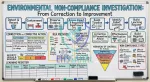
Environmental Non-Compliance Investigation: Process, RCA and Corrective Action
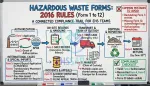
Hazardous Waste All Forms Form 1 to Form 12 Guide