
EHSShala
Ozone-Depleting Substances Rules, 2000 - A Practical Guide for Indian Industries
EHSSaral is an Environmental Compliance Intelligence Platform for Industries. Consent Intelligence • Alerts & Tasks • Incident Reporting • Form IV & V • Audit-Ready Records
See how EHSSaral works
19 Jul 2026
Let’s say this upfront.
Most bio-medical waste problems in non-hospital sites are not intentional.
They are not created to cut corners.
They are not created to hide anything.
They happen quietly.
Across factories, offices, warehouses, construction sites, and corporate parks, the pattern is familiar:
a small first-aid room exists
injuries happen occasionally
cotton, bandages, gloves get used
a doctor or nurse visits once in a while
health check-ups happen once a year
And somewhere along the way, someone says:
“We are not a hospital.”
That sentence feels safe.
It feels logical.
And in many sites, it becomes the reason BMW compliance is ignored.
Then one day, during inspection or renewal, a simple question is asked:
“Do you generate bio-medical waste?”
That’s when confusion starts.
Not because the site is careless - but because no one ever explained BMW from a non-hospital point of view.
This article exists to:
remove that confusion
reduce inspection anxiety
explain BMW only as much as a non-hospital needs
help EHS professionals manage BMW quietly, correctly, and confidently
This is not a legal document.
This is not written for hospitals.
This is a ground-reality guide for people managing many responsibilities at once.
“Good compliance is boring.
Most problems start when assumptions replace clarity.”
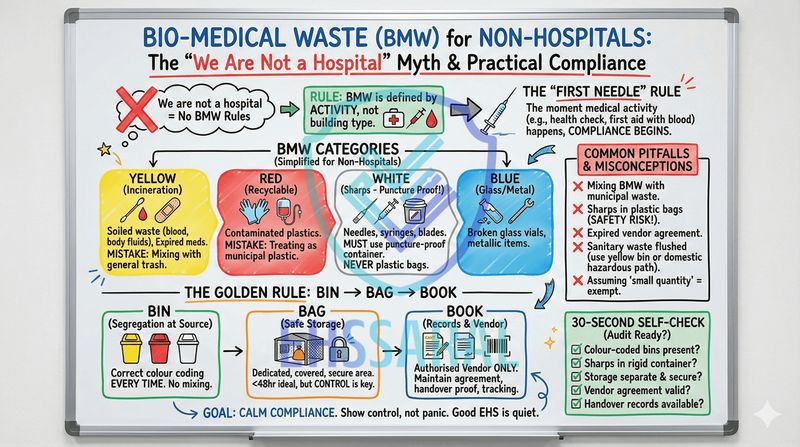
Bio-medical waste is not defined by buildings.
It is defined by activities.
In simple terms:
Bio-medical waste is any waste generated during medical or health-related activity.
This includes waste generated during:
first aid
diagnosis
treatment
immunisation
vaccination
health check-ups
blood sample collection
This is the most important mental shift for non-hospital sites.
BMW rules do not ask:
“Are you a hospital?”
They ask:
“Did medical activity happen here?”
If the answer is yes - even once - BMW responsibility exists for that waste.
A common misunderstanding is:
“If it happens rarely, it doesn’t count.”
That is incorrect.
If a first-aid incident happens once a year, the BMW rules do not disappear for that one incident.
The waste generated from that activity still has to be managed correctly.
“Low quantity does not mean no responsibility.”
This is where many good EHS professionals get caught - not due to negligence, but due to unclear boundaries.
Biomedical Waste Management Rules in India
BMW compliance commonly applies to non-hospital sites that have any of the following:
a first-aid room
an occupational health centre (OHC)
periodic doctor or nurse visits
vaccination camps (COVID, flu, tetanus, etc.)
annual or pre-employment health check-ups
blood sample collection on site
construction sites with medical rooms
remote sites with on-site medical treatment
If any one of these happens at your site, BMW compliance becomes relevant.
It does not matter if:
the site is small
the activity is occasional
the volume of waste is low
BMW compliance is activity-based, not volume-based.
This is why two factories next to each other may have different BMW obligations:
one conducts annual health camps on site
the other sends workers outside
The obligation follows the activity, not the industry.
This is the point where most non-hospital BMW issues begin.
Let’s look at a very common scenario.
A site has:
a basic first-aid kit
antiseptic liquid
band-aids
pain relief spray
Minor cuts are treated.
Cotton and bandages are used occasionally.
The site feels safe assuming:
“This is normal first aid. BMW is not applicable.”
Then something changes.
The company introduces:
an annual health check-up
blood sample collection
vaccination drives
Suddenly:
needles appear
syringes are used
blood-contaminated cotton is generated
That one activity changes everything.
The transition into BMW compliance usually happens at:
the first needle
the first syringe
the first blood sample
Not at inspection.
Not at registration.
Not at notice stage.
It happens the moment the activity changes.
This transition is rarely documented.
And because it is gradual, it is often missed.
That is why BMW issues in non-hospitals are discovered during inspections, not before.
In non-hospital sites, BMW compliance usually starts silently.
Not at inspection.
Not at registration.
Not at notice stage.
It starts at:
the first needle
the first syringe
the first blood sample
If you remember only one thing about BMW for your career, remember this:
“The first needle changes the rules.”
BMW categories are officially numbered, but in practice, colour matters more than category names.
Inspectors do not ask category numbers first.
They look at bins.
This category includes waste that is:
soiled
contaminated
not meant for recycling
Typical examples:
blood-stained cotton
used bandages
soiled dressings
expired medicines (general first-aid medicines like tablets and syrups - not cytotoxic drugs)
Common non-hospital sources:
injury treatment in first-aid room
blood sample collection
post-vaccination waste
Most common mistake:
Yellow waste mixed with general garbage.
Read Our Bio-Medical Waste Management Rules, 2016 for Factories and Checklist
This includes contaminated plastic items that can be recycled after treatment.
Typical examples:
gloves
IV tubing
plastic medical disposables
Common non-hospital sources:
health camps
temporary medical setups
Most common mistake:
Assuming “plastic = recyclable” and putting it in municipal waste.
This category is critical from a safety point of view.
It includes:
needles
syringes with fixed needles
blades
any sharp object capable of causing injury
Sharps must be stored in a puncture-proof container (PPC).
Not in a plastic bag.
Not in a dustbin liner.
Why this matters:
housekeeping staff handle waste
injuries here are common audit findings
this is treated as a safety lapse, not just a waste issue
Common non-hospital source:
vaccination camps
blood sample collection
This includes:
broken medicine vials
glass bottles
metallic medical containers
Common non-hospital source:
medical kits
sample collection material
In BMW compliance, visual segregation matters more than verbal justification.
Inspectors know:
explanations can be rehearsed
bins cannot hide mistakes
That is why colour coding is checked first.
| Colour | What Goes Inside | Non-Hospital Example | Common Mistake |
|---|---|---|---|
| Yellow | Soiled & contaminated waste (blood, body fluids, general expired medicines - non-cytotoxic) | Blood-stained cotton from first-aid injury | Mixed with general waste |
| Red | Contaminated recyclable plastic | Gloves from health check-up camp | Treated as municipal plastic |
| White | Sharps (needles, syringes, blades) | Vaccination camp waste | Kept in plastic bags instead of puncture-proof container |
| Blue | Glass & metallic medical waste | Broken medicine vials | Thrown with scrap glass |
Reality check: Inspectors remember colours, not explanations.
Most BMW compliance failures in non-hospital sites do not happen because people don’t know the rules.
They happen because the principles are not applied consistently.
From years of inspections and audits, five principles matter more than everything else.
BMW must be segregated where it is generated, not later.
This means:
at the first-aid room
at the medical room
at the vaccination camp table
at the blood sample collection point
Once BMW enters a mixed dustbin, it is already non-compliant.
A common assumption is:
“We will separate it later.”
That does not work for BMW.
“Segregation delayed is segregation denied.”
| DO | DON’T |
|---|---|
| Use colour-coded bins | Mix BMW with municipal waste |
| Use puncture-proof containers for sharps | Put needles in plastic bags |
| Store BMW in controlled area | Keep BMW near pantry or washroom |
| Use authorised vendor | Hand over to scrap dealer |
| Keep simple records | Assume “small quantity = no rules” |
Colour coding is not a one-time setup.
It is a daily discipline.
If:
yellow waste goes into a black bag once
sharps go into a polybag once
That one instance is enough to raise questions.
Inspectors rely on colour coding because:
it is visual
it is instant
it shows training quality
If colour coding is wrong, everything else is doubted.
You will often hear:
“BMW should not be stored beyond 48 hours.”
This statement needs context, especially for non-hospital sites.
In practice:
hospitals generate BMW daily
non-hospitals generate BMW occasionally
For low-volume generators:
weekly pickup is common
vendors may come once or twice a week
This is generally acceptable if:
waste is stored in a dedicated area
the area is secure and covered
the area is ventilated
the area is away from canteens and production zones
What matters is not hospital-grade 48-hour logic, but controlled storage with no exposure or mixing risk.
What inspectors look for is not the clock.
They look for uncontrolled accumulation.
If BMW is lying openly, mixed, or unattended, the problem is visible.
BMW must be handed over only to an authorised Common Bio-Medical Waste Treatment Facility (CBWTF).
What inspectors usually ask:
Who is your BMW vendor?
Is the authorisation valid?
Show agreement.
If the vendor is unauthorised, compliance collapses immediately.
Small quantity BMW still needs records.
Typical documents expected:
vendor agreement
handover manifests or receipts
barcoding records (where applicable)
Statements like:
“Quantity is very small”
do not replace documentation.
“In compliance, if it is not recorded, it did not happen.”
Rule 4 is the most important part of BMW rules for non-hospital sites.
It defines the duties of the occupier.
In plain words:
If bio-medical waste is generated at your site,
you are responsible for it, from generation to final disposal.
Even if:
a contractor manages waste
a vendor collects it
a consultant handles paperwork
Responsibility does not transfer.
Key expectations under Rule 4:
proper segregation
safe storage
authorised handover
records maintained
staff handling waste are informed
This is why inspectors focus on occupiers, not vendors.
“Work can be outsourced.
Responsibility cannot.”
Once this mindset is clear, BMW compliance becomes simpler.
Many EHS professionals apply general waste thinking to BMW.
That creates problems.
Frameworks like the “7 R’s” work well for:
scrap
packaging
But BMW is different.
For BMW:
reuse is mostly not allowed
repair and refurbish do not apply
safety overrides sustainability
The primary objective of BMW management is:
risk control, not optimisation.
Reduction matters.
Authorised recovery matters.
But safety always comes first.
Trying to over-optimise BMW - batching pickups, reusing containers, or mixing categories to reduce vendor visits - creates compliance gaps.
BMW is one area where simplicity beats optimisation.
These issues are seen repeatedly across industries.
The site has bins outside, but not where waste is generated.
This leads to mixing.
| Situation | Green Flag (Safe) | Red Flag (Risky) |
|---|---|---|
| BMW quantity | Low but segregated | Low and mixed |
| Storage | Dedicated, covered area | Corner near pantry / washroom |
| Sharps | Puncture-proof container | Plastic bag or dustbin |
| Vendor | Authorised + agreement | Informal pickup |
| Records | Simple but available | “We’ll arrange later” |
| Staff response | Calm, consistent | Confused or defensive |
Needles and syringes placed in thin polybags.
This is a serious safety issue for housekeeping staff.
Sharps must always go into a puncture-proof container.
Often done unknowingly, especially after camps.
Once mixed, the entire waste becomes non-compliant.
Vendor continues service, but paperwork is outdated.
This is a common renewal-time finding.
If this is discovered, renew the agreement immediately.
If BMW is generated before renewal, store it safely, document internally, and hand it over once the agreement is valid.
Do not hand over waste to an unauthorised party just to clear it quickly.
Small quantity does not exempt compliance.
Inspectors know this assumption well - and check harder because of it.
This deserves special mention.
In offices and corporate parks, sanitary napkins often create confusion.
In practice:
sanitary waste is treated as domestic hazardous waste under Solid Waste Management Rules
some BMW vendors accept it in yellow bags for incineration
What matters most:
it should not go into general waste
handling should be hygienic
the method should be documented and consistent
Confusion here usually creates mixed waste - which creates problems.
Sanitary waste should never be flushed, as it creates plumbing and hygiene issues in offices.
Many BMW systems now use barcoding.
Even small generators are often expected to:
scan waste bags at handover
link waste movement to the generating site
If your vendor:
collects waste
but does not scan or upload data
Then the waste is not traceable to your site.
During inspections, this becomes a documentation gap.
It is important to:
confirm whether your vendor is scanning
understand how your site is mapped in their system
BMW compliance is increasingly digital, even for small generators.
If your vendor uses barcoding, confirm during the first handover how your site appears in their system.
If scanning is not done, ask how site-specific waste movement is tracked.
This becomes important during audits, where digital records are increasingly used for verification.
This is where anxiety usually comes from.
Most EHS professionals prepare for BMW inspections by:
reading rules
memorising categories
arranging files
Inspectors work differently.
They start with what they can see.
Typical inspection flow in non-hospital sites looks like this:
visit the first-aid or medical room
look at bins and colour coding
check how sharps are stored
ask where BMW is kept before pickup
then ask for records
They rarely start with legal clauses.
You will usually hear some variation of these:
Do you generate bio-medical waste?
Where is it generated?
Where is it stored?
Who collects it?
Show the agreement.
Show recent handover records.
If answers are calm and consistent, inspections move quickly.
If answers are hesitant or defensive, deeper checking starts.
“Inspections become difficult only when uncertainty is visible.”
In most BMW inspections, officers subconsciously follow one sequence:
BIN - Is segregation visible at the point of generation?
BAG - Is waste stored correctly and safely?
BOOK - Are handover records available?
If you are confident in all three, inspections usually stay calm.
If even one is weak, questioning increases.
Remember:
“If BIN, BAG, and BOOK are correct - explanations are rarely needed.”
Why BMW Inspections Feel Stricter Today (India)?
Many non-hospital sites struggle with this part.
They generate BMW infrequently, so they:
keep waste in a corner
store it near the pantry
leave it in the first-aid room
This creates unnecessary exposure.
Good practice for non-hospital BMW storage:
a small, dedicated area
covered and secured
ventilated
away from food areas and production
accessible for vendor pickup
Inspectors are usually reasonable if:
storage is controlled
waste is segregated
no spillage or mixing is visible
What causes trouble is casual storage, not low quantity.
BMW posters and charts are everywhere online.
Most sites download them, print them, and feel relieved.
That relief is false if the chart is the only action taken.
“A BMW chart on the wall proves you downloaded a PDF.
It does not prove compliance.”
Charts actually help when they are used for:
training housekeeping staff
onboarding new employees
reinforcing segregation habits
supporting audits
Best practices for BMW charts in non-hospital sites:
pictorial visuals
minimal text
local language (Hindi / Marathi)
placed near the point of waste generation
Charts should support behaviour, not replace it.
This checklist is deliberately simple.
If you can confidently say “yes” to all points below, you are generally safe.
Yellow bin available where blood-stained waste can occur
White puncture-proof container present if any needle or syringe is used
Sharps never placed in plastic bags
BMW stored in a controlled area before pickup
Authorised BMW vendor agreement available
Handover records maintained
BMW not mixed with municipal waste
This is usually enough to handle most inspections without stress.
| Question | Yes / No |
|---|---|
| Is BMW generated at our site (even occasionally)? | ⬜ |
| Do we have colour-coded bins where waste is generated? | ⬜ |
| Are sharps stored only in puncture-proof containers? | ⬜ |
| Is BMW stored separately from general waste? | ⬜ |
| Do we have a valid authorised vendor agreement? | ⬜ |
| Can we show recent handover records? | ⬜ |
Area | Checkpoint | Status | Action Required? |
|---|---|---|---|
1. Segregation | Yellow Bin: Is a yellow bin available in the First-Aid/Medical room? | ☐ Yes / ☐ No | |
Sharps Safety: Are needles/syringes stored in a white Puncture-Proof Container (not a plastic bag)? | ☐ Yes / ☐ No | ||
No Mixing: Is general waste (wrappers, paper) strictly kept OUT of Yellow/Red bins? | ☐ Yes / ☐ No | ||
2. Storage | Location: Is BMW stored in a dedicated, covered area (not mixed with scrap/general waste)? | ☐ Yes / ☐ No | |
Duration: Is waste handed over regularly (not stored for months)? | ☐ Yes / ☐ No | ||
Hygiene: Is the storage area clean, with no spillage or foul odor? | ☐ Yes / ☐ No | ||
3. Vendor & Records | Agreement: Is the BMW Vendor agreement valid (not expired)? | ☐ Yes / ☐ No | |
Handover Proof: Do we have signed manifests/receipts for the last 3 pickups? | ☐ Yes / ☐ No | ||
Tracking: If the vendor uses barcoding, is our waste being scanned upon pickup? | ☐ Yes / ☐ No | ||
4. Staff Awareness | Training: Does the housekeeping staff know not to put hands inside waste bags? | ☐ Yes / ☐ No | |
Sanitary Waste: Is sanitary waste kept separate (and never flushed)? | ☐ Yes / ☐ No |
Environmental Compliance Checklist for Factories
Most BMW issues in non-hospital sites are:
not dramatic
not intentional
not expensive to fix
They exist because BMW sits in a grey zone:
not healthcare
not general waste
Once this grey zone is understood, BMW compliance becomes routine.
The waste was always there.
The obligation was always active.
Only awareness was missing.
“Good compliance removes uncertainty.
It does not create paperwork drama.”
If your site generates any bio-medical waste - even occasionally -
the question is not:
“Do the rules apply to us?”
The real question is:
“Can I calmly show segregation, storage, handover, and records if asked?”
If the answer is yes, BMW compliance stops being a source of anxiety.
It becomes just another quiet system working in the background -
which is exactly how good EHS systems should feel.
One Sentence to Remember for Your Career
BMW compliance is not about hospitals - it’s about being able to calmly show control when asked.
If you can confidently handle BMW in a non-hospital setting, you can handle it anywhere.
This topic looks small, but it tests:
judgement
calmness
clarity under questioning
Seniors notice professionals who manage BMW quietly without panic.
That confidence travels with you across roles.
Do offices really need BMW compliance?
Yes. If any medical activity happens on site, BMW rules apply to that waste.
Is BMW registration required for non-hospitals?
In many states, yes - especially if bio-medical waste is generated regularly.
Thresholds and procedures vary by State Pollution Control Board.
A practical approach: when you sign or renew your BMW vendor agreement, confirm whether occupier registration is expected in your state.
In most cases, the authorised BMW vendor is aware of local practice.
Can small quantity BMW go in general waste?
No. Quantity does not change the category.
Is outsourcing BMW handling enough?
No. Outsourcing work does not outsource responsibility.
What about old COVID-era waste still lying in stores?
This is common.
Unused PPE or expired kits without biological contamination are often treated as general waste.
If there is contamination or doubt, consult your BMW vendor and handle conservatively.

Founder, EHSSaral
Founder - EHSSaral | Partner - Perfect Pollucon | ISO 14001 Lead Auditor | GHG Protocol Scope 2 | Chemist | Data Scientist | Second-generation environmental professional simplifying EHS compliance for Indian industries through practical, automated, tech-enabled, data driven compliance workflows.
Ozone-Depleting Substances Rules, 2000 - A Practical Guide for Indian Industries

Chemical Accident Emergency Response Guide for Indian Factories | EHSShala
Why Form IV Filing Becomes Difficult for Indian EHS Teams: A Field-Level Analysis
Hazardous Waste Rules & Management Explained | EHSShala
Environmental Compliance Management in India: Systems vs Consultants Explained
Used Oil & Waste Oil Management in India - Factory & EHS Guide | EHSShala
Consent to Establish (CTE) Explained: Process, Documents, Rules & Common Mistakes | EHSShala
The Hidden Costs of Manual Environmental Compliance in India
 by EHSSaral v1.webp)
EADA Portal & Environment Audit Rules 2025: A Practical Guide for Indian Factories | EHSSaral
 ehssaral.webp)
Hazardous Waste Form 4 Portal Errors (MPCB & GPCB Fix Guide)