
 Practical Guide for Indian Factories EHSShala.webp)
EHSShala
Hazardous Waste Management Rules in India: Forms, Storage & Compliance
EHSSaral is an Environmental Compliance Intelligence Platform for Industries. Consent Intelligence • Alerts & Tasks • Incident Reporting • Form IV & V • Audit-Ready Records
See how EHSSaral works
8 Jun 2026
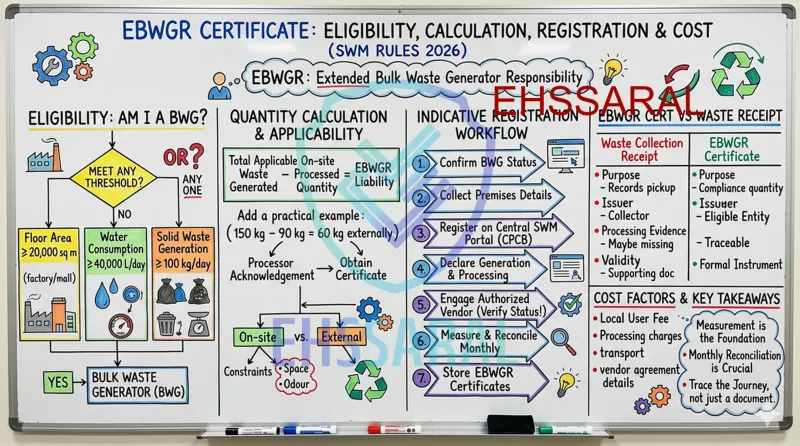
The EBWGR Certificate is one of the important new compliance concepts introduced under the Solid Waste Management Rules, 2026.
EBWGR stands for Extended Bulk Waste Generator Responsibility.
In simple terms, it means that large waste generators cannot simply hand over waste and forget about it. They are expected to ensure that the waste generated from their premises is segregated, collected, transported and processed through an accountable system.
For Bulk Waste Generators, especially factories, hotels, hospitals, commercial buildings, institutions and large residential societies, this certificate may become relevant where wet waste cannot be fully processed on-site and has to be managed through an authorised external route.
The important point is this:
An EBWGR Certificate should not be treated as an ordinary waste pickup receipt. It is a quantity-linked compliance record.
In many Indian plants and large facilities, solid waste compliance has traditionally been treated as a housekeeping activity.
Waste is collected.
A vendor comes.
A bill is paid.
The file is closed.
But under the Solid Waste Management Rules, 2026, this approach may not be enough for Bulk Waste Generators.
The new framework expects clearer accountability. It looks at whether waste is segregated properly, whether wet waste is processed on-site where feasible, whether externally handled waste is going through the right system, and whether the quantities reported on paper match actual operational records.
This is where the EBWGR Certificate comes into the picture.
For EHS teams and facility managers, the real challenge will not be only “getting the certificate.” The larger challenge will be maintaining a clean record trail from waste generation to final processing.
This article explains the EBWGR Certificate from a practical point of view.
The Solid Waste Management Rules, 2026 are in effect from 1 April 2026. However, the detailed operating procedure for EBWGR Certificate generation may continue to evolve through CPCB guidance, local-body implementation, portal updates and city-specific instructions.
So, while the regulatory logic is clear, practical details such as portal fields, document requirements, local-body validation, approved entities, user fees and certificate workflow should be verified for the concerned jurisdiction.
In this article, we will separate three things clearly:
This distinction is important because EBWGR is still a developing compliance area.
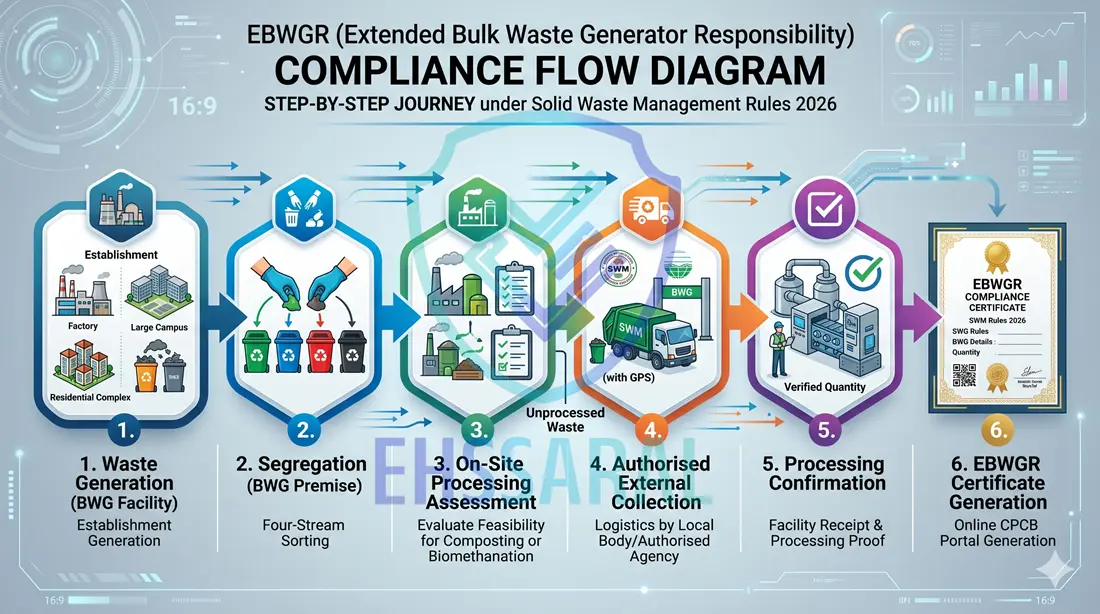
An EBWGR Certificate is a quantity-based compliance instrument under the Solid Waste Management Rules, 2026.
It helps a Bulk Waste Generator account for waste that is collected, transported and processed through an authorised system, especially where the waste cannot be processed fully on-site.
In practical terms, it answers questions like:
From a compliance point of view, the certificate is not just a document. It is the final output of a traceable waste-management chain.
EBWGR stands for:
Let us break this term down.
| Term | Practical meaning |
|---|---|
| Extended | Responsibility continues beyond simply handing over waste |
| Bulk Waste Generator | A large waste-generating establishment meeting the prescribed threshold |
| Responsibility | Accountability for segregation, collection, transport, processing and reporting |
The word “extended” is important.
It means that the waste generator’s role does not end at the gate. If the waste leaves the premises, the generator should still be able to show where it went and how it was processed.
This is a shift from a “vendor bill filed” mindset to a “quantity accounted” mindset.
Bulk Waste Generators contribute a significant share of municipal solid waste in urban and industrial areas.
Large campuses, factories, institutions, malls, hospitals, hotels, IT parks, warehouses and housing societies may generate sizeable quantities of wet waste, dry waste, sanitary waste and special-care waste every day.
If this waste is not segregated and processed properly, it increases the burden on municipal systems, landfills and informal waste channels.
The EBWGR framework is intended to bring more accountability into this chain.
Its practical objectives include:
In day-to-day operations, this means the EHS or facility team may need to manage solid waste with the same seriousness as water, hazardous waste, air emissions or compliance reporting.
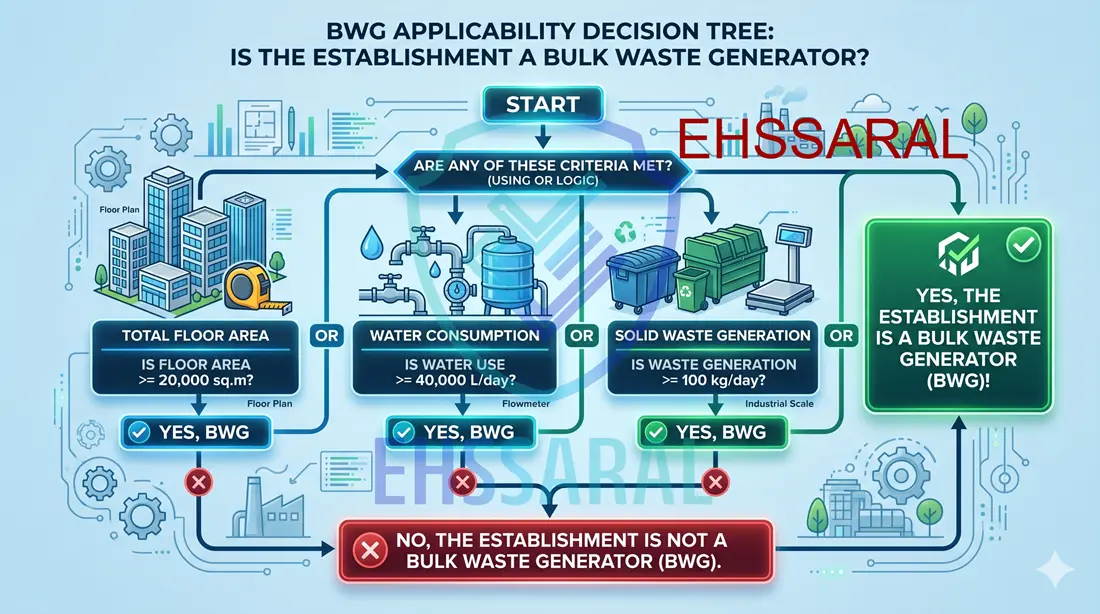
This is the first question every facility should answer.
Under the Solid Waste Management Rules, 2026, an establishment may be treated as a Bulk Waste Generator if it meets any one of the prescribed criteria.
| Applicability parameter | BWG threshold |
|---|---|
| Floor area | 20,000 square metres or more |
| Water consumption | 40,000 litres per day or more |
| Solid waste generation | 100 kg per day or more |
The important word here is “or.”
This means that an organisation should not check only one condition.
For example:
This is where confusion usually starts.
Many organisations assume that the 100 kg/day waste-generation limit is the only test. That may not be correct. Area and water consumption also need to be evaluated.
Before checking EBWGR Certificate requirements, facilities should first confirm whether they qualify as a Bulk Waste Generator under Solid Waste Management Rules 2026.
Some discussions around the new Rules refer to a 5,000 square metre figure for certain types of establishments or responsibilities.
This should not be confused with the Bulk Waste Generator water-consumption threshold.
For BWG applicability, the water-consumption threshold is 40,000 litres per day, not 5,000 litres per day.
Before making an applicability decision, the facility team should check all three parameters carefully:
A wrong threshold assumption can create confusion later during registration, reporting or inspection.
Yes, it can apply to factories if the factory qualifies as a Bulk Waste Generator.
But one important distinction is needed.
Not every waste generated in a factory falls under the same rule.
Factories may generate different types of waste, such as:
The Solid Waste Management Rules mainly deal with municipal-type solid waste, such as wet waste, dry waste, sanitary waste and special-care waste.
Industrial process waste, hazardous waste, used oil, e-waste, battery waste and plastic packaging may be governed under separate rules or EPR frameworks.
So, a factory should not mix everything into one solid waste category.
A practical way to look at it is:
| Waste type | Likely compliance route |
|---|---|
| Canteen food waste | Solid Waste Management Rules |
| Office dry waste | Solid Waste Management Rules |
| Garden waste | Solid Waste Management Rules |
| Sanitary waste | Solid Waste Management Rules |
| Process sludge | Hazardous waste or industry-specific compliance |
| Used oil | Hazardous and other waste framework |
| E-waste | E-waste rules |
| Battery waste | Battery waste rules |
| Plastic packaging | Plastic waste EPR framework |
In many factories, the EHS team will need to maintain separate records for different waste streams.
The EBWGR Certificate should not be confused with hazardous waste manifest, EPR certificate, e-waste certificate or recycler disposal certificate.
An EBWGR Certificate becomes relevant where a Bulk Waste Generator needs to account for waste handled through an authorised external route, especially where wet waste cannot be processed fully on-site.
The practical situation may look like this:
| Site situation | Practical compliance route |
|---|---|
| Full wet waste is processed on-site | Maintain generation and processing records |
| Only part of wet waste is processed on-site | Account for the externally processed balance |
| On-site processing is genuinely not feasible | Use the prescribed authorised route and obtain corresponding EBWGR certificates |
| Waste is collected without processing evidence | Traceability may remain incomplete |
| Waste is handed over in mixed condition | Certificate records may not solve segregation gaps |
| Ordinary vendor gives only an invoice | Invoice alone should not be treated as EBWGR Certificate |
From a practical standpoint, the first preference is to process wet waste on-site where feasible.
If on-site processing is not possible or only partly possible, the remaining waste should be handled through the system prescribed by the local body and relevant portal framework.
No.
An EBWGR Certificate should not be understood as an exemption from waste-management responsibility.
It is better understood as a way to account for waste that could not be processed on-site and was therefore sent through an authorised external processing route.
Before relying on the external route, the organisation should first evaluate whether on-site wet-waste processing is reasonably possible.
This evaluation may include:
The point is not to create a defensive file.
The point is to make a practical and technically reasonable decision.
In many Indian facilities, partial on-site processing may be possible even if full processing is difficult. In such cases, only the balance externally handled quantity may require separate accounting.
One common mistake will be to treat EBWGR as a document to be purchased.
That is not the right mindset.
A better way to understand the certificate is this:
Waste generation → segregation → measurement → on-site processing assessment → authorised external collection → processing confirmation → certificate → reporting
If any part of this chain is weak, the certificate alone may not protect the organisation from questions.
For example:
Therefore, the EBWGR Certificate should be treated as the end of the compliance trail, not the beginning.
The EBWGR Certificate mechanism is connected with the local body, authorised entities, registered processors and the centralised reporting system.
Depending on implementation, the following stakeholders may be involved:
A normal housekeeping contractor or waste collection vendor should not automatically be assumed to have authority to issue an EBWGR Certificate.
This distinction is very important.
Collecting waste is one activity.
Generating a compliance-linked EBWGR Certificate is another.
Before accepting any document as an EBWGR Certificate, the Bulk Waste Generator should verify:
This verification will become important during audits, inspections or annual reporting.
Many organisations already receive waste collection receipts, vendor bills or pickup slips.
These are useful supporting records, but they are not automatically the same as an EBWGR Certificate.
| Point | Waste collection receipt | EBWGR Certificate |
|---|---|---|
| Main purpose | Records pickup or service | Accounts for compliance-linked waste quantity |
| Typical issuer | Collector or contractor | Eligible entity under prescribed framework |
| Processing evidence | May not be included | Linked with recognised processing |
| Quantity basis | May be estimated or transaction-based | Expected to reflect accountable kilograms |
| Compliance value | Supporting document | Formal compliance instrument |
| Sufficient on its own | Generally not | Should still reconcile with supporting records |
A pickup receipt may show that waste left the premises.
An EBWGR Certificate should help demonstrate that the waste was part of an accountable collection and processing chain.
This difference matters.
From a practical standpoint, EBWGR quantity should be linked with the waste quantity that is not processed on-site and is handled through the authorised external route.
A simple working logic is:
EBWGR quantity required = Applicable waste generated − Applicable waste processed on-site
For example:
| Particular | Quantity |
|---|---|
| Wet waste generated | 150 kg/day |
| Wet waste processed on-site | 90 kg/day |
| Wet waste sent externally | 60 kg/day |
| Indicative quantity requiring EBWGR accounting | 60 kg/day |
This does not mean one separate paper certificate is issued for every kilogram.
It means the EBWGR Certificate is quantity-denominated.
For example, one certificate or portal entry may represent a consolidated quantity such as 500 kg, 1,000 kg or another applicable quantity for a particular period.
The exact method may depend on the portal workflow, local-body process and implementing guidelines.
Do not rely only on rough vendor estimates.
Use actual measurement wherever possible.
Records may include:
Measurement is the foundation.
Without measurement, certificate quantity becomes guesswork.
If the facility has composting, biomethanation or another processing system, maintain operating records.
These may include:
A machine installed on paper but not operated properly may not support the compliance position.
The balance quantity should match:
The practical check is simple:
Generated quantity = On-site processed quantity + Externally processed quantity ± explained difference
If this equation does not broadly match, the EHS or facility team should investigate the difference.
The exact online process may evolve. However, from a practical standpoint, the workflow may involve the following steps.
Check:
If any one threshold is crossed, the entity may fall under the Bulk Waste Generator framework.
Confirm which legal entity is responsible for the premises.
This may be:
The name used for registration should match operational and legal records.
Maintain:
Bulk Waste Generators may need to register through the centralised solid-waste management portal.
Portal fields and required documents may change as the system develops.
So, before submission, verify the latest portal instructions.
The facility may need to provide details of:
Registration alone is not enough.
The facility should maintain a running record of waste generation, processing and outward movement.
Where waste is sent outside, verify that the collection and processing route is recognised under the applicable local-body system.
Before certificate generation or reporting, reconcile:
Once the applicable quantity is processed and recorded through the prescribed system, the EBWGR Certificate or equivalent portal record should be stored safely.
The certificate should be supported by:
This will help during internal review, local-body verification or regulatory scrutiny.
The final document checklist may differ by city, portal and local-body instructions.
However, an indicative documentation set may include the following:
| Document or record | Purpose |
|---|---|
| Entity registration details | Identifies the responsible organisation |
| Authorised-signatory details | Establishes accountability |
| Property or floor-area records | Supports BWG applicability |
| Water bills and meter records | Supports water-consumption assessment |
| Waste-generation assessment | Establishes daily quantity |
| Seven-day or thirty-day weighment records | Supports average waste generation |
| On-site processing details | Shows installed and operating capacity |
| Site photographs | Supports infrastructure declaration |
| Local-body details | Links premises with jurisdiction |
| Vendor or concessionaire agreement | Establishes collection arrangement |
| Pickup slips | Records outward waste movement |
| Gate entry or vehicle records | Supports physical movement trail |
| Weighbridge or weighing records | Confirms quantity |
| Processor acknowledgement | Confirms receipt and processing |
| MRF or recovery facility receipt | Supports dry-waste traceability, where applicable |
| RDF dispatch record | Relevant only where RDF is actually produced |
| EBWGR certificates | Accounts for relevant quantities |
| Payment records | Supports transaction trail |
| Portal acknowledgements | Confirms online submissions |
| Monthly reconciliation sheet | Links daily records with certificate quantity |
| Annual reporting records | Supports statutory reporting |
The exact documents required should be verified against current portal and local-body instructions.
EBWGR discussions often focus on wet waste because on-site wet-waste processing is a major obligation for Bulk Waste Generators.
However, dry waste also needs traceability.
Dry waste may move through a Material Recovery Facility, commonly called an MRF, where recyclable materials are sorted and recovered. Residual combustible fractions may, in some cases, move towards RDF preparation or other authorised processing.
For EHS and facility teams, the practical point is this:
If segregated dry waste is handed over externally, ask for available evidence that shows what happened after collection.
Useful records may include:
Do not assume that every dry-waste pickup is automatically recovered or recycled.
The purpose is not to create unnecessary paperwork. The purpose is to avoid a situation where waste is shown as “collected” but its processing route remains unclear.
This is one of the most common questions, but it should be answered carefully.
There may not be one uniform national EBWGR Certificate cost.
Actual cost may depend on:
So, instead of assuming a fixed price, EHS and facility teams should ask for a clear cost breakup.
A practical cost breakup may include:
| Cost component | What to check |
|---|---|
| Collection charge | Is it per pickup, per kg or monthly? |
| Transport charge | Is distance included? |
| Processing charge | Is actual processing covered? |
| User fee | Is it prescribed by the local body? |
| Certificate charge | Is it linked to quantity? |
| Taxes | Are GST or other charges applicable? |
| Documentation charge | Are reports or certificates included? |
Avoid relying only on the lowest quotation.
The cheaper option may not be better if the vendor cannot provide traceability, processor acknowledgement or valid compliance records.
For many Bulk Waste Generators, the practical question will be:
Should we process wet waste on-site or use an authorised external route?
There is no single answer for every site.
The decision depends on space, quantity, manpower, cost, hygiene, technical suitability and local implementation.
| Factor | On-site processing | Authorised external route |
|---|---|---|
| Initial investment | Composting, biomethanation, civil work and storage | Usually lower direct capital investment |
| Recurring expenditure | Operators, electricity, consumables, maintenance | Collection, transport, processing and certificate-related charges |
| Space requirement | Dedicated space required | Smaller internal footprint |
| Daily management | High | Moderate, but oversight still required |
| Odour and hygiene | Must be actively controlled on-site | Mainly managed after collection |
| Data requirement | Generation and internal processing logs | Generation, pickup, processor and certificate records |
| Compliance risk | Installed system may remain non-functional | External route may lack traceability |
| Suitable where | Quantity is stable and space is available | Genuine site constraints make full on-site processing difficult |
The right decision should be based on total practicality, not just cost.
In some locations, on-site processing may be the better long-term route. In other cases, an authorised external system may be more realistic.
A common mistake is to compare only the purchase cost of a composting machine with the monthly vendor bill.
That is not enough.
A better approach is to compare the three-year or five-year cost of both options.
Consider:
Consider:
The cheapest option on paper may create higher compliance risk later.
For example:
Management should evaluate both financial and compliance risks before choosing the route.
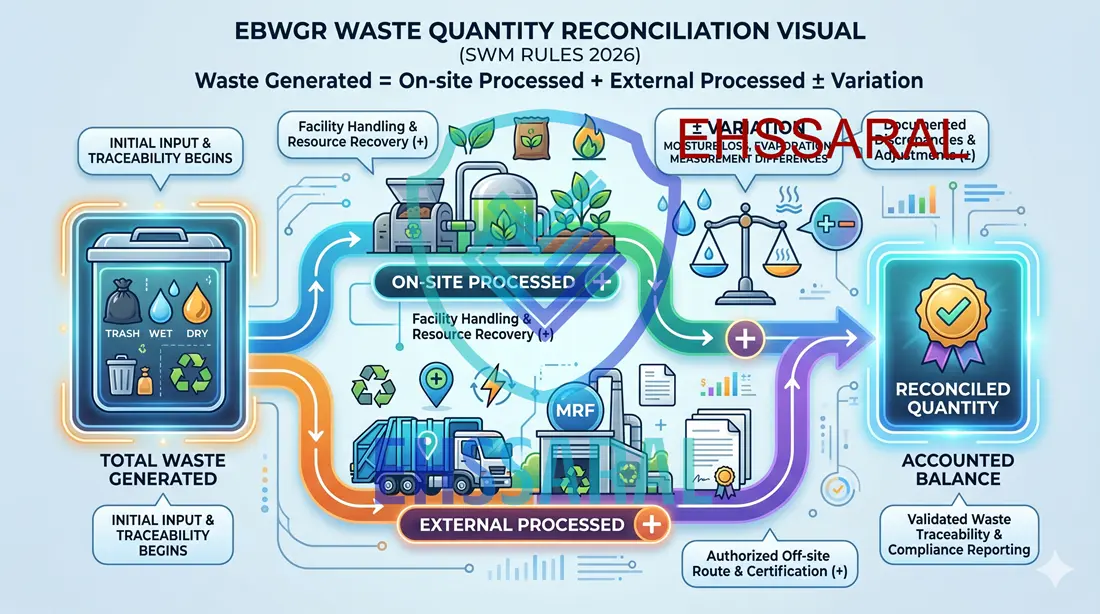
Monthly reconciliation is where the EBWGR system becomes practical.
Without reconciliation, records may remain scattered across housekeeping, admin, vendor bills, gate entries and compliance files.
A simple monthly format can help.
| Record source | Quantity |
|---|---|
| Wet waste generated | ___ kg |
| Wet waste processed on-site | ___ kg |
| Wet waste picked up externally | ___ kg |
| Quantity received by processor | ___ kg |
| EBWGR quantity obtained | ___ kg |
| Difference requiring explanation | ___ kg |
A practical equation is:
Waste generated = Waste processed on-site + Waste transferred externally ± documented variation
Some variation may occur because of:
The purpose of reconciliation is not to achieve mathematical perfection every day.
The purpose is to identify unexplained gaps before they become annual compliance issues.
For a Bulk Waste Generator, EBWGR-related compliance should be managed month-wise.
Recommended records include:
The main principle is simple:
The certificate should be supported by source records.
A certificate without a supporting quantity trail may create questions later.
EBWGR compliance should be supported by daily records of four-stream waste segregation, especially for wet waste, dry waste, sanitary waste and special-care waste.
The word “extended” can make EBWGR sound similar to Extended Producer Responsibility.
But EBWGR and EPR are different compliance concepts.
| Point | EBWGR Certificate | EPR Certificate |
|---|---|---|
| Responsible entity | Bulk Waste Generator | Producer, importer, brand owner or other obligated entity |
| Waste context | Solid waste generated by a BWG | Plastic, e-waste, battery, tyre, used oil or other notified stream |
| Primary purpose | Account for BWG waste handled through prescribed system | Fulfil rule-specific recycling or processing targets |
| Applicability basis | BWG thresholds under SWM Rules | Product placement, manufacture, import or sale |
| Operating system | SWM and local-body framework | Waste-stream-specific EPR portal |
| Interchangeable | No | No |
A factory may have both EBWGR responsibility and EPR-related responsibilities, depending on its activities.
But one certificate cannot be casually used in place of another.
For example:
Each waste stream should be handled under the correct framework.
An EPR Certificate is different from an EBWGR Certificate because it applies to specific waste-stream responsibility frameworks such as plastic, e-waste, battery waste, tyre waste or used oil.
This section should be understood calmly.
The purpose is not to create fear. The purpose is to understand operational risk.
If a Bulk Waste Generator does not register, segregate waste, maintain records, process wet waste where feasible or support reported quantities, the issue may first appear as a recordkeeping or reporting gap.
Depending on the nature of the issue, the concerned authority may:
For management, the immediate risk is not only penalty.
The bigger practical risk is the inability to answer simple questions:
Correcting twelve months of incomplete records is usually harder than maintaining a monthly reconciliation.
That is why facility teams should not wait until annual reporting to organise documents.
Let us take a simple example.
A manufacturing unit has a total floor area of 25,000 square metres.
Its municipal-type solid waste generation is only 85 kg/day.
The plant team assumes that EBWGR does not apply because waste is below 100 kg/day.
But this may be incorrect because the floor area exceeds 20,000 square metres.
Now assume the factory has a canteen generating wet waste.
| Particular | Quantity |
|---|---|
| Total wet waste generated | 70 kg/day |
| Processed through on-site composting | 45 kg/day |
| Sent externally | 25 kg/day |
In this case, the factory should maintain records showing:
This example shows two important points:
A large housing society may qualify as a Bulk Waste Generator based on floor area, water consumption or daily waste generation.
Typical waste streams may include:
If the society processes part of its wet waste through composting but sends the balance externally, it should maintain records for both streams.
In many societies, the biggest issue is not the absence of waste collection.
The issue is poor documentation.
Common gaps include:
The EBWGR framework may push such societies to bring more discipline into waste measurement and vendor records.
Hotels and hospitals may generate considerable wet waste due to kitchen operations.
They may also generate sanitary or special-care waste. Hospitals may additionally generate biomedical waste, which is governed separately.
For such establishments, waste segregation is critical.
A hotel or hospital should not mix:
EBWGR-related records should apply to the relevant solid-waste stream.
Other regulated waste streams should be managed under their respective rules.
This separation is important because a single vendor bill may not satisfy multiple compliance frameworks.
Over the years, most compliance gaps arise from interpretation issues, not necessarily from intent.
For EBWGR, the following misunderstandings are likely:
Area and water consumption thresholds also need to be checked.
For BWG applicability, the relevant water-consumption threshold is 40,000 litres per day.
A vendor invoice may support payment, but it is not automatically a compliance certificate.
The collector’s role and authority should be verified.
If part of the wet waste is processed on-site, only the balance may require external accounting.
Hazardous waste, e-waste, used oil, battery waste and plastic EPR waste should be handled under separate frameworks.
Equipment installation is not the same as processing evidence.
Monthly reconciliation is easier than year-end reconstruction.
Costs may differ depending on local-body directions and service arrangements.
They are different compliance mechanisms.
Pickup alone does not prove processing.
Housekeeping, admin, accounts and EHS records should be linked.
Check whether the premises crosses any BWG threshold:
Also check:
Ask:
Verify:
Under India’s newer environmental compliance approach, recordkeeping is becoming more evidence-based. The Environment Audit Rules, 2025 have introduced a formal framework for Registered Environment Auditors, with the National Productivity Council designated as the Environment Audit Designated Agency.
For Bulk Waste Generators, this means EBWGR-related records should not be maintained only for portal submission. They should also be organised in a way that can be reviewed during local-body verification, regulatory inspection, internal audit or any authorised environmental audit mechanism.
From a practical standpoint, keep the following records month-wise:
The strength of EBWGR compliance will depend on whether the certificate quantity can be traced back to source records.
Keep ready:
Portal declarations and annual reporting should be supported by source records. The concerned authority, local body or authorised verification mechanism may review the submitted data and evidence.
The EBWGR framework is new.
Some implementation details may continue to evolve through:
This is normal when a new digital compliance framework is introduced.
EHS teams should avoid two extremes:
The practical middle path is better.
Start measuring waste.
Improve segregation.
Review on-site processing feasibility.
Verify vendors.
Track quantities monthly.
Keep documents organised.
Check the latest portal and local-body requirements before submission.
For many organisations, EBWGR compliance will not be solved by one certificate.
It will require a simple but disciplined workflow.
A practical system should help teams track:
This is where digital compliance workflows can reduce confusion.
The goal is not more paperwork.
The goal is to make the waste journey visible.
For recurring solid-waste records, annual reporting and certificate tracking, an environmental compliance calendar can help teams avoid year-end confusion.
Use this copy-paste text:
In some external wet-waste processing arrangements, especially where biomethanation, energy recovery or other advanced processing is involved, there may be a commercial question around environmental credits, carbon benefits or similar future claims.
This should not be treated as a routine EBWGR requirement. However, where the processor is making such claims or where the project is structured around carbon or green-credit benefits, the Bulk Waste Generator should clarify the commercial position in the vendor agreement.
The agreement may clearly mention:
For ordinary EBWGR compliance, the immediate priority remains traceability of waste quantity, authorised processing and certificate reconciliation.
The EBWGR Certificate is not just another compliance document.
It represents a shift in how Bulk Waste Generators are expected to manage solid waste.
Earlier, many organisations stopped at collection.
Now, the responsibility is moving toward traceability.
For EHS and facility teams, the practical focus should be:
Good compliance starts with understanding the waste journey.
The EBWGR Certificate should simply confirm that the journey has been properly accounted for.
EBWGR stands for Extended Bulk Waste Generator Responsibility.
It refers to the responsibility of large waste generators to ensure that solid waste generated from their premises is segregated, collected, transported and processed through an accountable system.
An EBWGR Certificate is a quantity-based compliance record used to account for eligible solid waste managed through the prescribed authorised system.
It is especially relevant where a Bulk Waste Generator cannot process the entire applicable waste quantity on-site and uses an authorised external route.
A Bulk Waste Generator may need an EBWGR Certificate where applicable waste, especially wet waste, cannot be fully processed on-site and has to be managed externally through the prescribed system.
First, the organisation should confirm whether it qualifies as a Bulk Waste Generator.
An establishment may qualify as a Bulk Waste Generator if it meets any one of the following conditions:
The word “or” is important.
Yes.
If an organisation crosses any one prescribed threshold, it may fall under the Bulk Waste Generator framework.
For example, a factory with floor area above 20,000 square metres may qualify even if its municipal-type waste is below 100 kg/day.
No.
A factory should first evaluate whether it qualifies as a Bulk Waste Generator.
If it qualifies, it should then check its waste streams, on-site processing feasibility and external waste-management arrangement.
No.
A waste pickup receipt shows that waste was collected. An EBWGR Certificate is linked with accountable waste management under the prescribed framework.
A pickup receipt may support the record trail, but it should not automatically be treated as the certificate.
Not merely because the vendor collects waste.
The vendor’s authority and role under the applicable local-body or portal framework should be verified.
A private vendor may be part of the chain only if it is recognised or authorised under the relevant arrangement.
Broadly, the relevant externally accounted quantity can be calculated as:
Applicable waste generated − Applicable waste processed on-site
The balance externally processed quantity should match collection, transport, processor and certificate records.
The certificate framework is quantity-based and expressed in kilograms.
However, this does not mean one separate paper certificate is issued for each kilogram.
A certificate or portal record may represent a consolidated quantity for a defined period.
No.
EBWGR applies to Bulk Waste Generators under the solid-waste framework.
EPR applies to producers, importers, brand owners or other obligated entities under waste-stream-specific frameworks such as plastic waste, e-waste, battery waste, tyre waste or used oil.
There may not be one fixed national rate.
Cost may depend on local-body directions, waste quantity, collection, transport, processing, certificate charges and the authorised service arrangement.
Organisations should check current local-body and portal requirements.
Useful records include:
Bulk Waste Generators are expected to process wet waste on-site wherever feasible.
Where complete on-site processing is not feasible, the externally handled quantity should be accounted for through the prescribed system.
Then the organisation should maintain records for both parts:
The externally handled balance should be traceable through authorised collection, processing and certificate records.

Founder, EHSSaral
Founder - EHSSaral | Partner - Perfect Pollucon | ISO 14001 Lead Auditor | GHG Protocol Scope 2 | Chemist | Data Scientist | Second-generation environmental professional simplifying EHS compliance for Indian industries through practical, automated, tech-enabled, data driven compliance workflows.
Hazardous Waste Management Rules in India: Forms, Storage & Compliance
 EHSSaral.webp)
Environmental Monitoring Mistakes in Indian Factories (Real Issues Explained)
Best Environmental Compliance Software in India (2026): A Practical SME Comparison | EHSSaral

Evolution of EHS in India - (Part 1) Pre-Bhopal Era | EHSShala
MSME Supply Chains & BRSR 2026: Where Compliance Breaks | EHSSaral
Ozone-Depleting Substances Rules, 2000 - A Practical Guide for Indian Industries

Why We Wrote The Indispensable EHS Officer Book (A Realist Guide for India) | EHSSaral

Can You Transfer Hazardous Waste Responsibility in India? (What the Law Says)
MPCB Consent Explained - Lessons from 25 Years of Environmental Compliance | EHSSaral

Managing Safety Without Authority: Handling Protected Contractors in Indian Plants | EHSSaral