
CPCB OCEMS Flatline Notice: How Industries Should Respond (Safely) | EHSSaral
Blog
Latest compliance updates guides and industry insights
EHSSaral is an Environmental Compliance Intelligence Platform for Industries. Consent Intelligence • Alerts & Tasks • Incident Reporting • Form IV & V • Audit-Ready Records
See how EHSSaral works
8 Jun 2026
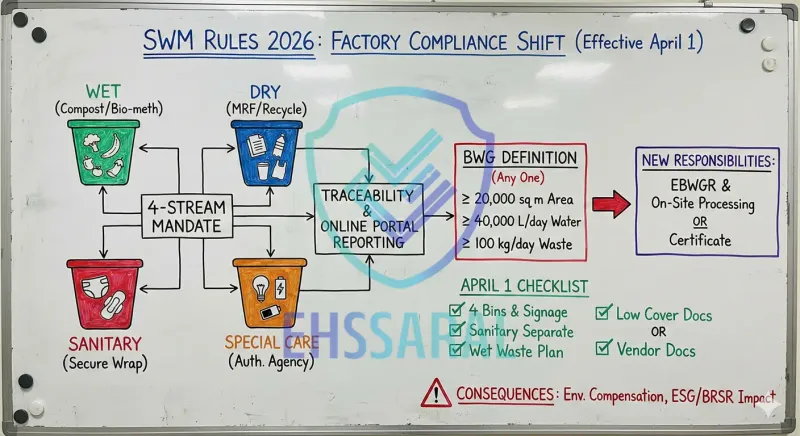
Under the Solid Waste Management Rules 2026, a factory qualifies as a Bulk Waste Generator (BWG) if it meets any one of these thresholds: floor area of 20,000 sq. metres or more, water consumption of 40,000 litres per day or more, or solid waste generation of 100 kg per day or more. BWGs must implement 4-stream segregation and ensure wet waste processing or obtain an EBWGR certificate.
On 28 January 2026, the Ministry of Environment, Forest and Climate Change notified the Solid Waste Management Rules, 2026, superseding the 2016 framework under the Environment (Protection) Act, 1986.
These rules come into full effect from April 1, 2026.
As you read this in late February 2026, you have roughly five weeks before the rules become fully enforceable. This is enough time to set up a defensible system - but only if BWG assessment and segregation planning start immediately.
At first glance, it appears to be a routine regulatory update.
But from a practical standpoint, the shift is deeper.
In many Indian factories, municipal-type waste has traditionally been treated as a housekeeping matter:
Segregate roughly into wet and dry
Hand it over to a contractor or local body
Keep minimal records
Focus more attention on hazardous waste and process emissions
The 2026 Rules change the accountability chain.
Waste is no longer just something that leaves your gate.
It is something you must now be able to trace, report, and justify.
And if you fall under the definition of a Bulk Waste Generator (BWG), the compliance burden increases significantly.
The new rules introduce three structural shifts that factories should clearly understand:
Segregation is now legally required into:
Wet Waste
Dry Waste
Sanitary Waste
Special Care Waste
This is not advisory. It is mandatory.
For the first time, thresholds are clearly defined (we will examine them in detail shortly).
Operating without registration, false reporting, forged documentation, or improper waste management can attract environmental compensation.
This is not limited to physical inspections.
Online reporting systems are being introduced to track the full waste chain.
This is where confusion usually starts.
Many EHS officers assume:
“Factory waste is governed under hazardous waste rules. So SWM rules may not apply.”
That assumption is only partially correct.
Municipal-type solid waste generated inside your factory premises, such as:
Canteen food waste
Office paper and packaging
Washroom sanitary waste
Expired medicines from first-aid room
Broken bulbs, small paint cans, mercury thermometers
This waste would exist even if you were not manufacturing anything.
Process waste from production
Chemical sludge
Used oil
Industrial rejects
Hazardous waste
Those remain under their respective regulatory frameworks.
In practical terms:
If the waste resembles what a commercial establishment generates - SWM 2026 applies.
If the waste originates from manufacturing activity - other rules apply.
Understanding this boundary avoids unnecessary over-compliance and under-compliance at the same time.
Let us break down each stream in practical terms.
Includes:
Kitchen waste
Fruit and vegetable peels
Cooked food leftovers
Flower waste
Requirement:
Wet waste must be composted or processed through bio-methanation at the nearest facility.
For Bulk Waste Generators, on-site processing is expected “as far as possible.”
In factories with active canteens, this is usually the largest SWM exposure.
Includes:
Paper
Cardboard
Plastic packaging
Metal pieces (non-process scrap)
Glass
Wood
Rubber
Dry waste must be transported to Material Recovery Facilities (MRFs) for sorting and recycling.
Informal scrap selling without traceability may not satisfy documentation expectations under the new system.
Includes:
Used diapers
Sanitary pads
Tampons
Condoms
These must be securely wrapped and stored separately to protect sanitation workers.
This category is frequently overlooked in factories where housekeeping mixes it with general waste.
Includes:
Paint cans
Bulbs
Mercury thermometers
Medicines
Practical clarity for factories:
Special care waste typically includes small, domestic-type items that contain hazardous traces - for example CFL/tube lights (not LED bulbs), mercury thermometers (where still in use), expired medicines from the first-aid room, small batteries, and empty/near-empty paint or chemical containers.
These items are not managed like bulk hazardous waste - but they also cannot go into normal dry scrap. They must be handed over to authorised agencies or deposited at designated collection centres.
This category is where many factories slip - not due to intent, but due to classification confusion.
This is the section most factories should read carefully.
Under SWM Rules 2026, an entity qualifies as a Bulk Waste Generator (BWG) if it meets any one of the following thresholds:
Floor area ≥ 20,000 square metres
Water consumption ≥ 40,000 litres per day
Solid waste generation ≥ 100 kg per day
CRITICAL: This is an “OR” condition.
You qualify as a Bulk Waste Generator if you cross any ONE threshold - not all three. Even one trigger can activate BWG responsibilities.
From day-to-day field experience:
A mid-sized industrial unit with an attached administrative block often exceeds 20,000 sq. m.
A plant with a functional canteen and utilities easily crosses 40,000 litres/day water consumption.
A workforce of 200–300 employees with canteen waste can generate 100 kg/day of solid waste without noticing.
In many Indian factories, waste is not formally weighed.
It is estimated.
And under the new regime, estimation may not be sufficient.
BWG status is not just a label.
It shifts responsibility in three important ways:
Bulk Waste Generators must ensure that waste is:
Collected
Transported
Processed
In an environmentally sound manner.
Responsibility does not end at the factory gate.
The Rules introduce Extended Bulk Waste Generator Responsibility (EBWGR).
Under this:
Wet waste must be processed on-site as far as possible.
If on-site composting or bio-methanation is not feasible, you must obtain an EBWGR Certificate.
What the EBWGR Certificate practically means:
An EBWGR Certificate is meant for cases where on-site wet waste processing is genuinely not feasible (space constraints, lease restrictions, technical limitations, or site conditions). It is not an exemption from responsibility - it is documented permission to route wet waste through an authorised processing channel. Even with an EBWGR certificate, you are still expected to maintain traceability and records.
This is an important operational fork.
You must decide:
Do we invest in on-site composting infrastructure?
Or do we formalise compliance through authorised EBWGR channels?
Either way, documentation becomes central.
Under the “Polluter Pays” principle, environmental compensation may be levied for:
Operating without required registration
False reporting
Forged documentation
Improper waste handling
Unlike earlier years where enforcement was largely inspection-based, the new framework introduces online tracking and reporting systems.
That changes the evidence trail.
The Rules provide for a Centralised Online Portal to track:
Waste generation
Collection
Transportation
Processing
Disposal
Processing facilities will upload reports online.
Audit reports will be submitted digitally.
For factories, this means:
Registration and reporting will increasingly move online.
Portal data becomes compliance evidence.
Mismatch between declared volumes and actual processing certificates can raise flags.
From a practical standpoint:
Paper registers may continue internally.
But digital reporting becomes the official record.
The Rules also define and regulate the use of Refuse Derived Fuel (RDF).
Industrial units using solid fuel - such as cement plants and waste-to-energy plants - are mandated to increase RDF substitution:
From 5% to 15% over a six-year period.
This does not apply to every factory.
It applies to industries consuming solid fuel.
So don’t interpret it as a universal RDF mandate for all manufacturing units. It is primarily a substitution obligation for solid-fuel users - while for other factories, RDF is mainly a downstream channel for suitable dry waste.
However, for factories generating high-calorific dry waste, this creates a structured downstream pathway.
In simple terms:
If you are a fuel user → substitution obligation applies.
If you are a waste generator → RDF becomes a disposal channel.
Clarity here avoids unnecessary confusion.
Many factories operate within industrial estates or SEZs.
A frequent question arises:
“If the estate manages common waste collection, are we still responsible?”
The short answer: yes.
Even if:
Waste is centrally collected
Common infrastructure exists
Local body manages disposal
If your unit independently crosses BWG thresholds, accountability may still apply at your level.
This is an area where documentation clarity and shared responsibility agreements become important.
Ignoring it is risky.
What to document in shared estate scenarios:
Written agreement describing who handles collection/processing responsibilities (unit vs estate/SPV)
Copy of the estate’s waste management arrangements and vendor authorisations
Monthly handover records (date, approximate quantity, stream-wise where possible)
Any receipts / acknowledgements from the estate’s waste handler
You cannot outsource legal liability completely. But you can establish a clear custody chain if questioned.
Before reacting, start with clarity.
You do not need a consultant to determine whether SWM Rules 2026 materially affect your factory. You need structured internal assessment.
Here is a simple 4-step framework.
Check the three triggers:
| Parameter | Your Factory’s Data | BWG Threshold | Above Threshold? (Yes/No) | Where to find this |
|---|---|---|---|---|
| Floor area | ___ sq. m | ≥ 20,000 sq. m | ___ | Site layout / approved plan |
| Water consumption | ___ L/day | ≥ 40,000 L/day | ___ | Water bills / borewell log / utility records |
| Solid waste generation | ___ kg/day | ≥ 100 kg/day | ___ | Weigh for 7 days (canteen + office + housekeeping) |
If you don’t have waste weight data today, do a 7-day weighing exercise. Most misclassification happens because waste is estimated, not measured.
If any one is crossed, assume BWG applicability and proceed accordingly.
Do not rely on assumptions like:
“We are mid-sized.”
“We are not a mall or IT park.”
“Municipality collects our waste.”
Numbers decide BWG status - not business category.
Walk the site physically.
Map these zones:
Canteen
Office block
Washrooms
First-aid room / clinic
Security cabin
Garden / landscaping area
Ask one simple question at each point:
If this factory stopped manufacturing tomorrow, would this waste still exist?
If yes → SWM 2026 applies.
This mental filter reduces confusion between production waste and municipal-type waste.
If you are a BWG, wet waste becomes the central compliance point.
Evaluate:
Is canteen waste segregated properly?
Is on-site composting feasible?
Do we have space?
Is odour management possible?
Is there technical capacity to maintain the system?
If on-site processing is impractical, begin exploring EBWGR-certified alternatives early.
Do not wait until enforcement tightens.
Ask your current waste vendor:
Are you authorised?
Where does the dry waste go?
Can you provide processing documentation?
Will your reporting align with the upcoming central portal system?
In many Indian factories, this is the weakest link.
Waste leaves the gate - but the documentation chain ends there.
Under the 2026 Rules, that gap becomes visible.
At minimum, a BWG should maintain:
Vendor agreements (collection, transport, processing) with authorised parties
Authorisation / registration proofs of vendors and linked facilities (MRF / processors)
Monthly waste summary (approx. wet/dry/sanitary/special care quantities)
Wet waste processing evidence (on-site log OR EBWGR certificate + handover records)
Sanitary waste handling method (separate storage + disposal route)
Special care waste handover proof (authorised agency / collection centre receipt, wherever applicable)
The goal is simple: you should be able to show custody chain - not just bins.
Factories usually ask a fair question:
“What must be in place by April 1 - and what can stabilise after?”
A practical way to approach this is in tiers:
4-stream segregation started on ground (bins + clear labels + basic signage)
Sanitary waste kept separate with secure wrapping and separate storage
Wet waste route decided (on-site processing plan OR EBWGR path initiated)
Vendor authorisation documents collected (MRF / authorised handlers where relevant)
Staff training completed (housekeeping + canteen + supervisors)
Internal monthly record template running (stream-wise quantities)
Special care waste handover route formalised (authorised agency / centre)
Internal segregation quality checks (monthly)
Vendor documentation chain consistent and audit-friendly
Portal-ready data structure (so reporting is smooth when the system goes live)
You don’t need perfection on Day 1.
You need a system you can defend calmly.
Over the years, regulatory transitions follow similar patterns.
Here are likely mistakes under SWM 2026:
Segregation fails at execution level, not policy level.
Usually happens because washrooms don’t have a separate collection path.
Not all scrap routes provide the traceability expected under the new framework.
Canteen waste is often outsourced, but documentation and processing proof are missing.
Either SWM gets ignored completely, or hazardous-waste logic gets incorrectly applied to municipal-type waste.
Trying to apply HW manifest logic to municipal waste - or ignoring SWM entirely.
Most non-compliance arises from interpretation gaps, not intent.
This shift is not isolated.
Increasingly, waste data feeds into:
ESG disclosures
Corporate sustainability metrics
When reporting moves online:
Waste quantities
Processing routes
Certificates
Audit reports
These become traceable.
If your ESG report claims 100% waste segregation, but portal records show inconsistencies, the audit trail begins here.
SWM 2026 is operational compliance.
But it is also data discipline.
For many years, solid waste in factories sat at the bottom of the compliance hierarchy.
Air emissions, effluent discharge, hazardous waste - those received attention.
Canteen waste rarely reached the boardroom.
The 2026 Rules elevate it.
Not because waste suddenly became more dangerous - but because accountability systems matured.
From a senior compliance standpoint:
SWM Rules 2026 are not about adding bins.
They are about knowing:
What waste is generated,
Where it goes,
Who processes it,
And whether you can demonstrate it.
Clarity at the segregation stage prevents confusion during audits.
And clarity today avoids environmental compensation tomorrow.

Founder, EHSSaral
Founder - EHSSaral | Partner - Perfect Pollucon | ISO 14001 Lead Auditor | GHG Protocol Scope 2 | Chemist | Data Scientist | Second-generation environmental professional simplifying EHS compliance for Indian industries through practical, automated, tech-enabled, data driven compliance workflows.
Latest compliance updates guides and industry insights
Practical EHS learning for Indian professionals

Latest compliance updates guides and industry insights
Latest compliance updates guides and industry insights
Practical EHS learning for Indian professionals

Practical EHS learning for Indian professionals
Latest compliance updates guides and industry insights
Data backed insights into real compliance challenges
Practical EHS learning for Indian professionals
 EHSSaral v1.png)
Latest compliance updates guides and industry insights