
EHSShala
Bio-Medical Waste Management for Non-Hospitals (India) | EHSShala
EHSSaral is an Environmental Compliance Intelligence Platform for Industries. Consent Intelligence • Alerts & Tasks • Incident Reporting • Form IV & V • Audit-Ready Records
See how EHSSaral works
22 Jul 2026
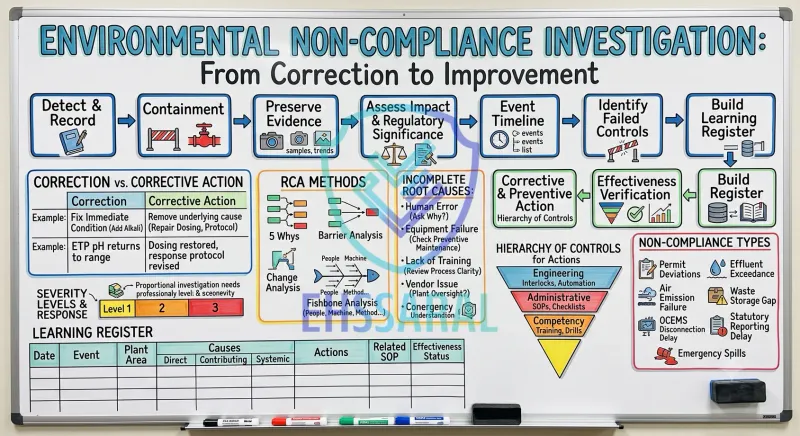
An environmental non-compliance investigation helps a plant move beyond immediate correction and understand why an emission, discharge, waste-management or reporting control failed.
A plant observes an abnormal pH reading at the ETP outlet.
The operator adds alkali, the pH returns to the acceptable range, and the incident is entered in the logbook as “rectified.”
Three weeks later, the same deviation occurs again.
Once again, chemical is added. The reading is restored. The matter is closed.
This pattern is common in many Indian plants. The immediate condition is corrected, but nobody examines why the treatment process repeatedly loses control.
The number was corrected. The system was not.
Environmental non-compliance should therefore not be treated only as a problem to be rectified. It should be treated as operational feedback—a signal that an equipment control, procedure, responsibility, communication channel or management process may not be working as intended.
Correction restores the immediate condition. Investigation helps prevent the condition from returning.
This article explains when environmental non-compliance should be investigated, how the investigation can be conducted, what the organisation should learn from it, and when those learnings should be converted into an SOP, checklist, alarm, interlock or wider management control.
Environmental non-compliance is often associated only with a major discharge, emission exceedance or regulatory notice.
In day-to-day operations, however, it can take many forms.
| Area | Examples of non-compliance or deviation |
|---|---|
| Consent and permit conditions | Production beyond permitted capacity, use of an unapproved fuel, failure to operate required pollution-control equipment |
| Water and effluent | Outlet parameter exceedance, untreated discharge, bypassing treatment, inaccurate flow measurement |
| Air emissions | Stack-emission exceedance, air-pollution-control equipment failure, missed monitoring |
| Hazardous waste | Improper storage, excess accumulation, missing labels, document mismatch, dispatch through an unsuitable vendor |
| Environmental monitoring | Sampling missed, calibration overdue, instrument failure, incomplete reports |
| Online monitoring | OCEMS disconnection, prolonged invalid data, unattended alarms, calibration or connectivity gaps |
| Statutory reporting | Delayed return, inaccurate submission, missing supporting records |
| Environmental clearance | Non-compliance with a stipulated condition or incomplete compliance reporting |
| Documentation | Production, water, fuel, waste and monitoring records not reconciling |
| Emergency events | Spill, leakage, overflow, accidental release or containment failure |
| Internal controls | Corrective action overdue, inspection missed, alarm ignored or escalation not completed |
Depending on the plant and its approvals, these obligations may arise from consent conditions, environmental-clearance conditions, waste authorisations, statutory rules, monitoring directions and specific instructions issued by regulatory authorities.
India’s environmental compliance framework includes the Water Act, Air Act, Environment (Protection) Act, waste-management rules and project-specific environmental-clearance conditions. Hazardous-waste requirements are governed through the Hazardous and Other Wastes (Management and Transboundary Movement) Rules, 2016, while environmental-clearance applications and compliance processes are administered through the PARIVESH system.
The purpose of an investigation is not to classify every small error as a major incident. The depth of investigation should be proportionate to the significance of the event.
The most common weakness in environmental incident management is the assumption that restoring the parameter means the matter has been resolved.
Consider a few examples:
These actions may be necessary, but they address only the visible condition.
They do not explain:
This is where the distinction between correction and corrective action becomes important.
Read more about ETP & STP Troubleshooting: The Complete Indian Guide in EHSShala
| Term | Practical meaning | Example |
|---|---|---|
| Correction | Fix the immediate condition | Add alkali and restore ETP pH |
| Containment | Stop the situation from causing further impact | Stop outlet discharge and hold water in the equalisation tank |
| Corrective action | Remove the underlying cause | Repair the dosing system and establish a response protocol |
| Systemic action | Check and strengthen similar controls elsewhere | Inspect all chemical-dosing systems in the plant |
| Effectiveness check | Confirm that the action has worked | Review pH trends, alarm response and pump performance for 30 days |
A statement such as “chemical added and pH normalised” is therefore a correction.
It is not a complete investigation finding or corrective action.
Similarly:
“Operator instructed to be careful” is not a strong corrective action unless the investigation shows exactly what the operator misunderstood and why instruction will prevent recurrence.
Where the cause remains unidentified, the deviation may reappear during another shift, production batch, maintenance condition or high-load period.
A missing hazardous-waste manifest may appear to be a documentation problem.
Further investigation may reveal that:
The missing manifest is the visible symptom. The real weakness is the absence of a controlled dispatch-and-closure process.
A report showing that every issue is “closed” may appear positive.
But if closure means only that the immediate condition was corrected, management may not see:
A well-investigated deviation can improve:
A poorly investigated deviation becomes only another entry in a register.
Not every missed signature or incomplete label requires a large investigation committee.
If every minor issue is treated as a major incident, the process becomes bureaucratic and operating teams may stop taking it seriously.
A proportionate approach is more practical.
Examples may include:
A suitable response may involve:
A formal root-cause analysis may not be necessary unless the same issue repeats.
Examples may include:
A suitable response may involve:
Examples may include:
A suitable response may involve:
The depth of investigation should consider five questions:
A low-impact event may still deserve detailed investigation where it reveals a serious potential weakness.
For example, a chemical spill fully contained inside a dyke may have caused no actual environmental damage. But if the dyke drain valve was found open, the potential consequence could have been significant.
Investigation depth should reflect both what happened and what could reasonably have happened.
Read more about Hazardous Waste Management Rules in India: Forms, Storage & Compliance
A useful investigation process should be simple enough to follow during plant operations but detailed enough to produce meaningful learning.
The process can be remembered as:
Contain → Preserve → Assess → Reconstruct → Analyse → Act → Verify → Learn
The first record should contain facts, not conclusions.
Record:
Avoid vague descriptions such as:
“ETP problem occurred.”
A better statement would be:
“During routine monitoring at 10:20 AM, the manually measured ETP outlet pH was 5.3. The online pH display showed 6.8 at the same time. Treated-water discharge was in progress.”
This factual description immediately creates useful investigation questions:
The first person recording the event should not be expected to know the root cause.
The responsibility at this stage is to preserve an accurate starting point.
Investigation should not delay containment.
Depending on the situation, containment may include:
The priority is to prevent the condition from becoming more serious.
For example, if ETP outlet quality is doubtful, debating whether the probe or process is responsible should not delay a decision to hold the discharge where adequate storage is available.
Environmental evidence can disappear quickly.
A tank may be emptied. A parameter may return to normal. A failed part may be replaced. An alarm history may be overwritten. A spill area may be washed.
Preserve relevant evidence such as:
Evidence should be preserved to understand the event, not to create fear or blame.
The purpose of evidence preservation is to reconstruct the event accurately before memories, conditions and records change.
CPCB OCEMS Flatline Notice: How Industries Should Respond (Safely)
The team should next determine what the event means from an environmental and compliance perspective.
Ask:
This assessment should be made carefully and factually.
Not every deviation requires external reporting. At the same time, a reportable event should not be overlooked merely because the plant restored normal operation.
The applicable consent, authorisation, environmental clearance, statutory rule and specific regulatory directions should be reviewed for the actual facility.
A timeline is one of the most useful investigation tools.
It separates facts from assumptions and often shows where the response broke down.
| Time | Event |
|---|---|
| 8:00 AM | Production batch started |
| 9:10 AM | High-acidity cleaning stream entered the collection system |
| 9:25 AM | Alkali-dosing pump tripped |
| 9:30 AM | Low-pH alarm appeared on the control panel |
| 9:37 AM | Alarm was acknowledged |
| 9:45 AM | Standby pump was checked and found unavailable |
| 10:20 AM | Manual outlet pH was measured at 5.3 |
| 10:25 AM | Treated-water discharge was stopped |
| 10:40 AM | Temporary dosing arrangement was started |
| 11:15 AM | pH returned to the operating range |
This timeline raises several questions:
Without a timeline, the investigation may incorrectly conclude only that the dosing pump failed.
Before searching for a single root cause, identify the controls that were expected to prevent, detect or contain the event.
Examples of controls may include:
Ask:
This approach prevents the investigation from ending too quickly with “operator error” or “equipment failure.”
Read Environmental Inspection India: What Inspectors Check
A meaningful investigation may identify more than one type of cause.
The immediate event that produced the deviation.
Example:
The alkali-dosing pump stopped.
Conditions that increased the likelihood or severity of the event.
Examples:
The deeper organisational weakness that allowed the direct and contributing causes to exist.
Examples:
The direct cause explains what physically happened.
The systemic cause explains why the organisation was vulnerable to it.
Several root-cause-analysis methods can be used. The correct method depends on the complexity of the event.
The method is less important than the quality of questioning.
Five Whys is useful for relatively straightforward events.
Why did ETP pH fall?
Because alkali dosing stopped.
Why did dosing stop?
Because the operating pump tripped.
Why was dosing not restored quickly?
Because the standby pump was unavailable.
Why was the standby pump unavailable?
Because its repair request had remained pending.
Why did a critical repair remain pending?
Because ETP dosing equipment was not included in the plant’s critical-maintenance escalation system.
The first answer suggests a pump repair.
The final answer suggests a management-system improvement.
Five Whys should not be treated as a requirement to ask exactly five questions. Sometimes three questions are sufficient. In complex cases, more investigation may be necessary.
Barrier analysis is especially useful for spills, leaks, overflows, uncontrolled emissions and accidental discharges.
It asks which physical, administrative and response barriers should have prevented the event.
| Intended barrier | What the investigation found |
|---|---|
| Primary storage tank | Tank flange leaked |
| High-level or leak detection | No leak alarm was provided |
| Secondary containment dyke | Dyke was available |
| Dyke drain control | Drain valve had been left open |
| Operator inspection | Leak was noticed after routine rounds |
| Emergency drain protection | Drain cover was not immediately available |
| Escalation | Supervisor was informed after a delay |
The release risk did not arise because of one failed flange alone.
It arose because several barriers were absent, ineffective or not maintained.
Major environmental events often occur when multiple barriers fail together.
Change analysis is useful where the process had operated normally in the past.
Ask what changed before the deviation:
An ETP upset, for example, may be linked not to the treatment plant itself but to a new cleaning chemical introduced by production without reviewing its impact on biological treatment.
Fishbone analysis is helpful where several departments or factors may be involved.
Possible categories include:
For an emission exceedance, the investigation may examine:
The purpose is not to fill every branch of a diagram. It is to prevent the team from focusing on only the most obvious explanation.
“Operator error” is one of the most common conclusions in weak investigation reports.
It may describe who was involved, but it rarely explains why the error became possible.
A stronger investigation asks:
Suppose an operator failed to record a flow-meter reading.
Possible deeper causes may include:
The solution depends on the actual cause.
Training may help in some situations. In others, the real need may be clearer ownership, better access, automation or supervisory verification.
All equipment can fail.
A useful investigation asks:
“Pump failed” may be the direct cause.
“Critical pollution-control equipment was excluded from maintenance escalation” may be the systemic cause.
Training is easy to recommend and easy to close.
But repeated training does not solve:
Before assigning retraining, establish what competency was missing and how the revised training will be evaluated.
Industries commonly depend on external laboratories, recyclers, transporters, treatment facilities and consultants.
A vendor may contribute to a failure, but the plant should still review its own controls.
Ask:
The activity may be outsourced. Oversight responsibility cannot be treated as fully outsourced.
An investigation has limited value unless the findings produce stronger controls.
The action plan should address:
A weak action is:
“Operators will be instructed to monitor carefully.”
A stronger action is:
“The shift operator will record equalisation-tank pH every two hours. The ETP supervisor will verify at least one reading per shift for the next 30 days.”
A good corrective-action table may include:
| Action | Action type | Owner | Target date | Closure evidence | Effectiveness check |
|---|---|---|---|---|---|
| Repair standby dosing pump | Immediate correction | Maintenance | 24 July | Work-order closure | Trial run completed |
| Add low-flow alarm | Engineering control | Projects | 10 August | Installation record | Alarm challenge test |
| Define abnormal-load communication | Procedural control | Production and EHS | 30 July | Approved protocol | Shift interviews |
| Review all dosing systems | Systemic action | Maintenance | 5 August | Inspection records | Management review |
| Monitor pH trend | Effectiveness check | ETP supervisor | 30 days | Trend report | No repeat deviation |
Actions should be realistic, assigned and measurable.
Where practical, stronger controls should be preferred over repeated instructions.
Examples:
Examples:
Examples:
A well-designed system should not depend only on a person remembering the correct action during a stressful situation.
This is one of the most important investigation questions:
Where else in the plant could the same failure mechanism exist?
If one dosing pump remained unrepaired because pollution-control equipment was not classified as critical, the same weakness may affect:
If one statutory task was missed because it depended on a personal spreadsheet, other obligations may also depend on individual memory.
Systemic learning means looking beyond the immediate location.
Not every incident requires a new SOP.
Too many SOPs can create another problem: employees may face a large document library that is difficult to understand, remember and apply.
An SOP is useful when:
An existing SOP should be revised where the process is already documented but the investigation shows that it is:
Sometimes a checklist, alarm, interlock or ownership change is more useful than another lengthy procedure.
| Investigation finding | More suitable control |
|---|---|
| Operator forgets one critical check | Shift checklist |
| Alarm is repeatedly ignored | Escalation logic and alarm-response matrix |
| Tank may overflow | High-level alarm and automatic shutdown |
| Vendor documents remain incomplete | Dispatch-closure workflow |
| Due dates depend on one person | Shared compliance calendar |
| Different shifts respond differently | One-page abnormal-condition response sheet |
| Records are maintained in separate departments | Reconciliation process with defined ownership |
For abnormal situations, a one-page response sheet placed near the operating area may be more useful than a 20-page SOP stored in an office file.
A practical SOP may include:
The language should reflect actual plant operation.
An SOP that looks technically perfect but cannot be followed during the night shift or during equipment failure will provide limited protection.
A simple response sheet may require the operator to:
This is clear, practical and usable during an abnormal condition.
Completing an action does not prove that the problem has been solved.
A pump may be repaired, an SOP may be revised, and training may be conducted. The same failure may still return.
Effectiveness verification asks:
What evidence shows that recurrence risk has actually reduced?
Possible methods include:
The verification period should reflect the nature of the issue.
A corrective action related to a daily operating parameter may be reviewed within a month. An action related to monsoon preparedness or annual reporting may require a longer review period.
| Stage | Question |
|---|---|
| Action completed | Was the assigned task carried out? |
| Evidence reviewed | Is there proof of completion? |
| Effectiveness checked | Did the action reduce the risk? |
| Final closure | Can the organisation reasonably conclude that the control has improved? |
An investigation should not be closed merely because all action owners have marked their tasks complete.
Environmental non-compliance is often assigned entirely to the EHS department.
In practice, the causes may sit in production, maintenance, utilities, purchase, stores, laboratory operations or management systems.
| Department | Possible investigation role |
|---|---|
| EHS | Compliance assessment, investigation coordination, reporting evaluation |
| Production | Process conditions, abnormal loads, raw-material or batch changes |
| Maintenance | Equipment reliability, alarms, interlocks, standby systems |
| Utilities | ETP, STP, boilers, scrubbers, water and energy systems |
| Stores | Chemical inventory, waste storage, labels and stock records |
| Purchase | Vendor evaluation, authorisation checks, contracts and renewals |
| Laboratory or quality | Sampling, analysis, calibration and data integrity |
| IT or automation | Portal access, connectivity, data retention and alert systems |
| HR and training | Competency, induction and refresher programmes |
| Plant head | Resources, accountability, priority and final closure |
The EHS function may coordinate the process, but it should not be expected to own every technical or operational cause.
Environmental performance is produced by operations. EHS helps the organisation understand, verify and control it.
An incident register records what happened.
A learning register records what the organisation understood and changed.
Useful fields may include:
Over time, the register can reveal patterns such as:
These patterns are difficult to see when every event is stored in a separate investigation file.
For a smaller plant with limited events, a controlled spreadsheet may be sufficient.
As the number of facilities, obligations, action owners and incidents increases, scattered spreadsheets can make trend recognition difficult.
A digital register can help connect:
The value is not digitisation by itself.
The real value is seeing patterns that isolated reports normally hide.
ETP outlet COD exceeded the applicable limit.
Discharge was stopped and additional treatment was carried out.
The treatment plant had received a high-strength cleaning stream from production. No prior communication was made to the ETP operator.
The equalisation tank had limited available capacity, and the incoming load entered biological treatment before adequate blending.
High-strength wastewater entered the treatment system.
The plant had no formal process for reviewing and approving abnormal wastewater discharge from production.
The ETP failure was not only a treatment-plant problem. It was a production-to-utilities coordination failure.
The hazardous-waste register showed dispatch, but complete supporting documents were unavailable.
The vendor was contacted and pending records were collected.
Waste was dispatched based on an operational request. Stores maintained the gate record, EHS maintained the waste register, and accounts held the vendor invoice.
No person was responsible for ensuring that the weighbridge slip, manifest and recycler acknowledgement were reconciled before closure.
Dispatch documentation remained incomplete.
The plant had a waste-dispatch process but no defined evidence-closure process.
A waste movement is not fully controlled merely because the vehicle has left the plant.
Quarterly stack monitoring was not completed within the planned period.
Monitoring was scheduled at the earliest available date.
The due date was maintained in one employee’s spreadsheet. The employee was on extended leave.
There was no backup owner, shared calendar or management escalation.
The monitoring activity was not scheduled.
Statutory obligations were being managed as personal reminders rather than organisational commitments.
Compliance dates should belong to the organisation, not to one person’s memory or spreadsheet.
Minor repeated deviations can reveal an important systemic weakness before a serious event occurs.
The immediate environmental risk should first be controlled.
Photographs, samples, trends and equipment condition may be lost.
This discourages honest reporting and may hide equipment, process and management weaknesses.
The report should explain why the error was possible and why the control system did not prevent or detect it.
Training is useful where competency is the issue. It is ineffective where the real cause is poor design, unclear ownership or faulty equipment.
Sometimes an alarm, interlock, checklist, spare-part policy or responsibility change is more effective.
Task completion does not automatically mean risk reduction.
A maintenance or control weakness found in one pollution-control system may exist elsewhere.
Vendor performance should also trigger review of plant-side selection, verification and follow-up controls.
Production, maintenance, utilities and management may own important parts of the cause and solution.
A well-formatted investigation report is not useful if the plant continues operating in the same way.
Before closing a significant environmental non-compliance investigation, management should check:
A plant does not need a complicated system for every event.
It needs a consistent system that helps management distinguish between a corrected condition and a strengthened process.
Environmental non-compliance is often treated as an interruption that must be corrected quickly so normal operations can continue.
Immediate correction is important. But it is only the beginning.
A mature plant asks:
The purpose of investigation is not to make the incident appear larger than it was. Nor is it to prepare a defensive report or identify someone to blame.
Its purpose is to convert a deviation into a stronger operating system.
Good environmental compliance is not demonstrated by having no recorded deviations. It is demonstrated by how clearly the organisation detects, investigates, learns from and prevents their recurrence.
Most environmental failures do not begin with bad intent.
They begin with small control gaps that remain unexamined.
Clarity at the investigation stage helps the plant strengthen those controls before the same weakness returns in a more serious form.
It is a structured review of an environmental deviation to understand what happened, assess its significance, identify failed controls, determine underlying causes and prevent recurrence.
No. Investigation depth should be proportionate to actual impact, potential impact, regulatory significance, recurrence and loss of control. Minor isolated issues may require only correction and a brief review.
Correction fixes the immediate condition. Corrective action addresses the cause that allowed the condition to occur.
Adding chemical to restore pH is correction. Improving the dosing system, alarm response and maintenance process is corrective action.
EHS may coordinate the investigation, but the investigation team should include departments connected to the event, such as production, maintenance, utilities, laboratory, stores or purchase.
It may be a direct or contributing cause, but it is rarely a complete root cause. The investigation should examine procedure clarity, training, workload, supervision, equipment design and system controls.
An SOP may need revision where responsibilities are unclear, critical steps are missing, different shifts follow different practices, the process has changed or the existing procedure is impractical.
No. Depending on the finding, a checklist, alarm, interlock, inspection routine, ownership change or compliance-calendar control may be more effective.
Effectiveness may be checked through trend review, repeat sampling, alarm tests, field inspections, operator interviews, internal audits, drills or recurrence monitoring.
Vendor failure may be part of the cause, but the plant should also review vendor selection, authorisation verification, scope clarity, performance review, backup arrangements and document-closure controls.
Yes, particularly where they repeat or indicate a control weakness. A proportionate recording system helps the plant identify patterns before they become significant.
This depends on the applicable law, consent, authorisation, environmental-clearance condition, event type and specific direction. The plant should assess this promptly based on its actual approvals and circumstances.
Relevant records may include photographs, instrument readings, trends, alarm history, samples, laboratory reports, logbooks, maintenance records, production data, waste documents, vendor communications and operator statements.
It should remain open until immediate actions are completed, root causes are reasonably established, corrective actions are implemented and effectiveness verification is either completed or formally scheduled.
It is a consolidated register that captures not only incidents but also causes, corrective actions, recurrence, related controls and lessons applicable to other departments or sites.

Founder, EHSSaral
Founder - EHSSaral | Partner - Perfect Pollucon | ISO 14001 Lead Auditor | GHG Protocol Scope 2 | Chemist | Data Scientist | Second-generation environmental professional simplifying EHS compliance for Indian industries through practical, automated, tech-enabled, data driven compliance workflows.
Bio-Medical Waste Management for Non-Hospitals (India) | EHSShala

How to Read Your Consent Copy (CTE & CTO Explained Simply) | EHSShala
Form 10 Manifest System Explained: 7 Copies, Flow & SPCB Inspectors Checklist | EHSShala
Evolution of EHS in India - (Part 2) Post-Bhopal | EHSShala
Ozone-Depleting Substances Rules, 2000 - A Practical Guide for Indian Industries
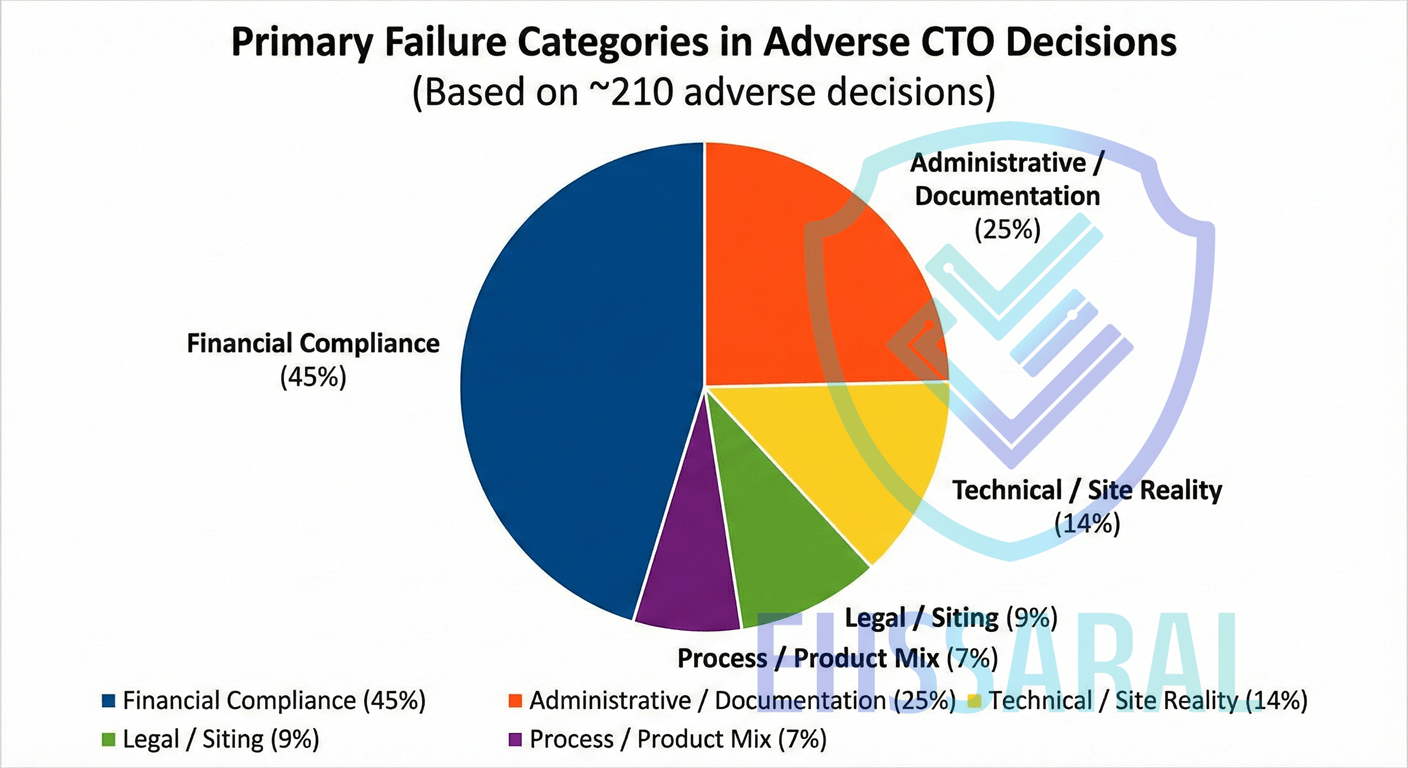
MPCB CTO Refusal Patterns in Maharashtra (2023–2025) Analysis | EHSSaral Research
Battery Waste Registration for Equipment Importers (BWM Rules 2022 Explained) | EHSSaral
 ehssaral.webp)
4-Stream Waste Segregation for Factories (SWM 2026) | EHSSaral
Environmental Monitoring Calendar for Industries - Expert Guide by EHSSaral
Hazardous Waste Packaging & Labelling in India (Inspector Guide) | EHSShala