
EHSShala
Hazardous Waste Storage Rules in Indian Factories | EHSShala
EHSSaral is an Environmental Compliance Intelligence Platform for Industries. Consent Intelligence • Alerts & Tasks • Incident Reporting • Form IV & V • Audit-Ready Records
See how EHSSaral works
30 Dec 2025
This is not about whether GRAP is right or wrong.
This is about what happens when your factory is inside NCR and AQI crosses 450.
In many Indian plants, the first question during a severe AQI episode is not about pollution metrics or regulatory philosophy.
It is much simpler - and much more urgent:
“Do we need to shut down today or not?”
This article exists to answer that question calmly, defensibly, and practically.
Not based on rumours.
Not based on fear.
Not based on copy-pasted notifications.
But based on how GRAP Stage IV is actually interpreted and enforced on the ground.
This is where most confusion - and unnecessary panic - begins.
When GRAP Stage IV is activated by the Commission for Air Quality Management, many factories assume one of two extremes:
“Everything must shut down immediately.”
“This doesn’t apply to us; we’ll explain if needed.”
Both assumptions are risky.
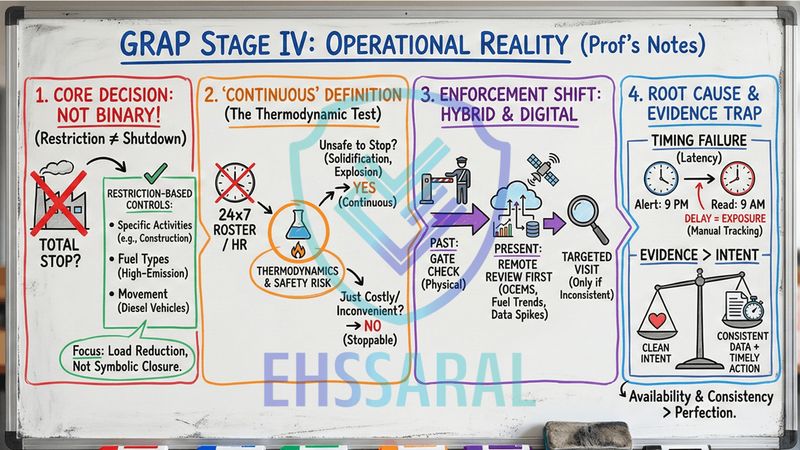
From a practical standpoint, Stage IV is restriction-based, not binary.
It does not say:
It says:
Certain activities must stop.
Certain fuels must not be used.
Certain movements must be restricted.
Certain operations require justification if they continue.
The outcome depends on what you are doing, how you are doing it, and whether you can explain it clearly.
On factory floors, decisions during GRAP often get distorted because:
WhatsApp forwards oversimplify directions
Different teams interpret rules differently
No one wants to take ownership of a “stop” decision
Everyone wants a yes/no answer - but the rule isn’t written that way
GRAP Stage IV introduces conditional logic into operations.
Factories that try to force it into a yes/no framework usually end up either:
Over-shutting (unnecessary loss), or
Under-complying (avoidable exposure)
Instead of asking:
“Are we allowed to run?”
The more useful operational question is:
“Which parts of our operation are restricted today - and why?”
This single shift in thinking changes how decisions are taken.
It moves the discussion from fear to logic.
Without going into notification language, Stage IV usually tightens controls on:
Non-essential manufacturing
Construction and earthwork
Diesel vehicle movement
High-emission fuel usage
DG set operation beyond emergencies
Whether your factory must fully stop, partially restrict, or continue under justification depends on process nature, not intention.
That distinction matters - and it’s where most interpretation errors occur.
This is the single most misunderstood concept during GRAP Stage IV - and the reason many otherwise well-run factories get into trouble.
On factory floors, the logic often sounds like this:
“We run 24×7.”
“Our shifts are continuous.”
“Stopping will cause production loss.”
“So we must be a continuous process unit.”
This assumption is understandable - but regulatorily weak.
From an enforcement and interpretation standpoint, continuous process is not defined by:
Shift patterns
Manpower schedules
Monthly production targets
Commercial loss due to stoppage
Instead, it is assessed on technical feasibility and safety.
A simple way officers think about it is:
“If this process is stopped, does it create a technical or safety risk - or only a business inconvenience?”
That distinction decides outcomes.
In real GRAP Stage IV evaluations, officers implicitly apply this logic:
If stopping the process causes:
solidification of molten material
pressure imbalance in a closed system
explosion, rupture, or irreversible damage risk
→ the process is considered technically continuous
If stopping the process causes:
loss of output
restart delays
efficiency drop
wastage due to shutdown
→ the process is usually considered stoppable
In short:
Continuous process is a thermodynamic and safety question - not a rostering or productivity question.
This is not arbitrary.
Exemptions during GRAP Stage IV exist because some processes:
cannot be stopped instantly
pose greater risk if force-stopped
require controlled ramp-down, not abrupt shutdown
The intent is risk reduction, not punishment.
That is why:
dairy processing
certain pharmaceutical operations
essential utility-linked processes
are often evaluated differently - when they can demonstrate why.
The most common mistake is not claiming exemption - it is claiming it without technical backing.
Typical weak justifications include:
“We run continuously”
“Stopping is costly”
“We’ve never stopped before”
These statements explain business impact, not technical necessity.
During GRAP Stage IV, business impact alone rarely carries weight.
Even during Stage IV:
GRAP does not automatically shut all factories - but the burden of proving exemption eligibility lies with the unit, not the regulator.
Officers do not come assuming you are exempt.
They come checking whether your claim is defensible.
That defensibility comes from:
process logic
safety reasoning
consistency with data and records
Not from intent, seniority, or past practice.
Instead of asking:
“Are we continuous or not?”
A more useful question is:
“If asked today, can we technically explain why stopping this process is unsafe or infeasible?”
If that answer is unclear, the exemption is weak - regardless of how long the plant has been running.
A common assumption in many plants is:
“If no one has come to the gate, we’re probably okay.”
That assumption no longer holds - especially during GRAP Stage IV.
By 2025, GRAP enforcement is rarely only about physical inspections.
In many cases, it follows a hybrid sequence:
Remote review first
Physical visit later, only if something looks inconsistent
This is why some factories are questioned days later about actions taken during a specific AQI window - even when no officer visited that day.
During Stage IV periods, regulators commonly look at:
Emissions trends during severe AQI hours
OCEMS uptime and continuity
Fuel usage patterns (especially diesel vs cleaner fuels)
Sudden drops, flatlines, or spikes in data
Correlation between AQI alerts and operational behaviour
This review happens quietly, often before any call or visit.
Enforcement today often starts on a dashboard - not at the factory gate.try
Another dangerous assumption during GRAP is:
“We didn’t receive any direct instruction, so we can continue.”
GRAP directions are public, location-based instructions, not unit-specific notices.
That means:
Lack of direct communication does not imply exemption
Awareness is assumed once directions are issued
Actions are evaluated against timestamps, not phone calls
Factories that wait for a personal intimation usually realise too late that:
data already exists
decisions have already been logged
explanations are now retrospective
When enforcement does move from screen to site, officers typically want to verify three things:
Applicability awareness
Did the unit understand that GRAP Stage IV applied to its location and activity?
Reasonableness of action
Once aware, did the unit take proportionate and timely steps?
Consistency across records
Do verbal explanations, manual logs, and digital data align?
If these three line up, escalation is rare.
If they don’t, even minor deviations attract attention.
This shift changes the role of EHS teams during GRAP:
It’s no longer only about managing inspections
It’s about ensuring decision traceability
It’s about aligning operations with awareness timing
GRAP Stage IV exposes not just emissions - but how quickly and coherently a factory responds to external regulatory stress.
During GRAP Stage IV, many EHS teams rely on a quiet assumption:
“Our intent is clean. If something comes up, we’ll explain.”
In routine compliance, that approach sometimes works.
During Stage IV, it usually doesn’t.
GRAP Stage IV compresses timelines.
Officers are not asking:
They are asking:
This turns evidence into the centre of every conversation.
Many teams believe that:
good intent
past compliance history
cooperative behaviour
will compensate for gaps during GRAP.
In practice, Stage IV scrutiny is far more transactional:
Action + timing + traceability matter more than explanation.
This is not about being harsh.
It’s about managing a city-wide emergency condition where decisions must be defensible quickly.
Read more about Environmental Compliance in India
One pattern appears again and again during GRAP reviews:
Manual logbook says: “All parameters normal”
Digital data shows:
a spike
a flatline
a gap during restricted hours
The issue is not always the deviation itself.
It is the mismatch.
When manual records and digital data don’t tell the same story, trust erodes fast - even if the deviation was minor or explainable.
Another assumption that causes trouble:
“We’ll explain later if asked.”
During GRAP Stage IV:
explanations are judged against timestamps
actions are evaluated before intent is discussed
retrospective narratives carry less weight
A partial, early action with records often carries more credibility than a perfect explanation given late.
Across multiple Stage IV cases, one principle consistently holds:
Availability and consistency beat perfection.
That means:
having data, even if incomplete
maintaining alignment between teams
avoiding contradictory records
Factories rarely get into trouble for not being perfect.
They get into trouble for appearing uncertain or inconsistent.
During GRAP Stage IV, the EHS role quietly shifts:
From defending intent
To demonstrating decision discipline
The goal is not to prove innocence.
It is to show that actions were:
timely
reasonable
and coherent with available information
When that is visible, most GRAP interactions remain brief and uneventful.
Most GRAP Stage IV issues are not caused by exceedances.
They are not caused by defiance.
They are not caused by ignorance of rules.
They are caused by late awareness.
A very typical sequence looks like this:
AQI crosses the Severe+ threshold
Commission for Air Quality Management issues Stage IV directions in the evening (often 8–9 PM)
The message circulates through websites, press notes, and WhatsApp groups
Many factories become fully aware of this only the next morning.
By then:
Diesel vehicles may have already entered the premises
Night shifts may have run as usual
DG sets may have operated
Fuel switching may not have been initiated
On paper, this becomes non-compliance.
In reality, it was a timing failure, not a compliance mindset failure.
In many Indian plants, GRAP awareness depends on:
Morning emails
Consultant messages
News updates
Informal WhatsApp forwards
These methods work for routine compliance.
They fail during time-compressed regulatory actions like GRAP Stage IV.
When decisions depend on when you know - not just what you know - latency becomes risk.
Manual tracking creates delay.
Delay creates exposure.
During Stage IV, enforcement logic is timestamp-driven.
Officers don’t only ask:
They also ask:
A reasonable action taken early is often viewed more favourably than a perfect explanation offered late.
This is why factories with good intent still feel exposed during GRAP - their response clock starts late.
Many GRAP issues occur before anyone consciously decides anything.
By the time a meeting is called or instructions are drafted:
actions have already happened
data has already been logged
the timeline is already fixed
This is why GRAP Stage IV often feels unfair - not because rules are harsh, but because the window to act is short.
During GRAP periods, the EHS role quietly becomes one of time management, not paperwork management.
The critical questions shift to:
How quickly do we become aware?
How fast can we communicate internally?
How early can we freeze or redirect activities?
Factories that shorten this awareness gap usually avoid escalation - even when restrictions are tight.
This matrix is not a legal checklist.
It reflects how decisions are commonly evaluated in practice during GRAP Stage IV.
Use it to align internal discussions - not to argue exemptions.
| Trigger / Activity | Typical Direction Under Stage IV | Practical Impact on Factories | Where Exemptions May Apply | Common Assumption That Fails |
|---|---|---|---|---|
| AQI > 450 (Severe+) | Stage IV activated | Heightened scrutiny | Location/activity-specific | “It’s just an advisory” |
| Manufacturing (non-essential) | Restriction / halt | Partial or full stoppage | Genuine continuous process | “We’ve always run during winters” |
| Continuous process claim | Case-by-case | Justification required | Technical & safety infeasibility | “24×7 = continuous” |
| Construction / earthwork | Complete halt | Project stoppage | Public infrastructure | “Internal repair is okay” |
| Diesel vehicles | Entry restrictions | Dispatch & logistics delays | Essential goods | “Vendor vehicles don’t count” |
| DG set operation | Restricted use | Backup power limits | Emergency safety use | “Short duration won’t matter” |
| Fuel switching | Expected where feasible | Operational adjustment | Proven infeasibility | “We’ll do it later” |
How to use this matrix internally
Start with activity, not permission
Identify what changes today versus what continues with justification
Remove assumption-based decisions before they compound
Most GRAP confusion disappears when teams align around activities instead of debating entitlement.
Factories that navigate GRAP Stage IV quietly tend to do a few simple things differently.
They don’t:
Panic and shut everything
Ignore directions hoping no one notices
Argue policy logic during inspections
They do:
Track severe AQI proactively during winter
Pre-decide which activities freeze first
Issue short, clear internal advisories
Keep explanations factual and consistent
Most importantly, they adopt a different internal question.
Instead of asking:
“Are we allowed to run today?”
They ask:
“If questioned today, can we clearly explain why we are running or stopped?”
That question forces:
clarity of applicability
discipline of timing
consistency of records
GRAP Stage IV does not demand perfection.
It demands coherence under pressure.
Factories that can demonstrate coherent decision-making - even in tight windows - rarely face escalation, even during severe AQI periods.
That is the operational reality of GRAP Stage IV.
GRAP Stage IV often attracts attention from citizens, media readers, and regulators-in-training who are trying to understand what “industry shutdown” actually means.
A few clarifications help avoid misunderstanding.
When GRAP Stage IV is announced, it does not mean:
all factories are operating illegally if they’re running
pollution control has failed
exemptions are arbitrary or favours
What it usually means is:
activities are being selectively restricted
some processes cannot be stopped instantly without safety risk
enforcement focuses on reducing peak load, not symbolic shutdowns
Seeing a factory operating during Stage IV does not automatically imply non-compliance.
What matters is what activity is running and why.
Read more about SPCB Consent conditions and how to read it
GRAP Stage IV is increasingly becoming a decision-audit framework, not just an emissions-control measure.
It tests:
awareness timing
proportional response
documentation discipline
internal coordination
This is why modern enforcement relies less on:
and more on:
data correlation
timeline reconstruction
consistency across records
Factories that demonstrate situational awareness and reasoned action often pass through Stage IV without friction - even under strict conditions.
No.
GRAP Stage IV is not a blanket shutdown order.
It imposes restrictions on specific activities such as non-essential manufacturing, construction, diesel usage, and high-emission operations.
Whether a factory must fully stop, partially restrict, or continue depends on process nature, fuel type, and defensibility of operations - not on assumptions.
A continuous process is not defined by 24×7 operation or shift patterns.
From a practical enforcement standpoint, regulators look at technical feasibility and safety:
The burden of explaining this distinction lies with the unit.
Not necessarily.
GRAP Stage IV enforcement today often starts with remote data review - emissions trends, OCEMS uptime, and fuel usage - before any site visit.
Silence or lack of physical inspection does not imply exemption or approval.
Actions are frequently reviewed retrospectively based on available data.
Night operation is not automatically prohibited, but it is closely scrutinized.
If restricted activities (diesel vehicle movement, DG usage, high-emission processes) continue during night hours after Stage IV activation, they may still be treated as non-compliance - even if inspections occur later.
Timing of awareness and response matters.
Good intent helps cooperation, but it does not replace evidence.
During GRAP Stage IV, officers primarily evaluate:
In practice, availability and consistency of evidence matter more than intent.
The most common reason is timing failure, not violation.
Many factories become aware of Stage IV directions hours after they are issued.
By then, diesel entry, night shifts, or DG operations may have already occurred - unintentionally creating non-compliance.
Late awareness creates exposure even in otherwise compliant plants.
They treat GRAP Stage IV as a temporary operating condition, not a crisis.
Typically, they:
Their internal question is simple:
“If questioned today, can we clearly explain why we are running or stopped?”
No.
GRAP Stage IV is designed to reduce pollution load quickly during extreme conditions, not to assign blame.
It functions as a stress test of awareness, timing, and decision discipline.
Factories that respond proportionately and coherently rarely face escalation.

Founder, EHSSaral
Founder - EHSSaral | Partner - Perfect Pollucon | ISO 14001 Lead Auditor | GHG Protocol Scope 2 | Chemist | Data Scientist | Second-generation environmental professional simplifying EHS compliance for Indian industries through practical, automated, tech-enabled, data driven compliance workflows.
Hazardous Waste Storage Rules in Indian Factories | EHSShala
The ZLD Mass Balance Trap: How Auditors Calculate Effluent Using Your Water Bills | EHSSaral
CTO Auto-Renewal: Capital Investment Rules 10% & 30% | EHSSaral
E-Waste Management Rules (2022) in India - Practical Guide for Factories | EHSShala
Why Form IV Readiness Cannot Begin at the End of the Year
Form V Data Variation: Explain Water, Waste & Pollution Changes
Isokinetic Sampling Basics: Simple Guide for Stack Monitoring | EHSShala

Is There Truly Free Environmental Compliance Software in India? (An Honest Answer) | EHSSaral

Form 4 vs Form 5: Why Hazardous Waste Numbers Don't Match
Common Hazardous Waste Mistakes in Indian Factories | EHSShala